Features
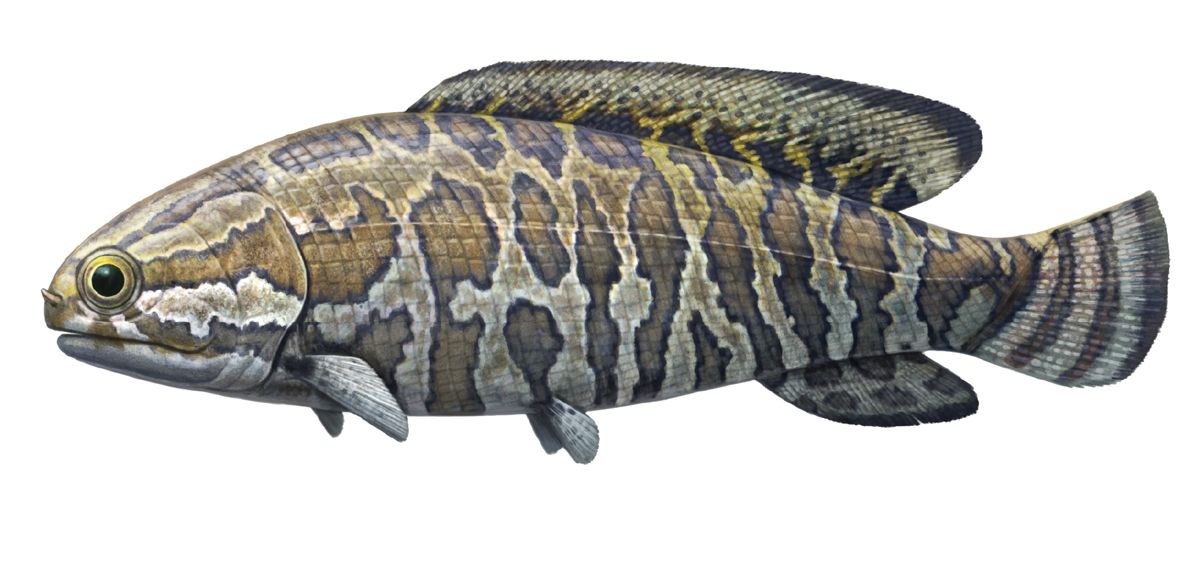
Oxford researchers have conducted a new analysis which reveals a surprising twist in the tale of how fish evolved.
The ray-finned fishes are the most numerous group of backboned animals. There are tens of thousands of different ray-finned species, from angelfish to zebrafish, making up 99% of all species of fish, and 50% of all vertebrates. They are useful to humans as a source of food, and sometimes even as pets, but they are also our distant cousins. We share a common ancestor, deep in evolutionary history. We know a lot about how the other major group of vertebrates, lobe-finned fishes, evolved as they began to move onto dry land, giving rise to birds, reptiles, amphibians and mammals, including humans. However, the early evolution of the ray-finned fishes’ side of the family tree is not so well understood.
Now, an international team including researchers from Oxford University’s Department of Earth Sciences have discovered a new piece of the puzzle. They looked at polypterids, bizarre fish which live in African freshwaters. Led by Dr Sam Giles from the University of Oxford, they used CT scanning to take a fresh look at the ancestors of modern polypterids, fossilised 250 million years ago.
Although polypterids are technically ray-finned fish, they have a curious combination of features, including thick scales, lungs and fleshy fins, which make them look very ancient - they have been referred to as “dinosaur fish”. They are so strange that scientists didn’t work out that they were ray-finned fish for more than a century after they were discovered. The polypterids seem to be out of place in time, more primitive in evolutionary terms than fossilised ray-finned fish from millions of years ago.
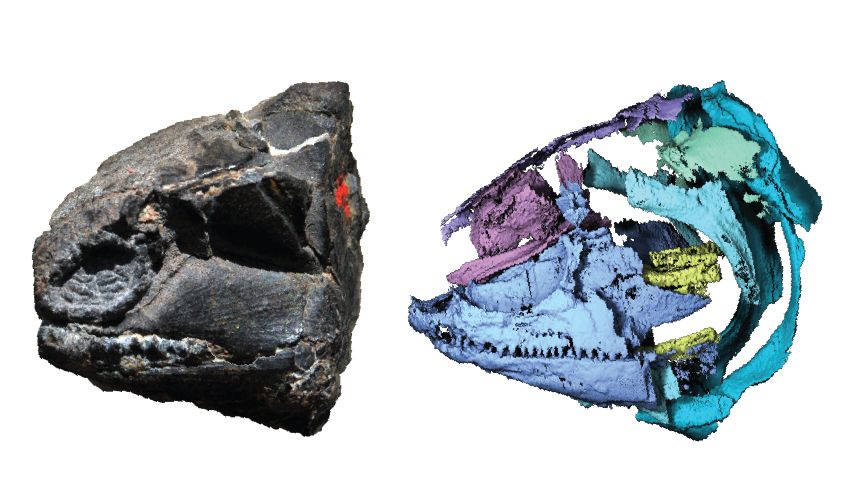 250-million-year-old fossilised head of a polypterid beside a digital visualisation of its skull
Image credit: Andrey Atuchin
However, the researchers discovered that the “dinosaur fish” aren’t as primitive as they seem. Looking at modern polypterids alongside fossils of their ancestors, it appears that, in fact, they developed some of their odd characteristics later in time.
“Polypterids appear to have undergone several reversals in their evolution, which has clouded the view of their position in the fish family tree,” Dr Giles explained. “It’s as if your brand-new smartphone came with a rotary dialler and without Wi-Fi; we know it’s the latest handset, but its characteristics might lead us to think it’s an older model.”
Now we understand these outwardly “primitive” characteristics for what they were, the polypterids, and their position in the lineage of ray-finned fish, start to make more sense.
“With this new analysis, we were able to iron out a lot of the wrinkles in our understanding of the sequence of evolutionary events,” Dr Giles reflected. “These results change our understanding of when the largest living group of vertebrates evolved, and tell us that ray-finned fishes dominated the seas following a major mass extinction that eradicated their closest rivals.”
“Analyses like these are powerful tools, and go to show that palaeontology doesn’t always rely on the discovery of new fossils; re-examination of old fossils using new techniques is just as important for revitalising our understanding of vertebrate evolution.”
The full paper was published in Nature as “Early members of ‘living fossil’ lineage imply later origin of modern ray-finned fishes”: DOI: 10.1038/nature23654.
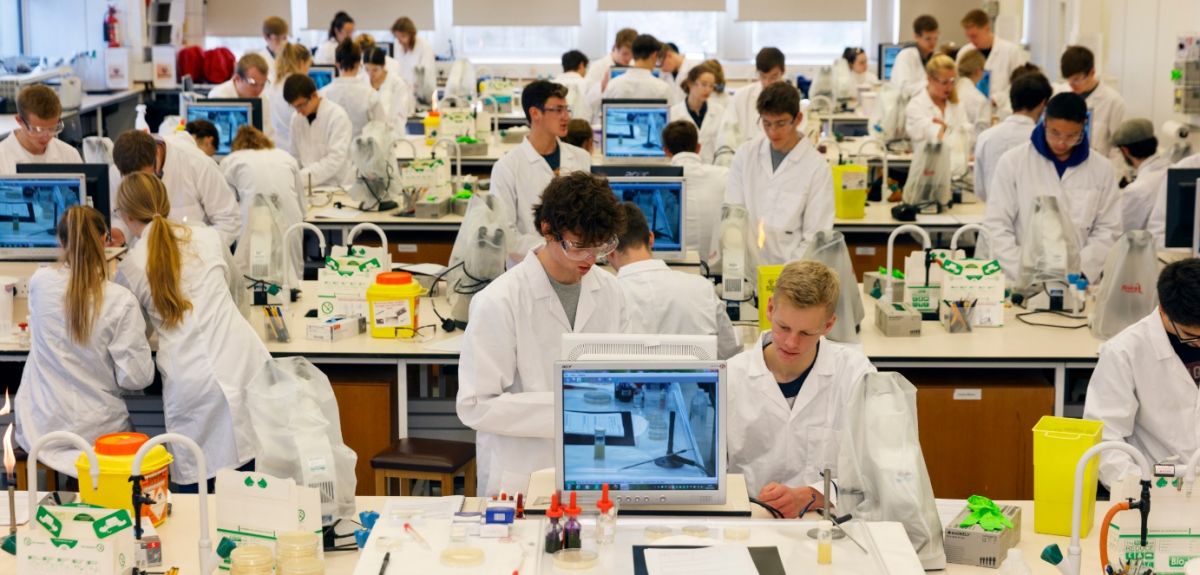
Cutting-edge science research in gleaming laboratories. Undergraduates defending their essays to a world expert in the field in a tutorial. The tortoises who take part in an annual inter-college race.
This diverse group of people – and reptiles – are the stars of a new exhibition of photography by Magnum photographer Martin Parr.
Martin Parr: Oxford is a free exhibition that forms part of Photo Oxford 2017 (8 – 24 Sept) and will run from 8 September to 22 October 2017 at the Weston Library.
As part of the commission, Mr Parr was given access to many of the University’s most iconic buildings and events. He told Vice that he enjoyed the project.
“[Oxford] has everything. It has tradition, it's on the cutting edge of research, it's evolving yet staying still,” he said.
“It was meant to be one year's project; it became two years. I don't know how many trips I made there, 50 or 60. I could have gone on for ten years. Once you start digging, you realise the complexity of a place.”
‘Martin Parr has brought his unique viewpoint to the University and we are delighted to be able to show some of his images opening up Oxford at this free exhibition in the Weston Library,’ says Richard Ovenden, Bodley’s Librarian.
‘Martin strongly supported the Bodleian’s campaign to acquire the archive of William Henry Fox Talbot, who made the first photographic journey to Oxford in the 1840s, and I’m sure this new collection, looking at the many different aspects of Oxford life will be of huge interest to Martin’s fans, local residents, visitors and alumni alike.
'This is a rare opportunity to see work of a brilliant photographer who normally only exhibits at larger international galleries.’
A one day symposium featuring talks by the Photo Oxford 2017 artists will run at the Weston Library on Thursday 7 September. The publication OXFORD Martin Parr, by Oxford University Press, is available to pre-order online.
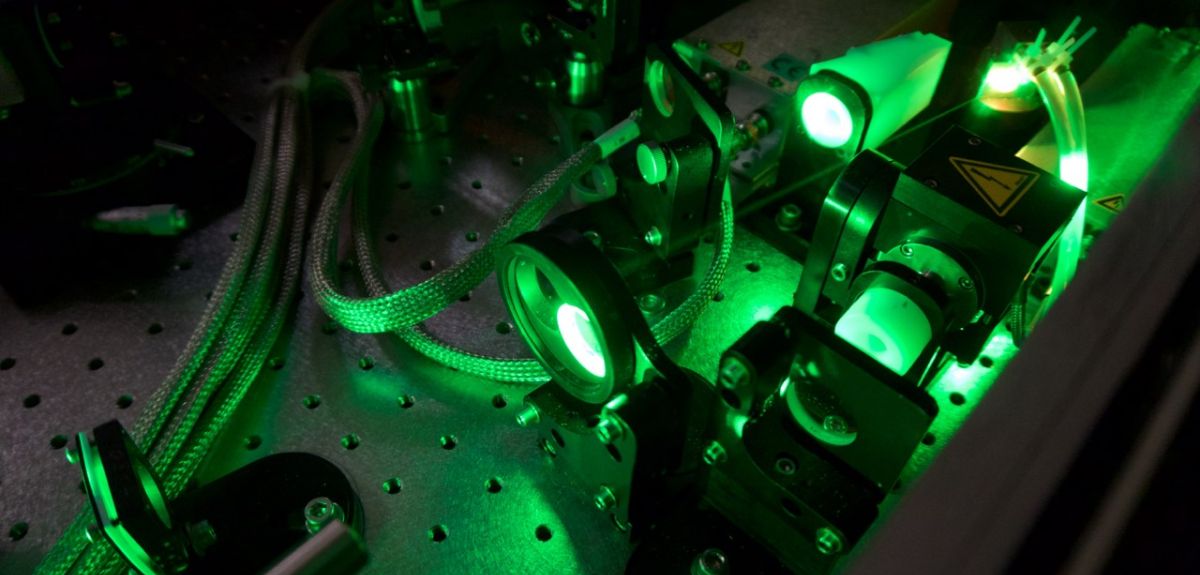
Simon Hooker is a Professor of Atomic and Laser Physics at the University of Oxford, and Chris Arran and Robert Shalloo are two of his graduate students. They discuss the group's work on developing plasma accelerators for real-world applications.
In our group at Oxford's Department of Physics, we combine high-intensity lasers and plasmas to build extremely compact particle accelerators. Our recent experimental results, published in Physical Review Letters, demonstrate a new way to do this - bringing us a step closer to seeing these accelerators widely used in commercial and medical applications.
When we think of particle accelerators - machines which accelerate particles such as electrons and protons to almost the speed of light, we tend to think of the Large Hadron Collider at CERN, which is the largest machine ever built at 27 km in circumference. But of the more than 30,000 particle accelerators in operation worldwide today, fewer than 10% are used for scientific research and only 1% specifically in high energy particle physics. So what are the rest used for?
Particle accelerators have been used to investigate new fuel sources and study holy relics - but the vast majority are used in medicine and industry. In medicine, accelerators are used for the diagnosis and treatment of cancer, to produce high quality beams of X-rays, and for advanced medical imaging. In industry, accelerators are an integral part of processing a broad range of products, from treating foodstuffs for increased shelf life to microelectronics inside smartphones. In fact, it is estimated that every year accelerators treat over £350 billion worth of products. But almost all of the accelerators used for these applications rely on technology developed nearly a century ago.
In recent years, scientists around the world have been working to develop new accelerators powered by the interaction of very intense laser pulses and plasmas. In these "laser wakefield accelerators" an intense laser pulse is fired into a gas, which ionizes it to form a mixture of negatively charged electrons and positively charged ions, at temperatures approaching a million degrees. As the laser pulse travels through the plasma it pushes the plasma electrons out of its way, setting up a "plasma wake" behind it - just as a boat moving across a lake creates a wake. The alternation of positive and negative charge densities within the plasma wake sets up huge electric fields, equivalent to a voltage difference of 10 million volts across the diameter of a human hair. These intense fields can be used to accelerate charged particles to high energies in a distance hundreds to thousands of times smaller than in a conventional particle accelerators, dramatically shrinking the size and cost.
Laser-plasma accelerators have already been used to generate electron beams with similar energies to that used in synchrotron light sources - like the Diamond Light Source near Oxford, but in an accelerator stage only a few centimetres long, rather than in a stadium-sized machine. However, the lasers used could only fire a few times per second, severely limiting the applications of these compact accelerators.
We recently proposed a new approach, called the "multiple-pulse laser wakefield accelerator" (MP-LWFA) which could increase the repetition rate of laser-plasma accelerators by a factor of a thousand.
The idea is to drive the plasma wake with a train of lower energy laser pulses, rather than with a single, high-energy pulse. If the pulses are spaced correctly they "kick" the plasma in time with the plasma motion driven by the earlier pulses, in just the same way that repeated, well-timed pushes of a swing result in a large amplitude oscillation. This change of approach allows very different types of laser to be used, which can deliver thousands of pulse trains per second and with high "wall-plug" efficiency. The ultimate goal is to generate synchrotron-like electron and X-ray beams from a laboratory-scale device.
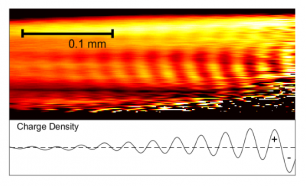
A snapshot of a laser wakefield produced in our experiment. The image shows the wake created behind a laser pulse travelling left to right, leaving behind areas of alternating positive and negative charge.
Recently we demonstrated these ideas in an experiment performed at the Rutherford Appleton Laboratory near Oxford. In that work, we fired a train of laser pulses into a plasma and measured the size of the plasma wake which was driven. We found that, just as expected, the strength of the wake was maximized when the laser pulses were separated so that they kicked the plasma in time with the plasma oscillation driven by the earlier pulses. In contrast, if the pulse separation was mismatched to the plasma oscillation then the plasma wake disappeared. Detailed analysis showed that the experimental data was in very good agreement with our theoretical models, confirming that we have a clear understanding of the physics at play.
Having demonstrated the concept, future work will be aimed at generating electron beams and working with experts in laser physics to develop an architecture for a new generation of compact laser-driven accelerators with properties useful for real-world applications.
If you'd like to read more about the experiment you can find a general synopsis article here and you can find out more about our group and other areas of research here.
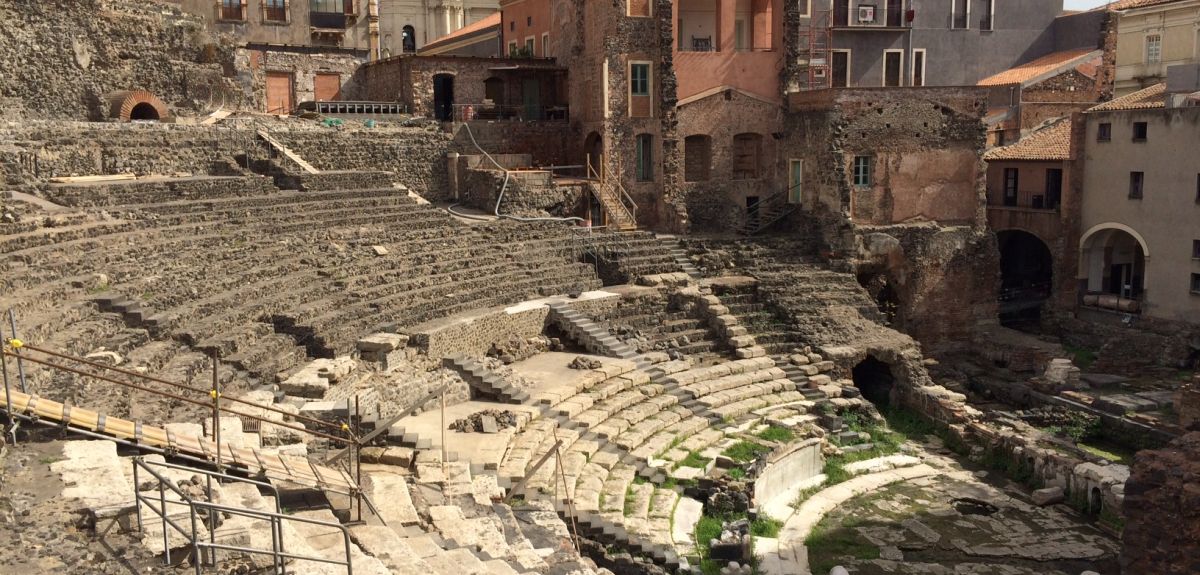
An Oxford classicist has worked with Italian secondary-school students to create an award-winning new exhibition in Sicily, cataloguing stone inscriptions from the Roman period.
Dr Jonathan Prag, of Oxford’s Faculty of Classics, worked in collaboration with students from the Liceo Artistico Statale M.M. Lazzaro in Catania, Sicily, to create the exhibition, entitled ‘Voci di Pietra’ (‘Voices of stone’).
The exhibition, which is housed in the Norman castle that now serves as Catania’s civic museum, features artefacts between 1500 and 2500 years old, including funerary inscriptions, sculptures, and fragments of buildings, as well as video installations created by the students.
These texts are important because they are contemporary documents. They very often provide information about specific events and private individuals, of a type that is not recorded elsewhere. Inscriptions provide a vast body of information on religious beliefs, naming practices, language, and much more.
Dr Jonathan Prag
Catania was originally a Greek city, and was re-founded as a Roman colony, so the inscriptions are in a mixture of Greek and Latin. The inscriptions provide valuable information both about economics and diplomacy in ancient Catania, and about the private lives of individuals in the city.
One intriguing item is a funeral inscription for a Jewish Roman citizen called Aurelius Samohil (i.e. “Samuel”), from 383 AD (pictured below). This is written in a mixture of Latin and Hebrew, and constitutes the longest Latin text from the ancient Jewish diaspora in the Roman world. The inscription contains a triple warning to posterity not to break into the tomb where Aurelius Samohil and his wife Lassia Irene were buried. This and other texts suggest there was a strong Jewish community in Catania.
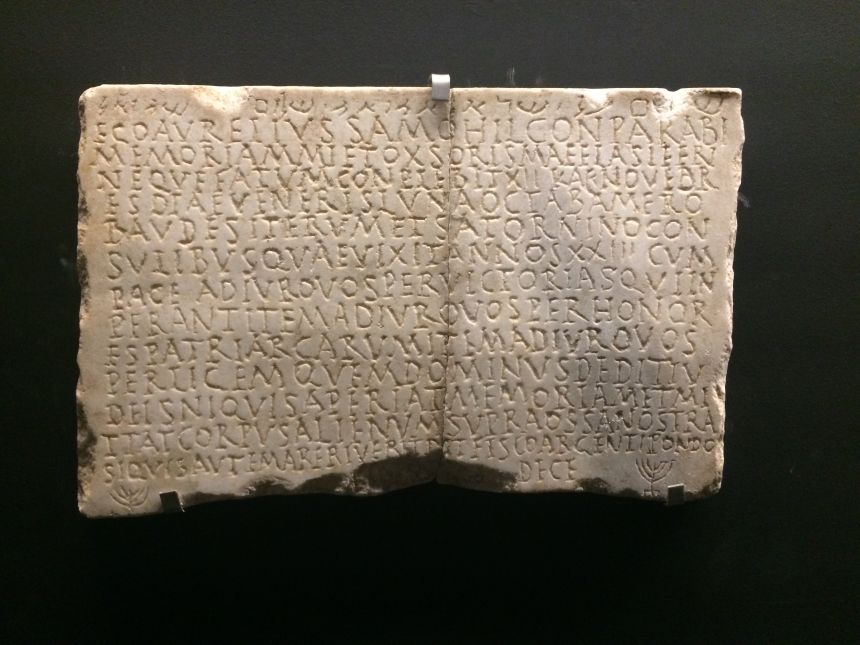 "The warning against breaking into or reusing the tomb is particularly nice and unusual because it appeals simultaneously to the authority of the Roman emperors, the Jewish patriarchs, and Talmudic law." - Jonathan Prag
The students, who won a prize for their work from the Italian Ministry of Education, worked on the exhibition between 2015 and 2017. They were involved in locating, cleaning and recording the exhibits, as well as presenting them in novel ways – for instance, they designed a reconstruction of a columbarium, a type of Roman tomb. They will use the prize to visit Oxford this autumn.
“The enthusiasm and engagement of the students went well beyond anything I had seen elsewhere or expected,” said Dr Prag, who undertook the project as a Knowledge Exchange Fellow at the Oxford Research Centre for the Humanities (TORCH). “They did not have a background in classical studies, but they brought serious artistic flair and a very high level of observation and skill. The end result – a highly professional permanent exhibition – is certainly beyond my original expectations.”
He adds that one of his favourite exhibits is “the rather wonderful video of a very elderly retired stone mason from Catania whom the students found and interviewed, in order to learn about the actual practicalities of engraving on stone”. The students used what they learned from him to create their own inscription as a record of the exhibition.
Dr Prag is now working on a larger project called I.Sicily, which aims to create an online archive of Sicilian inscriptions, reflecting the diverse languages spoken on the island in ancient times.
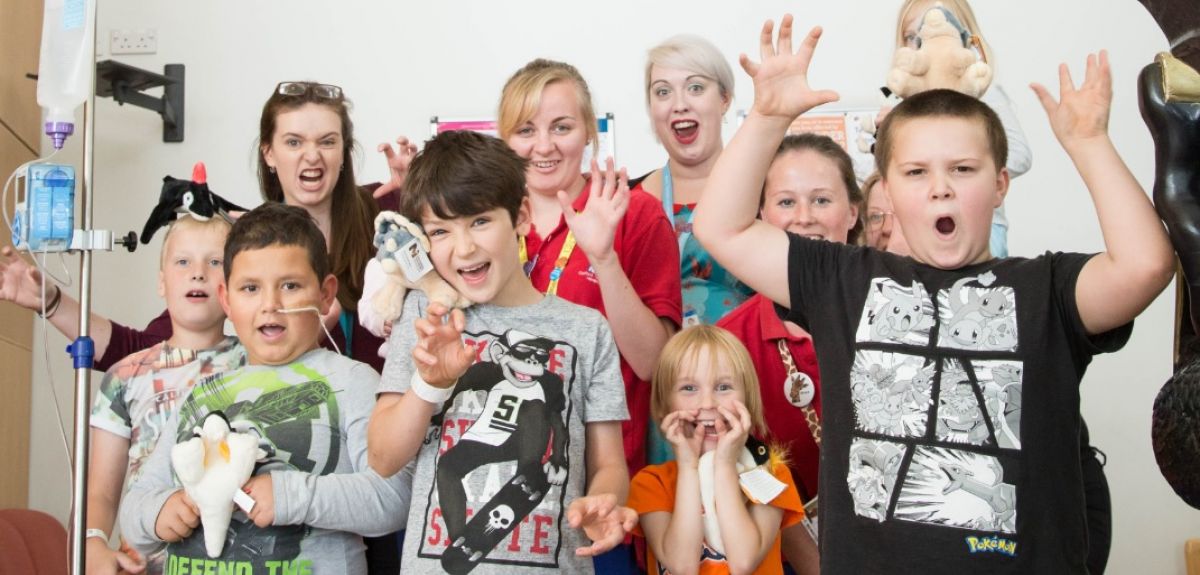
One dinosaur, free to a good home.
This was the call from Oxford University's Museum of Natural History last year, when they asked the public for suggestions for where they should relocate their four-metre long model of a Utahraptor.
The dinosaur has definitely found a good home: it has now been installed at the Children’s Hospital at Oxford’s John Radcliffe Hospital.
The Museum acquired the model in 2000, and it spent time terrorising shoppers at Blackwell’s book shop as part of the Museum’s Goes To Town project in 2014.
But following a reorganisation of the Museum’s collections, it asked for nominations for somewhere to send the dinosaur.
200 venues around the world put in their bids, but the winning one came from Sarah Fletcher, who thought the dinosaur could amaze and inspire the young patients at the hospital.
“The idea of having a model Utahraptor in the hospital seemed like a lot of fun,” she said.
“Having been through the Children’s Hospital with my family, I knew that it would make such a difference to everyone who walks through those doors.
“But I never thought in a million years that we would win it – I am thrilled!”
Hannah Allum, Project Manager at the Museum, is delighted with the outcome. “I hope that the Utahraptor will delight patients and visitors,” she said.
“It’s a nice thought that this Cretaceous character will bring a little piece of the Museum into the hospital environment.”
The dinosaur is now in place, looking down on the entrance to the Children’s Hospital.
- ‹ previous
- 92 of 253
- next ›
 What Louise Thompson’s campaign tells us about the national maternity crisis
 Celebrating 25 Years of Clarendon
  Learning for peace: global governance education at Oxford
  What US intervention could mean for displaced Venezuelans
  Setting the agenda for the next century of quantum
 10 years on: The Oxford learning centre making an impact
 Mapping the Moon: the world’s first lunar atlas goes digital
  Oxford and The Brilliant Club: inspiring the next generation of scholars
 New course launched for the next generation of creative translators
 The art of translation – raising the profile of languages in schools