
The art of translation – raising the profile of languages in schools
Designed to promote language learning in schools, the Anthea Bell Prize raises the profile of modern languages. Inspired by the work of the renowned translator, the free-to-enter prize is open to secondary schools across the UK. With a range of texts to translate, the prize develops students' problem-solving and critical thinking skills while boosting their confidence and aspirations.
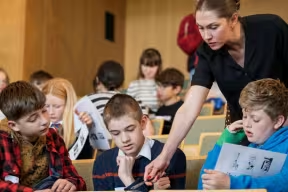
Language learning offers much more than language skills – it's about problem solving and critical thinking © Edmund Blok

To mark the European Day of Languages, The Queen’s Translation Exchange (QTE) – run by The Queen’s College – has launched the sixth Anthea Bell Translation Prize for Young Translators.
Designed to promote language learning in schools and arrest the decline in the study of modern languages, the prize is inspired by the work of the translator Anthea Bell who helped open up the world of Asterix the Gaul to millions of children in the UK.
The prize is open to all secondary schools with specific categories for pupils from key stage three upwards. ‘We start young because it is essential for languages,’ says Dr Charlotte Ryland, QTE Founding Director. ‘It’s too late to expect to be able to enthuse young people with a love of languages if we wait until they are 14 when they have probably already made their GCSE decisions.’
The prize is free to enter and currently runs in six languages: French (into Welsh and English), Spanish, German, Italian, Mandarin and Russian. It also offers a range of texts to translate including poetry, fiction and non-fiction, and has become increasingly popular. Last year 22,000 learners from 412 schools took part, while more than three in four teachers involved in the prize said it had helped raise the profile of languages in their schools.
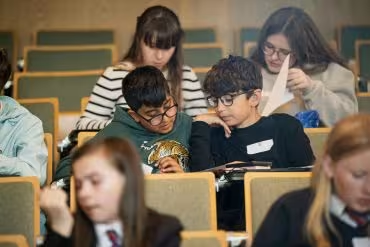
“One teacher has told us that running the Anthea Bell has enabled the school to run an A level language class for the first time in two years.”
Although the prize is being launched this month, it won’t officially open to entrants until February. ‘This is because it isn’t a one-off event. We want teachers to integrate the Anthea Bell into their teaching throughout the year,’ says Dr Ryland.
To enable this, QTE provides more than 100 teaching packs that teachers can request when they register for the prize. Packs provide lesson plans based on authentic texts and include a range of resources such as teacher notes, worksheets, glossaries, videos and extension activities. Care has been taken to link resources to the curriculum while preparing students to enter the prize when they will be expected to complete tasks in the classroom, without teacher support.
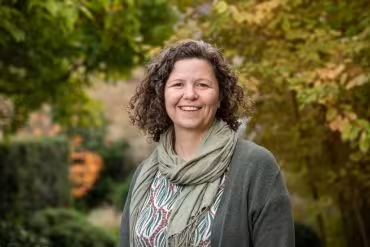
As the prize has gathered momentum Dr Ryland and her QTE colleagues have had to develop an efficient means of judging the many thousand entries. The first part of the process takes place in schools. Schools can enter as many languages and levels as they wish but teachers are asked to submit their top five entrants for each level in each language – making a maximum of 20 entries per language per school.
Entries are then judged for their accuracy and creativity by Oxford University languages students and professional literary translators. This is initially done geographically, with area winners selected for each level and language and put forward for the national awards. All winners, runners up and commendees receive a certificate and their names are published on the Queen’s College Website. UK winners also receive a book prize.
It's not just that the prize makes language learning more engaging for their students of all ages that attracts teachers to the Anthea Bell – although it does. They also recognise that it develops their students’ problem solving and critical thinking skills. More importantly, it has offered many of them a huge uplift in self-confidence and self-belief and a sense of opportunities they had never considered within their reach. For some young participants, it is the first time they have talked about the possibility of going to university.
“It is impossible to underestimate the value of languages when it comes to positively influencing our view of contrasting cultures.”
Dr Ryland takes it a step further. She believes that encouraging more people to study languages – at whatever level – fosters cultural inclusion and diversity. ‘It is impossible to underestimate the value of languages when it comes to positively influencing our view of contrasting cultures,’ she says. ‘Young people who immerse themselves in languages are better placed to appreciate the cultural diversity around them and its value to wider society.’


