
Faculty of Asian and Middle Eastern Studies
Among subjects in the Humanities, Asian and Middle Eastern studies is unique in offering advanced study of cultures and civilisations in Asia, the Middle East and North Africa.
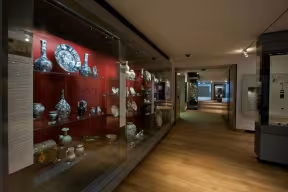
Galleries in the Ashmolean Museum. Credit: Phil Sayer Partnership / Oxford University Images

Overview
Asian and Middle Eastern Studies has a long history in Oxford: the Laudian Chair of Arabic, for instance, was established in 1636. The Bodleian and other libraries have acquired magnificent collections. The Nizami Ganjavi Centre, China Centre, Bodleian Japanese and Indian Institute libraries offer loan collections in their respective fields. Adjacent to the Faculty of Asian and Middle Eastern Studies is the Ashmolean Museum, which houses superb collections. The neighbouring Bodleian Art, Archaeology and Ancient World Library includes the principal library for Islamic Art, Egyptology and Ancient Near Eastern studies, while the ethnographic materials and some manuscripts are also found in the Pitt Rivers Museum.
The courses offered by the faculty present both the major traditions of the regions studied and, in most cases, their modern developments. All courses include language, literature, history and culture, and there are a wide range of options in such fields as art and architecture, archaeology, history, literature, philosophy, religion and modern social studies. The very varied subjects of study and research are organised into the following principal areas:
- Eastern Christianity
- Egyptology and Ancient Near East
- Hebrew and Jewish studies
- Modern Middle Eastern Studies
- The Islamic World
- South and Inner Asia
- East Asian studies
Courses offered
The courses shown below are offered at postgraduate-level.
- MSt in Asian and Middle Eastern Studies (full time)
- DPhil in Asian and Middle Eastern Studies (full time)
- MSt in Bible Interpretation (full time)
- MPhil in Buddhist Studies (full time)
- MSt in Classical Hebrew Studies (full time)
- MPhil in Classical Indian Religion (full time)
- MPhil in Cuneiform Studies (full time)
- MPhil in Eastern Christian Studies (full time)
- MPhil in Egyptology (full time)
- MPhil in Islamic Art and Architecture (full time)
- MSt in Islamic Art and Architecture (full time)
- MPhil in Islamic Studies and History (full time)
- MSt in Islamic Studies and History (full time)
- MSc in Japanese Studies (full time)
- MPhil in Japanese Studies (full time)
- MSt in Jewish Studies (full time)
- MPhil in Jewish Studies (full time)
- MPhil in Jewish Studies in the Graeco-Roman Period (full time)
- MSt in Jewish Studies in the Graeco-Roman Period (full time)
- MPhil in Judaism and Christianity in the Graeco-Roman World (full time)
- MSt in Korean Studies (full time)
- MPhil in Modern Chinese Studies (full time)
- MPhil in Modern Middle Eastern Studies (full time)
- MSc in Modern Middle Eastern Studies (full time)
- MSc in Modern South Asian Studies (full time)
- MSt in Syriac Studies (full time)
- MPhil in Tibetan and Himalayan Studies (full time)
- MSt in Traditional China (full time)
- MPhil in Traditional East Asia (full time)
Humanities Division
Oxford is at the forefront of international research in the humanities, with five subject areas judged to have the highest volume of world-leading 4*-rated research in the UK in the 2021 Research Excellence Framework.

The Humanities Division comprises around a third of the University's community of staff and students, offering taught graduate and research degrees in a very wide range of subjects. Humanities departments and faculties attract outstanding students, academics and researchers from across the globe. As a result, graduate students have the opportunity to undertake their studies and research in a stimulating, challenging and highly rewarding intellectual environment.
Some of these subjects are relatively new, and cross the boundaries of traditional disciplines. Others are areas of academic research that have long been recognised as of central importance, and they include some that few other universities are still able to support. In each case, the objective is to sustain and to teach the highest standards of scholarship. The dynamism of intellectual activity is evident in the wide variety of open lectures and seminars, in addition to those for specific courses.
You will have access to an immense range of research material, including digital resources. These resources are provided through Oxford’s impressive library system, based on the central Bodleian libraries, through the work produced by the University's research projects, and through the rich and diverse holdings of its museums.
In addition to materials and support focused on conveying subject-specific knowledge, there are a wide range of facilities aimed at the personal and professional development of students, strengthening their existing skills, developing new skills, and preparing them for careers after they have completed their studies.