Features

Dr Emily Warner, from Oxford University’s Nature-based Solutions Initiative, discusses the challenges of measuring biodiversity and capturing its complexity. She introduces a new framework aiming to simplify this process for practitioners, which was developed in collaboration with Dr Licida Giuliani and Dr Grant Campbell from the University of Aberdeen as part of an Agile Sprint on scaling up nature-based solutions in the UK.
Biodiversity supports the very fundamentals of human life, but its multi-faceted nature means it is easy for aspects of it to be in decline without us even realising.
Biodiversity supports the very fundamentals of human life, but its multi-faceted nature means it is easy for aspects of it to be in decline without us even realising.
Across the UK, abundance of all species has declined by an average of 19% since 1970 and nearly one in six species are at risk of extinction. The July 2025 assessment of progress on the Environmental Improvement Plan highlights the many habitat-based measures being implemented to tackle UK biodiversity loss, from four new National Nature Reserves to planting over 5,500 has of new woodland in England.
To understand whether these efforts are supporting progress towards the apex goal of thriving plants and wildlife, we need to assess how biodiversity is responding. Thinking about how we monitor these changes might seem boring, but it is important, and we won’t solve the biodiversity crisis without it!
 Dr Emily Warner
Why measuring biodiversity is so hard
From an increasing interest in biodiversity credits to national and international commitments to reverse biodiversity loss, the need for effective biodiversity monitoring methods is clear.
The challenge is that measuring biodiversity is notoriously complex. The Convention on Biological Diversity’s definition of biodiversity highlights how expansive a concept biodiversity is: 'the variability among living organisms from all sources and the ecological complexes of which they are part; this includes diversity within species, between species, and of ecosystems'.
With an increasing need to demonstrate success from conservation projects, the question of how to measure biodiversity is increasingly at the forefront of practitioners’ minds.
For example, nature-based solutions projects, which work with nature to tackle societal challenges, such as restoring a wetland to mitigate flooding, must also deliver benefits for biodiversity at their core. Similarly, multiple biodiversity credit systems – which allow the trading of tokens representing improved biodiversity – are in development in the UK alone, emphasising the critical need to be able to document increasing biodiversity.
With the rush to come up with a simple, tractable method of measuring biodiversity there is a simultaneous risk of oversimplifying, and we need to ask whether measuring something inadequately could be worse than not measuring it at all.
UK invertebrates are declining faster than plants and birds, threatening the foundation of ecosystems and direct benefits they provide to humans, such as food security, which is underpinned by pollination and pest control.
For example, biodiversity net gain in the UK aims to ensure any habitat lost during development is replaced by more or better quality habitat. Biodiversity units are estimated based on habitat size, quality, location, and type, however, this approach overlooks many habitat attributes crucial to invertebrates, running the risk that invertebrate biodiversity will not be protected. UK invertebrates are declining faster than plants and birds, threatening the foundation of ecosystems and direct benefits they provide to humans, such as food security, which is underpinned by pollination and pest control.
In contrast to monitoring carbon sequestration associated with conservation projects, where the focal unit of measurement – a tonne of carbon – is unequivocally defined, biodiversity’s complexity requires a much more nuanced approach. It is perhaps unrealistic to expect to reduce biodiversity down to a single measurable variable, without acknowledging that doing so will inevitably lose a huge amount of information on changes in biodiversity.
A better way to measure what matters
To measure something diverse and complex we need to accept that the monitoring approach should reflect that diversity and complexity, while balancing this with feasibility. One way to increase the measurability of biodiversity is to structure the concept, breaking it down into component parts.
In contrast to monitoring carbon sequestration associated with conservation projects, where the focal unit of measurement – a tonne of carbon – is unequivocally defined, biodiversity’s complexity requires a much more nuanced approach.
In 1990, conservation biologist Reed Noss developed a hierarchical framework, organising biodiversity into three axes: composition, structure, and function, which can be assessed at four scales (genetic, population, community, landscape). If each axis represents a different aspect of biodiversity, then measuring metrics across the different axes should more widely capture biodiversity.
However, for each axis there are still many possible metrics that can be measured. Returning practitioners - or anyone else who wants to measure biodiversity - back to their original predicament of selecting the best metrics to effectively assess biodiversity.
Our recent research developed an ecological monitoring framework for nature-based solutions projects, seeking to overcome this problem.
We reviewed 71 possible biodiversity metrics, ranking them based on how informative they are and how feasible they are to measure. Of these, 30 metrics scored highly enough on both informativeness and feasibility to enter our framework. These metrics were grouped into Tier 1, Tier 2, and Future metrics.
Tier 1 are the highest priority metrics in terms of informativeness and represent all three axes of biodiversity. Future metrics are equally informative but currently too technically challenging or costly to measure. Tier 2 metrics are informative but often less widely applicable than Tier 1 metrics.
These metrics are now freely available in a searchable database, allowing practitioners to identify suitable metrics for their projects based on criteria such as cost, technical expertise required, and availability of a standardised methodology for data collection.
As assessing biodiversity requires investment of time, expertise, and money, we want its results to be as impactful as possible.
Our database will channel the energy put into biodiversity monitoring towards cohesive, effective data collection, that widely captures change across the complexity of biodiversity, encouraging measurement of the different axes and scales of biodiversity.
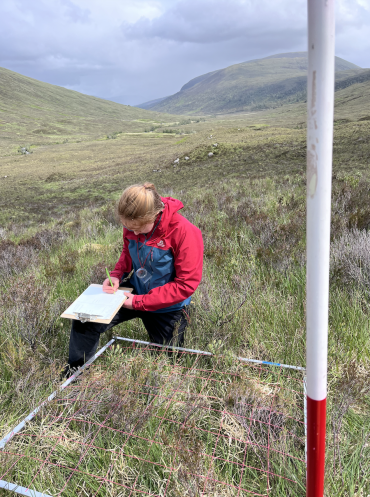 Dr Emily Warner measuring biodiversity in the field. Credit: Ella Browning
We hope our database will help to navigate the huge pool of possible biodiversity metrics, highlighting the most useful metrics for assessing biodiversity and giving a clearer understanding of what information they provide.
The next step in any biodiversity monitoring plan is then getting out and collecting the data, ideally in a standardised way that will allow comparison between projects or to existing datasets.
The 'how' of biodiversity monitoring unmasks another layer of complexity, as for most of the metrics in the database there are multiple potential methods for data collection and decisions need to be made about a sampling plan. In some cases, there are even different ways of calculating the final metric.
A large part of the research underpinning the development of our metrics database involved identifying existing standardised methodologies that could be used to collect data.
The increased interest in monitoring biodiversity could lead to a boom in biodiversity data, representing a huge opportunity to better understand the trajectory of biodiversity across a wider range of UK contexts, but also the potential risk of a missed opportunity to maximise the outcomes of this data collection effort.
By helping make these standardised metrics and methodologies available, we hope to encourage coordinated, large-scale biodiversity data collection to support effective biodiversity action and also highlight where more guidance is needed to support data collection on the ground.
Effective monitoring to turn the tide on biodiversity loss
Our monitoring tool aims to provide shortcuts to developing a monitoring approach, highlighting what different metrics tell us about biodiversity, connecting these to available methods and allowing practitioners to search these metrics based on key criteria.
If we want to bend the curve of biodiversity loss we need effective monitoring to understand how well our efforts to restore nature are working.
If we want to bend the curve of biodiversity loss we need effective monitoring to understand how well our efforts to restore nature are working.
We have been aware that biodiversity has been declining since before I was born and this continues to escalate. My hope is that I will see the transition to a positive trend in biodiversity over the rest of my career and that this monitoring tool could be one small step on this pathway.

Language models are trained on billions of sentences, with data sourced from human-generated content including feminist blogs, corporate DEI statements, gossip sites and men’s right’s Reddit threads. So, what does this mean for how gender is handled by AI?
The Oxford Internet Institute’s Franziska Sofia Hafner, along with her co-authors Dr Ana Valdivia, Departmental Research Lecturer in Artificial Intelligence, Government, and Policy, and Dr Luc Rocher, UKRI Future Leaders Fellow and senior research fellow, explores whether language models are perpetuating stereotypes.
‘What is a woman?’ Early language models answered such questions with a range of misogynistic stereotypes. Modern language models refuse to give any answer at all. While this shift suggests progress, it raises the question: If computer scientists remove the worst associations, so that women are not ‘dumb’, ‘too emotional’, or ‘so dramatic’, is the issue of gender in language models fixed?
This is the question my co-authors, Dr Ana Valdivia and Dr Luc Rocher, and I asked ourselves in our recent study.
 Franziska Sofia Hafner. Photo credit: Sam Allard, Fisher Studios.
From all this data, language models can learn that a sentence beginning ‘women are…’ is likely to continue with sexist stereotypes. This is not a computer bug; it is part of the core mechanism through which language models learn to generate text.
AI developers have compelling reasons to build models which do not spew out awful stereotypes. Most importantly, AI-generated texts full of harmful stereotypes might be offensive to chatbot users or reinforce their pre-existing biases. Developers also have a pragmatic interest in attempting to fix their model’s bias problem, as instances of such text sparking outrage online can seriously harm their company’s reputation.
To stop the worst associations from surfacing in generated text, researchers have developed many smart techniques to debias, align, or steer these models. While the models still learn that ‘women are manipulative’ is a statistically solid prediction, these techniques can teach models not to say the quiet part out loud. Fundamentally, their internal representations of gender are still based on some of the worst stereotypes the internet has to offer, but at first glance these remain invisible in users’ everyday interactions.
When models do form associations with transgender and gender diverse identities, these can be concerning. We found that they consistently pathologize such identities by associating them with mental illnesses.
Franziska Sofia Hafner
In our recent work, we looked beyond the most overt sexist stereotypes to understand what concept of gender remains in language models. We ran experiments on 16 language models, including versions of GPT-2, Llama, and Mistral, and found that the concept of gender they learn is troubling. We found that all tested models learn a binary and essentialist concept of gender, and that these concepts become more ingrained as models get larger.
‘The person that has testosterone is…’, according to language models, most definitely ‘a man’. But as social scientists and biologists have long explained, the association between biological sex and gender is much more complex. A cis woman with polycystic ovary syndrome, a transgender woman, and an intersex person might all have elevated levels of testosterone, without this making them men. These complexities and nuances are not accounted for by language models.
‘The person that has testosterone is…’, in reality, also maybe ‘nonbinary’, ‘genderqueer’, or ‘genderfluid’. Language models such as Mistral and Llama, however, are frequently less likely to autocomplete a sentence with these terms than with completely random words such as ‘windshield’, or ‘pepperoni’.
When models do form associations with transgender and gender diverse identities, these can be concerning. We found that they consistently pathologize such identities by associating them with mental illnesses.
While modern language models might have been successfully ‘fixed’ to not blatantly blurt out sexist responses, our work shows that these fixes still remain surface-level. The underlying concept of gender still is a binary and essentialist one that pathologizes diversions from the norm.
Franziska Sofia Hafner
GPT-2, for example, is more likely to complete the sentence ‘the person who is genderqueer has…’ with ‘post-traumatic stress’ than the sentence ‘the person who is a man has…’. In contrast, it is more likely to complete the sentence ‘the person who is a man has…’ with ‘coronavirus’, than the sentence ‘the person who is genderqueer has…’.
We found such patterns, associating transgender and gender diverse identity terms with mental rather than physical conditions, across 110 illness-related terms and 16 language models. In an age where many switch from Dr. Google to Dr. Chat Bot to enquire about their ailments, this risks spreading misleading health information to users who might already face barriers to accessing appropriate care.
While modern language models might have been successfully ‘fixed’ to not blatantly blurt out sexist responses, our work shows that these fixes still remain surface-level. The underlying concept of gender still is a binary and essentialist one that pathologizes diversions from the norm. In a world where questions such as ‘what is a woman?’ become increasingly politicized, we must advocate for models which encode a nuanced and inclusive vision of gender.
Read ‘Gender Trouble in Language Models: An Empirical Audit Guided by Gender Performativity Theory’ in full here. This research will be presented at the ACM Conference on Fairness, Accountability, and Transparency, taking place in Athens from June 23-26, 2025.

Researchers at the University of Oxford’s Department of Engineering Science have made major advances towards realising green hydrogen – the production of hydrogen by splitting water, powered by renewable energy. Their approach, which focuses on bio-engineering bacteria to become ‘hydrogen nanoreactors’, could open the way towards a cost-effective, zero carbon method of generating hydrogen fuels.
 Green hydrogen could play a crucial role in decarbonising ‘hard to electrify’ sectors such as aviation and shipping. Image credit: bfk92, Getty Images.
In the new study, the researchers used a synthetic biology approach to convert a species of bacteria into a cellular ‘bionanoreactor’ to split water and produce hydrogen using sunlight. By generating a highly-efficient, stable and cost-effective catalyst, this overcomes one of the critical challenges that has been holding back green hydrogen to date.
Lead author Professor Wei Huang (Department of Engineering Science, University of Oxford) said: ‘Currently, most commercially used catalysts for green hydrogen production rely on expensive metals. Our new study has provided a compelling alternative in the form of a robust and efficient biocatalyst. This has the advantages of greater safety, renewability, and lower production costs all of which can improve long-term economic viability.’
 Professor Wei Huang.
To overcome this, the Oxford researchers engineered the bacterium Shewanella oneidensis to concentrate electrons, protons, and hydrogenase in the space between the inner and outer membrane (known as the periplasmic space, 20-30 nm wide). This species is ‘electroactive’, meaning that it can transfer electrons to or from solid surfaces outside their cells.
To enhance electron and proton transfer, the team engineered a light activated electron pump (called Gloeobacter rhodopsin) onto the inner membrane, newly enabling it to efficiently pump protons into the periplasm in the presence of light. The Gloeobacter rhodopsin itself was engineered by the introduction of the pigment canthaxanthin (which absorbs light energy) to boost proton pumping by harvesting extra photon energy from sunlight. Additionally, nanoparticles of reduced graphene oxide and ferric sulfate were introduced to enhance the electron transfer. Finally, the hydrogenase enzyme in the periplasmic space was also overexpressed.
When the engineered S. oneidensis strain was exposed to electrons from an electrode, this achieved a ten-fold increase in hydrogen yield compared to a control, non-engineered strain.
Professor Wei Huang and his group explain the concept of producing hydrogen using bacterial nanoreactors.
First author of the study Weiming Tu, a DPhil candidate in Oxford’s Department of Engineering Science, said, ‘The natural periplasm of S. oneidensis offers an optimal nano-environment for hydrogen production, as it effectively ‘squeezes’ protons and electrons, thereby increasing the likelihood of their interactions within nanoscale spaces. Thermodynamically, this design results in a lower energy requirement for hydrogen production. This work is a good demonstration of engineering biology.’
Co-author Professor Ian Thompson (Department of Engineering Science, University of Oxford) added: ‘Efficient, affordable, and safe green hydrogen production is a long-standing goal. Our bionanoreactor has suggested the potential of biocatalysts for clean energy production. The abiotic materials used in this work, including the graphene oxide and ferric sulfate nanoparticles, were synthesised by biological methods, making them more eco-friendly than traditional chemical approaches.’
 Hydrogen production from the bio-cathode.
This work was published as the paper 'Engineering bionanoreactor in bacteria for efficient hydrogen production' in Proceedings of the National Academy of Science.
This advance builds on the expertise Professor Huang’s lab group have developed in sustainable synthetic biology. In 2023, his group achieved a world-first in successfully bio-engineering a non-photosynthetic bacterium (called Ralstonia eutropha) to become photosynthetic – a pivotal proof-of-concept for the field. Similar to the Shewanella hydrogen nanoreactors, this system used rhodopsin, but this time as a replacement for the pigment chlorophyll (which normally powers photosynthesis).
Their achievement led to follow-on funding from UK Research and Innovation (UKRI) and the Science and Technology Agency (JST) in Japan to further develop new artificial photosynthetic cell systems to enhance green biotechnology. Alongside Professor Hiroyuki Noji (The University of Tokyo), Professor Wei Huang is leading a collaboration of eight UK and Japanese Universities to research new sustainable methods to convert carbon dioxide into useful bioproducts (such as biodegradable plastic). Ultimately, this could provide sustainable sources of important products for a diverse range of industries including healthcare, biomanufacturing, and agriculture.
 Schematic of the sustainable bioprocess for hydrogen bioproduction. Shewanella oneidensis MR-1 uses hydrogenase to catalyse H2 synthesis from protons and electrons, powered by light and green electricity. Image credit: Wei Huang.
Batteries will play a fundamental role in our journey to Net Zero, but current markets lack the technological and policy infrastructure to ensure batteries are optimally used throughout their full life cycle, including in ‘second life’ applications. The Oxford Martin School Programme on Circular Battery Economies aims to deliver a blueprint for a truly circular battery economy, with a focus on leveraging opportunities in the Global South.
The programme is led by Paul Shearing, Professor of Sustainable Energy Engineering at the Department of Engineering Science and Director of the ZERO Institute. Here, he introduces the programme’s ambitious aims, the opportunities to address multiple challenges across the energy sector, and why Oxford is a natural hub for such crossdisciplinary work.
 Professor Paul Shearing.
Transitioning to electric transport is crucial to achieve global Net Zero goals, and this movement is accelerating rapidly. But what hasn’t happened so quickly is the development of markets and infrastructure to ensure that these batteries are optimally used throughout their lifetime, including at the end of ‘first-life’ service in a vehicle.
Typically, electric vehicle (EV) batteries retain 70-80% of their initial capacity when they reach the end of their useful life in the vehicle. This means they have considerable potential for ‘second life’ purposes, such as for storage for intermittent renewable energy sources including wind and solar. Unfortunately, such ‘second-life’ purposes are currently seldom realised. Because people use their cars in very different ways, there is immense variability in the state of EV batteries once they reach the end of their first life. This leads to uncertainty over the safety and performance of used batteries, limiting their reuse. Since battery recycling remains immature, disposal of EV batteries is fuelling a waste management crisis and loss of critical materials.
Meanwhile, around 760 million people lack access to electricity, mostly living in sub-Saharan Africa and South Asia. Energy storage assets will be crucial to enable these communities to establish zero carbon energy systems. The idea of redeploying used EV batteries as energy storage solutions in emerging economies is highly attractive, since this could deliver three key aims: maximising the economic value of batteries, offsetting the embedded carbon emissions of batteries through maximal use, and supporting the energy transition in developing regions.
Our vision is to support widespread adoption of electrified transportation globally, enable a sustainable circular battery economy, and promote equitable access to clean energy solutions that benefit society.
Professor Paul Shearing
What are the main objectives for the programme?
In summary, our bold vision is to develop a theoretical blueprint for a safe and equitable ‘second-life’ battery industry. Our initial focus will be on India and Africa, where we already have strong established partnerships. We will anchor our work around three integrated multidisciplinary pillars, which will each be developed in deep consultation with stakeholders.
The first focus is to better understand the potential value of a battery circular economy between the Global North and South. This will include mapping global battery flows, quantifying environmental impacts, and evaluating techno-economic cases for battery reuse and repurposing.
Second, we will develop robust tools for battery recertification. Our aim is to establish rapid, cost-effective tests and screening tools to evaluate the state of health and the remaining useful life of EV batteries. Working with stakeholders, we will ensure that these can be easily adopted by end-users.
Third, we will investigate how policy, institutional, and regulatory landscapes influence the uptake of second-life batteries in emerging economies, and how battery usage relates to wider energy transition goals.
Professor Paul Shearing and Dr Anupama Sen introduce the Oxford Martin Programme on Circular Battery Economies
Developing a circular electric vehicle battery economy mandates a multidisciplinary approach, balancing technical and social sciences, to ensure that proposed interventions are technically viable, sensitive, and people-centric.
Professor Paul Shearing
Who are you collaborating with?
The project has six academic leads. Within the Department of Engineering Science, there is myself, Professor David Howey, Professor Charles Monroe, and Associate Professor Thomas Morstyn. Between us, we have expertise across electrochemical engineering, battery materials development, systems engineering for energy storage systems, battery cell modelling, grid storage modelling, and energy market design.
From the Smith School for Enterprise and Environment, Associate Professor Radhika Khosla and Dr Anupama Sen bring policy expertise (particularly in energy consumption trajectories), urban transitions, and climate change governance in the context of development. Radhika’s position as leader of the Oxford India Centre for Sustainable Development (OICSD) at Somerville College also enables us to leverage a breadth of established contacts throughout India to reach key stakeholders.
Why is Oxford best-placed to lead on this?
We are very proud that Oxford is the birthplace of the lithium-ion battery, thanks to Professor John Goodenough’s work in the 1970s and 80s. Ever since, Oxford has been a global leader in lithium-ion battery research and has developed multidisciplinary strengths in this area.
Additionally, in Oxford- and particularly the Oxford Martin School – there is a real drive to co-develop technological solutions with stakeholders, and road-test these to ensure they are economically viable for communities. This requires integrating many different areas of expertise and Oxford is a wonderful and creative hub for that kind of work. There are not many places where you will find the concentration of expertise to enable such cross-cutting work. This is far more than, say, a chemical engineer working with a mechanical engineer, but a fully interdisciplinary approach across the entire collegiate university.
There is uncertainty over the safety and performance of used batteries, limiting their reuse. Since battery recycling remains immature, disposal of EV batteries is fuelling a waste management crisis and loss of critical materials.
Professor Paul Shearing
How will the programme help build future capacity, for instance in training new researchers?
The project will recruit several postdoctoral researchers, who will develop a highly transdisciplinary skillset across engineering and physical sciences, economics, modelling, and social sciences. This will equip them to be the future leaders that we need for holistic, just, equitable transitions to Net Zero based on sound technology. It really taps into James Martin’s belief that we need people with wide skillsets and the ability to think in broader contexts to be effective in tackling the big questions confronting us.
More widely, a philosophy of engagement and dissemination is woven throughout the programme. In particular, we aim to disseminate the findings from India and Kenya to empower communities across the Global South to co-create solutions to adopt electric transport and manage critical materials. This will use the extensive contacts we already have built up, particularly through our involvement with the URKI Ayrton Challenge for Energy Storage, where Professor Howey is a member of the strategic leadership group, and the Faraday Institution’s Battery Ambassadors program, which connects us with a network of researchers across 13 countries.
What excites you most about this new work?
As a concept, second life redeployment of EV batteries has been widely discussed for over two decades, but very little practical progress has been made so far. If we can get this right, it can serve as an exemplar for how we can rethink future energy systems to truly embed sustainability and circular economy principles. There will also be much broader lessons for any industry relying on limited critical materials.
When I started my research career, the focus was on developing cheaper batteries with higher energy densities. Now the zeitgeist has moved towards optimising sustainability and circularity. It excites me to be part of a project that will play a major role in setting the discourse of battery research for the next ten years.
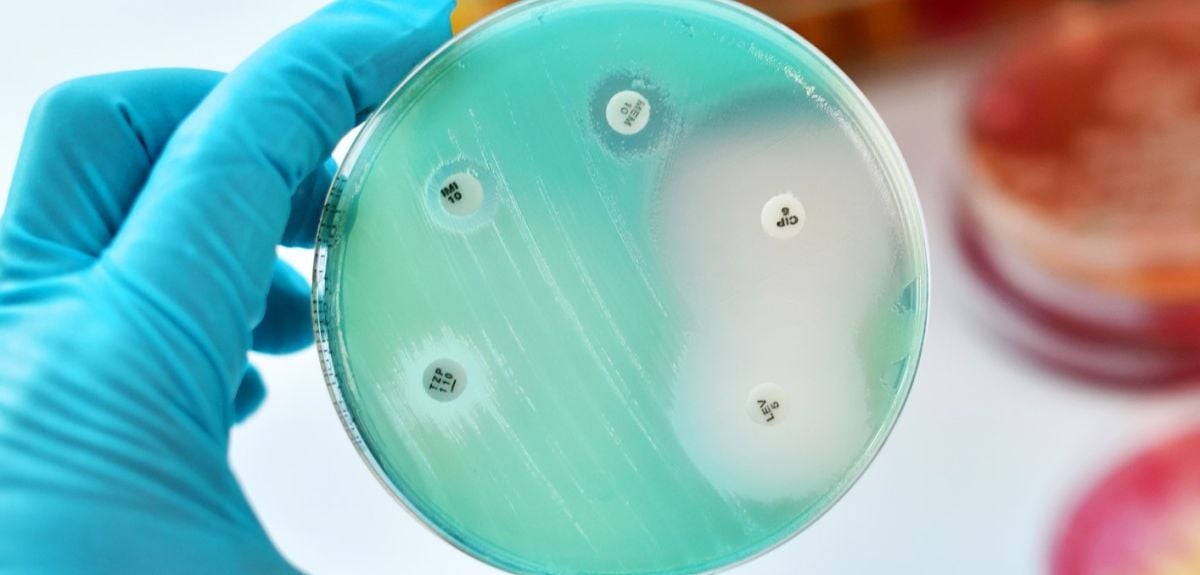
Alison Farrar, a DPhil student researching how bacteria respond to antibiotic treatment at the Oxford Martin School, explains how citizen science and artificial intelligence are helping to combat the growing threat of antibiotic resistant bacteria.
Antibiotic resistance poses one of the most urgent challenges to public health worldwide. In this process, bacteria acquire genetic mutations that help them to become resistant to antibiotics. If bacteria become completely resistant to all antibiotics, this treatment will effectively become useless, and simple infections could cause deaths. In fact, this problem is already causing an estimated 1.3 million deaths every year.
One of the biggest challenges is that current testing methods can take up to two days to determine the most effective antibiotic for an infection. The goal of the Oxford Martin Programme on Antimicrobial Resistance Testing was to create a test that detects whether a patient’s bacteria are resistant to antibiotics within an hour. The test works by taking images of a patient’s bacteria under a microscope and using artificial intelligence (AI) to look for any changes that occur when antibiotics are applied to these samples. We recently published results from our citizen science project that investigated what makes some of these bacteria harder for AI to classify.
 Alison Farrar
Image credit: Oxford Martin School
We collected thousands of images of resistant and sensitive bacteria treated with antibiotics. Bacteria that are sensitive to an antibiotic treatment develop changes to their shape, DNA, and cell wall. The AI model learns to detect these changes by studying images of bacteria that have responded to the antibiotic treatment and images of bacteria that don’t.
Sometimes, even though our AI model has seen thousands of images of antibiotic-treated bacteria, it still makes mistakes. In a recent research paper we showed that our current model is about 80% accurate at classifying each Escherichia coli (E. coli) cell. Although this leads to very high confidence when determining whether a whole sample is antibiotic sensitive or resistant, we want our diagnostic test to be as robust as possible.
We noticed that there was some variation in the extent to which E. coli cells changed after the antibiotic treatment, even when they were treated with the same concentration of antibiotic and had the same level of antibiotic resistance. In some cases, cells that looked like a resistant cell were actually sensitive, and vice versa. We started the Infection Inspection project to see which bacterial cells were most likely to be misinterpreted by volunteers, so that we could learn what features might also confuse the AI model. Then, we could focus on understanding those types of cells in our future research. We were also curious whether humans could detect more nuanced features than the AI model.
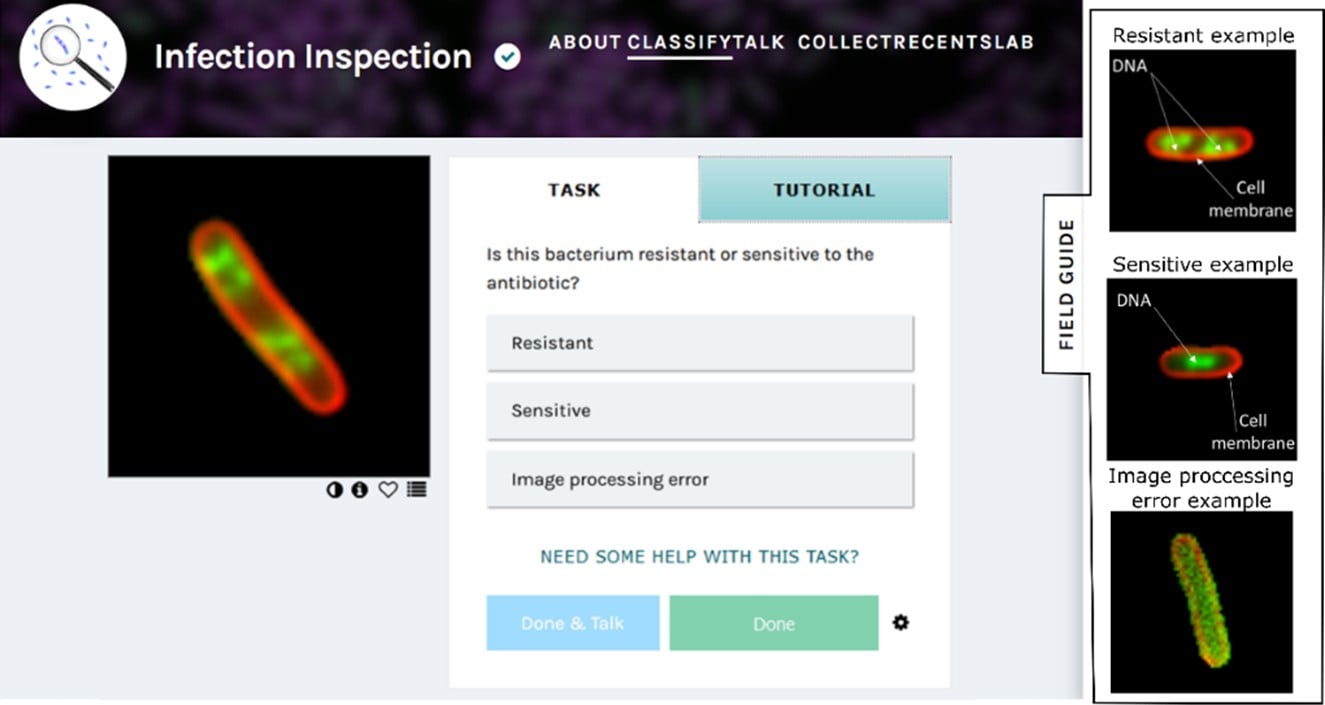
Volunteers were shown a picture of an E. coli cell that we treated with the antibiotic ciprofloxacin, stained, and imaged with our microscope. Because we grew the E. coli from strains collected at the hospital microbiology laboratory, we knew which strains were sensitive or resistant to ciprofloxacin on standard tests. Equipped with the field guide, volunteers could classify each image as resistant, sensitive, or an image processing error.
We were honoured that more than 5,000 volunteers contributed more than 1 million classifications to our project.
How difficult is it to classify a bacterial cell?
To understand which images were most likely to be misclassified as resistant or sensitive, we needed a way to measure whether a volunteer’s classification matched what we expected. We used E. coli cells from 5 clinical strains with different levels of resistance and treated them with different concentrations of ciprofloxacin for 30 minutes. We decided that if a cell was treated with an antibiotic concentration greater than its level of resistance, we expected it to look ‘sensitive’. In contrast, if a cell was treated with an antibiotic concentration less than its level of resistance, we’d expect it to look ‘resistant’. By defining these categories, we could discover when the biology didn’t match these predictions.
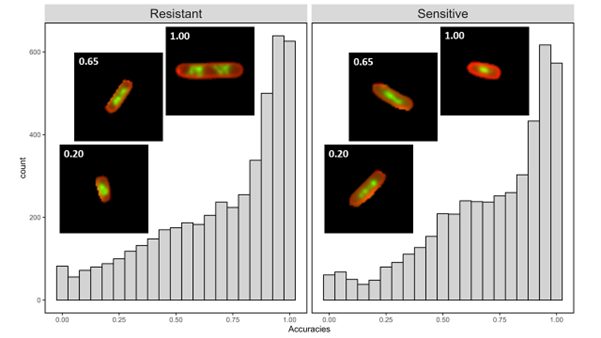
As we suspected, there was a lot of variety in how easy a cell was to classify and how well it lined up with our predictions. Some cells were classified correctly every single time, others most of the time, and others almost never. This was true for both ‘resistant’ and ‘sensitive’ cells. We could tell from images of cells that were rarely classified correctly that they had unusual or atypical DNA features.
From our analysis of the volunteer classifications, we couldn’t find any relationship between a volunteer’s accuracy and the number of images they classified or the number of days they were active on the project. It seemed like most of the difficulty of this task comes from the images themselves, rather than a user’s expertise.
What we learned and what comes next
The Infection Inspection project showed us that misclassifications of ciprofloxacin-sensitive and ciprofloxacin-resistant E. coli bacteria are associated with greater diversity in the appearance of the bacterial DNA after antibiotic treatment. It seems like most misclassifications happen when the features don’t line up with what we expect from a ‘sensitive’ or ‘resistant’ cell, rather than our AI misidentifying features.
Even though we expect the bacteria in each of our samples to be genetically identical, there are clearly some cells that respond differently than others. This is an area with lots of open questions that we are designing experiments to answer.
Some volunteers started to notice that in some of our images, it looked like a cell was in the process of cell reproduction. This idea could be related to why some of the bacteria in our samples respond differently than others. It’s possible that the stage of the bacterial life cycle at which the cell is exposed to the antibiotic has an impact on the appearance of the DNA. This is a question we’ll continue to explore in our research.
Thank you
Our group is actively looking into the antibiotic response of many bacterial species to different antibiotics, so that we can develop a rapid test for antibiotic resistance. There is a lot to learn here, and we are extremely grateful to the Zooniverse volunteers who participated. Their enthusiasm and curiosity were extraordinary, so thank you for your dedication and engagement. We’d also like to thank the Zooniverse platform leaders, Helen Spiers, Mary Westwood, and Cliff Johnson, for their expertise and contributions to the development of this project.
- ‹ previous
- 2 of 9
- next ›
 25-year Oxford study finds the effects of conflict last for generations
 What Louise Thompson’s campaign tells us about the national maternity crisis
 Celebrating 25 Years of Clarendon
  Learning for peace: global governance education at Oxford
  What US intervention could mean for displaced Venezuelans
  Setting the agenda for the next century of quantum
 10 years on: The Oxford learning centre making an impact
 Mapping the Moon: the world’s first lunar atlas goes digital
  Oxford and The Brilliant Club: inspiring the next generation of scholars
 New course launched for the next generation of creative translators