Features

As conflicts continue to escalate in the Middle East and around the world – including rising tensions in northern Ethiopia – new evidence from the University of Oxford shows that, beyond the immediate devastation, the impact of war on young people can last for decades, affecting mental health, education, employment and even the next generation.
Based at the University of Oxford, Young Lives is a unique longitudinal study of poverty and inequality. Since 2001, the Young Lives Study has followed the lives of 12,000 young people – from infancy to adulthood – in Ethiopia, India, Peru and Vietnam. In Ethiopia, researchers have collected rare long-term data in the conflict-affected areas of Tigray and Amhara.
 Dr Marta Favara, Director, Young Lives
What conflict means for young people
Through in-person surveys and qualitative interviews – alongside an innovative phone survey conducted in 2021 and 2022 during the COVID-19 pandemic and the start of conflict in Ethiopia – as well as audio computer-assisted self-interviews (read more here: 'Caught in the Crossfire'), the Young Lives study has captured in-depth first-hand accounts and lived experiences, demonstrating how conflict affects nearly all aspects of young people’s lives:
- Early marriage – Conflict and economic hardship are reshaping marriage practices, sometimes delaying marriage but also increasing early marriage in some areas, risking a reversal of recent declines. In Tigray, conflict has led some families to encourage early marriage or childbearing to offset lives lost during the war and to deter daughters from migrating.
- Maternal and child health – Damaged facilities, healthcare worker absences and financial constraints have led to a reduction in hospital deliveries, ambulance services and vaccinations.
- Sexual and reproductive health (SRH) – Services have been severely disrupted, limiting access to free contraceptives, implant removals and SRH education. Many young people have had to rely on expensive private clinics or go without altogether.
- Disabilities - War has increased disabilities through injuries and delayed medical treatment, compounded by additional economic pressures and long-term psychological trauma and emotional distress.
- Mental Health – Young people are reporting high levels of stress, anxiety and depression. In 2023-2024, 41% of participants from Tigray reported anxiety and 32% reported depression, while in Amhara, 32% reported anxiety and 19% reported depression. Young women face additional mental health issues due to excessive caregiving responsibilities and heightened risks of sexual violence. Psychological trauma continues long after the fighting ends, with high levels of reported post-traumatic stress disorder symptoms in conflict-affected areas.
- Food insecurity - Although food insecurity has remained persistently high over the last decade, Ethiopia reported particularly alarming levels in 2023-24, with 74% of Young Lives households reporting they were either worried about running out of food or did not have enough food due to financial constraints. Food insecurity was especially acute during the conflict period and further exacerbated by severe drought in the southern regions and crippling inflation, particularly in urban areas
- Education – Prolonged conflict has severely disrupted schooling, undermining learning outcomes and reducing young people’s ability and motivation to continue their studies.
- Work and Employment – Destroyed livelihoods and increased youth unemployment have left young people who dropped out of school - and even university graduates - in poor-quality jobs that fail to match their skills and expectations.
- Migration – Conflict and the associated economic hardships and disruption of education have displaced many young people in search of safer environments. Young women, who typically migrate for domestic work in the Middle East, are particularly vulnerable to exploitation, sexual harassment and deception.
Conflict’s long shadow
Events in Ethiopia and the Middle East show how quickly conflict can destabilise communities, heighten anxiety, disrupt services and destroy infrastructure. Young Lives’ longitudinal evidence suggests that without coordinated action, the consequences of conflict can echo across generations. Furthermore, beyond the immediate social and economic costs, the study shows that conflict also leads to an erosion of trust – an essential foundation for peacebuilding, as well as post-conflict stabilisation and reconstruction.
A call for action
Young Lives’ Qual 6 policy brief presents emerging recommendations based on our findings and calls for government ministries and agencies, donors, international organisations, local NGOs and community groups to:
- restore disrupted reproductive, maternal and child health services;
- expand mental health care to help address widespread psychological trauma;
- ensure targeted support to people with disabilities who are often disproportionately affected by disrupted services;
- support young people to return to education;
- create economic opportunities and expand access to decent work;
- mitigate increasing migration driven by insecure livelihoods and a growing sense of hopelessness among young people.
 Kath Ford, Deputy Director, Young Lives

 Alessandra Enrico Headrington, COMPAS
The United States’ intervention in Venezuela on 3 January 2026 marks a critical moment not only for the country’s political trajectory, but also for the future of one of the largest displaced populations in the world.
The situation before US intervention
The United States’ intervention in Venezuela has ignited questions about its legality under international law and the principles set out in the United Nations Charter. This moment reflects a broader trend in which core legal principles appear increasingly subordinated to power politics. Beyond questions of legality, it also raises deeper uncertainties about Venezuela’s political future and what leadership change might mean for the possibility of return for nearly 8 million Venezuelans displaced since around 2015.
Of the majority of those displaced, around 6.9 million are hosted by countries in Latin America, with Colombia and Peru receiving the largest numbers, followed by Ecuador and Chile, and more recently by Brazil. Since 2015, governments have granted legal stay through the provision of over 5.1 million special, time-limited residence permits. These measures allowed Venezuelans to live and work legally and were initially conceived as rapid and flexible tools to manage large-scale displacement.
This moment reflects a broader trend in which core legal principles appear increasingly subordinated to power politics. Beyond questions of legality, it also raises deeper uncertainties about Venezuela’s political future and what leadership change might mean for the possibility of return for nearly 8 million Venezuelans displaced since around 2015.
However, the limitations of this interim solution have become increasingly visible. Access to temporary permits has grown more restrictive, with the enforcement of tighter eligibility requirements and the reintroduction of border controls. While these schemes have enabled a quick path to legal stay for many Venezuelans, their temporary and conditional nature offer limited certainty about long-term protection or settlement. This policy choice is particularly striking in Latin America, where many states have deliberately incorporated the Cartagena definition into their national frameworks. This regional standard broadens refugee protection to include people fleeing widespread violence, human rights violations and serious public disorder. Under this definition, a significant share of Venezuelans could, in principle, be recognised as refugees, accessing a stronger, rights-based form of protection with greater legal certainty over time in host countries.
Nevertheless, my ongoing doctoral research at the University of Oxford with Venezuelans in Colombia, Peru and Ecuador, points to a clear pattern: many Venezuelans prefer temporary permits, despite their precarious and uncertain nature, over seeking refugee status, which is a protracted and complicated process. Temporary permits are comparatively simple and predictable – even when they involve fees.
But as the political environment shifts, broader questions are likely to arise about the sustainability of temporary permits and about what may come next for the more than 5 million Venezuelans currently living under them.
Will displaced Venezuelans return to Venezuela?
Comparative experience from other displacement contexts, such as Syria, suggests that even significant political or economic shifts in countries of origin do not automatically translate into large-scale return.
For many displaced Venezuelans, recent events symbolise the end of a political era marked with widespread human rights violations, the erosion of the rule of law, and large-scale displacement. These perceptions matter: they shape expectations about the future, influence personal and family decisions, and frame narratives around the possibility of return, even in the absence of immediate material change.
However, while the changing political situation may shape displacement dynamics, return is unlikely to be immediate or uniform.
Comparative experience from other displacement contexts, such as Syria, suggests that even significant political or economic shifts in countries of origin do not automatically translate into large-scale return. International standards make clear that return must be voluntary, safe and dignified, and premised on effective guarantees of physical security, legal protection, access to livelihoods, and institutional stability. In the absence of these conditions, and drawing on comparative experience from other protracted displacement contexts, any return is likely to remain limited and selective rather than widespread.
What may come next for displaced Venezuelans
After more than a decade spent managing Venezuelan arrivals, the question for host countries is no longer how to extend short-term legal stay, but whether this model can meaningfully evolve, or whether a different approach is needed. For most Venezuelans, medium-to long-term stay in host countries across the region therefore continues to be the more realistic horizon. This evolving situation points to three likely scenarios:
- Temporary protection as the dominant response: Temporary permits may continue to define access to legal stay across Latin America, operating largely at governments’ discretion, while refugee protection plays an increasingly limited role. As country-of-origin assessments evolve, this may affect future asylum decisions and, in some cases, the review of existing refugee status under international refugee law.
- Tighter access to legal stay and rising irregularity: Temporary permit schemes could be adjusted, affecting eligibility, duration, and in some cases their continuation. Given their discretionary nature, such shifts could increase legal uncertainty and, over time, push more Venezuelans into irregular status and onward movement.
- Selective return alongside sustained mobility: Voluntary return is likely to remain limited rather than widespread, shaped by continued uncertainty in Venezuela and occurring alongside ongoing mobility, including new departures by groups that had previously stayed in the country, some of whom supported Nicolás Maduro.
The bigger picture
The future of protection for Venezuelans will be shaped both by events in Venezuela and by political and electoral shifts in host countries. Electoral cycles and shifting domestic agendas in countries such as Ecuador, Chile and Peru are likely to influence whether existing legal protections are maintained, progressively narrowed, or increasingly reoriented towards return-focused approaches.
The future of protection for Venezuelans will be shaped both by events in Venezuela and by political and electoral shifts in host countries. Electoral cycles and shifting domestic agendas in countries such as Ecuador, Chile and Peru are likely to influence whether existing legal protections are maintained, progressively narrowed, or increasingly reoriented towards return-focused approaches.
Beyond Venezuela, these dynamics carry broader significance. The Latin American response, marked by the large-scale use of temporary permits and a more limited reliance on refugee protection, offers a revealing case of how states manage protracted displacement with precarious tools and under political uncertainty.
What happens next will affect not only the future of Venezuelans, but also how large-scale displacement is managed in other regional and global contexts, with consequences for society as a whole.

Ian Walmsley, a Professor of Quantum Science and Engineering and an internationally recognised expert in quantum photonics, has returned to Oxford from Imperial College London, where he served as Provost for the past seven years. He was previously Hooke Professor of Experimental Physics and Pro-Vice-Chancellor for Research and Innovation at Oxford. His career has seen him lead the UK’s first Quantum Technology Hub, co-found a quantum computing spinout, and serve on the UK Government’s National Quantum Strategic Advisory Board.
In October this year, he took up the position of Director of the Oxford Quantum Institute (OQI). Here, he reflects on Oxford’s strengths in quantum, the role that the OQI will play to accelerate impact, and how the UK as a whole can remain competitive in the quantum arena.
Your career has ranged across both fundamental and applied quantum science. What first drew you in?
There is a huge opportunity for quantum here in Oxford and a will to succeed. I look forward to getting the Institute underway and collaborating with brilliant colleagues working at the cutting edge of quantum.
My route into quantum was through optical science and engineering - using light as an exquisite sensor to probe systems, to link systems for secure communications, and increasingly to process information in photonic quantum computers. Light is special: it is the one physical medium we can control with extraordinary precision in which quantum effects remain accessible at room temperature. That makes it both a powerful scientific tool and practical technology, with a unique ability to bridge disciplines from astronomy to biomedicine.
I’ve had the good fortune to work with brilliant colleagues across many domains of optics and photonics, but particularly at the conjunction of ultrafast and quantum optics. This combines producing very, very short light pulses with the science of how light behaves according to the rules of quantum physics. One of my earliest directions was to use the brevity of ultrashort light pulses to map the quantum motion of vibrations in molecules, and later to make two diamonds sitting in the lab become “entangled” – meaning their properties became linked in a way that goes far beyond anything possible in everyday, classical physics.
Part of this effort required developing new tools to measure and fully characterise these very brief events, and that led to a commercial device that was used to ensure this category of lasers were performing as you wanted. More recently we’ve used this domain to generate the purest single photons yet made, and enabled quantum photonic platforms for information processing – elementary quantum computers, in fact, though far from a scalable machine.
How has the field of quantum computing changed over your career?
If we can harness the power of superposition (where units of information can exist in indeterminate states), this would unlock computational power far beyond that of classical computers.
Quantum science has been around for over 100 years, but the last two decades have been truly transformative. The key tipping point was the realisation that applying quantum principles to the transfer of information could be a reality and not just a theoretical possibility – unleashing the current intense development effort across engineering and physics. We can now conceive how quantum principles could be used in the future to perform useful work and solve problems.
If we can harness the power of superposition (where units of information can exist in indeterminate states), this would unlock computational power far beyond that of classical computers. As Bill Phillips (1997 Physics Nobel Prize winner) said: ‘A quantum computer is more different from today's digital computers than those computers are from the abacus.’
What is the aim of the Oxford Quantum Institute?
Our aim is to ensure that Oxford fulfils its potential as one of the world’s pre-eminent institutions for researching both fundamental quantum technologies and their impacts on society. Oxford already has exceptional quantum capabilities distributed across many departments; OQI adds value by joining these up. By coming together, we can develop shared concepts and language across disciplines to identify the really big questions and new ways to answer them.
The Institute will have a dedicated space in the Townsend Building to act as a common meeting point for both our diverse research community and external luminaries – from those working in technology governance at Oxford’s Blavatnik School of Government to biochemistry researchers using quantum to study the structure of enzymes.
No known physics forbids fault-tolerant quantum computers, but the technical challenges are formidable.
OQI will also serve as a ‘shop window’ of Oxford’s quantum capabilities to the wider world, providing a portal of access for external institutions to look through to see how they might access these strengths. The exchange of ideas is critical to drive forward research, and OQI will actively work to create opportunities for cross-disciplinary collaborations. A central aim is to create joint research partnerships that allow academics to move seamlessly between universities, research centres, and industry, gaining broad insights that enrich their work.
In short, the goal for the OQI is to set the agenda for the next 100 years of quantum science.
Where does Oxford stand in quantum right now?
Oxford has one of the deepest and broadest concentrations of quantum expertise anywhere, from thinking about the philosophical foundations of the theory to developing the technology for quantum computers and spinning out companies that are already commercially applying quantum principles. The University has played a leading role in the first three generations of the UK’s Quantum Hubs network and has had a large influence on the national agenda. For instance, Oxford is a key partner in the UK's first Quantum Biomedical Sensing Research Hub, launched last year, which is exploring how quantum technologies could transform early disease diagnosis.
At the same time, Oxford is really pushing at the frontiers of fundamental science. For instance, the QUEST-DMC experiment, in which Oxford is a key partner, is using the quantum properties of superfluids as a super-sensitive detector for dark matter. And the AION consortium is using atom interferometry with a similar aim. This is led by Imperial and Oxford, with the next generation large-scale interferometer hopefully to be built here.
It’s this combined breadth and depth that makes Oxford such a stimulating place to be in quantum.
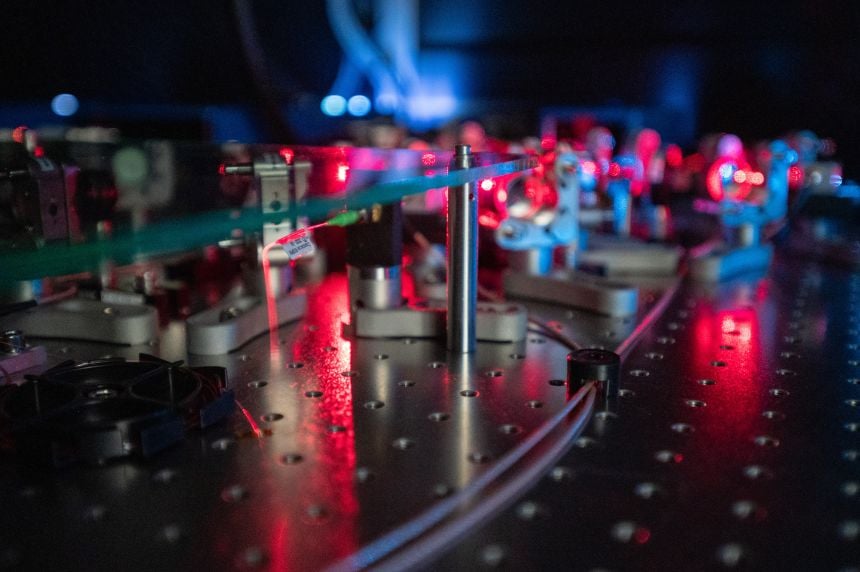 Quantum research at Oxford University. Credit: John Cairns.
How long will it be before we have a fully working quantum computer?
How long is a piece of string? The underlying technology for quantum computing has developed rapidly over recent years, and quantum concepts will soon start to impact our everyday lives, for instance room-temperature MRI sensors for brain imaging and ultra-secure communications over a quantum network. No known physics forbids fault-tolerant quantum computers, but the technical challenges are formidable. Until these are addressed, it is still a case of if not when we get to functional fault-tolerant quantum computers capable of realising the full promise of the technology. I am sanguine that we will eventually get there, but that we’ll probably need a few more creative ideas to do so.
Nevertheless, with so much resource being applied to this goal, we can be confident that the journey will result in ‘spin off’ benefits along the way. We can expect hybrid quantum–classical co-processors that can slot into data centres, boosting certain AI and optimisation tasks, sometimes with lower energy or higher accuracy. Another likely application is navigation with quantum accelerometers and gyroscopes that can work in GPS-denied environments. Sensitive quantum probes of sub-surface structures and long-distance quantum key networks are also in commercial prototype stages.
Tell me about your quantum spinout, ORCA computing.
The exchange of ideas is critical to drive forward research, and OQI will actively work to create opportunities for cross-disciplinary collaborations across academia and industry.
I co-founded ORCA Computing in 2019 as a spinout from the first Quantum Computing Hub, which was based here at Oxford. My co-founders were Professor Josh Nunn at the University of Bath, one of my former DPhil students and research colleague, and Dr Richard Murray, from Teledyne, who we met through the first Quantum Hub when he was at Innovate UK - another example of how initiatives that bring academia and industry together can bear unexpected fruit.
Our aim was to apply what we had learned from more than a decade of research at Oxford toward building a flexible quantum computer powered by photonics. The machines we produce store and process information using individual particles of light (photons) travelling through standard optical fibre, rather than electricity. These can plug directly into existing data centre infrastructure to enable organisations to try real-world tasks – such as optimising complex networks or experimenting with AI/machine learning workflows- by running quantum and classical computing side-by-side in a hybrid manner.
We now supply photonic computers for machine learning to a range of international customers including the UK Ministry of Defence, the UK’s National Quantum Computing Centre (UK), and Montana State University (US).
Oxford’s spinout track record in quantum is strong, but what is the outlook for quantum commercialisation in the UK?
The UK is well positioned to develop commercial quantum applications. The UK National Quantum Technologies Programme, which has been in place for 10 years now, has really been a spur to bring together the great scientific ideas based in universities and real-world, user knowledge within industry. The intersection of these has already launched a wide range of quantum spinouts and Oxford has been particularly prolific.
Oxford has one of the deepest and broadest concentrations of quantum expertise anywhere, from philosophical foundations to developing technology and spinning out companies.
However, two things are crucial to ensure that the UK can capitalise on this. First, investing in the skills base. Universities play a vital role in developing highly talented people, but our efforts are compromised if the UK is not seen as open and attractive on the global stage. We need to actively engage with policy makers to ensure that immigration policies and visas, for instance, are aligned with national quantum goals.
The second issue is finance. In the UK, there is a definite funding gap between the stages of launching a seed company and developing the technology to the point of market-readiness. Here in Oxford, we can benefit from investment from Oxford Science Enterprises, but the UK Government needs to think hard on how to attract more venture capital money into the UK quantum ecosystem as a whole.
Do you have a favourite example of a quantum spinout launched at Oxford?
Of course, I’d be bound to say ORCA Computing! But there are many successful companies to choose from. The recent sale of Oxford Ionics based on their trapped-ion gate technology was clearly an outstanding success, and a global endorsement of Oxford’s capacity for creating world-leading tech companies. I’m generally quite fond of all those quantum computing businesses that emerged from the first two Hubs: Oxford Quantum Circuits, Quantum Motion, and Universal Quantum prominent among them.
You can find our news items on quantum-related research at Oxford University here.
For more information about this story or republishing this content, please contact [email protected]

Oxford University physicists are simulating the strange, probabilistic world of quantum mechanics, opening the door to new innovations for superconductors, materials science, and quantum technologies.
It turns out that when you chill atoms to near absolute zero and suspend them in magnetic fields, the usual rules of matter no longer apply. Instead, the bizarre logic of quantum mechanics - where particles behave like waves and probabilities replace certainties- rule the day. But here at Oxford, researchers are not merely observing these strange phenomena, but engineering and controlling it with pioneering precision.
The ability to trap atoms and separate them into two distinct layers using radio frequencies is something Oxford specialises in. It has taken years of development in our group to reach this point, but it is now yielding extraordinary new insights.
Erik Rydow, DPhil student (Department of Physics)
‘It’s a bit like building a wind tunnel for quantum physics,’ explains Erik Rydow, DPhil student in Oxford’s Ultracold Quantum Matter Lab. ‘You can simulate how an aircraft wing behaves on a computer, but to really understand it, you need a controlled experiment. We’ve built the quantum equivalent of that wind tunnel.’
Quantum systems can be notoriously hard to simulate because they don’t behave like the physical systems we experience day to day. In the classical world, if the starting conditions of a system are precisely the same each time, then the final result will be the same. But in quantum mechanics, particles can exist in more than one state at once. This means that simulating a quantum system in general does not give you a definite outcome: instead, it gives you a spread of probabilities for the different things that may happen.
‘You can think of it like rolling a dice,’ adds Erik. ‘In the classical world, if the starting conditions are exactly the same each time, then the dice will land in the same place. But in the quantum world, even if the starting state is exactly the same between rolls, the dice can land on different sides. This means you can’t say for certain what outcome will happen; you can only give a probability.’
 The researchers use lasers and radiofrequency signals to trap and cool atoms. Credit: Caroline Wood.
This capability rests on decades of innovations to trap and cool atoms. Using finely-tuned lasers and magnetic fields, a gas of rubidium atoms is chilled to near absolute zero; cold enough that tens of thousands of atoms all occupy the same quantum state. At such a low temperature, the behaviour of the atoms is determined by their quantum wavelike nature, and the different outcomes for identical particles can reveal the probabilities predicted by quantum mechanics. This creates an extraordinary laboratory for probing quantum effects that, until recently, were purely theoretical.
A hallmark of Oxford’s expertise is precision control. By manipulating atoms with radio frequencies, the team can separate them into ultrathin layers only a few microns apart with an exactness that is challenging to achieve with more standard protocols that use lasers. Uniquely to Oxford’s apparatus, these atoms can be precisely engineered into not just a single layer, but two. This enables researchers to capture extraordinary quantum ‘tunnelling’ effects, where atoms can be present in both layers at once, or flickering between them in ways that defy classical physics.
‘The ability to trap atoms and separate them into two distinct layers using radio frequencies is something Oxford specialises in,’ adds Erik. ‘It has taken years of development in our group to reach this point, but it is now yielding extraordinary new insights.’
 Left: Erik Rydow working on the Ultracold Quantum Matter group’s experiment. Right: Vacuum system and cold atom source in the Ultracold Quantum Matter group’s experiment. At the center of the round aperture, atoms of rubidium gas are cooled and pushed into the experiment using laser light. Credit for both images: Caroline Wood.
Creating new phases of matter
As well as exploring exotic physics, understanding these quantum effects could help unlock a pivotal goal: next-generation superconducting materials that enable frictionless flow of electrons at higher temperatures.
Layered quantum systems are at the heart of many next-generation materials, from superconductors to quantum devices. By recreating and tuning such systems from the ground up, physicists are testing longstanding theories and exploring new phases of matter with unprecedented control.
Dr Shinichi Sunami (Department of Physics)
In a recent study published in Nature Communications, the Oxford team were able to map out, for the first time, how their double-layer system changes under different conditions - a kind of ‘phase diagram’ for this new quantum material. What they saw was striking: when the two layers were brought close enough, quantum tunnelling between them helped the particles flow without friction, even at higher temperatures than expected for a single layer.
Normally, tiny whirlpools (known as vortices) would appear and disrupt this frictionless flow. However, the tunnelling between the layers effectively suppressed those disturbances, preserving the smooth, resistance-free movement.
‘While actual tunnelling of particles is not very frequent, the consequences are dramatic: it binds the layers into a single state with shared coherence, enabling frictionless flow across both layers. It effectively becomes a new phase of matter,’ says Dr Shinichi Sunami, a postdoctoral researcher of the group who supervised the project. Oxford’s state-of-the-art quantum simulator apparatus enables researchers to precisely control the separation and therefore quantum tunnelling rate between the layers, allowing them to investigate precisely how these phenomena invoke new properties.
 Two layers of ultracold gas in the group's experiment. Credit: Ultracold Quantum Matter group.
A platform for discovery
Here at Oxford, this is just the beginning. The same apparatus that allows researchers to validate theories can also explore uncharted territory: How do quantum systems evolve when cooled suddenly? How do entirely new phases of matter emerge in real time?
‘These are questions theory alone struggles to answer,’ says Erik. ‘But with our simulators, we can perform the experiment and watch events at the quantum level unfold. I feel extraordinarily lucky to be working on this for my DPhil research. There are so many other interesting phenomena we can explore with this unique apparatus.’

Dr Zakiyya Adam, Research Associate at the Transport Studies Unit within the University of Oxford’s School of Geography and the Environment, outlines recommendations for the implementation of cycling-promoting initiatives in mid-sized European cities.
 Dr Zakiyya Adam, Research Associate, Transport Studies Unit
 When a city provides only cycle lanes, this comes with the implicit belief that individuals can attain a bike without any financial aid, are confident in their cycling proficiency, and that they have a secure location at which to store their bike.
This is not the case for many, especially those from lower socioeconomic backgrounds.
Truly inclusive policy should strive to remove barriers to cycling - both objective and perceived - for all segments of society.
Likewise, cycling provisions should not only focus on individuals; cargo bikes make it possible for businesses to swap out their car or van trips and for children to be transported around as passengers. To encourage this use, the larger profile and heavier frame of e-cargo bikes needs to be accounted for when designing cycle infrastructure.
Whilst it is admirable that many cities aspire to be cycle-friendly and encourage people to shift from car travel to bikes, good will and cycle lanes alone will not instigate behaviour change.
Research as part of the SPECIFIC project, led by the Transport Studies Unit (TSU), and conducted in collaboration with academics in Austria, the Netherlands, Poland and Switzerland, has sought to understand what exactly is needed to see this ambition be realised in mid-sized European cities.
Truly inclusive policy should strive to remove barriers to cycling - both objective and perceived - for all segments of society.
A thorough analysis of cycling-promoting initiatives was conducted in Bristol by TSU researchers as well as in Graz (AT), Maastricht (NL), Poznań (PL) and Bellinzona (CH) by the other teams.
In 2008, Bristol was the first city in the UK to gain Cycling City status, which secured significant investment for cycling schemes. Since then, Bristol has continued its commitment to increase the number of cyclists through the creation of dedicated cycle lanes, better cycling facilities, and more cycle training. Despite the hilly terrain, Bristol has a strong cycling culture and good infrastructure.
In each of the five cities, the researchers interviewed a comprehensive array of individuals from across local government, consultancy, advocacy groups and academia who were directly involved in such schemes, and also engaged with publicly available literature.
Policy briefs were produced for each of the five cities, highlighting the key factors that enabled or hindered pro-cycling initiatives and outlining learnings for governance and planning.
Common threads emerged across the five mid-sized cities spanning the UK, Switzerland, Austria, the Netherlands and Poland, with the following five recommendations for encouraging participation and long-term behaviour change.
1. Safe, Continuous, and Inclusive Infrastructure
If we want more people to cycle, we need to build for the bikes - and riders - we have now and want in the future.
Cycle lanes should be physically separated from other road users where possible.
Gaps, fragmentation, or poorly integrated cycle lanes are major deterrents to cycling due to safety concerns, especially for families and new riders. And all cycling infrastructure – including, for example, bollards and chicanes, and cycle parking - should be designed to be inclusive, ensuring accessibility for cargo bikes and e-bikes that are heavier and larger than conventional bikes.
If we want more people to cycle, we need to build for the bikes - and riders - we have now and want in the future.
2. ‘Cycling Support’ Beyond Paths
Cycle paths alone are not enough. Supporting infrastructure - such as secure parking, maintenance facilities, and cycle training - is essential.
Cycle paths alone are not enough. Supporting infrastructure - such as secure parking, maintenance facilities, and cycle training - is essential.
On-street cycle hangars are particularly important for people living in apartments or without access to home storage. And secure parking near mobility hubs and workplaces often determines whether people choose to ride – the risk of your bike not being there at the end of the day is not one many can afford to take.
Only by addressing the full range of rider needs does cycling become a viable and attractive option for all.
3. Community Engagement Early and Often
Public participation, especially in planning and prioritising investments, is essential. Cities that actively consult residents on infrastructure tend to see higher uptake and less resistance.
Public participation, especially in planning and prioritising investments, is essential. Cities that actively consult residents on infrastructure tend to see higher uptake and less resistance.
In Bristol, for example, cycle hangars that enable six bikes to be parked in the space of one car were heavily subscribed to at just the planning stage, and faced little public resistance as the locations were proposed and voted on by Bristolians. Citizen-led initiatives also help foster lasting behavioural change.
People back what they help to build.
4. Address Cultural and Behavioural Barriers
Campaigns, community rides, gamified apps, and ambassador programmes can play a key role in shifting perceptions and normalising cycling.
Even with adequate cycling infrastructure, social norms and personal habits can discourage people from making the switch.
Perceived safety risks, discomfort in bad weather, status quo bias, and deeply embedded car-centric mindsets all hinder uptake.
Campaigns, community rides, gamified apps, and ambassador programmes can play a key role in shifting perceptions and normalising cycling. In Bellinzona, for example, the Bellidea and Bikecoin mobile apps reward users with points redeemable for vouchers or discounts, reinforcing cycling as a socially approved and economically rewarding practice.
Changing streets is important but changing minds is essential.
5. Build Long-Term Capacity
In the UK, the spending review in June 2025 saw cuts to the level of funding for Active Travel England, who many local authorities are reliant on for delivering cycle schemes. Volunteer-led efforts are valuable, but they are not sustainable without institutional backing.
Projects must be properly resourced, with long-term investment in training, evaluation, and leadership.
In the UK, the spending review in June 2025 saw cuts to the level of funding for Active Travel England, who many local authorities are reliant on for delivering cycle schemes. Volunteer-led efforts are valuable, but they are not sustainable without institutional backing.
Cities also need robust monitoring and feedback systems in order to adapt and scale successful schemes. Only with long-term investment can promising initiatives become permanent solutions.
-
International best practice offers a clear roadmap for action: invest in connected infrastructure, provide inclusive cycling support, embed public engagement in planning, focus on encouraging behavioural change, and commit to long-term investment and leadership.
And it is important that we get this right, as cycling initiatives have the potential to not just change how we move, but transform how we feel and live.
- 1 of 9
- next ›
 25-year Oxford study finds the effects of conflict last for generations
 What Louise Thompson’s campaign tells us about the national maternity crisis
 Celebrating 25 Years of Clarendon
  Learning for peace: global governance education at Oxford
  What US intervention could mean for displaced Venezuelans
  Setting the agenda for the next century of quantum
 10 years on: The Oxford learning centre making an impact
 Mapping the Moon: the world’s first lunar atlas goes digital
  Oxford and The Brilliant Club: inspiring the next generation of scholars
 New course launched for the next generation of creative translators