
School of Anthropology and Museum Ethnography
The School of Anthropology and Museum Ethnography is the largest anthropology department in the UK. It tackles real world problems through its uniquely wide-ranging approach. It produces internationally recognised research and teaches on challenging issues.
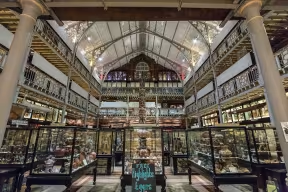
The Pitt Rivers Museum. Credit: Oxford University Images / Ian Wallman

Overview
In 2026, the school was ranked first in the QS World University Subject Rankings for Anthropology for the fourth year.
The research units that make up the school carry out cutting edge, impactful research and its close ties to The Pitt Rivers Museum, one of the world’s great ethnographic collections, allows for unique teaching and learning opportunities. Together the school and its research units take an interdisciplinary and holistic approach to anthropological research and teaching. At its heart, is an ethos of openness and tolerance that guides its work.
The school embraces the expansive nature of anthropological research methods and the need for ‘undisciplined scholarship’ (Rayner) in understanding the manifold complexities of human beings in the world. Its work ranges from global comparative approaches to locally-focused ethnographic studies and includes the study of humans and other primates across deep time and space. Many large, multi- and interdisciplinary programmes at the University of Oxford are led by, or involve, anthropologists, bringing anthropology to bear on pressing global challenges such as migration, global health, decolonising heritage and museums, and the study of the evolutionary and cultural logics of social cohesion.
Home to over forty academic staff, a hundred plus doctoral students, providing both master’s courses and undergraduate degrees, the school is divided into a number of constituent parts:
- The Institute of Social and Cultural Anthropology (ISCA) is a world leading centre for anthropological teaching and research. This is complemented by its close relationship with the Pitt Rivers Museum, one of the world's great ethnographic collections.
- The Institute of Human Sciences (IHS) offers the opportunity for deep engagement across biological and social sciences through their innovative, interdisciplinary degree course and research.
- The Institute for Science, Innovation and Society (InSIS) researches and informs key contemporary and emerging issues and processes of social, scientific and technological change.
- The Centre on Migration, Policy and Society (COMPAS) conducts high quality research, develops theory and facilitates knowledge exchange in the field of migration.
- The Centre for the Study of Social Cohesion (CSSC) conducts research on the causes and consequences of social cohesion – the bonds that hold groups together, from families and gangs to nations and world religions.
Courses offered
The courses shown below are offered at postgraduate-level.
- DPhil in Anthropology (full time and part time)
- MSc in Medical Anthropology (full time)
- MPhil in Medical Anthropology (full time)
- DPhil in Migration Studies (full time and part time)
- MSc in Migration Studies (full time)
- MPhil in Social Anthropology (full time)
- MSc in Social Anthropology (full time)
- MPhil in Visual, Material and Museum Anthropology (full time)
- MSc in Visual, Material and Museum Anthropology (full time)
Social Sciences Division
The Social Sciences Division comprises the largest grouping of social sciences in the UK, home to 14 outstanding departments, tackling some of the major challenges facing humanity in the 21st century.
This video is hosted on YouTube. Please enable video cookies to play it.
Oxford's Social Sciences departments are committed to research that develops a greater understanding of all aspects of our complex society, including cybercrime, economic and political turmoil, environmental change, inequality, legal systems, movement of people and social development.
This research is disseminated through a wide range of innovative graduate courses, many of which are recognised by the UK Research Councils and provide preparation for doctoral work, as well as being discrete programmes of advanced study in their own right; others provide a professional qualification.
The purpose-built Centre for Advanced Studies in the Social Sciences, adjacent to the Faculty of Law houses the Department of Economics, the Department of Politics and International Relations and the Bodleian Social Science Library, providing exceptional facilities for master's and research students. All are rooted in research of international standing and students have access to a well-resourced, active research environment. The division also includes the Saïd Business School and the Blavatnik School of Government.
As one of the major providers of social science research in the UK, the University, in collaboration with Brunel University of London and The Open University, hosts the Grand Union Doctoral Training Partnership, one of fifteen Doctoral Training Partnerships accredited by the Economic and Social Research Council (ESRC) as part of a Doctoral Training Network. ESRC DTP studentships are available in a wide variety of training pathways in the social sciences, for both DPhil and master's-to-DPhil programmes.