Features
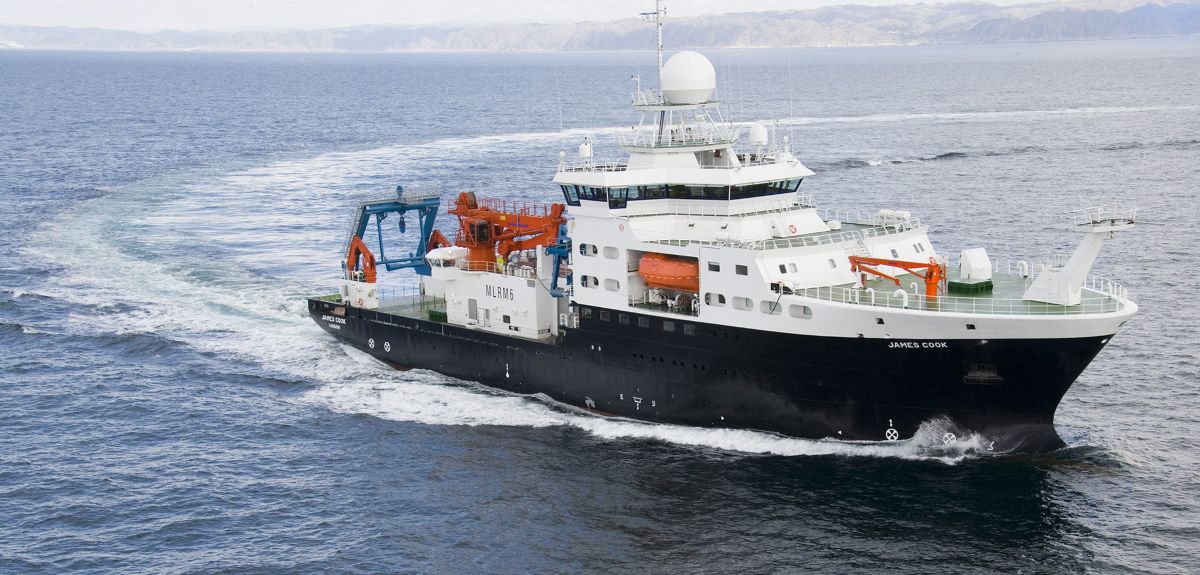
A team from Oxford University has teamed up with colleagues at Plymouth for a six week voyage of discovery around the North Atlantic on UK research ship RRS James Cook.
the James Cook will visit seamounts across the Northeast Atlantic so that the researchers can use a remotely operated vehicle to collect corals, sea urchins and sea cucumbers to try to find out what drives genetic variation across this area at different depths.
The map below shows the latest position of the ship so that you can where the Deep Links team are carrying out their research.
A team from Oxford University has teamed up with colleagues at Plymouth for a six week voyage of discovery around the North Atlantic on UK research ship RRS James Cook, as the Science Blog found out.
Until the fuss around #BoatyMcBoatface, the UK's fleet of Royal Research Ships (RRS) has been little known beyond the scientists who use them and the odd maritime enthusiast. But they are a vital part of understanding our oceans and much in demand.
Very little is known about how well connected deep-sea organisms are over depth and across local, regional and oceanic distances.
Dr Michelle Taylor, Ocean Research and Conservation Group, Department of Zoology
The opportunity to make a sea-going expedition is therefore rare, explains deep sea ecologist Dr Michelle Taylor, one of those leading the 16-strong team, which set sail on 14 May. Amidst final preparations, she notes that the last sea-going expedition her lab undertook was a NERC-funded expedition on the same vessel, the RRS James Cook, to the South West Indian Ocean in 2011.
This year's opportunity may, on the face of it, seem a little less exotic. The Northeast Atlantic is closer to home for starters. But look beneath the surface - literally in this case - and things get more interesting.
The expedition is part of the Deep Links project, as Dr Taylor explains: 'Very little is known about how well connected deep-sea organisms are over depth and across local, regional and oceanic distances. Species populations are connected to each other through both movement of adults – migration – and the movement of eggs, larvae, and juveniles – dispersal. If populations become isolated from one another so they are no longer connected, then through genetic mutation, drift and natural selection, they may become so different that they evolve into new biological species, a process called speciation.
'Understanding how populations become isolated is critical to understanding the process of speciation. In the marine environment, many species, such as corals, do not move as adults or move very slowly, sea urchins for example. This means that for different adult populations to remain connected they rely on dispersal of early life history stages. Most marine species have a larval stage that lives in the water column for a period of time, moving with the currents, before settling in a new area. It is larval dispersal that keeps distant populations connected. So understanding patterns of larval dispersal is important for understanding connectivity.'
The practical upshot of that ambition is that the James Cook will visit seamounts across the Northeast Atlantic so that the researchers can use a remotely operated vehicle to collect corals, sea urchins and sea cucumbers to try to find out what drives genetic variation across this area at different depths.
'Such information is important in defining the size of and specific areas that should be targeted for conservation or closed to destructive activities,' says Dr Taylor.
Even a few years ago that might have been a less pressing question but the move towards more and more use of the sea, especially for deep sea mining, means that we can no longer take for granted that these areas of the ocean will be undisturbed.
'Governments all over the world are setting up networks of Marine Protected Areas (MPAs) to protect against serious ecosystem disturbance. There are many questions to be answered when trying to set up an MPA network, but one important question is where to put them to make sure that the populations that live within them are not isolated from each other but are connected. This research will help answer this question in the deep sea, and so help us ensure the long-term health of the ocean.'
Life on board
The aim is to gather as much information as possible during the six weeks, so every member of the science crew will be on a 12 hour shift, a necessity when undersea surveys can be 18 hours long.
Depending on if you are on days of nights you will wake for breakfast or for the evening meal, which makes for an unusual array of breakfast choices.
Dr Michelle Taylor
Dr Taylor says: 'Depending on if you are on days of nights you will wake for breakfast or for the evening meal, which makes for an unusual array of breakfast choices in addition to the usual cereal options.
'Both shifts will have similar responsibilities. These include watching the live video feeds from the remotely operated vehicle, Isis, recording animal locations as well as selecting which organisms will be sampled and, at the end of the survey, brought back to the surface.
'We therefore also have scientists to sub-sample the organisms on the ship – work that is undertaken in a 4 degree cold room, the temperature of the deep-sea. They record images of the organisms and curate them. There is always a lot of computer based curation too for the images and data from each animal. Taxonomists on board will also be doing a lot of identifications.
'There is lots to do and no day is likely to be the same.'
Once back on dry land, the team will analyse their results and what they have gathered. Overall, Deep Links is a three year project.
You can follow the voyage on the Deep Links website or by using any of the links on the right.
Let me start with a statement of the blindingly obvious: People are fundamental to health services. Design whatever health system you like but you'll still need people to deliver healthcare to those other people - patients. As an example, Oxford University Hospitals Trust has more than 12,000 staff and around one million patient contacts each year.
So when you're designing or redesigning parts of your hospital or drawing up new processes and procedures, it's probably a good idea to take the people into account…
For example, you have two drugs to inject into a patient. One needs to be injected into the spine, the other into a vein. The catch: If you inject the second drug into the spine, it is almost always fatal. The problem: The two drugs look pretty much the same – syringes in clear packaging.
On 4 January 2001, chemotherapy patient Wayne Jowett was injected with two drugs at a hospital in Nottingham. The first, Cytosine, was correctly injected into his spine. The second, Vincristine, should have been injected into a vein. Instead, it was also injected into his spine. Despite the error being identified quickly and rapid emergency treatment, he died on 2 February.
Doctors are designing their work environment all the time, whether they're setting up the operating theatre or selecting tools and equipment.
Dr Lauren Morgan, Kadoorie Centre
Yet, around the world, similar errors had been made before and similar errors have been made since – Vincristine has been injected into a patient's spine more than 120 times since 1968. In almost all cases, the issue is that two syringes look similar.
A few years later, a Loughborough Ergonomics student is being taught about human factors and Vincristine is an example.
'I thought: That's not right,' explains Dr Lauren Morgan.
Now, Dr Morgan is a human factors researcher based within Oxford's Nuffield Department of Surgical Sciences and working in the Oxford University hospitals. I talked to her about her work and started by asking her to explain what's meant when we talk about human factors.
'It's about anything that affects the way humans can do their work,' she says, explaining that it breaks down into five areas – physical environment; tools and technology; organisation and culture; people; and the work they do.
'Doctors are designing their work environment all the time, whether they're setting up the operating theatre or selecting tools and equipment. That is unique to medicine. Then they step up to management where they design organisational processes.'
The use of human factors specialists to advise on these designs is still unusual. Lauren says she knows of three other people doing what she does, but the usefulness of her advice is increasingly recognised.
'Mostly, the Trust asks for training. However, the IT and Medical directors have asked for a redesign of some of the tools and processes of care, and that's really where we can start to make an impact.'
Making the most of the tablets
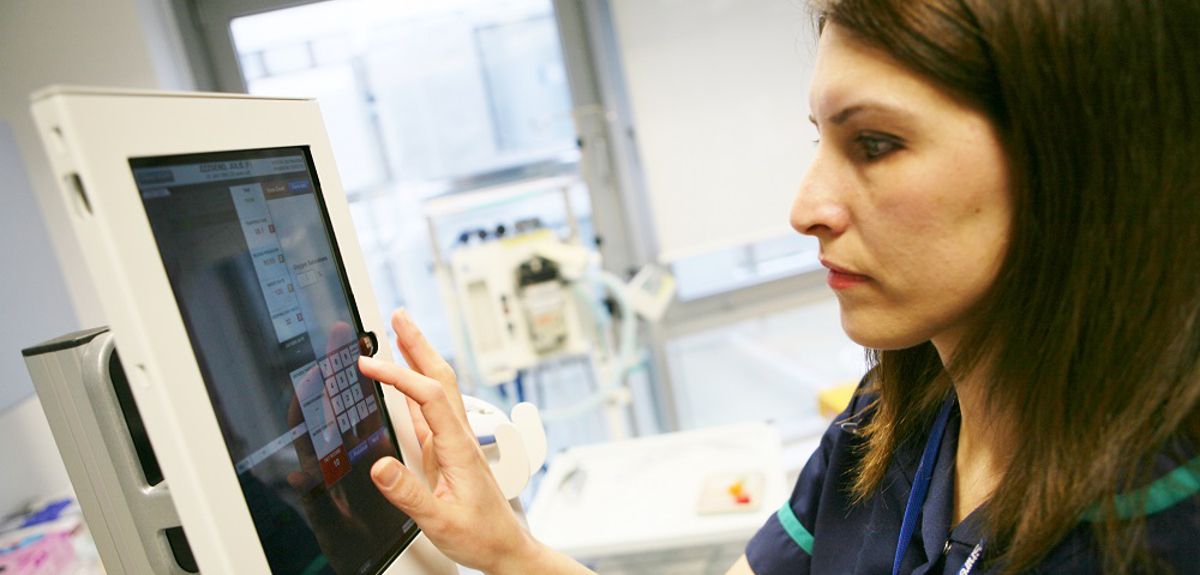
As more technology is introduced, there are opportunities to redesign things better. One project has been SEND – the System for Electronic Notification and Documentation – now rolled out across the four hospitals run by the Oxford University Hospitals Trust. This replaces traditional paper charts with tablet computers that can issue alerts when patient vital signs are too low or high.
People resist human factors when they think you're trying to make them a better human. You're trying to make the interface better, not the people.
Dr Lauren Morgan, Kadoorie Centre
'We began by looking at the enablers and barriers to good practice. So we observed what nurses and medics were doing and asked what of that we needed to save and what needed to go. It's about fitting the task to the human so that the system flows the same way as people do.'
Patient notes were often not with patients, so staff would jot down blood pressure or pulse readings on a piece of paper and then transcribe them to the patient chart later. One issue is that errors can creep in when transcribing – misreading or mis-entering information, or putting it in the wrong file. The other is that if the nurse is called away, the latest figures may not be in the patient record when another medic comes to review it, potentially missing a change that could indicate a problem. A further observation was that not all the necessary equipment was immediately to hand, wasting time as staff hunted for it.
These observations informed the set-up of the SEND system and even the trolley the tablet computer was on. All the equipment is on the trolley and the tablet expects inputs in the same order that the staff work, saving around three minutes per set of observations – and there are dozens of these happening every hour. There is positive identification of the patient by scanning a wristband and immediate entry of the figures into the record. There is also a 'concern' button, which staff can press when their professional instincts say while the readings may seem acceptable, the patient does not look right. This overrides any automatic triggers in the system.
Lauren explains that features like the button are critical: 'People resist human factors when they think you're trying to make them a better human. You're trying to make the interface better, not the people.'
Another project is looking to take the principles in SEND further. HAVEN will issue alerts using algorithms to monitor not just vital signs but blood test results, and even what ward they are on (the alerts for a patient on a cancer ward need to be different to those in neuroscience intensive care). One human factors issue is making sure the system doesn't generate so many alerts that people get 'alarm fatigue' and start to ignore them
Patient interaction
Lauren believes this work could also provide new opportunities for patients: 'Patients have access to their notes, but the paper charts can be quite hard to understand. With an electronic patient record, there's an opportunity to present information in a way that the patient wants.
A lot of patients with long-term conditions are doing their own health monitoring at home and bringing that to appointments. If they can enter that data into the system, perhaps via an app, we could adapt care plans.
Dr Lauren Morgan, Kadoorie Centre
'We could also make things interactive. A lot of patients with long-term conditions are doing their own health monitoring at home and bringing that to appointments. If they can enter that data into the system, perhaps via an app, we could adapt care plans. For example, oncology patients monitor their temperature at home. We could feed that data into the algorithm. One output might be to actively manage appointments: delaying them when things are going well and bringing them forward when the data suggests there may be an issue. People wouldn't have to come in when they didn't need to and we could concentrate care on those who need it most.'
The list of projects goes on – a redesign of neurosurgery referrals to move them online rather over the phone means that they take three minutes rather than thirteen, and all staff can see the entire history of the referral.
Lauren concludes: 'The thing that human factors does is consider all the humans within that system. Clinical staff are obviously one of the human elements, but healthcare is quite unique in that we have these other human elements – the patients – who often get missed when you’re looking at systemic changes within healthcare. That's where human factors can be really useful – to bring their needs and issues and abilities to the fore.'

How is social media affecting our behaviour?
Has the gender of an author influenced whether their work is accepted into the literary ‘canon’?
These are among the questions being explored by four new research networks at Oxford University.
The new networks will bring together researchers from across the Humanities and beyond will come together to discuss topics from the Psalms to social media as The Oxford Research Centre in the Humanities (TORCH) launches four new research networks.
The new networks, #SocialHumanities, Gender and Authority, Rethinking the Contemporary, and the Oxford Psalms Network, will hold talks, workshops, performances and conversations for scholars to share and discuss their findings.
Professor Elleke Boehmer, Professor of World Literature in English and Director of TORCH, said: ‘We are delighted to support these new networks that capture the breadth, liveliness and diversity of research in Oxford.
'Bringing together researchers from a wide range of subjects and career stages, these networks address contemporary concerns, longstanding questions, and pressing new global challenges. The networks’ events are open to all and we encourage you to come along and find out more!’
#SocialHumanities will look at how social media is affecting our language, behaviour and culture. The network will probe the value of social media to society, and what the risks and dangers might be.
Yin Yin Lu, who is studying for a DPhil in Information, Communication and the Social Sciences, said: 'Social media research is exploding.
'Data generated by platforms like Twitter, Facebook, and YouTube have become the substance of academic inquiry, because they reveal much about social processes and human behaviour.'
The Gender and Authority project will look at the literary “canon”. Through public seminars, researchers will explore how gender influences whose work comes to be considered “classic literature”, and whose work is marginalised.
It will look at how we determine the quality and authority of works of art, and which assumptions might distort our view.
Rethinking the Contemporary will investigate the major forces at work in the world since the 1980s, from the changing role of religion to the transformative effects of the internet.
David Priestland, Professor of Modern History, said: 'Of course, a great deal of work is being done on the contemporary world, especially in the social sciences, but many scholars in the humanities are also interested in these issues, and we wanted to create a forum to link them together.'
The Oxford Psalms Network will examine the impact of the Psalms from the earliest times to the present day, looking at how the Psalms have been translated and reinterpreted in different cultures and settings, and how they have influenced culture and identity in Christianity, Judaism and other world religions.
TORCH is an interdisciplinary research centre which promotes collaboration between Oxford humanities researchers and other disciplines, institutions and external partners.
For more information on these networks, and the other networks in TORCH, click here.
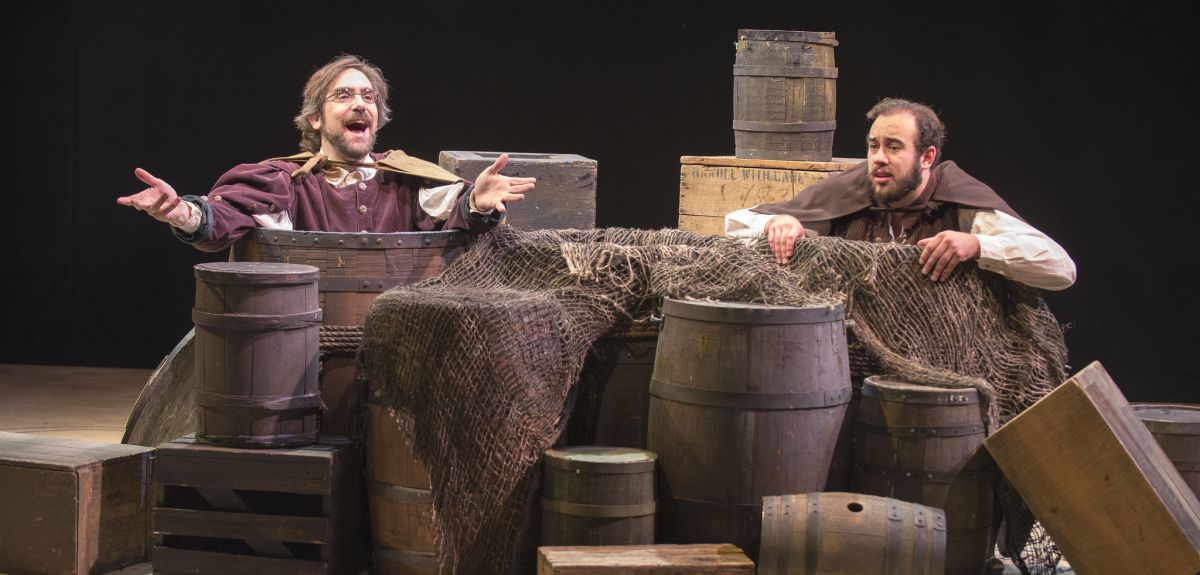
This academic term will be a busy one for the Humanitas Visiting Professorship programme.
Novelist and historian Dame Marina Warner will give her inaugural lecture as Visiting Professor in Comparative European Literature tomorrow (27 April). This will be the first in a series of talks by her called ‘The Sanctuary of Stories’.
From 9 May, historian and television presenter Simon Schama will give a public lecture and take part in a round table discussion with Craig Clunas and Margaret Macmillan on the past and its publics. He is Visiting Professor for Historiography.
He will be taking part in an in conversation with Craig Clunas and Margaret Macmillan on the 11 May.
Award-winning playwright Tom Stoppard is this year’s Visiting Professor of Drama Studies. He will give a public lecture on 18 May and a Q&A on 19 May.
Then on 25 May and 26 May respectively, renowned guitarists the Assad Brothers will give a talk and a recital as Visiting Professors for Classical Music.
Oxford University’s Professor Sos Eltis, the Academic Director for the Humanitas Visiting Professorship in Drama, says of Professor Stoppard’s visit: ‘Tom Stoppard is one of the greatest modern playwrights. He has delighted audiences worldwide with the wit, daring, wisdom, dazzling intellectual challenge and sheer theatrical fun of his plays.
‘He has pushed the boundaries of dramatic form and reinvented the play of ideas. These events will be a wonderful opportunity for schools, university students and anyone interested in theatre to hear an extraordinary writer offer new perspectives on his life and work.'
Professor Elleke Boehmer, director of TORCH, adds: 'We are thrilled to bring some of the world’s most inspiring thinkers and creative minds to Oxford for a richly diverse programme of workshops, talks and performances.
'This term we will be joined by leading figures from the spheres of theatre, history and music, including award winning playwright Tom Stoppard, world renowned historian Simon Schama and gifted guitarists Sérgio and Odair Assad. Exploring issues as wide ranging as public history and theatre making, the events are a rare opportunity for public audiences to join leading speakers for debate and discussion.’
Humanitas is a series of Visiting Professorships at the Universities of Oxford and Cambridge intended to bring leading practitioners and scholars to both universities to address major themes in the arts, social sciences and humanities.
Created by Lord Weidenfeld, the Programme is managed and funded by the Weidenfeld-Hoffmann Trust with the support of a series of generous benefactors and administered by TORCH | The Oxford Research Centre in the Humanities.
The events are free and open to all. For more information, including booking details, visit the TORCH website.
The website also includes a more detailed summary of the dates and content of each Visiting Professor’s visit.
- ‹ previous
- 127 of 253
- next ›
 25-year Oxford study finds the effects of conflict last for generations
 What Louise Thompson’s campaign tells us about the national maternity crisis
 Celebrating 25 Years of Clarendon
  Learning for peace: global governance education at Oxford
  What US intervention could mean for displaced Venezuelans
  Setting the agenda for the next century of quantum
 10 years on: The Oxford learning centre making an impact
 Mapping the Moon: the world’s first lunar atlas goes digital
  Oxford and The Brilliant Club: inspiring the next generation of scholars
 New course launched for the next generation of creative translators