Features
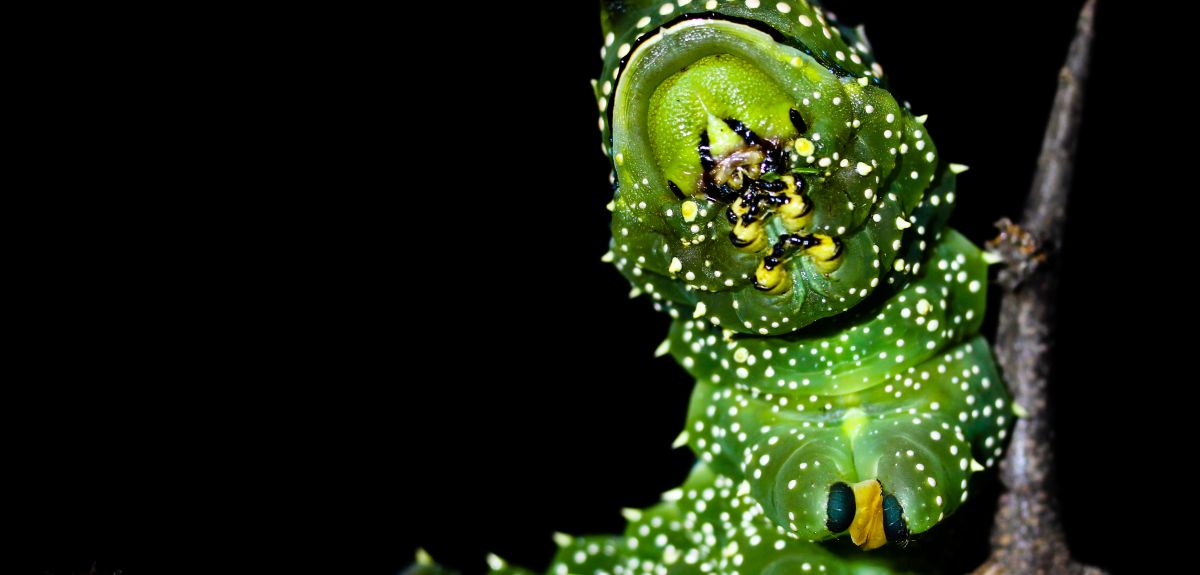
A conservation DPhil student at Oxford University has won the student section of the 2016 British Ecological Society Photographic Competition.
Leejiah Dorward's winning picture, You are old, Father William, features a reflectively spotty Gynanisa minettii caterpillar emerging from a thorny bush in Tanzania.
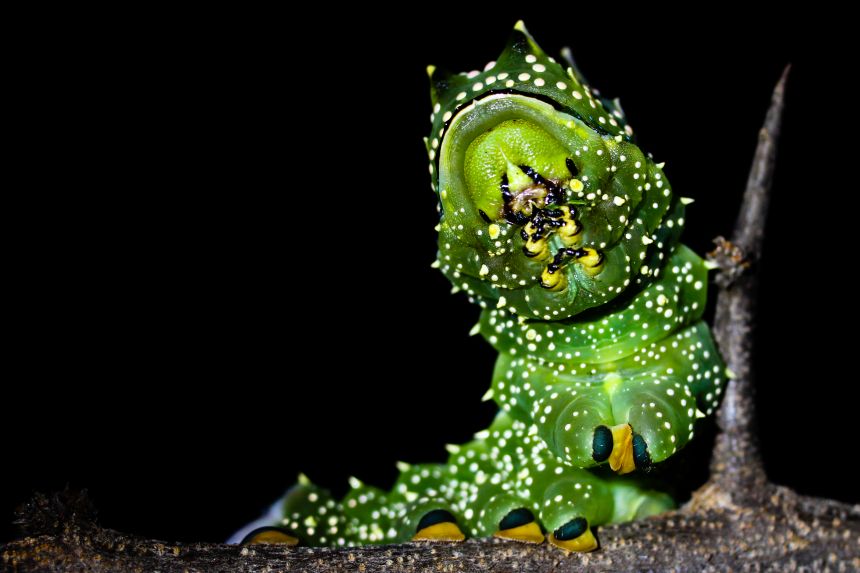 A reflectively spotty Gynanisa minettii caterpillar emerges from a bush in Tanzania.
Image credit: Leejiah Dorward
Leejiah is a DPhil student in Oxford's Department of Zoology conducting research into human-wildlife conflict in Tanzania. His research tries to understand some of the factors that contribute to conflict between large carnivores and pastoralists – for instance, understanding in which seasons and habitat types livestock are most at risk of being attacked by lions or hyenas.
He said: 'This picture was taken at my field site around Ruaha National Park in Tanzania. I frequently search for animals around my camp at night, as there are a number of slightly more unusual creatures that are more active and visible at night. This moth caterpillar's almost reflective skin was hard to miss under torchlight, and it obliged me with some interesting poses while I photographed it.
'I enjoy using photography to share aspects of the natural world that I find beautiful or unusual, so it's great to have a picture recognised by the British Ecological Society. Hopefully, along with the other photographs, my photography will help in some small way by inspiring interest in the natural world and action to help conserve it.'

Since late 2015, an epidemic of yellow fever in the central African countries of Angola and the Democratic Republic of Congo (DR Congo) has affected more than 7,000 people, causing almost 400 deaths.
An international team of researchers led by epidemiologists at Oxford University and Institut Pasteur has sought to better understand the spread of this outbreak, with the aim of making more efficient use of the limited vaccine stocks available.
First author Moritz Kraemer, of Oxford's Department of Zoology, told Science Blog about the study, which is published in The Lancet Infectious Diseases:
'Yellow fever is a haemorrhagic fever transmitted between humans by the Aedes aegypti mosquito, and for a long time it was one of the most feared lethal diseases. In about 15-25% of people infected, it causes severe symptoms that can lead to death. Fortunately, there is a single dose vaccine to protect people for the rest of their lives.
'We analysed datasets describing the epidemic during a large urban yellow fever outbreak in Angola and DR Congo in combination with mosquito-ecological and demographic information. Our aim was to predict the invasion of yellow fever in the region during this outbreak and test whether we could predict where it would arrive next. This was done in light of a shortage in vaccine stock that became apparent during this outbreak in central Africa.
'Early invasion was positively correlated with high population density. The further away locations were from Luanda, the capital of Angola, the later the date of invasion. A model that captured human mobility and vector suitability successfully discriminated districts with high risk of invasion from others at lower risk. If, at the start of the epidemic, sufficient vaccines had been available to target 50 out of 313 districts in the area, our model would have correctly identified 27 (84%) of the 32 districts that were eventually affected. We found that by using a simple statistical model, we could identify locations at highest risk of yellow fever cases.
'From our analysis, we anticipate that the spread of the virus was the result of two factors. One of these was the increased travel between districts – especially large urban centres such as Luanda and Kinshasa, the capital cities of Angola and DR Congo respectively. Such big urban centres are hubs for mosquito activity, and the density of living contributes to the high risk of being infected. In addition, the low levels of vaccination against the virus may have contributed to the successful arrival of the virus in new regions where it had been absent previously.
'The research and model applied here is applicable for a range of diseases, including those rapidly expanding, such as Zika or Ebola. Predicting where the next location may be is important for public health policy makers to decide where to target their resources.
'The continental expansion of Zika in the Americas has shown how quickly new viruses can expand, especially in locations where they have been absent previously. Zika, for example, is also transmitted through the Aedes aegypti mosquito, the same insect that transmits yellow fever. However, in our research we point towards the importance of human demography as a main driver of spread and highlight the possibility that this research could be readily implemented in the context of other vector-borne diseases.'

A gallery of potraits of great Oxford classicists has been installed at the University's Ioannou Centre for Classical and Byzantine Studies.
The portraits, which include Dame Averil Cameron, Gilbert Murray, Anna Morpugo Davies and Sir Fergus Millar, can now be viewed by members of the public in the building on St Giles' in Oxford.
There are images of 32 classicists in total - 28 are photographs and four are oil paintings.
‘These portraits, along with the current exhibition of the Garima Gospels, are part of our aim to brighten up the Classics Faculty’s building and invite people in to look around,’ says Mai Musié of the Classics Faculty.
‘The gallery not only provides a history of Classics at Oxford, but it also celebrates the contributions of many female classical scholars whose work has often not been fully recognised outside their areas of specialism,’ says Professor Fiona Macintosh, Curator of the Ioannou Centre.

A new role has been discovered for a well-known piece of cellular machinery, which could revolutionise the way we understand how tissue is constructed and remodelled within the body.
Lysosomes are small, enzyme-filled sacks found within cells, which break down old cell components and unwanted molecules.
Their potent mixture of destructive enzymes also makes them important in protecting cells against pathogens such as viruses by degrading cell intruders.
However, new research from the University of Oxford has revealed that in addition to breaking down cellular components, lysosomes are also important in building cellular structures.
‘We’ve traditionally viewed lysosomes as the cell ‘dustbin', because everything that goes into them gets chewed up by enzymes,’ said Professor Nigel Emptage from the University’s Department of Pharmacology, who led the research. ‘However, our research has revealed that lysosomes actually play a far more elaborate role, being involved in building as well as demolition, and playing a key part in structural remodelling of cells.'
The discovery was made while the team was looking at hippocampal pyramidal neurones – specialist brain cells important in spatial navigation and memory, which degenerate in Alzheimer's disease. The researchers observed that lysosomes were involved in supporting the growth of spines from dendrites, structures that increase the cell’s ability to store and process large amounts of information.
He added: ‘This discovery fundamentally changes how we view this well-known organelle, as it appears that without them new memory could not be stored in the brain. There has been a growing body of evidence for some time that lysosomes have other functions in addition to their traditional role, but it appears that they are also important in cellular construction.’
The full paper, ‘Activity-Dependent Exocytosis of Lysosomes Regulates the Structural Plasticity of Dendritic Spines’ can be read in the journal Neuron.
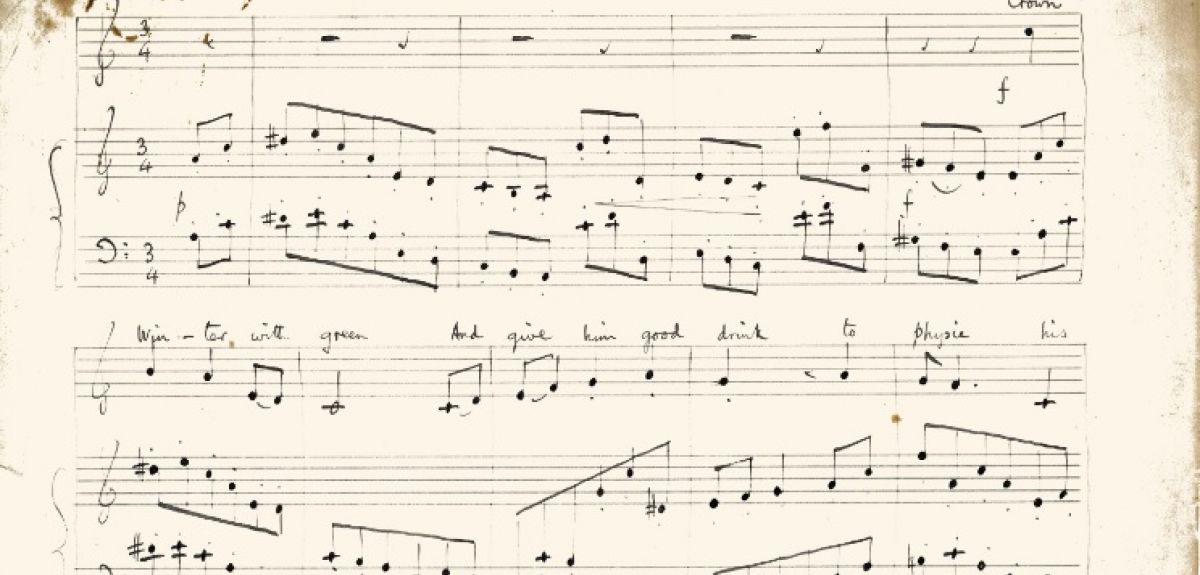
A long-lost song by English composer George Butterworth has been rediscovered at the University of Oxford’s Bodleian Libraries, a century after his death in the trenches.
The three-page score is a musical setting of a short festive poem by Robert Bridges, beginning with the words Crown winter with green. It is believed to be the only surviving copy of this Butterworth composition.
It was found among a group of uncatalogued music manuscripts which were transferred from the library in Oxford University's Music Faculty to the Bodleian's Weston Library.
The festive find is particularly special because the body of Butterworth’s surviving work is relatively small. Butterworth (1885-1916) was one of the most promising English composers of his generation, but his life was cut short when, at the age of 31, he was killed at the Battle of the Somme in World War I.
Before going off to war he destroyed all of his music which he thought not worthy of preserving. His few surviving works, which include his song settings of AE Housman’s poems from A Shropshire Lad and an orchestral idyll The Banks of Green Willow, are considered masterpieces.
The newly-discovered song has three verses and the lyrics speak of Christmas cheer. It begins with the words ‘Crown winter with green, And give him good drink To physic his spleen …’ and ends with the lines ‘And merry be we This good Yuletide.’ Butterworth’s later music often drew inspiration from English folk music and traditions. He wrote the musical setting for this poem in the style of a drinking song, for voice and piano.
It is not known how the manuscript came to be in the Bodleian Libraries. One possibility is that Butterworth’s father, Sir Alexander Kaye Butterworth, may have passed it on to Sir Hugh Allen, who was a great friend of the composer from his days as an undergraduate at the University of Oxford. Allen was Heather Professor of Music at Oxford from 1918 until his death in 1946, after which his collection of books and music was incorporated into the University’s Music Faculty Library, which is now part of the Bodleian Libraries. It is possible that the song was among these papers but its significance was not noticed at the time.
‘The song’s musical and technical shortcomings suggest that it is probably one of Butterworth’s earlier pieces, possibly dating from his school or student days, which would have been in the early years of the 20th century,’ said Martin Holmes, Alfred Brendel Curator of Music, who rediscovered the manuscript at the Bodleian.
‘As a song, Crown winter with green may not be a masterpiece, in the way that Butterworth’s later Housman songs undoubtedly are, but it can perhaps be seen as a small step on the path towards his musical maturity.'
The manuscript score of Butterworth’s Crown Winter with Green will be on public display in the Bodleian’s Weston Library from Wednesday 14 December to Sunday 18 December, 10am – 5pm (11am-5pm on Sunday). The display will be accompanied by a listening post where visitors can hear a recording of the song.
- ‹ previous
- 107 of 252
- next ›
 Learning for peace: global governance education at Oxford
  What US intervention could mean for displaced Venezuelans
  Setting the agenda for the next century of quantum
 10 years on: The Oxford learning centre making an impact
 Mapping the Moon: the world’s first lunar atlas goes digital
  Oxford and The Brilliant Club: inspiring the next generation of scholars
 New course launched for the next generation of creative translators
 The art of translation – raising the profile of languages in schools
  Opening a window into the quantum world
 Tracking resistance: Mapping the spread of drug-resistant malaria