Features

From the 'Red List' of threatened species to reports of indigenous people suffering from the loss of their natural resources, we are constantly faced with upsetting news about conservation.
But while the issues facing the planet are serious and urgent, a new summit being organised by the University of Oxford is aiming to highlight the positive work being done in conservation: the new government initiatives, the success stories at local level, and the optimism we can feel about the future.
The Conservation Optimism Summit, to be held next year from 20-22 April, will bring together people from the worlds of conservation, government, industry, NGOs and academia to highlight ways in which we can celebrate successes and get behind a new, positive way of thinking about conservation.
The summit, which is a joint venture with the Zoological Society of London (ZSL), will culminate on Earth Day 2017 with an outreach event open to the wider public.
Professor EJ Milner-Gulland, Tasso Leventis Professor of Biodiversity in Oxford's Department of Zoology, and Director of Oxford's Interdisciplinary Centre for Conservation Science (ICCS), is one of the figures spearheading the event. She says: 'In broad terms, we are trying to effect a change in the way people think about conservation. There's lots of bad news out there, and it can give the impression that the field is all doom and gloom.
'But it's not like that, and what we need to do is change that mindset so that we can continue to attract talented young people into conservation, as well as engaging the public with important topics like biodiversity and ensuring we can influence policy makers to help address the most urgent problems facing the planet.'
Professor Milner-Gulland highlights initiatives such as #OceanOptimism, which was launched two years ago and is spreading the word about ocean conservation successes via social media.
She says: 'Nobody is underestimating the task that faces us in terms of conservation. The massive loss of global biodiversity – much of it caused by human activity – is very clearly expressed in things like the IUCN Red List and the Living Planet Index, and this has a huge knock-on effect on the livelihoods of people around the world.
'But we also have to realise that things are moving forward productively – from smaller successes at local level to things we can be proud of at government and international level, such as the establishment of marine protected areas.'
Jonathan Baillie, Conservation Programmes Director at ZSL, says: 'No matter how you dress it up, the human impact on the environment has been devastating. Not surprisingly, the conservation movement has traditionally had negative messaging focusing on the threats and overwhelming challenges. However, this is not the way to inspire change. We need to create a positive vision for the future, focus on solutions and inspire society to take action. We need to celebrate success, identify what is working and bring it to scale.'
The summit has already attracted a high-profile supporter in the form of chef, television personality and environmental campaigner Hugh Fearnley-Whittingstall, who says: 'I'm lucky enough to have the medium of television to discuss and investigate environmental issues that I think are important. One thing I've learned is how important it is to present positive solutions and to keep hope alive, as well as educating audiences about the problems facing the world.
'I've met so many people doing fantastic work to protect and restore our natural world. We should be sharing these inspiring stories far and wide, rather than always getting bogged down in doom and gloom. I’m therefore delighted to support the Conservation Optimism initiative and its partners in their mission to spread a new wave of positivity throughout the environmental community.'
The event will partner with the Global Earth Optimism Summit, coordinated by the Smithsonian Institute, and will touch on a number of themes: why we need to be optimistic; how we can celebrate successes; how we can learn from those successes (and from failures); and how we can scale up good ideas to help tackle the world’s major conservation challenges.
Professor Milner-Gulland adds: 'We're also trying to engage the arts in a way that doesn’t usually happen in conservation science. By thinking more creatively about optimism and conservation, we hope to be able to engage people with the subject in greater numbers.
'Our response to pressing conservation issues has thus far been half-hearted. We want to form a big, global movement to help change people's attitudes towards conservation.'
The first two days of the Conservation Optimism Summit will be held at Dulwich College, London, with the third hosted by the Zoological Society of London.

Is the Weston Library one of your favourite buildings? What about the Blavatnik School of Government?
If so, they need your help. The BBC has launched a public poll to find the nation’s favourite building out of those shortlisted for the RIBA Stirling Prize.
An unprecedented two Oxford University buildings have been shortlisted for this year’s prize, which will be announced on Thursday 6 October. You have tomorrow and Wednesday to make your mind up, because the BBC’s online poll will close at midnight on Wednesday 5 October.
The BBC has also produced stunning short films of both buildings for its Stirling Prize pages.
Although the world’s media is currently occupied with the US presidential debates, we are not going to make pitches on behalf of the Blavatnik or the Weston. Instead, Arts Blog has decided to let these two buildings speak for themselves.
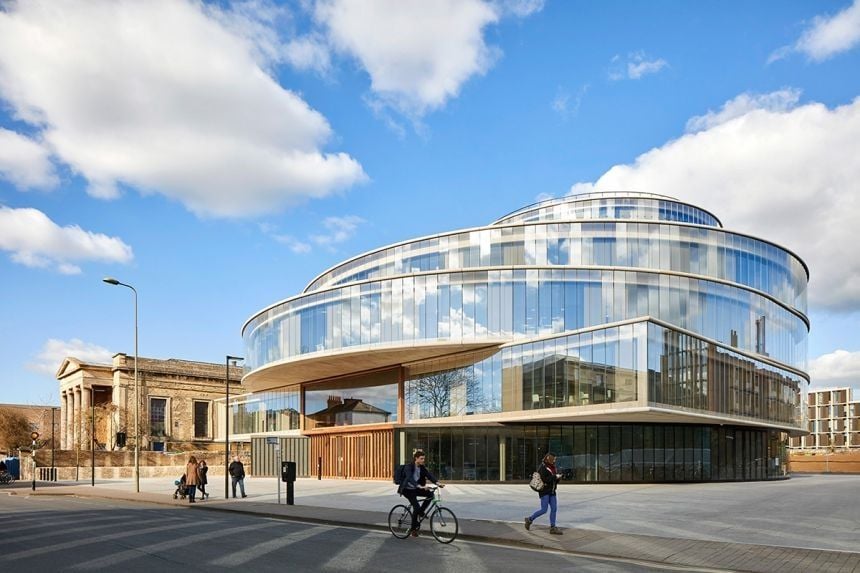 The Blavatnik School of Government
Hufton Crow
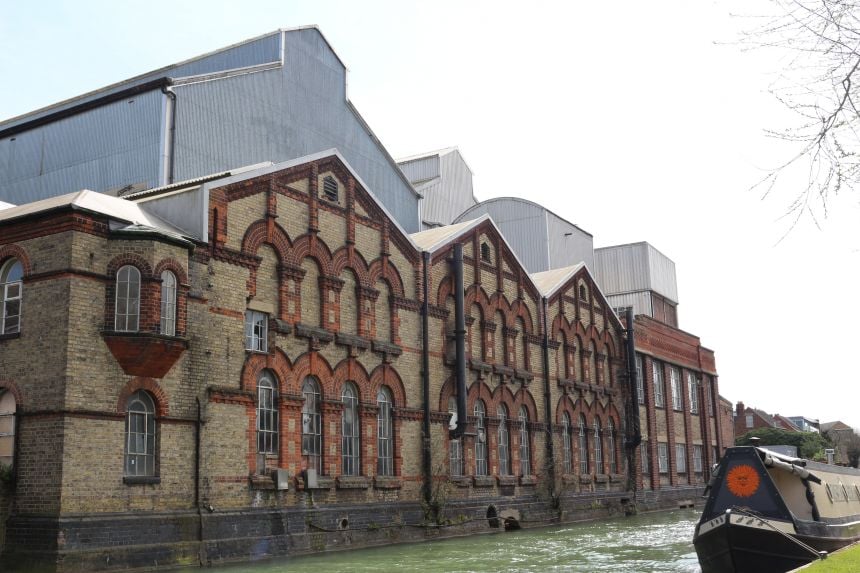 James Brittain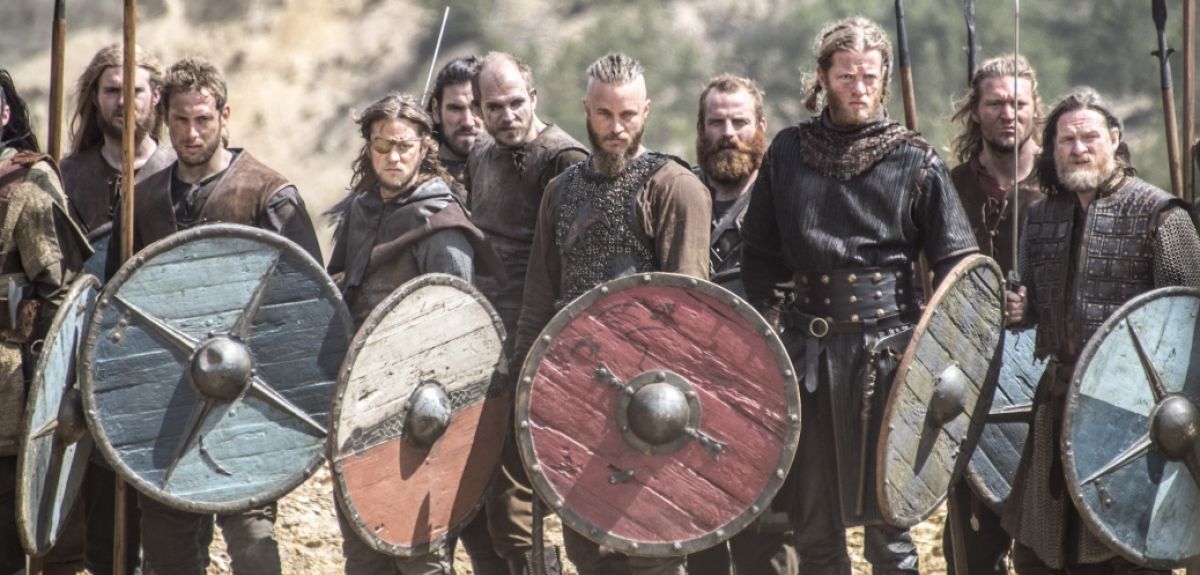
A new character in the popular TV series Vikings has been inspired by an Oxford University historian’s research.
Michael Hirst, creator of Vikings, read The Silk Roads by Dr Peter Frankopan, Director of the Oxford Centre for Byzantine Research at the University of Oxford. He was inspired by the book to create a new character called Astrid, who will appear in the fifth series of the drama which is watched by millions in the USA and Canada.
‘Talk about academic impact!’, says Dr Frankopan. ‘There is nothing more exciting as a historian to know that things you’ve written are being read far and wide – and completely thrilling when they have are brought in to mainstream media.’
In The Silk Roads: A New History of the World, Dr Frankopan showed the importance of the east and the role it had in shaping modern Europe. It was a bestselling book, praised for shifting the centre of world history to the east.
He says: ‘It is rather wonderful that Astrid, the new character who has been introduced in part thanks to Silk Roads, is going to show off some of the main themes of my book: the way the world is connected; the extent of cultural and commercial exchange across the spine of Asia; the sophistication of the east – and the role it had in shaping Europe.
‘What used to be called ‘The Dark Ages’ in the west were nothing of the sort elsewhere. I’m so excited Michael Hirst is going to incorporate this.’
‘I think it’s terrific that TV series like Vikings work so hard to be accurate,’ he says. ‘I’ve been contacted in the past by those involved in the series to ensure that lines in Arabic and Berber are correct, so I am not surprised that those behind the show are on top of the latest scholarship in the field.’
Mr Hirst, who created the TV series, said in an interview with Entertainment Weekly: ‘I’ve read this great book, called “The Silk Road,” which was showing that in the Dark Ages, it might have been the Dark Ages to the western culture, but to the east, there was trade, cultural exchange. The Vikings were on Silk Road. So a character like Astrid, who appears to be slightly more modern? She is more modern.’
Vikings is screened by the HISTORY channel and it was renewed for a fifth series in March.
The Silk Roads is published by Bloomsbury Publishing.
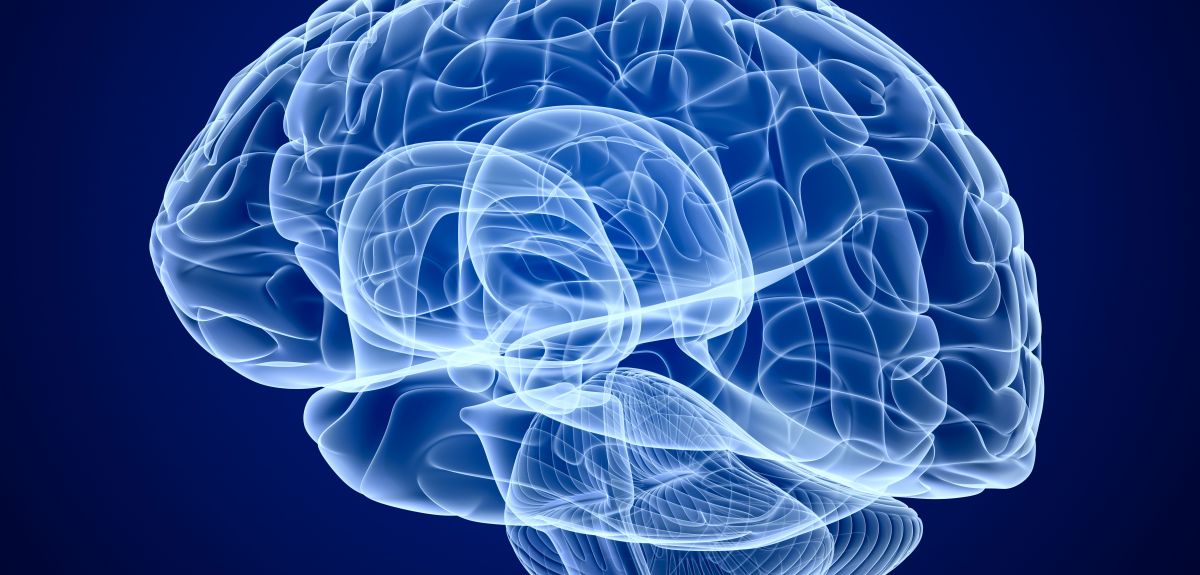
It might sound alarmingly similar to the prehistoric procedure of trepanning, but decompressive craniectomy – the removal of a large part of the skull to reduce swelling in the brain – is still used as a last-resort treatment for traumatic brain injury or stroke by surgeons around the world.
Perhaps unsurprisingly, the complication rate of this major operation is high. As the brain 'mushrooms' out of the skull following the removal of bone from the skull, stresses and stretches placed on other parts of the brain can lead to neuronal damage and potential long-term disability.
But this is no longer just a challenge for neurosurgeons. Mathematicians are now able to study and model the impact of surgery at organ level, developing a more specific picture across the whole brain. Professor Alain Goriely of Oxford Mathematics and Stanford colleagues Professor Ellen Kuhl and Dr Johannes Weickenmeier have looked at the issue by studying a standard physical problem: the problem of bulging in soft solids.
Bulging takes place when a material swells while constrained – except at an opening, as seen when the skull is opened during decompressive craniectomy and the brain bulges out of the newly created hole. This can create deformations in another part of the brain, away from the immediate incision.
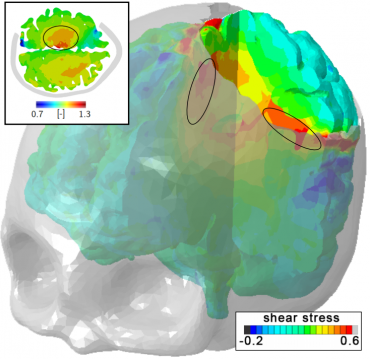 Researchers used high-resolution magnetic resonance imaging to create craniectomy models.
Image credit: Alain Goriely
To quantify possible deformations inside the brain, the team created a personalised craniectomy model from high-resolution medical resonance imaging. Their study reveals three mechanisms of failure that could denote damage beyond the initial incision point: axonal stretch in the centre of the bulge (axons are nerve fibres that carry impulses away from nerve cells), axonal compression at the edge of the craniectomy, and axonal shear around the opening. Strikingly, even small amounts of swelling can induce axonal strain in excess of 30% above reported damage thresholds in patients.
Professor Goriely said: 'This research points towards a possible way of proving and identifying long-term damage to the brain following decompressive craniectomy. Indeed, this theoretical study is a first step towards gaining better insight into the complex mechanisms underlying craniectomy and opens the door for systematic personalised studies of craniectomy in patients. The next step is to combine this theoretical work with experimental and clinical work to enable surgeons to provide better-informed and more successful treatments.'

Today is international languages day. But in the UK, modern languages is “at a crossroads”, according to an Oxford University professor. Katrin Kohl, professor of German Literature, says the perception of languages in schools and society is suffering.
Today, she and her fellow researchers have launched a major four-year research programme to investigate the interconnection between linguistic diversity and creativity. The project, called Creative Multilingualism, will explore how being able to speak more than one language can make us more creative. There is much more information about the planned research on the project’s website.
Professor Kohl tells Arts Blog a bit more about the project:
"Modern Languages is at a crossroads, and an ambitious research project will seek to give new impetus to the subject by putting creativity at the heart of it. This runs counter to the way languages are currently perceived, both in schools and in society – as a subject that consists merely of a bundle of practical skills. Research on Creative Multilingualism is designed to open up and showcase the cultural and cognitive riches associated with linguistic diversity, in order to reinvigorate the subject across the educational and academic spectrum and in society.
The researchers will be working on projects that are designed to investigate the creative roots of Modern Languages in the humanities, and explore the role of creativity in the interdisciplinary reach of languages as the communicative medium that characterises us as human beings.
In schools, Modern Foreign Languages has been suffering attrition for years, with the Government’s decision in 2004 to make inclusion of a language at GCSE optional leading to a significant and ongoing drop in take-up and in progression to A level. Together with league table pressures and the complexity and teaching-intensive nature of the subject, this has impacted negatively on Modern Foreign Languages departments in schools, and in turn caused some fifty university departments to close.
The falling number of Modern Languages graduates has contributed to an intensifying teacher shortage, with Brexit uncertainties now impeding recruitment from France, Spain and Germany. These factors have contributed to an unprecedented crisis in the subject, with a danger of meltdown especially in the state sector.
But we also need to ask ourselves why children and young people have been voting with their feet, and what’s been happening with the subject itself. We need go no further than the A level syllabus in force until this summer to find that the subject has been drained of academic substance. It restricts assessment to the ‘four skills’ of speaking, listening, reading and writing while reducing cultural content to a ‘carrier’ of language that is not assessed. This is like calling an A level subject “Maths” when actually it only consists of Applied Maths.
Moreover, at a time when the rise of global English has reduced the incentive to learn languages for native speakers of English, it has restricted the subject to its driest parts, with too few lessons per week to ensure sufficiently swift progress to sustain motivation. This reductive development has also opened up a gulf between Modern Foreign Languages in schools, and Modern Languages as they’re taught and researched in the humanities sections of Russell Group universities.
The Arts and Humanities Research Council is now investing an unprecedented £20 million into multi-institutional and interdisciplinary research as part of its Open World Research Initiative. This is designed to transform and invigorate Modern Languages research, and incentivise academics to work with partners that can help to raise the status of languages across UK society.
Four major collaborative research programmes led by Cambridge, King’s College London, Manchester and Oxford are being funded over the next four years to build a stronger and more vibrant identity for the subject, and to open up Languages to include ‘lesser taught’ ones in schools such as Mandarin and Arabic, and encourage cooperation between university departments in (European) Modern Languages and departments that teach Asian and African languages.
The Oxford-led programme entitled Creative Multilingualism includes researchers from Birmingham City University, Cambridge, Reading, SOAS, Pittsburgh, and the University of California, Santa Barbara. Together they have expertise in over 40 languages, which they will draw on as they conduct their research on the interaction and interdependence of linguistic diversity and creativity. They will be focusing on different aspects of language, ranging from the relationship between language and thought through to the interaction between languages in literary texts and theatrical performances.
A project on translation will investigate how moving from one language to another not only results in a transposed text, but also opens up new dimensions of meaning that lay hidden in the original. An empirical study conducted in UK classrooms will compare learning outcomes between functionally oriented tasks and tasks involving linguistic creativity.
A vital part of Creative Multilingualism is its work with partners including the British Council, the Association for Language Learning, English PEN, GCHQ, Business in the Community and a wide range of schools. In conferences, workshops, a Multilingual Music Fest, after-school clubs, a Linguamania event in January 2017 and a Road Show planned for 2019, participants of the programme will collaborate to showcase and explore linguistic creativity, make the value of community languages more visible, and give a more imaginative dimension to career choices involving languages.
Above all, they will seek to generate enthusiasm for the value of languages as a fascinatingly diverse medium of communication that allows us to express our cultural identities creatively, individually, and in original ways."
- ‹ previous
- 118 of 253
- next ›
 Celebrating 25 Years of Clarendon
  Learning for peace: global governance education at Oxford
  What US intervention could mean for displaced Venezuelans
  Setting the agenda for the next century of quantum
 10 years on: The Oxford learning centre making an impact
 Mapping the Moon: the world’s first lunar atlas goes digital
  Oxford and The Brilliant Club: inspiring the next generation of scholars
 New course launched for the next generation of creative translators
 The art of translation – raising the profile of languages in schools
  Opening a window into the quantum world