Features
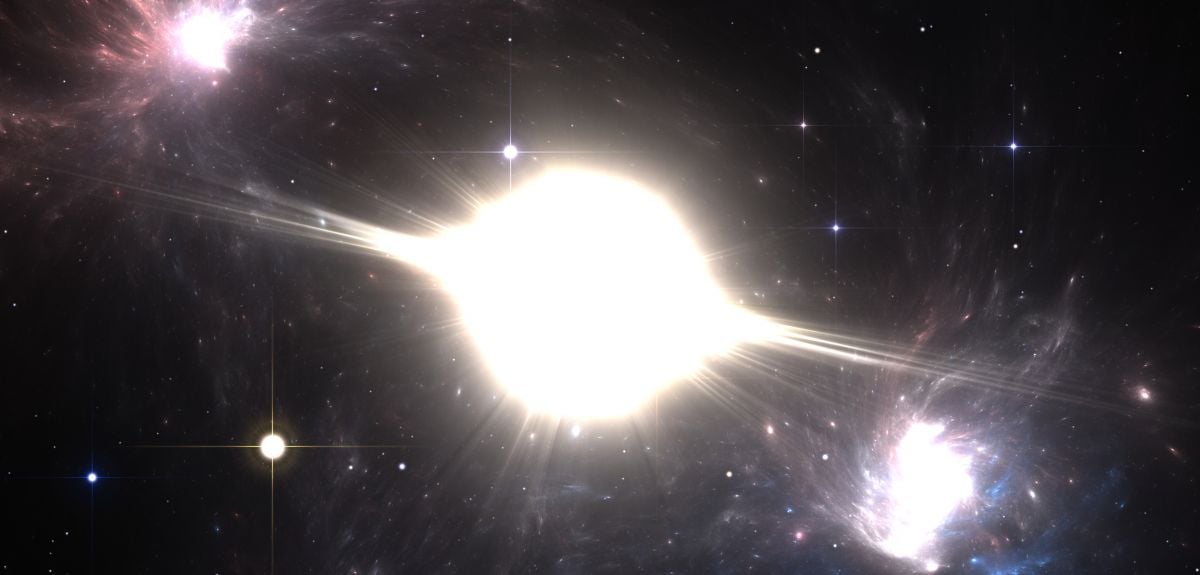
Five years ago, the Nobel Prize in Physics was awarded to three astronomers for their discovery, in the late 1990s, that the universe is expanding at an accelerating pace.
Their conclusions were based on analysis of Type Ia supernovae – the spectacular thermonuclear explosions of dying stars – picked up by the Hubble space telescope and large ground-based telescopes. It led to the widespread acceptance of the idea that the universe is dominated by a mysterious substance named 'dark energy' that drives this accelerating expansion.
Now, a team of scientists led by Professor Subir Sarkar of Oxford University's Department of Physics has cast doubt on this standard cosmological concept. Making use of a vastly increased data set – a catalogue of 740 Type Ia supernovae, more than ten times the original sample size – the researchers have found that the evidence for acceleration may be flimsier than previously thought, with the data being consistent with a constant rate of expansion.
The study is published in the Nature journal Scientific Reports.
Professor Sarkar, who also holds a position at the Niels Bohr Institute in Copenhagen, said: 'The discovery of the accelerating expansion of the universe won the Nobel Prize, the Gruber Cosmology Prize, and the Breakthrough Prize in Fundamental Physics. It led to the widespread acceptance of the idea that the universe is dominated by "dark energy" that behaves like a cosmological constant – this is now the "standard model" of cosmology.
'However, there now exists a much bigger database of supernovae on which to perform rigorous and detailed statistical analyses. We analysed the latest catalogue of 740 Type Ia supernovae – over ten times bigger than the original samples on which the discovery claim was based – and found that the evidence for accelerated expansion is, at most, what physicists call "3 sigma". This is far short of the 5 sigma standard required to claim a discovery of fundamental significance.
'An analogous example in this context would be the recent suggestion for a new particle weighing 750 GeV based on data from the Large Hadron Collider at CERN. It initially had even higher significance – 3.9 and 3.4 sigma in December last year – and stimulated over 500 theoretical papers. However, it was announced in August that new data shows that the significance has dropped to less than 1 sigma. It was just a statistical fluctuation, and there is no such particle.'
There is other data available that appears to support the idea of an accelerating universe, such as information on the cosmic microwave background – the faint afterglow of the Big Bang – from the Planck satellite. However, Professor Sarkar said: 'All of these tests are indirect, carried out in the framework of an assumed model, and the cosmic microwave background is not directly affected by dark energy. Actually, there is indeed a subtle effect, the late-integrated Sachs-Wolfe effect, but this has not been convincingly detected.
'So it is quite possible that we are being misled and that the apparent manifestation of dark energy is a consequence of analysing the data in an oversimplified theoretical model – one that was in fact constructed in the 1930s, long before there was any real data. A more sophisticated theoretical framework accounting for the observation that the universe is not exactly homogeneous and that its matter content may not behave as an ideal gas – two key assumptions of standard cosmology – may well be able to account for all observations without requiring dark energy. Indeed, vacuum energy is something of which we have absolutely no understanding in fundamental theory.'
Professor Sarkar added: 'Naturally, a lot of work will be necessary to convince the physics community of this, but our work serves to demonstrate that a key pillar of the standard cosmological model is rather shaky. Hopefully this will motivate better analyses of cosmological data, as well as inspiring theorists to investigate more nuanced cosmological models. Significant progress will be made when the European Extremely Large Telescope makes observations with an ultrasensitive "laser comb" to directly measure over a ten to 15-year period whether the expansion rate is indeed accelerating.'

Our desire to communicate and interact on social media took off long before we considered how this vast and ever-growing mass of information might shape our world, for better or worse.
Scientists involved in the Digital Wildfire project in Oxford's Department of Computer Science are searching for ways to make sense of the huge volume of publicly accessible data that our social media obsession has created. They're exploring the pros and cons of social media, from its positive use as a communications tool to the harmful spread of misinformation and hate speech.
Learn about their work in the latest animation from Oxford Sparks.
Oxford Sparks is a great place to explore and discover science research from the University of Oxford. Oxford Sparks aims to share the University's amazing science, support teachers to enrich their science lessons, and support researchers to get their stories out there. Follow Oxford Sparks on Twitter @OxfordSparks and on Facebook @OxSparks.
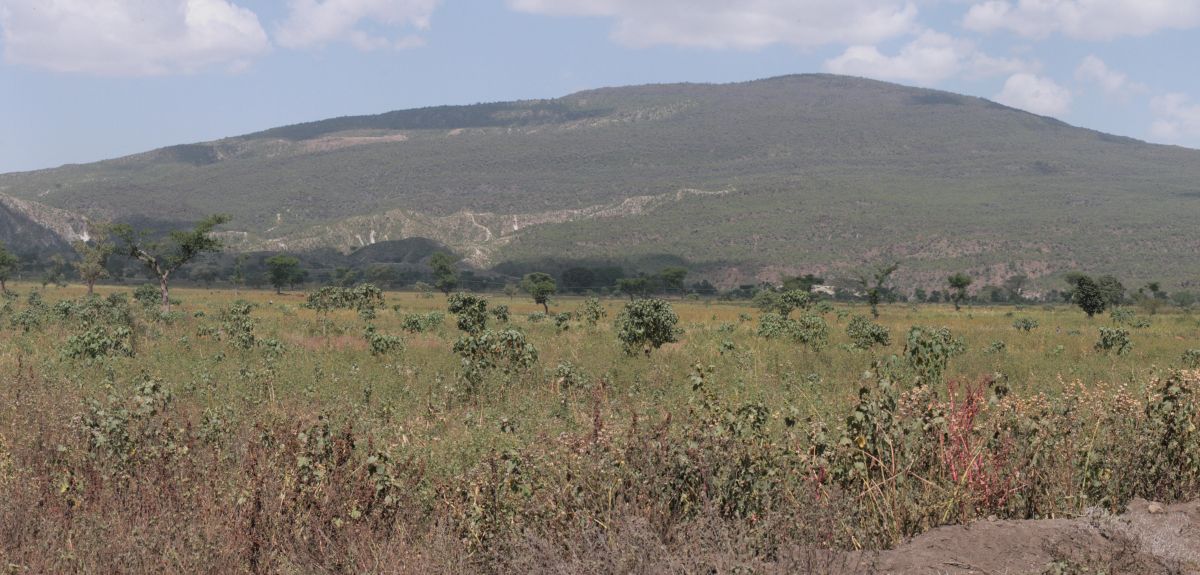
In a guest post for Science Blog, Professor David Pyle of Oxford's Department of Earth Sciences discusses a new paper looking at ancient volcanic activity in the Ethiopian Rift Valley.
The great Rift Valley that runs through Ethiopia has played a pivotal role in human evolution. It is both the location of the earliest fossils of anatomically modern humans and, later, become an important route for human migrations 'out of Africa'.
Today, it is home to more than ten million people, a major hub for tourists, and the location of important transport links. The main Ethiopian Rift Valley is also one of the largest fields of volcanoes on Earth – although this status may not be obvious from the remnants of the sprawling tumbledown hills that break through the dusty flats of the rift valley floor. Here, Africa has been slowly pulling apart for millions of years. As the continent pulls apart, the crust extends and thins, promoting the rise of magma from the depths of the Earth's mantle. None of these volcanoes is thought to have erupted since the early 19th century, and several are now the focus of development of geothermal energy potential.
In a new paper published in the journal Nature Communications, Will Hutchison, an Oxford DPhil student, and a team of collaborators from the UK, Ethiopia and the USA, shed a little more light on the violently explosive past of several of these rift volcanoes. Using a combination of field work (to reconstruct the deep history of the volcanoes) and isotopic age dating techniques, the researchers find that at least four of the volcanoes of the main Ethiopian Rift Valley suffered colossal eruptions between about 320,000 and 170,000 years ago. These were very significant eruptions – perhaps of the scale of the eruption of Krakatoa in Indonesia in 1883. They would have buried the rift floor in volcanic ejecta, disrupting water sources and habitats across wide areas, with the collapsed remnants of the volcanic edifices forming great 'calderas', or craters, in the rift floor.
This pulse in volcanism coincides with the arrival of Homo sapiens in the region around 200,000 years ago and raises the question of to what extent these changes in the landscape and environments occupied by our earliest human ancestors might have influenced human evolution and migration. The recognition that explosive volcanism in the rift occurs in bursts also poses some interesting geological questions, and future inter-disciplinary research is needed to understand the scale of eruptions at other large volcanoes of the rift, their causes, and their wider consequences.

As the US presidential election campaign reaches it final few weeks, the potential impact of overseas voters on key battleground states has been highlighted by a new report from the Rothermere American Institute (RAI) at the University of Oxford.
America’s Overseas Voters: 2016’s Forgotten Constituency? considers the states in which overseas voters stand to have the biggest impact. It identifies that winning a majority of overseas voters – often amounting to just a few thousand votes – could be enough for the candidates to snatch certain swing states.
The Trump campaign has suffered significant setbacks over the last two weeks, and the resulting decline in domestic support could mean that overseas voters provide the extra push needed for Hillary Clinton to secure Iowa, Arizona and Georgia.
But – as the recent Brexit vote and UK general election have shown – pollsters’ predictions can be significantly wrong. If Trump’s real support-base in Ohio, Nevada and North Carolina is close to where it appeared to be earlier in October, then Trump could take these states if he is able to command a sufficiently large majority of overseas voters.
Dr Halbert Jones, Director of the Rothermere American Institute at the University of Oxford, and co author of the report said: “Our analysis shows that, based on recent polls, Trump might need a majority of just 5,600 among Ohio’s overseas voters to win the state, and a majority of just 7,100 among overseas voters to win Nevada.
“But if the national vote swings further behind Clinton, the overseas vote could mean she takes the presidency with a rout rather than a slim victory – helping the Democrats to snatch prizes like Georgia, Iowa and Arizona.”
The report examines the characteristics of the overseas voting population, drawing on data on absentee ballot requestsfrom the state of North Carolina. This analysis concludes that while Americans casting their votes from abroad are a diverse group, in at least one key swing state they are, as a group, disproportionately Democratic, urban, and white. The ways in which the profile of the overseas population differs from that of the electorate at large has potentially significant implications in a very close election.
It also analyses a recent US Government study suggesting that more than 2.6 million potential US voters live overseas, though this may well be a significant underestimation. US Government data highlights key populations of overseas US voters in Canada (661,000), Britain (306,000), France (159,000) and Israel (133,000), with other populations of more than 100,000 in Japan and Australia.
The population of potential US voters in Mexico is contested – with a US Government study suggesting just 65,000, while the 2010 Mexican census suggests a figure closer to 200,000. However sources agree that there is a huge number of US-born children living in Mexico - this means that the country is set to play an increasingly important role in US elections in the future.
Dr Patrick Andelic, Research Associate at the RAI, and co author of the report, said: “Canada, Britain, France and Israel all play a substantial role in US elections now. While current polling places Clinton in a commanding lead, the volatile nature of the race so far means that anything can still happen - and if Britain’s recent general election and Brexit result have shown us anything, it’s that one shouldn’t call a winner until the votes have all been counted. Overseas voters proved crucial to George W Bush’s victory in 2000, and they may make a critical difference in 2016. Political parties ignore this hidden constituency at their peril.”

Bob Dylan was announced as the winner of the Nobel Prize for Literature yesterday.
Many pundits hailed this as a vindication for Christopher Ricks, a former Professor of Poetry at the University, who has studied Bob Dylan’s lyrics for many years.
In The Times, Anne Treneman said that he “has laid the groundwork for a better understanding of Dylan’s literary significance”.
Some people reacted to the news by questioning whether a ‘singer’ should be eligible for the Nobel Prize for Literature. But Professor Seamus Perry, Chair of the English Faculty at Oxford University, disagrees.
‘Dylan winning the Nobel was always the thing that you thought should happen in a reasonable world but still seemed quite unimaginable in this one,’ he says.
‘He is, more than any other, the poet of our times, as Tennyson was of his, representative and yet wholly individual, humane, angry, funny, and tender by turn; really, wholly himself, one of the greats."
The announcement was a surprise because the bookmakers’ favourite to win had been Kenyan writer Ngugi wa Thiong’o. His writing was the subject of the MPhil thesis of Professor Elleke Boehmer, who is now Director of The Oxford Research Centre in the Humanities (TORCH).
‘Ngugi is an undisputed giant of the African novel and African theatre, who has always seen literature as a powerful weapon in the struggle for greater justice and freedom,’ she says.
‘His ideas on how we 'decolonize' minds and cultures and use books as weapons of struggle, have proved hugely influential, not least today, with the ongoing discussion of decolonizing the curriculum in the US, UK and South Africa.’
But Professor Boehmer agrees that Dylan is a worthy winner – and not just because she saw him in concert in Amsterdam last year!
‘Though it would have been special for Ngugi to win, at this time of Black Lives Matter, I'm really thrilled about this gong for Bob,’ she says.
‘He created the anthems, the love songs, and the anti-love songs that defined the post-1968 generation and still resonate today. He is the subtlest rhyme artist -- captures unspoken meanings in the modulations of his rhyme.’
- ‹ previous
- 116 of 253
- next ›
 Celebrating 25 Years of Clarendon
  Learning for peace: global governance education at Oxford
  What US intervention could mean for displaced Venezuelans
  Setting the agenda for the next century of quantum
 10 years on: The Oxford learning centre making an impact
 Mapping the Moon: the world’s first lunar atlas goes digital
  Oxford and The Brilliant Club: inspiring the next generation of scholars
 New course launched for the next generation of creative translators
 The art of translation – raising the profile of languages in schools
  Opening a window into the quantum world