Features

The 25 of April is World Malaria Day - a good time to take stock of progress towards dealing with one of the great historical global scourges.
Malaria is caused by a tiny parasite transmitted to humans by the bite of certain sorts of (Anopheline) mosquitos. It occurs though the tropics and subtropics. Historically is has caused so many deaths that it has been one of the most powerful selective forces acting on human evolution.
At the turn of this century malaria was rightly described by many as a ‘disaster’: resistance to drugs used in treatment was widespread and estimates of deaths were in millions a year. There was a sense of national and international paralysis. In response to this dire situation came a whole set of initiatives, including declarations by heads of states the initiation of new public private partnerships and the launch of the Global Fund to fight AIDS, TB and malaria. Often such efforts are greeted with a certain amount of scepticism but in this case they marked the beginning of a log order rise in global investment in malaria control and a truly remarkable change in the global malaria situation.
Over the next 15 years malaria reduced dramatically in almost all parts of the world accompanied by an incredible 60% reduction in malaria death rates. In large part this was due to the widespread deployment of effective new drugs, the so called artemisinin combinations and the use of bed nets impregnated with insecticide Encouraged by the possibilities many began to call for a new campaign of global malaria eradication. Others were concerned that this was hubristic, given the biological and social complexity of malaria. The WHO set out in 2015 a Global Technical Strategy, which while disappointing some by not calling for eradication in any short time frame, was in fact very ambitious in aiming at a 90% reduction in malaria deaths by 2030 and at least 35 countries to have achieved elimination.
Over the last few years we have come to a more realistic and nuanced appreciation of the global position. In areas of lower transmission progress toward the elimination targets is on track but at the other end of the spectrum malaria remains a major cause of death in high burden countries. 75% of the worlds estimated 435,000 deaths each year occur in just 11 countries, ten of them in Africa and the eleventh being India. Here progress is in danger of stalling without concerted political and societal action. Against this background there is also concern about emerging drug and insecticide resistance and static levels of international funding. On the more optimistic side there is exciting progress towards potential new tools including drugs, vaccines and ways of genetically modifying mosquito populations.
So on malaria day 2019 we can reflect both on the massive progress over the last 19 years and but also on the considerable challenges ahead. It is a matter of pride that researchers from many parts of Oxford University and especially the major overseas collaborating programmes in south East Asia and Africa have played a central role in the many of the developments that have contributed to the progress described above.
Kevin Marsh is Professor of Tropical Medicine at the Nuffield Department of Medicine.

By Penny Mealy, Thom Wetzer and Matthew Ives
Search online for ‘climate change’ and ‘tipping points’, and you will find some scary results. Melting Ice-sheets, the collapse of the Atlantic thermohaline circulation, the permafrost methane ‘time bomb’ and the dieback of the Amazon that threaten to exacerbate the climate crisis and cause global warming spiralling out of control.
But what if we could leverage similar tipping point dynamics to solve the climate problem? Like physical or environmental systems, socioeconomic and political systems can also exhibit nonlinear dynamics. Memes on the internet can go viral, loan defaults can cascade into financial crises, and public opinion can shift in rapid and radical ways.
Research into such positive socio-economic tipping points is underway at the Institute for New Economic Thinking for the Oxford Martin School Post-Carbon Transitions Programme, headed by Professors Doyne Farmer and Cameron Hepburn. In an article just published in Science, the team outline a new approach to climate change that seeks to identify areas in socio-economic and political systems that are ‘sensitive’ - where a modest, but well-timed intervention can generate outsized impacts and accelerate progress towards a post-carbon world.
Sensitive Intervention Points (SIPs)
These “Sensitive Intervention Points” – or SIPs – could trigger self-reinforcing feedback loops, which can amplify small changes to produce outsized effects. Take, for example, solar photovoltaics. As more solar panels are produced and deployed, costs fall through “learning-by-doing” as practice, market testing and incremental innovation make the whole process cheaper.
Cost reductions lead to greater demand, further deployment, more learning-by-doing, more cost reductions and so on. However, the spread of renewables isn’t just dependent on technology and cost improvements. Social dynamics can also play a major role. As people observe their neighbours installing rooftop solar panels they might be more inclined to do so themselves. This effect could cause a shift in cultural and social norms.
Financial markets are another key area where SIPs could help accelerate the transition to post-carbon societies. Many companies are currently failing to disclose and account for climate risks associated with assets on their balance sheet. Climate risk can entail physical risks, caused by extreme weather or flooding. They can also entail the risk of assets such as fossil fuel reserves becoming stranded as economies transition to limit warming to 1.5℃ or 2℃, when such resources are no longer valuable.
Most of the world’s current fossil fuel reserves can’t be used if the world is to limit warming and they become effectively worthless once this is acknowledged. By not accounting for these risks to fossil fuel assets, high-emission industries are effectively given an advantage over low-carbon alternatives that shouldn’t exist. Relatively modest changes to accounting and disclosure guidelines could make a significant difference.
If companies are required to disclose information about the climate risks associated with their assets – and if such disclosure is consistent and comparable across companies – investors can make more informed decisions and the implicit subsidy enjoyed by high-emission industries is likely to rapidly disappear.
Opportunities for triggering SIPs in a given system can also change over time. Sometimes “windows of opportunity” open up, where very unlikely changes become possible. A key example in the UK was the political climate in 2007-2008 which enabled the 2008 UK Climate Change Act to pass with near unanimous support. This national legislation was the first of its kind and committed the UK to reducing greenhouse gas emissions by 80% relative to 1990 levels by 2050.
The act also created a regular ratcheting cycle which encourages more ambitious future climate action. Since 2008, emissions in the UK have fallen dramatically. However, the UK Climate Change Act’s influence beyond the UK is also significant as it encouraged similar legislation in other countries, including the Paris Agreement, which contains the same self-reinforcing ratcheting mechanism.
Using SIPs for rapid change
Thinking about SIPs in policy and business could accelerate the post-carbon transition – but much work lies ahead. The first step is to systematically identify potential SIPs and the mechanisms by which they can be amplified.
Unfortunately, traditional economic models commonly used to evaluate climate policy are poorly equipped to do this, but new analytical methods are increasingly being used in policy.
These new methods could provide more accurate insights into the costs, benefits and possibilities of SIPs for addressing climate change. As SIPs could be present in all spheres of life, experts in social and natural sciences will need to work together.
The window to avert catastrophic climate change is closing fast, but with intelligent interventions at sensitive points in the system, we believe success is still possible. Since the stakes are so high – and the time frame so limited – it is not possible to chase every seemingly promising idea. But with a smart, strategic approach to unleashing feedback mechanisms and exploiting critical windows of opportunity in systems that are ripe for change, we may just be able to tip the planet onto a post-carbon trajectory.
A version of this article originally appeared in The Conversation.

TORCH (The Oxford Research Centre in the Humanities) will welcome Ms Nur Laiq as its Global South-Mellon Visiting Professor 2019-2020.
Nur Laiq is a public policy practitioner. She has sought to investigate the combustible power of identity and politics, based on her ground experience in the political and policy arena. Her research aims at bridging the gap between academia and policy.
Ms Laiq has worked on policy with political parties in India and Britain, as well as in the Policy Planning Unit of the UN Department of Political Affairs Policy in New York, with a particular focus on sustaining peace – the idea that nations need to continuously invest in the fundamentals of inclusion and equality to keep war at bay. She also served on the UN Advisory Group on Youth, Peace and Security, appointed by the UN Secretary-General.
Ms Laiq has been a senior policy analyst at the International Peace Institute in New York, a stagiaire at the European Commission DG External Relations in Brussels, and holds a visiting fellowship at the Centre for Policy Research in New Delhi. She has an MPhil in Modern Middle Eastern Studies from St Antony’s College, Oxford, which included studying Arabic in Damascus and Persian in Tehran.
Her publications include Talking to Arab Youth: Revolution and Counterrevolution in Egypt and Tunisia (New York: International Peace Institute, 2013), based on fieldwork with social movements and political parties across the entire ideological spectrum in Egypt and Tunisia following the 2011 uprisings. She is co-editor of The Search for Peace in the Arab-Israeli Conflict (Oxford: Oxford University Press, 2014), which aims to offer policymakers a toolbox of options for negotiations, based on documentary history and interviews conducted with Arab, Israeli and American stakeholders. Ms Laiq has been a member of the United Nations advisory group for The Missing Peace: Independent Progress Study on Youth and Peace and Security (New York: United Nations, 2018) and the Center for American Progress task force for The United States and India: Forging an Indispensable Democratic Partnership (Washington, DC: Centre for American Progress, 2018).
Drawing on her experiences, Ms Laiq is working on a book project on the new varieties of liberal responses to new strands of populism and the politics of identity. She seeks to explore the flammable properties of grievance, aspiration and insecurity and the power of narratives in these situations, based on her work on the ground. She sifts through the changing discourse around inequality and identity as the idea of civic nationalism faces grave challenges in both the Global North and South. Her study of shifting political assumptions and practices necessarily takes an interdisciplinary approach.
TORCH welcomes Ms Laiq's knowledge and expertise, which will provide a timely contribution to ongoing work to bring together researchers and policymakers interested in the future of identity, and consequently the future of democracy, peace and security. This is a theme explored in the TORCH headline series ‘Humanities and Identities’.
Ms Laiq said: ‘I am pleased to be joining TORCH and working with Professor Rana Mitter, the History Faculty and the Blavatnik School of Government. I look forward to engaging with students and academics on the navigation of identity and politics in contemporary politics, which is a work in progress. I am excited to be part of a forum for the exchange of ideas between policy experts, politicians, and the Oxford academic community.'
Rana Mitter, Professor of the History and Politics of Modern China at Oxford University, said: ‘I am delighted to be Ms Laiq’s academic host during her permanence in Oxford. We are working on an exciting schedule of events to allow Nur to engage with students and academics from the University. Discussions on populist politics and the Indian elections, as well as graduate workshops on policy, will feature in it.’
Nur Laiq is based in TORCH from Trinity Term 2019 through 2020.
The TORCH Global South Visiting Professorships Programme is designed to bring world-leading figures to the University of Oxford for at least one term and be included in the teaching and research environment, hosted by leading academics in the humanities. Funded by the Andrew W. Mellon Foundation, the Programme is a collaboration between the Faculties of the Humanities Division and Colleges of the University of Oxford.

Oxford neuroscientists are marking British Science Week and Brain Awareness Week (11th-17th March 2019) with an interactive experiment to help schoolchildren understand how to improve their revision skills.
Researchers from Oxford Neuroscience have designed a fun game that can be downloaded and played on a phone, which will test whether cramming for exams is successful, or whether learning something over a longer period of time produces a better outcome.
Once downloaded, users will be sorted into two groups: one group will take part in the quick learning, which is done in a single day, and the second group will be selected to take part in a week of learning, where they will play the game every day.
The University of Oxford will be collecting anonymous data about which group of people has most success in the game.
The results from the 'Find the Brain' game will be revealed live on Friday 15 March at 3.00pm, as a volunteer also plays the game while in an MRI scanner to show what’s going on in our brain when we are learning.
Throughout Brain Awareness Week there will also be events to delve into more detail about how the brain learns, how we can re-learn after stroke, how we learn during adolescence, and how sleep and exercise affect our learning.
Through interactive Facebook Lives with researchers, Twitter Takeovers and podcasts, researchers will be working with young people to explore how we can improve the way we learn.
Find out of you are a crammer or a planner by downloading the game from the dedicated microsite that has been created in partnership with British Science Week: www.oxfordsparks.ox.ac.uk/brain-discovery-week
Watch the results of the fun experiment revealed live from the fMRI scanner at the University of Oxford on Friday 15 March, 3.00pm, to find out who learned best: the crammers or the planners! www.facebook.com/OxSparks

By Dr Wahbi El-Bouri
There are over 1.2 million stroke survivors in the UK, with 100,000 strokes happening in the UK each year. That’s the equivalent of one stroke every five minutes. They are also the leading cause of disability in the Western world.
Research underway in the Department of Engineering Science’s Cerebral Haemodynamics Group, headed up by Professor Stephen Payne, is changing our understanding of blood flow around the brain. Here, I explain how this could speed up the arduous process of bringing stroke drugs to market.
Our research has two main questions. Firstly, can we model blood and oxygen transport in the entire human brain, across the billions of blood vessels present? And secondly, can we run in-silico clinical trials (that is, trials performed entirely on a computer) of stroke and stroke treatment?
This is what we are tackling as part of a Horizon 2020 project (In-Silico Trials for Treatment of Acute Ischaemic Stroke) alongside European research collaborators from 10 other institutes, including radiotherapists, clinicians, academics, and industrial partners.
A continuous supply of oxygen and glucose, via the bloodstream, is essential to maintain healthy brain function under all circumstances. Whereas the rest of our body can release stored-up energy when we feel hungry, the brain has no such reserves. As such, any reduction in blood flow to the brain, even if only for a few minutes, can lead to cell death and loss of brain function. A large reduction of blood flow for a prolonged period of time, whether through a blocked or ruptured vessel, is known as a stroke.
In addition, dementia (the leading cause of death in the UK) is increasingly being linked to changes in our smallest blood vessels, or microvasculature, as we age. There is clearly an urgent need to understand the mechanisms of stroke and brain ageing in order to combat these debilitating diseases.
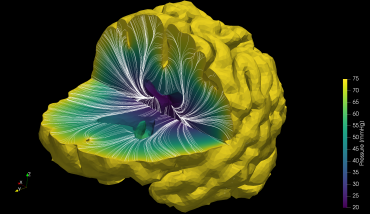 Capiliary velocity
The starting point for these models must be real-life data. Unfortunately, due to the low resolution of current clinical imaging modalities, the only way we can currently ‘see’ the smallest vessels in the brain (which average 1/10th the width of a human hair) is to image slices of dead human brains. Using these, researchers construct networks on a computer and simulate blood and oxygen transport. However, we quickly run into the problem of scaling up these networks to encompass the billions of blood vessels that make up the human brain.
Our team is using mathematical tools developed for use in the oil and gas industry, who have been trying to model water and oil flow through rock for decades. We treat the brain as a chunk of porous rock and hence approximate the flow through our brain, as opposed to modelling the flow in each individual vessel. This allows us to rapidly produce full brain computer models of blood and oxygen transport!
The models that we are developing, along with models of clot formation, clot removal using a stent and thrombolysis (dissolving the clot with drugs), will be used to run clinical trials on computers that can be personalised and help to inform real-life clinical trials. For example, certain geometries of blood vessels or certain clot positions may be more amenable to a certain treatment.
This knowledge, from the in-silico clinical trial, can then inform a real-life trial to target treatment to those people and hence improve the chances of that stroke treatment being brought to market and used to save lives. In the future, these models could be used to simulate a variety of neurological diseases and help us to understand the human brain, in both health and disease.
Read more about the Cerebral Haemodynamics Group’s research.
Find out more about Brain Awareness Week at Oxford.
This article was published to mark Brain Awareness Week, a global campaign running from 11-17 March.
- ‹ previous
- 58 of 253
- next ›
 What Louise Thompson’s campaign tells us about the national maternity crisis
 Celebrating 25 Years of Clarendon
  Learning for peace: global governance education at Oxford
  What US intervention could mean for displaced Venezuelans
  Setting the agenda for the next century of quantum
 10 years on: The Oxford learning centre making an impact
 Mapping the Moon: the world’s first lunar atlas goes digital
  Oxford and The Brilliant Club: inspiring the next generation of scholars
 New course launched for the next generation of creative translators
 The art of translation – raising the profile of languages in schools