
Department of Physiology, Anatomy and Genetics
The Department of Physiology, Anatomy and Genetics (DPAG) is a major basic-science department within the Division of Medical Sciences.
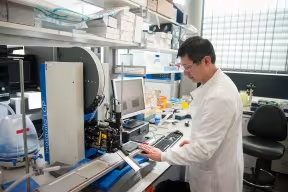
Genetic scientist screening protein crystals. Credit: Oxford University Images / John Cairns

Overview
Ranked number one in Anatomy and Physiology in the world according to the QS World University Rankings 2026, the department has excellent facilities for the large number of full-time research students who are fully integrated into the seven broad research areas of:
- Bionanoscience
- Cardiac Science
- Cell Physiology
- Development and Cell Biology
- Functional Genomics
- Metabolism and Endocrinology
- Neuroscience
The department's work is necessarily multidisciplinary and cross-cutting, which means researchers often work across more than one theme, as well as collaborating with colleagues in the physical sciences, life sciences and clinical departments across Oxford and elsewhere.
Due to DPAG’s multidisciplinary nature, it is hoped that the postgraduate students’ experiences in DPAG will help them to become the leaders in science of tomorrow, whilst communicating and employing their research in the wider world.
DPAG is home to a large number of internationally-renowned teams of scientists addressing major questions in biomedicine, the answers to which will have a profound effect on modern biology. Crucially, DPAG thinks learning is just as important as research, and at the department's core lies a belief that a synthesis of the two is key to advancing our understanding. As such, DPAG works to provide outstanding opportunities for graduate students to enjoy cutting-edge training across a diverse range of state-of-the-art methodologies in leading laboratories in the field, to develop practical skills to excel in academia, industry, consulting, high-tech start-ups and have made outstanding achievements in a variety of career fields; from making ground-breaking discoveries into fundamental biological processes to translational contributions with real-life impacts.
As the department's work is multidisciplinary and cross-cutting, with researchers working across more than one theme, as well as collaborating with colleagues in the physical sciences, life sciences and clinical departments across Oxford and elsewhere, it is hoped, the postgraduate students’ experiences in DPAG will help them to become the leaders in science of tomorrow, whilst communicating and employing their research in the wider world.
In parallel to research, DPAG staff undertake the majority of the pre-clinical teaching for the University's top-ranked medical degrees while the department's graduate courses also attract a wealth of international talent. Ultimately, the department is built on a desire to understand its scientific research areas with the belief its students are the future of research.
Courses offered
The courses shown below are offered at postgraduate-level.
- Doctor of Medicine (DM) (variable intensity)
- DPhil in Physiology, Anatomy and Genetics (full time)
- MSc by Research in Physiology, Anatomy and Genetics (full time)