
Nuffield Department of Orthopaedics, Rheumatology and Musculoskeletal Sciences
The Nuffield Department of Orthopaedics, Rheumatology and Musculoskeletal Sciences (NDORMS) is a vibrant multi-disciplinary department focusing on musculoskeletal and immunological diseases, and epidemiological research, from bench to bedside.
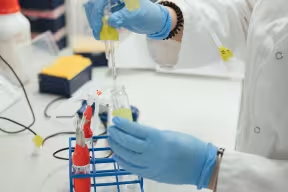
Experimenting in the laboratory, Medical Sciences Division (University of Oxford Images / Ian Wallman)

Overview
NDORMS is the largest European academic department in its field and runs a globally competitive programme of research and teaching. Committed to training the next generation of scientists in biological and clinical sciences, NDORMS has over 500 staff, approximately 120 postgraduate research students and a grant portfolio in excess of £150 million.
NDORMS has state-of-the-art research facilities across the spectrum of our research expertise, located on different sites:
- The Botnar Research Centre on the Nuffield Orthopaedic Centre (NOC) site;
- The Kennedy Institute of Rheumatology on the Old Road Campus site;
- The Centre for Statistics in Medicine;
- The Oxford Clinical Trials Research Unit; and
- The Kadoorie Centre for Critical Care Research and Education, based in the John Radcliffe Hospital.
The Botnar Research Institute provides a unique setting for basic science researchers, statisticians and clinical trials experts to interact with clinician scientists, and to translate new experimental medicines and surgical designs into successful treatments. The Botnar Research Centre is strongly connected to the internationally renowned NOC, providing crucial access to patients' samples and an overall capacity for clinical and surgical trials.
The Kennedy Institute carries out basic and clinical research in chronic inflammatory and degenerative diseases including arthritis and inflammatory bowel disease. The Kennedy Institute is famous for its development of anti-TNF therapy to treat rheumatoid arthritis, a chronic debilitating disease. This treatment has improved the lives of millions of patients around the world.
The Kadoorie Institute develops and evaluates innovative treatments, technologies, and models of care designed to improve patient outcomes and deliver more effective, efficient healthcare. By integrating expertise and resources across trauma, emergency, and critical care, the Institute accelerates the translation of research into clinical practice.
Courses offered
The courses shown below are offered at postgraduate-level.
- DPhil in Clinical Epidemiology and Medical Statistics (full time and part time)
- MSc in Experimental and Translational Therapeutics (part time)
- DPhil in Molecular and Cellular Medicine (full time and part time)
- MSc by Research in Molecular and Cellular Medicine (full time and part time)
- MSc in Musculoskeletal Sciences (part time)
- DPhil in Musculoskeletal Sciences (full time and part time)
- MSc by Research in Musculoskeletal Sciences (full time and part time)
Medical Sciences Division
The Medical Sciences Division houses some of the strongest biomedical research in the world; Oxford is repeatedly placed first in clinical, pre-clinical and health in the Times Higher Education World University Rankings.
The Medical Sciences Division's departments and institutes in Oxford and overseas are home to some of the strongest biomedical research in the world, regularly appearing at the highest levels in world rankings and rated world-leading and internationally excellent.
The division’s 2,000 researchers cover a wide range of research, from atomic-resolution molecular structural biology to epidemiology as applied to very large populations. This enables students to work on virtually any biomedical problem.
The division provides a stimulating and challenging environment for more than 2,000 talented graduate students with excellent new facilities and close personal supervision by world-class researchers. To complement research supervision and course teaching there is a wide range of facilities aimed at the personal and professional development of students, strengthening their existing skills and developing new skills.
All candidates who apply by the December or January deadline shown on the course page are automatically considered for full funding awards, irrespective of their nationality.