Features

Deciding when to return to the GP when symptoms do not resolve is something many people struggle with, especially when the symptoms may not appear to be serious or life-threatening. Research with cancer patents in Denmark, England, and Sweden, published today in BMJ Open, indicates that small changes to how doctors conclude consultations with their patient could help to improve both survival rates and efficiency.
Led by Oxford University, the international team included researchers from Aarhus University in Denmark with Lund University, Umeå University and the Karolinska Institute in Sweden. The project was funded by Cancer Research UK.
The researchers interviewed 155 people aged between 35 and 86 years old, within six months of being diagnosed with lung or bowel cancer. Patients were invited to talk about events since they had first noticed a problem, including what influenced their decision to consult a doctor.
The study compared Denmark, England, and Sweden because survival rates for lung and bowel cancer between 1995 and 2007 were persistently higher in Sweden than in Denmark or England, particularly in the first year following diagnosis.
Notable differences between the three countries were found in patients’ accounts of the clarity and communication of action plans at the end of GP consultations. Patients in England and Denmark told the researchers that they had not known whether and when to return to their GP with symptoms, while Swedish patients described clear action plans with instructions from their GP to return in specified timeframes.
The study concluded that if clear action plans are used routinely in primary care consultations then uncertainty, false reassurance, and the inefficiency and distress of multiple consultations during cancer diagnosis could be reduced.
The authors recommend that every GP consultation should conclude with explicit advice about what to look out for and provide specific advice for patients to return if symptoms do not resolve, or re-occur.
Dr John MacArtney, Senior Researcher at Oxford University’s Nuffield Department of Primary Care Health Sciences, said: ‘Spotting cancer early can make the difference between survival and death. We already know that many people are reluctant to seek medical attention in the first place, for fear of unnecessarily bothering their doctor. If they have already seen a GP for the same or similar symptoms then they may wait longer to return, even if they have been given the general advice to “come back if things don’t get better”. This makes it important to understand why people might be reluctant to re-visit their GP.’
The study, which is the first to study how patients experience the pathway to cancer diagnosis, has helped to illuminate previous findings from other International Cancer Benchmarking Partnership studies, which have shown that no single factor could explain why differences in cancer outcomes persist between high-income countries with universal health coverage.
The study lead Sue Ziebland, Professor of Medical Sociology in Oxford University’s Nuffield Department of Primary Care Health Sciences, said, ‘Making the general public aware of the seemingly innocuous symptoms of common cancers is only one part of improving early diagnosis. It is just, if not more, important to remove the barriers patients face in getting to see their GP if they are concerned about their health. One of those barriers arises when patients are unsure about what to do when symptoms return or persist, because they have already seen a GP.
‘Recognising these issues exist, and encouraging GPs to communicate concrete and specific action plans, could be vital in improving patient survival, especially for those patients who worry about wasting the doctors time.’
Sara Hiom, Cancer Research UK’s director of early diagnosis, said: ‘Diagnosing cancer is complex and most often starts with someone presenting to their GP with signs or symptoms they’re not sure about. This fascinating study builds our understanding of what’s happening at a very personal level, at what can be an anxious and difficult time for patients. Having this insight across different countries and cultures helps build a clear picture of what’s most important about the conversation between the doctor and patient, and could well improve cancer outcomes. GPs across the UK may need more support to help them make the most of these critical consultations in the little time available. Charities such as Cancer Research UK can provide information to patients at this point in the diagnostic process.’
The full paper, 'Patients’ initial steps to cancer diagnosis in Denmark, England and Sweden: what can a qualitative, cross-country comparison of narrative interviews tell us about potentially modifiable factors?' can be read in BMJ Open.

This is the latest in the Artistic Licence series.
Everyone knows a Dave. But how many of us know an Apollonios?
Apollonios, Ἀπολλώνιος in its original Greek, is derived from the name of the God Apollo, and was a popular name in the Ancient World.
And a long-running project in the Classics Faculty has spent the past 45 years collecting and recording thousands and thousands of similar names—to create a dictionary all of the personal names that men and women went by in Ancient Greece. These names can give fresh insights into Ancient Greek society.
The Lexicon of Greek Personal Names (LGPN) was established in 1972. Its aim is to scour Ancient Greek literature, inscriptions, graffiti, coins, vases, and other artefacts, and create a dictionary of all of the names found in them.
By collecting these names, researchers hope to shed light on the social history of the Ancient Greek world. Names can help us to understand how religion shaped society, how naming patterns changed, and even how some Ancient Greek names have survived to this day.
Take Apollonios (Ἀπολλώνιος). Because it derives from the God Apollo, is it known as a ‘theophoric’ name—a name that comes from the Gods. This sort of name was common in Ancient Greece, and give us an insight into which Gods were important at different times.
“The names reflect various levels of religion and piety,” says Dr Michael Zellmann-Rohrer, a researcher for the LGPN project. “It’s a much richer record than literary texts or even temples.”
This is because, while it may be normal to find tributes to Gods in temples, naming your beloved child after a God shows a much stronger sense of devotion. “Parents are expressing their relations to the Gods in the naming of their children,” Dr Zellmann-Rohrer says.
These days, theophoric names like Apollonios or Demetria—after the goddess Demeter—are not so common in English. But some traditions have stayed around.
“I was named after my father,” says Dr Zellmann-Rohrer. “Naming a child after a parent or grandparent is quite common—and people did it in Ancient Greece too.”
So chances are that Zosimos (Ζώσιμος) might well decide to call his baby daughter Zosime (Ζωσίμη), just as Dave might decide on Davina.
And some names have even lasted to the present day.
“For various reasons, Greek names do continue, some of them via Christianity,” Dr Zellmann-Rohrer says. One example is Theodore, which comes from Theodōros, and means “God’s gift.”
In the volumes, which are organised by region, researchers record all the names they find, where they found them, and note any well-known individuals who bore the name.
It’s a huge task, but has benefited from being collaborative from the beginning. A small group of researchers work on the project full-time from their Oxford office, but are supported by an international community of scholars.
“It’s one of the good traditions of the project,” says Dr Zellmann-Rohrer. The volumes are also available online, so that everybody can access and learn from them.
Currently, Dr Zellmann-Rohrer is working on the Near East, combing sources for names from that area. He works alongside Professor Robert Parker and Dr Jean- Baptiste Yon, the co-Principal Investigators, and Mr Richard Catling and Dr Jean-Sébastien Balzat, who are co-editors.
To explore the world of Ancient Greek names, or see if you might have Greek roots yourself, visit the LGPN website.
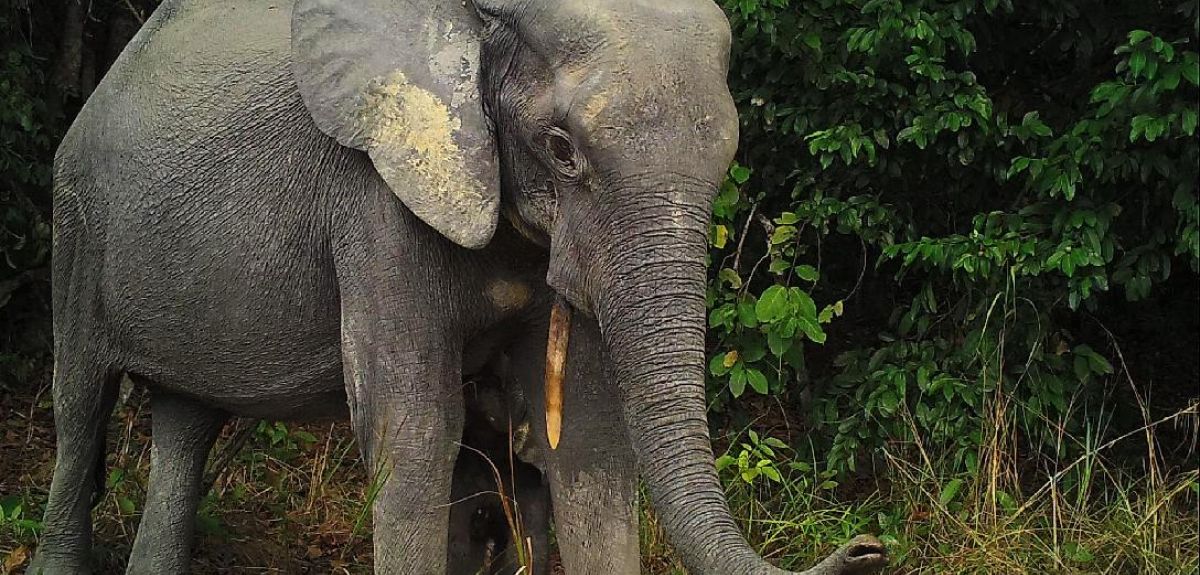
In a guest post for Science Blog, Oxford DPhil student Anabelle Cardoso, from the Environmental Change Institute in the School of Geography and the Environment, writes about a citizen science project helping us better understand the endangered African forest elephant.
Anabelle and her colleagues need volunteers to help classify photos taken by cameras set up in a forest-savannah landscape in Gabon. Find out more about the Elephant Expedition project, and volunteer as a citizen scientist, here. The project is also on Twitter and Instagram.
'Our project is set up in a mosaic landscape in Gabon, where tropical savannahs and forests interlock with one another, forming a habitat that supports a hugely diverse range of species, including the endangered African forest elephant. In this landscape, and in many other African sites, valuable savannah habitat is being lost to forest encroachment as a result of human-induced global change. Most people don't think of forest expansion as a problem, but when it expands into ancient savannah ecosystems you lose habitat diversity and it can be really detrimental to the ecological health of the landscape.
'My research focuses on better understanding the factors that affect how much forest encroachment a landscape experiences, and elephants can be a key determinant of this. In other parts of Africa we know that the bush elephant, which is a different species to the forest elephant, can help prevent this loss of savannah habitat, for example by knocking down trees. But nobody knows what the forest elephant does to trees in these forest-savannah mosaics. Do they behave like bush elephants? Or are they doing something completely different?
'To try and answer some of these questions, our team uses camera traps to monitor where and how many elephants there are in the landscape at different times of year, as well as why the elephants might be choosing these places, and what effects they are having on the trees in the places that they visit. Gabon is the perfect place to do this because it's home to most of the world's remaining forest elephants.
'Forest elephants are an endangered species as they are being heavily hunted for their ivory across central Africa. A better understanding of forest elephants can help to develop more effective conservation strategies and advocate more compellingly for their protection, both on a local and a global scale.
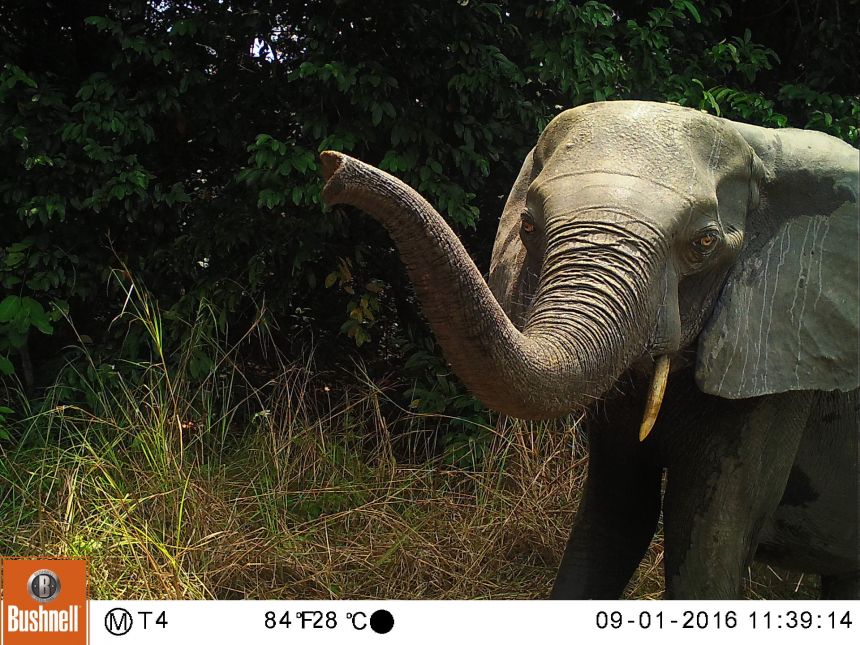 An African forest elephant poses for the camera in Gabon.
'Our 40 camera traps across the landscape set to take photos when they get triggered by motion or by heat. The camera traps allow us to monitor the elephants 24/7, and we can set up lots at the same time across a large area, which makes them an extremely effective scientific monitoring tool. Forest elephants have also had to deal with a huge amount of hunting pressure for their ivory, so they can get quite spooked and upset when strangers sneak up on them in the forest! The camera traps help with this, because they are unobtrusive and don't bother the elephants too much, which is ideal because we don't want to upset these beautiful animals.
'When we first set up the project, the plan was that I would go through all the photographs myself and count the elephants, which retrospectively seems almost laughably optimistic, because we definitely didn't anticipate just how many animals there were in the forest and how many thousands and thousands of photos we would end up needing to classify. Thankfully, through the University of Oxford we linked up with Zooniverse.org, which is a wonderful citizen science platform that helps connect projects like Elephant Expedition with a great group of dedicated citizen scientists.
'In Elephant Expedition we've created a platform for citizen scientists to go through each photograph taken by our camera traps and classify it. Photos are classified according to whether or not they have an animal in them, and what kind of animal this is. If the photo has an elephant in it, the citizen scientist also counts how many elephants they see. The platform is super easy to navigate, and it's really fun. It's kind of like going on a virtual safari because you never know what you're going to find next! What this does is create a database where all the images become linked with classification information, and then we can calculate how many elephants there were at a particular site at a particular time. This information is the core of our research, and without the citizen scientists this work would be impossible.
'We find that citizen scientists are really observant and engaged, so the quality of the information we get from their classifications is absolutely amazing. The platform that Zooniverse provides for this connection between the project and the citizen scientists is also really engaging, so there is a lot of interaction between citizen scientists and the research team, which is beneficial to both. I am definitely learning a lot from the project volunteers, and the feedback we get from them indicates they feel the same! It's been really encouraging for us to see how many volunteers post the project photos to their personal Twitter or Instagram accounts, showing that they care about the elephants as much as we do.
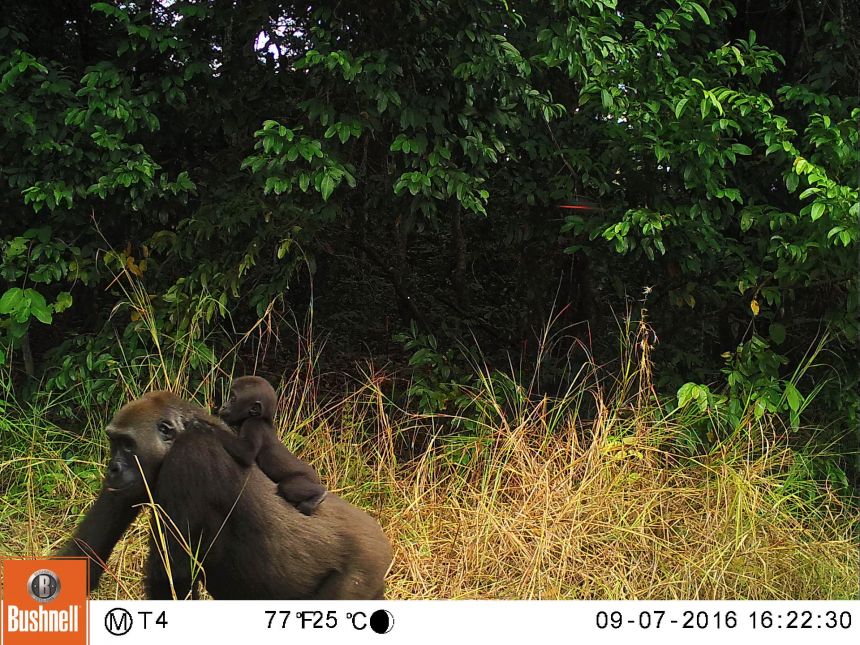 It's not just elephants that are captured on camera...
'At the moment, however, we have nearly 750,000 photos to classify, and our team just needs more hands on deck to get through all of them. Every month there can be in excess of 3,000 images on each camera, and there are 40 cameras, so it all adds up. The good news is that it's really easy to help with the project just by visiting our project page. You can classify as many images at a time as you want to, so absolutely anyone can help with the project, no matter whether you have a spare five minutes or five hours. Every single volunteer makes a difference.
'One of the best things about the project is that it isn't just elephants you spot in the photos. Our study site is filled with gorillas, chimpanzees, leopards, mandrills, pangolins, red river hogs, forest buffalo, monkeys, and lots of different antelope. So when you go on an elephant expedition it's really more of a virtual safari through the central African rainforest! Plus, the website has features to keep a collection of your favourite images, which you can share on social media or even print out for your fridge if you want to. The website is also applicable for all ages, so we encourage everyone from kids to grandparents to get involved.'
The research has been made possible thanks to the University of Oxford's Hertford College Mortimer-May fund and the support of Gabon's Agence Nationale des Parcs Nationaux (ANPN) and the University of Stirling.
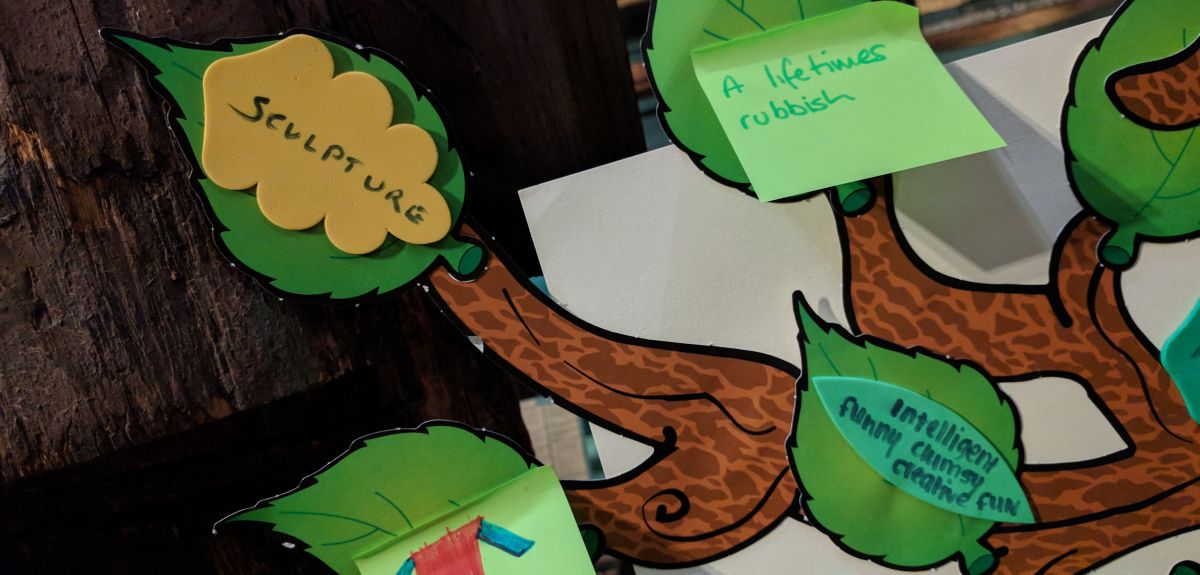
If you had to sum up your identity with only a pen and a post-it note – or a tweet – what would you write?
This was the challenge set for visitors to the University’s largest ever public engagement event last month, the Curiosity Carnival.
Helen Swift and Jessica Goodman are experts in Medieval and Early Modern French literature, and explore themes like identity, memory, and posterity, to reveal how unstable and precarious they are.
To get people thinking about these themes, they asked them to draw one object – or write up to five words – that would represent their legacy.
Several people drew a physical object – a wedding ring, a football, a favourite T-shirt.
“The blue-and-red T-shirt was clearly an important projection of an identity this person was very happy with,” says Helen.
Some people left their favourite inspirational quote, or a message. “Words: treasure them,” wrote one visitor.
Before they drew on the post-it note and added this ‘leaf’ to the legacy tree, visitors were asked to think about what happens to someone’s identity after they die, and the objects and words through which we construct stories about people from the past, and ourselves.
This led to a lot of thought-provoking conversations. A teenager told Jessica that he often deleted his Instagram pictures because they didn’t represent him anymore. An older woman decided she needed to think about what she could leave her children.
Others “were inspired to think environmentally about our individual and collective impact on the world in what we leave,” says Jessica. “Some people made very honest admissions that what our generation will leave will be a lot of rubbish.”
One person left an ellipsis… “This was an outcome of a very interesting conversation about how much what we call someone’s identity is or isn’t identical with that person’s sense of self,” says Helen.
“Even when you’re projecting your own identity, it’s still a projection, inevitably partial – and so identity is revealed as a slippery and uncertain entity insofar as it can be defined.”
Jess says the exercise was a great way to introduce visitors to timeless themes of literary study. “It was fantastic to spark people’s interest in the themes we work on in French texts from the past, which might initially seem inaccessible,” she says.
“I found it exciting to see people applying the idea of ‘You are what you leave’ to their own lives”.
“And some people also just had fun with our sticky shapes,” adds Helen.
What would you leave behind? Put it in a tweet and use the hashtag #cclegacy
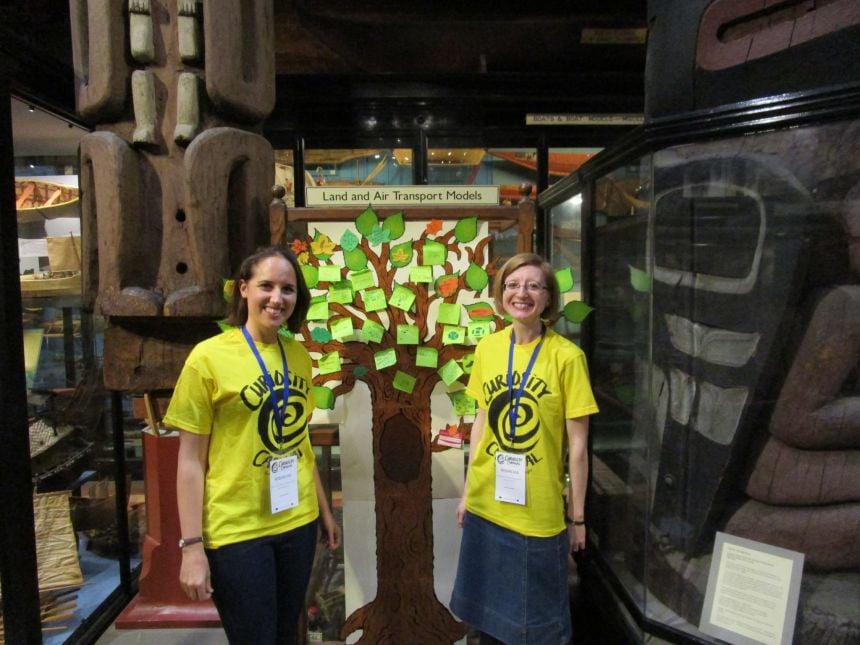 Jessica Goodman and Helen Swift during the Curiosity Carnival
This is the latest in the Artistic Licence series.
Chris Smart had only been in Oxford for a week when he joined one of Oxford’s most innovative student-led campaigns.
At the fresher’s fair, packed into a hall full of the University’s societies and sports clubs, Chris met DPhil student Thais Roque and a group of students who all had a clear objective: to help refugees study in Oxford.
Two years later, Chris is now one of the key figures running the Oxford Students Refugee Campaign (OxSRC), and the only undergraduate committee member. The campaign, which is entirely student-run, helps refugee students from abroad, and asylum-seeking students in the UK, continue their studies in Oxford.
Chris and his colleagues began by targeting the student body. During his first year, alongside the obligatory essay crises and weekly tutorials, Chris went from college to college pitching the campaign. The reception was overwhelmingly positive, and by the end of the year around half of students across the University had committed to annual donations of £12.
With these donations, and other fundraisers, the campaign has now raised an impressive £70,000, and is hoping to see its first funded students arrive in Oxford in October.
Meanwhile, Chris has just started the third year of his History degree at Mansfield College, and he’s managed to pack a lot into his two years here.
Originally from Cornwall, where he spends his free time in the sea, he’s also a keen photographer, and has acted in student theatre. But it’s OxSRC that has had the biggest impact on his Oxford experience.
“I learnt a huge amount very quickly,” he says. “And not just essential skills, like teamwork and organisation.
“I’ve also gained a far better understanding of what life is like for at risk students. I’m in contact with applicants via e-mail, and sometimes hearing what they’re going through is hard-hitting.”
After finishing his first year exams, Chris headed to Calais to volunteer at the refugee camp.
While there, Chris worked with the charity L’auberge des migrants, recycling waste wood for cooking fuel and distributing it within the camp alongside food deliveries. It was a steep learning curve, but one that OxSRC had prepared him well for.
Now back in Oxford, Chris is focused on the campaign again. He’s currently working on an emergency fundraising appeal, which is raising urgent funds online and was recently featured in Vice magazine.
In the long-term, the campaign hopes to establish a permanent, sustainable scholarship fund that will be able to anticipate the needs of future refugee students.
“It’s so important to reach out to refugee groups in need of education,” he says.
“The demonstration of this in history is huge— the scientists and mathematicians and Abstract Expressionist artists who fled authoritarian regimes in the USSR and Europe had a massively important impact on the societies they settled in. We should avoid the negative stigma that now exists around migrants and refugees.”
And being involved in the campaign has helped Chris too. “I think the impact of my work with OxSRC will continue to positively affect my entire self for a long time to come,” he says.
To learn more about the campaign’s goals and achievements, visit their website here. You can also contribute to their emergency campaign, and watch their campaign video, here.
- ‹ previous
- 88 of 253
- next ›
 25-year Oxford study finds the effects of conflict last for generations
 What Louise Thompson’s campaign tells us about the national maternity crisis
 Celebrating 25 Years of Clarendon
  Learning for peace: global governance education at Oxford
  What US intervention could mean for displaced Venezuelans
  Setting the agenda for the next century of quantum
 10 years on: The Oxford learning centre making an impact
 Mapping the Moon: the world’s first lunar atlas goes digital
  Oxford and The Brilliant Club: inspiring the next generation of scholars
 New course launched for the next generation of creative translators