Features
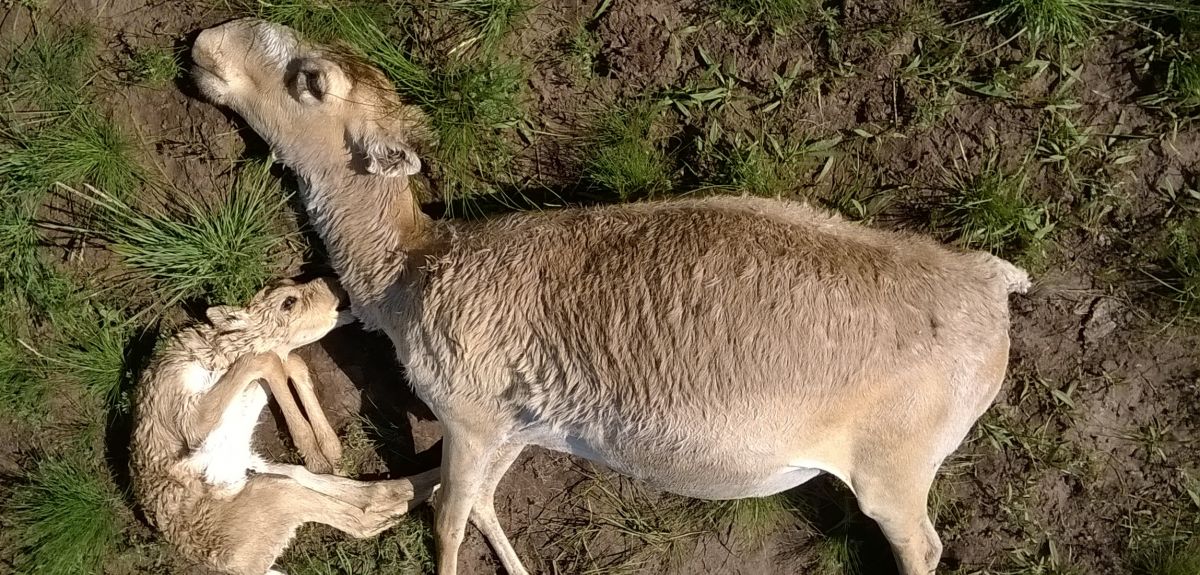
The sudden death of over 200,000 saiga antelopes in Kazakhstan in May 2015, which affected more than 80% of the local population and more than 60% of the global population of this species, baffled the world. In just three weeks, entire herds of tens of thousands of healthy animals, died of haemorrhagic septicaemia across a landscape equivalent to the area of the British Isles in the Betpak-Dala region of Kazakhstan. These deaths were caused by Pasteurella multocida bacteria.
But this pathogen most probably was living harmlessly in the saigas’ tonsils up to this point, so what caused this sudden dramatic Mass Mortality Event (MME)?
New research by an interdisciplinary, international research team has shown that many separate (and independently harmless) factors contributed to this extraordinary phenomenon. In particular, climatic factors such as increased humidity and raised air temperatures in the days before the deaths apparently triggered opportunistic bacterial invasion of the blood stream, causing septicaemia (blood poisoning).
By studying previous die-offs in saiga antelope populations, the researchers were able to uncover patterns and show that the probability of sudden die-offs increases when the weather is humid and warm, as was the case in 2015.
The research also shows that these very large mass mortalities, which have been observed in saiga antelopes before (including in 2015 and twice during the 1980s), are unprecedented in other large mammal species and tend to occur during calving. This species invests a lot in reproduction, so that it can persist in such an extreme continental environment where temperatures plummet to below -40 celsius in winter or rise to above 40 celsius in summer, with food scarce and wolves prowling. In fact, it bears the largest calves of any ungulate species; this allows the calves to develop quickly and follow their mothers on their migrations, but also means that females are physiologically stressed during calving.
With this strategy, high levels of mortality are to be expected, but the species’ recent history suggests that die-offs are occurring more frequently, potentially making the species more vulnerable to extinction. This includes, most recently, losses of 60% of the unique, endemic Mongolian saiga sub-species in 2017 from a virus infection spilling over from livestock. High levels of poaching since the 1990s have also been a major factor in depleting the species, while increasing levels of infrastructure development (from railways, roads and fences) threaten to fragment their habitat and interfere with their migrations. With all these threats, it is possible that another mass die-off from disease could reduce numbers to a level where recovery is no longer possible. This needs to be countered by an integrated approach to tackling the threats facing the species, which is ongoing under the Convention on Migratory Species’ action plan for the species.
This research was conducted as part of a wide international collaboration, adopting a ‘One Health’ approach – looking at the wildlife, livestock, environmental and human impacts that have driven disease emergence in saiga populations.
Adopting such a holistic approach has enabled the research team to understand the wider significance of die-offs in saiga populations, beyond simply the proximate causes of the 2015 epidemic.
Professor Richard Kock, Professor in Emerging Diseases lead researcher at the Royal Veterinary College, said: 'The recent die-offs among saiga populations are unprecedented in large terrestrial mammals. The 2015 Mass Mortality Event provided the first opportunity for in-depth study, and a multidisciplinary approach has enabled great advances to be made. The use of data from vets, biologists, botanists, ecologists and laboratory scientists is helping improve our understanding of the risk factors leading to MMEs – which was beneficial when another MME occurred, this time in Mongolia in 2017. Improved knowledge of disease in saigas, in the context of climate change, livestock interactions and landscape changes, is vital to planning conservation measures for the species’ long-term survival.'
Professor EJ Milner-Gulland, Tasso Leventis Professor of Biodiversity at Oxford University, said: 'This important research was possible due to a strong partnership between European universities, governmental and non-governmental Institutions in Kazakhstan, and international bodies such as the Food and Agriculture Organisation and Convention on Migratory Species, as well as generous funding from the UK government and conservation charities worldwide. During the more recent saiga disease outbreak in Mongolia, this international partnership was useful for supporting in-country colleagues, for example by providing emergency response protocols. It’s excellent to see the real-world value of research partnerships of this kind, and the great advances we have made in understanding disease in saigas thanks to such a productive collaboration.'
Mr Steffen Zuther, Project manager for Kazakhstan at the Frankfurt Zoological Society/Association for the Conservation of Biodiversity of Kazakhstan, said: 'This research is not only the first of its kind through its complexity and interdisciplinary approach, it also helps in capacity building inside Kazakhstan and shaping the public opinion towards a more evidence based thinking. MMEs are a major threat for the saiga antelope and can wipe out many years of conservation work and saiga population growth in just a few days. Therefore, understanding these MMEs, what triggers them and what can be done to combat them is extremely important to develop effective saiga conservation strategies. The triggering of such MMEs in saiga through weather conditions shows that not much can be done to prevent them occurring, and therefore how important it is to maintain saiga populations of sufficient size for the species to survive such catastrophes.'
Professor Mukhit Orynbayev, Senior Researcher at the Research Institute for Biological Safety Problems, Kazakhstan, said: 'Kazakhstan plays a crucial role for the conservation of saiga, and its government takes this very seriously. This research is an important component of the government's strategy for the conservation of the species, and we as researchers are grateful for the support we have received during our work. Through several years of work on this subject, the team of the RIBPS has gained experience in fieldwork and laboratory tests. This allows us to react quickly to any disease outbreak and get a diagnosis for it.'

Professor Sir John Beddington of the Oxford Martin School explains the Oxford Martin Principles for Climate-Conscious Investment
The 2015 Paris Agreement was the culmination of 21 years of negotiations about how the world could deal with climate change. The outcome is a challenge for the world’s countries to limit temperature rise to below 1.5°C, if at all possible, and below 2°C, if absolutely necessary. But, nearly 3 years on, how we get from here to there remains unclear, and the private sector in particular is woefully far behind.
The effective mitigation of greenhouse gas emissions on a global scale will involve the reshaping of an economic system that in many respects, and for many generations, has been an efficient creator of human wealth and capital. For the commercial and investment communities, taking action on climate change will often be painful, particularly for short-term returns. And faced with uncertainty, inaction often feels like the natural choice. Inaction will, however, without a doubt, be more painful. This is most acutely the case for corporations who do not react nimbly and pre-emptively to the low carbon transition. If those corporations fail to thrive, their shareholders, suppliers and customers are equally implicated: shareholders via falling returns, suppliers by falling revenues and margins, and customers via diminishing choices.
The risk from inaction on the part of corporations comes both in the form of ill-preparedness for new policy and regulation, and in the longer-term, from physical risks from climate change on a company’s core activity and its supply chains. Listed corporations have fiduciary duties to their shareholders to anticipate and adapt to these risks. Yet companies are not alone in feeling unable to react to the current tangled skeins of guidance over assessing, disclosing and acting on climate-change related business risk.
The Oxford Martin School has funded a group of researchers, Dr Richard Millar, Professor Cameron Hepburn, and Professor Myles Allen, to develop a simple, scientifically-grounded set of principles that provide clarity for investors and for company strategists in analysing a business in the light of what we know about climate change and the likely path of mitigation. We have named them the Oxford Martin Principles for Climate-Conscious Investment.
The Oxford Martin School funded this work with the Sullivan Principles in mind. These were used in the 1970s by investors, customers and suppliers of corporations doing business under the South African apartheid regime. The challenge of doing business under climate change presents a similar moral conundrum. Like the Sullivan Principles, the Oxford Martin Principles are designed to have a material impact on corporate decision-making. Like the Sullivan Principles they provide a more sophisticated alternative to simple divestment for the investment community to use. And like the Sullivan Principles, they help, by setting out clear guidelines of what is expected of companies as they navigate a contemporary moral maze.
The principles, published last week in Nature Climate Change, are as follows:
1. Commit to reaching net zero emissions from their business activities
2. Develop a plausible and profitable net zero business model
3. Set out quantitative mid-term targets compatible with their net zero goals
The Oxford Martin Principles should be seen both as a code of conduct and a set of tools for existing and potential investors. They prompt three deceptively simple questions: first, is this company committed to moving to net zero emissions for its own activities? Second, under current plans, will this business be profitable in a net zero economy? And third, can the company provide quantitative mid-term targets that are consistent with its net zero goal? In the paper, these questions are applied to three companies with very different business models: BHP Billiton, Unilever and Statkraft. The case studies reflect that whilst most companies would not be able to claim compliance with all three principles today, to do so is not unachievable in the future.
Simply put, these Principles are a call for companies to commit to net zero; to remain profitable; and to be verifiable. Deceptively minimal, they provide a framework through which to interrogate a company’s future plans, on timeframes that are relevant to both investment horizons and to climate change mitigation.

The Royal Astronomical Society (RAS) has awarded 2018 Winton Capital prizes, which recognise the outstanding work of young researchers, to Oxford University scientists Dr Rebecca Bowler and Dr Kerri Donaldson Hanna.
Dr Kerri Donaldson Hanna, UKSA Aurora Research Fellow in the Department of Physics, is honoured for her contribution to her field of geophysics. Specialising in the study of the surface compositions of rocky, airless bodies through infrared remote sensing, Dr Donaldson Hanna is currently playing a key role on NASA’s OSIRIS-Rex mission to return a sample of the asteroid Bennu to Earth in 2022.
Her research record includes leading on projects combining datasets across multiple wavelength ranges and work in the field of thermal infrared spectroscopy. Alongside her research goals, Dr Donaldson Hanna also makes contributions to the wider planetary science community, organising RAS specialist discussion meetings and acting as a committed mentor for budding planetary scientists.
Dr Donaldson Hanna said: 'I feel quite honoured to be recognised for my early career achievements through such a prestigious award and genuinely appreciate those that nominated me for the award.'
Dr Rebecca Bowler, Hintze Fellow in the Department of Physics at Oxford University, receives the prize for astronomy. Through her work demonstrating that highly luminous objects do exist into the epoch of re-ionisation, and understanding star-forming galaxies at ultra-high redshifts, she has helped to shape our knowledge of the world above us.
Although still in the early stages of her career, Dr Bowler has already served as principal investigator on Hubble Space Telescope, ALMA and VLT projects. She was also awarded the 2016 Block Prize for ‘promising young physicist.’
Dr Bowler said she was ‘delighted and honoured’ to receive the RAS award.

In last week's Artistic Licence blog, Bethany White wrote about a writing group run by history students. This week, she finds out whether or not the group works.
I’d heard many good things about the Shut Up And Write writing group, but I’d never tried it out for myself.
But with a worryingly high number of words left to write for my PhD, and the encouragement of the group’s leader, Rachel Delman, I finally decided to give it a go.
Feeling lethargic on a Monday morning in June, I headed to the History Faculty.
The group I found there was small but friendly. We gathered in the common room for breakfast and chatted about our writing goals. At 9.30, we settled into one of the classrooms.
Furtively brushing pastry crumbs from my lap, I opened my laptop and dutifully gathered my notes, casting sneaky glances around the room.
I felt like a novice. Would I really be able to write for this long without getting distracted? What about Twitter?!
It’s no secret that writing a PhD is a long slog. In fact, any kind of writing involves navigating a psychological obstacle course.
First there are all the distractions: e-mail, Twitter, Facebook, news, memes, YouTube, 4,000-word think-pieces that must be read now. Suddenly, everything else in the world seems far more important.
But it’s not just the lure of distraction. You’ve also got to contend with writer’s block. Writer’s block is endlessly frustrating. At its worst, you can’t think of any words at all.
At its best, you can just about pluck some out and put them in order, but at a pace that feels like running in slow-motion.
It was these two demons that I was hoping to excise by joining the writing group. Hopefully, I thought, the guilt-trip of being in a room full of productive people would keep me on the straight and narrow.
Before we began, Rachel went around the room and asked us to announce a writing goal for the day.
Someone wanted to finish their master’s thesis; another wanted to tidy up their references; another needed to perfect an abstract. I settled for a thousand words of a new chapter.
As soon as we started, library silence filled the room: complete stillness save the tapping of keyboards and the odd shuffle of papers. Brows furrowed and pens were chewed as everyone clicked into concentration.
It was remarkably easy to focus. The room felt heavy with the weight of work, and in a room like that, motivation is catching. By the end of the first hour, I’d written five hundred words, and hadn’t checked Twitter once.
During the break, I chatted to Rachel about why she thinks writing in a group helps.
“I think it works because it’s such short chunks of time, and you assume everyone else is working,” she says.
“When I’m on my own, if I get an e-mail, I check it. But when I’m in the group, I think, I’ve only got fifty minutes left—I’ll check it later!”
I agree. Most of the time, comparison is demoralising and unhelpful. But in such a supportive environment, little dashes of it can help. If he can finish his footnotes, I can write this paragraph. We’re all in this together.
In the second session, I flew through five hundred more words. It felt refreshing to work uninterrupted, and to wrangle with references rather than guilty retweets.
The third hour was harder, and more sluggish. But by the end of the session I had 1,263 words, in a row, making some degree of sense, that I hadn’t had that morning. I’d also gained three strawberries, an almond pastry, two cups of coffee, and some writing companions.
I’m sure the writing group isn’t a magic fix. We all have good days and bad days—days when you feel like you’re writing the next big thing, and days when all you can heave out of yourself is one lonely sentence.
But working together, regularly, for a strict number of hours, is unusual for a humanities postgraduate, and it definitely helps. It helps to know that you’re among others and that everyone else struggles, but it also helps just to have a chat over coffee.
Writing is hard. But with initiatives like Shut Up and Write, hopefully the journey will feel a little easier. Plus, there are free strawberries. That always helps.
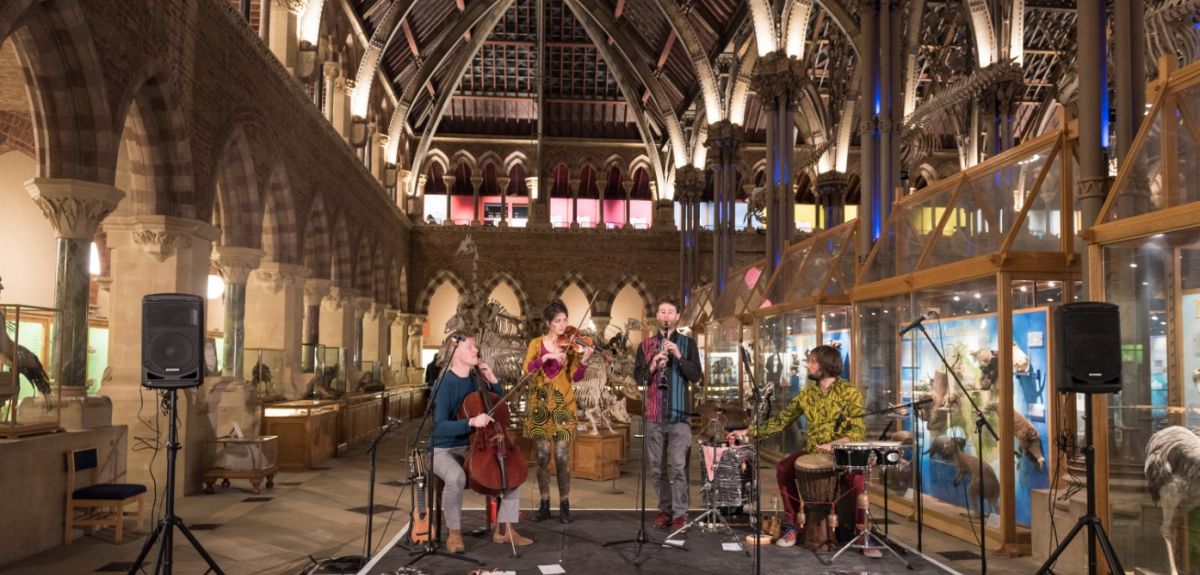
'Lost Late' was a sold-out event held in Oxford late last year, as part of the national Being Human festival.
It was hosted at the Oxford University Museum of Natural History and the Pitt Rivers Museum, and was a collaboration with The Oxford Research Centre in the Humanities (TORCH).
On the night, researchers from across the humanities put on events for the public.
For example, Sally Shuttleworth, Professor of English Literature at Oxford, told some of the 1,600 visitors about a lesser-known aim of many people in Victorian England - to live to 100. "The ‘secrets’ of such long life might strike us as surprisingly modern – cut down on drink, tobacco and meat-eating; don’t overwork, and construct a ‘green’ town, filled with gardens and trees," she said.
"I love events like Lost Late with their blending of research with games or music and drama, and magical transformation of the buildings."
TORCH has partnered with the national Being Human Festival for the last three years. Vicky McGuinness, TORCH Business Manager, said the partnership works well because both organisations have "shared aims of public engagement with research with wider audiences".
"And by collaborating with Pitt Rivers Museum and the Museum of Natural History, we are able to do so in an exciting and diverse environment and give researchers a much larger audience reach," she added.
Here are some photographs from the night:
 Professor Katrin Kohl
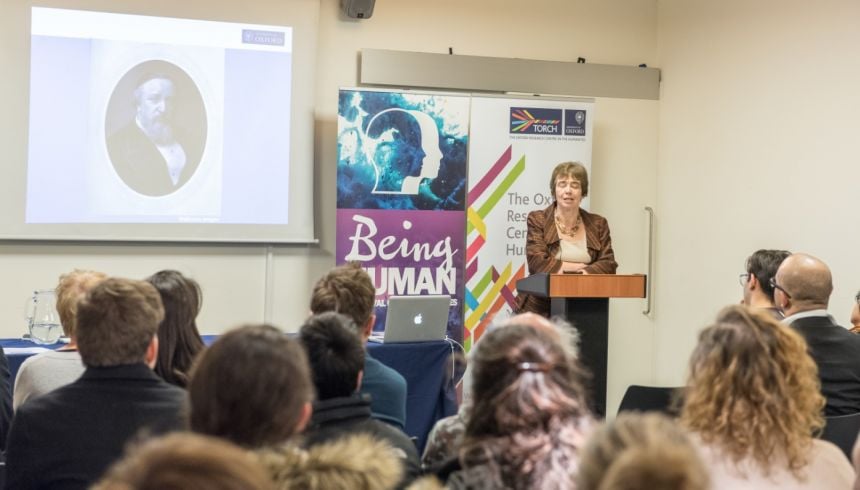 Professor Sally Shuttleworth
- ‹ previous
- 83 of 252
- next ›
 Learning for peace: global governance education at Oxford
  What US intervention could mean for displaced Venezuelans
  Setting the agenda for the next century of quantum
 10 years on: The Oxford learning centre making an impact
 Mapping the Moon: the world’s first lunar atlas goes digital
  Oxford and The Brilliant Club: inspiring the next generation of scholars
 New course launched for the next generation of creative translators
 The art of translation – raising the profile of languages in schools
  Opening a window into the quantum world
 Tracking resistance: Mapping the spread of drug-resistant malaria