Features

A giant study of genetic variants previously associated with cases of severe malaria has tidied up the existing evidence and provided a platform for further discoveries in understanding genetic influences on the disease.
The study confirmed some well-established findings, while more than 20 previously reported associations could not be confirmed.
'The study is important because it has enabled us to evaluate studies that have been published so far,' says Professor Dominic Kwiatkowski of the University of Oxford and the Wellcome Trust Sanger Institute. 'We have been able to distinguish genuine differences from differences due to different methodology or experimental error.'
The research, published in Nature Genetics, also provides insights into the evolutionary battle between the malaria parasite and human populations.
The findings come from a giant research effort, which successfully integrated data from almost 30,000 participants across multiple locations in Africa, Asia and Oceania. Samples were collected from 11,890 children and adults with severe Plasmodium falciparum malaria – either cerebral malaria (coma), or anaemia, or both – and 17,441 healthy controls matched with the cases by ethnic group. The samples were collected in the course of individual studies in Burkina Faso, Cameroon, The Gambia, Ghana, Kenya, Malawi, Mali, Nigeria, Tanzania, Vietnam and Papua New Guinea.
'This was a massive collective effort spanning nearly a decade. Hundreds of people from across our many study sites – researchers, clinicians, field workers, ethicists and others – worked together to build this unique data resource,' says Dr Kirk Rockett, Research Manager at the University of Oxford and a founding member of the MalariaGEN Consortium.
MalariaGEN (Malaria Genomic Epidemiology Network), led by Professor Kwiatkowski, was set up in 2005 to provide access to genotyping and sequencing technologies, and a framework for sharing and integrating data, for a number of partner research groups in malaria endemic countries.
In this new study, the MalariaGEN Consortium set out to replicate the many findings of genetic associations with severe malaria that have been reported in the literature.
'In malaria it's often not possible to replicate findings, because of heterogeneity in host and parasite populations,' says Kwiatkowski. 'We've broken down that hurdle.'
Several genetic loci are already well known to be associated with resistance to severe malaria. Children who inherit one copy of the sickle cell mutation have a ten-fold reduction in their risk of severe malaria, which accounts for the high frequency of this mutation even though it causes serious illness in those who inherit it from both parents. Those who have the O blood group also enjoy significant protection.
The study confirmed these findings to a very high level of confidence, across all the locations in the study. 'That reassures us that our ability to capture real biological effects is very strong,' says Kwiatkowski.
In contrast, more than 20 previously reported associations could not be confirmed. Others appeared to have some influence at some locations but not others.
The study revealed an intriguing and unexpected finding. Carriers of a single copy of the gene variant that causes a condition called G6PD deficiency had been thought to be protected in a similar fashion to sickle cell carriers. However, this study found that although G6PD carriers were protected against cerebral malaria, they were more likely to suffer from anaemia as a complication of malaria.
'Overall, G6PD is not providing strong protection,' says Kwiatkowski. 'This very common human polymorphism turns out to have more complex effects than we supposed, in ways that we don’t fully understand.'
It is not obvious how a mutation with such contrasting effects might have emerged during human evolution. One possibility is that it became common as a result of "balancing selection" by a different malaria parasite, Plasmodium vivax, which no longer exists in much of Africa. The mutation would then persist there merely as an evolutionary throwback.
'Life has got more interesting,' says Kwiatkowski. 'In different places, the evolutionary battle between host and parasite has played out in different ways. And it's clear that in order to understand resistance, you need to amalgamate data from many places. Our study has provided a platform for the discovery of new loci associated with resistance to malaria.'
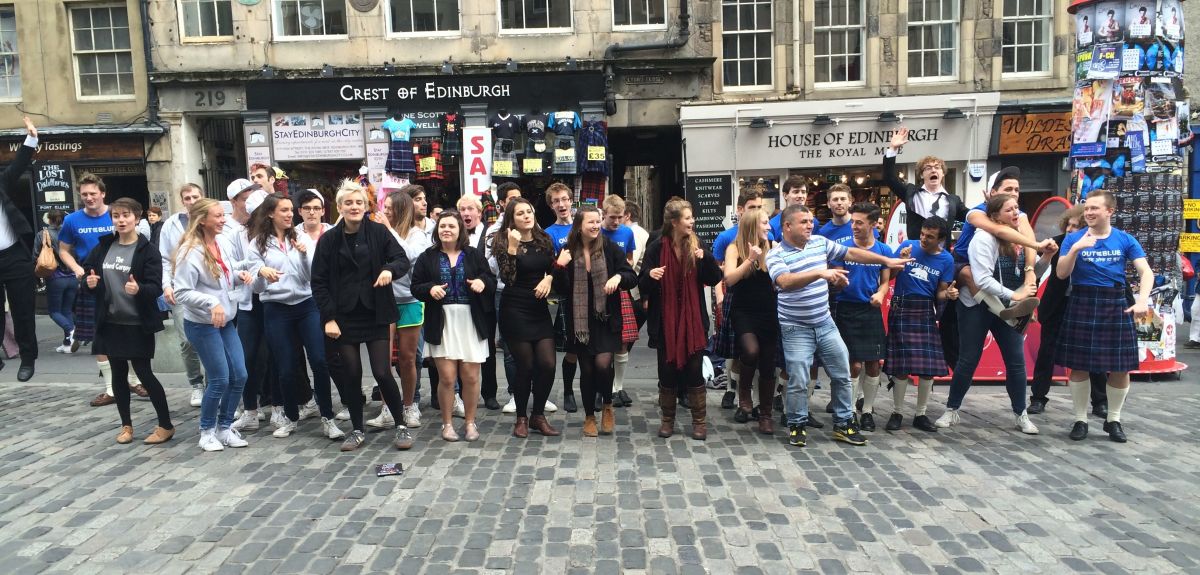
Every summer student singers, actors and comedians travel to Edinburgh to cut their teeth at the Fringe Festival. This year established comedy groups Oxford Revue and Oxford Imps performed, as well as newer comedy shows such as ‘Big Brass’ and ‘No Strings’. But the largest group of Oxford students at the Fringe were there to sing a capella.
The Oxford Gargoyles, Out Of The Blue, The Oxford Alternotives, In The Pink and The Oxford Belles all took shows to Edinburgh last month. In a guest blog, Emma Fox and Daniel Overin of The Oxford Gargoyles explain the popularity of a cappella and describe their time at the Fringe:
‘A cappella at the Edinburgh Fringe has never been stronger, with collegiate and professional groups dominating the busking stages on the Royal Mile – the hub of show advertising in Edinburgh during the Fringe. With the release of the film Pitch Perfect 2 on the horizon, and the ever-increasing fame of a cappella groups such as Pentatonix, the building interest in a cappella is hardly a surprise.
'With our diverse individual styles, the collective a cappella groups gave people a wide variety of genres and sounds to choose from. While many of the groups mostly offered their own distinctive takes on pop music, our group, The Oxford Gargoyles, was one of the only groups offering an exclusively jazz a cappella show.
'Our audiences consisted of a cappella and jazz fans in equal measure (and many who are fans of both genres), as well as those who were not necessarily interested in either, but had liked what they had seen or heard from us on the Royal Mile.
'This year's Fringe was notable for the friendly relationships between all of the a cappella groups. There is certainly an element of competition between the groups when it comes to advertising, as the target audiences of each group tend to be quite similar. However, this year, the overall feeling amongst the groups was one of comradery, rather than hostility or competition.
'One of the most effective ways of advertising a show is getting up on one of the dedicated busking stages on the Royal Mile and singing a short set. Handing out flyers and busking at the same time, though, can prove a little tricky at times. We overcame this problem by taking turns to hand out one another's flyers – when one group was busking, another would hand out flyers on their behalf.
'About halfway through our run at the Fringe, All The Kings Men – an all male group from King’s College London - hosted a showcase featuring many of the different a cappella groups at the Fringe. This was a great opportunity to hear the other groups sing a short set (something we wouldn’t have had the opportunity to do otherwise because many of our shows were scheduled at similar times), but also simply an enjoyable evening that saw us sharing a passion we all have in common.
'The final day of the Fringe saw positive a cappolitical relations come to a head, as the groups joined together to perform some rousing renditions of some of the best-known and best-loved a cappella arrangements that had been sung on the busking stages throughout August.
'One of the featured pieces was a Gargoyles take on Soul Bossa Nova (the theme from Austin Powers) - a catchy number, and a favourite of the Fringe. Fifty a cappella singers (some wearing kilts, others in black tie) were a sight to behold and, judging by the audience’s faces, they were having as much fun watching us as we were performing.
'The Edinburgh Fringe run is taxing for every a cappella singer but it is also tremendous fun and extremely rewarding. Delivering great show after great show might take a lot of energy but the buzz you receive from an audience screaming for an encore is incredible.
'Memories and friendships are forged within and between a cappella groups and you end up returning home absolutely shattered but eagerly awaiting next year to do it all again.'
The Oxford Gargoyles' show received a five star review from BoxDust and a four star review from Broadway Baby. Their time at the Fringe is captured in this video by Jack Solloway:
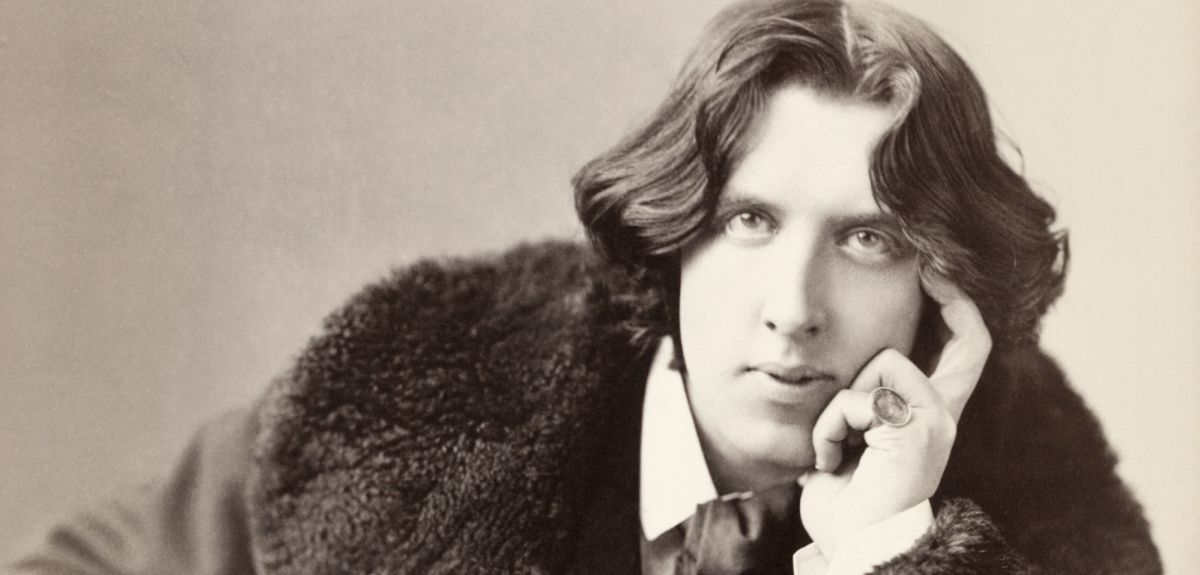
160 years after Oscar Wilde's birth, an Oxford University student hopes to introduce visitors to a city that had a profound impact on Wilde's development as a writer and thinker: Oxford itself.
Wilde's ties to Dublin, London, Paris, or even New York are well known. However, Iarla Manny, a doctoral student in the Faculty of Classics, believes Oxford was just as important as these cosmopolitan hotspots for Wilde, who read Classics as an undergraduate at Magdalen College from 1874 to 1878.
Drawing on his research, which focuses on Wilde’s relationship with classical antiquity, Mr Manny is now producing a guided audio walking tour of Oxford in partnership with a new travel company, Oscar Wilde Tours.
'It's not for nothing that Wilde's biographer Richard Ellmann declared that he "created himself at Oxford",' said Mr Manny. 'It was a pivotal period for him. Later on, looking back at his life after his trials and imprisonment for "gross indecency", Wilde would write in a letter from Reading Gaol to his lover Lord Alfred Douglas that "the two turning-points in my life were when my father sent me to Oxford, and when society sent me to prison".
'So you can see the significance Oxford held for him, even almost two decades after he had left it. Douglas himself was a Classics student at Magdalen when he first became involved with Wilde, and Wilde frequently found reasons to return to Oxford after he left.'
One of Mr Manny's main intentions in producing an audio tour based around Wilde’s time in Oxford has been to investigate the relationship between physical space and individual identity. He said: 'One of the great things about Oxford, then as now, is that it gives its students the opportunity to think through the big questions, and to work out who they are and what they believe.
'Wilde would have looked at issues of life and art through the lens of Classics, which was at the heart of the humanities at the time. For Wilde this search for enlightenment and self-definition was intimately bound up with different locations.
'He was torn between pagan Greece and Papal Rome, which symbolised the two sides of his sexual and religious struggles. Wilde visited both places during his classical studies, but for the budding poet and playwright Oxford was "paradise" and "in its own way as memorable as Athens".'
He added: 'Long after taking his degree, Wilde continued to contemplate the philosophical questions that had occupied him at Oxford. He appears to have followed in the footsteps of the Athenian Socrates by adopting as his mottos the inscription at Delphi "Know thyself" and the maxim that "the unexamined life is not worth living". With my audio tour, I hope to map Wilde’s metaphorical journey of self-discovery and self-creation at Oxford onto a literal journey through the city.'
Oscar Wilde Tours is run by classicist Andrew Lear, and specialises in developing tours exploring gay history. Mr Manny's public-engagement proposal was awarded funding from the Arts & Humanities Research Council as part of the Communicating Ancient Greece and Rome programme, organised by the Archive of Performances of Greek and Roman Drama based in the Faculty of Classics. His audio tour project is expected to be completed in early 2015.

Oxford academics will discuss major ethical issues in a series of free podcasts released over the next two months.
The Practical Ethics Bites Podcasts cover subjects such as war, euthanasia and abortion and are aimed at schools. Podcasts will be released every Wednesday until 5 November.
The podcasts will feature leading academics in the Oxford Uehiro Centre for Practical Ethics, which is part of the Faculty of Philosophy. They are professionally produced by the team behind the Philosophy Bites podcasts.
Dr Dominic Wilkinson, director of medical ethics at the Uehiro centre, is interviewed in the first podcast titled 'Should euthanasia be legal?' He said: 'These podcasts will bring ancient and modern philosophical thinking to bear on some of the most important ethical issues facing humanity today, and we hope it will engage students in philosophy, as well as a wider audience.'
Full list of podcasts:
Dr Dominic Wilkinson: should euthanasia be legal?
Professor Roger Crisp: what is virtue ethics? (release date 24 Sep)
Professor Neil Levy: free will, and its connection to moral responsibility (release date 01 Oct)
Professor Julian Savulescu: choosing the sex of your child (release date 08 Oct)
Dr Rebecca Roache: the rights and wrongs of abortion (release date 15 Oct)
Professor Jeff McMahan: is there such a thing as a just war? (release date 22 Oct)
Professor Janet Radcliffe Richards: the ethics of homosexuality (release date 29 Oct)
Dr Tom Douglas: should we allow genetic engineering on embryos? (release date 05-Nov)

With each passing day it seems that the torrent of data generated by devices such as computers and smart phones grows ever greater.
If we humans are struggling to cope with this 'information overload' then spare a thought for the machines tasked with trying to improve web searches, understand the content of video and images, translate speech, and even analyse genomes.
Machine learning, where computers figure out 'for themselves' how to perform data analysis, modelling and inference, and optimisation, finding the best solution to a problem from a set of alternatives, can help us to manage our data-rich lives. But there's a problem:
'Machine learning and optimisation are important, but they are hard for conventional computers,' Simon Benjamin of Oxford University's Department of Materials tells me. 'The tasks don't scale well. Suppose that you can 'just about' handle some particular task, but then you instead try to handle a task that is twice as complex. Then it can be vastly more difficult for the computer, practically impossible, even if you bring in lots more computers to help.'
Now a new project starting this month called Quantum Optimisation and Machine Learning (QuOpaL), jointly supported by Oxford University, Nokia, and Lockheed Martin, is setting out to explore the potential for quantum technology to enhance optimisation and machine learning tasks.
'The hope is that by harnessing quantum effects, we can tackle things in a fundamentally different way and then the learning process will scale better – allowing us to get to the really tough tasks that reach far beyond human capabilities,' explains Simon, who is leading the Oxford side of the project with Steve Roberts of the Department of Computer Science.
From search engines such as Google to the speech recognition software powering Apple's Siri, machine learning and optimisation are already part of our everyday lives but they are also at work behind the scenes in service industries and manufacturing:
'Another example is predicting things, like anticipating the supply needs of a big supermarket chain based on analysing loads of sales data from previous months,' adds Simon. 'But the applications go even further including finding the 'best way' to solve problems. For example, Intel researchers were able to show that improved computer optimisation of the design of silicon chips can reduce power consumption by 38%. These, and many other applications, are potentially areas where quantum machine learning and optimisation can help.'
QuOpaL will examine a range of approaches being developed as part of research into quantum information processing – using effects in the quantum world to store and manipulate information. One of the most promising is adiabatic quantum optimisation (and the closely related phenomenon of quantum annealing). Here, a system is initialised to a simple state and then the conditions are slowly ('adiabatically') changed to reach a complex final state that describes the solution to a computational problem. Many believe that this approach is the best way to start using quantum effects for accelerated machine learning.
'The idea that harnessing quantum physics can help with hard computing tasks has been around for nearly thirty years, and has driven a worldwide race to develop the necessary hardware,' Simon tells me. 'The exciting news is that the hardware is nearly ready! What we can now do in Oxford and in other leading labs elsewhere in the world, is to make components that meet and exceed the necessary performance figures for a real working device. Now, we have to build it!
'For machine learning in particular there is also some important theory that needs to be worked out to fully understand the best way to exploit the quantum effects for the different kinds of application. It's very timely to be starting QuOpaL - the project is up and running and we're recruiting, looking at people from all sorts of backgrounds to join this interdisciplinary project. I'm very excited about it!'
- ‹ previous
- 163 of 253
- next ›
 25-year Oxford study finds the effects of conflict last for generations
 What Louise Thompson’s campaign tells us about the national maternity crisis
 Celebrating 25 Years of Clarendon
  Learning for peace: global governance education at Oxford
  What US intervention could mean for displaced Venezuelans
  Setting the agenda for the next century of quantum
 10 years on: The Oxford learning centre making an impact
 Mapping the Moon: the world’s first lunar atlas goes digital
  Oxford and The Brilliant Club: inspiring the next generation of scholars
 New course launched for the next generation of creative translators