Features

TORCH (The Oxford Research Centre in the Humanities) will welcome Ms Nur Laiq as its Global South-Mellon Visiting Professor 2019-2020.
Nur Laiq is a public policy practitioner. She has sought to investigate the combustible power of identity and politics, based on her ground experience in the political and policy arena. Her research aims at bridging the gap between academia and policy.
Ms Laiq has worked on policy with political parties in India and Britain, as well as in the Policy Planning Unit of the UN Department of Political Affairs Policy in New York, with a particular focus on sustaining peace – the idea that nations need to continuously invest in the fundamentals of inclusion and equality to keep war at bay. She also served on the UN Advisory Group on Youth, Peace and Security, appointed by the UN Secretary-General.
Ms Laiq has been a senior policy analyst at the International Peace Institute in New York, a stagiaire at the European Commission DG External Relations in Brussels, and holds a visiting fellowship at the Centre for Policy Research in New Delhi. She has an MPhil in Modern Middle Eastern Studies from St Antony’s College, Oxford, which included studying Arabic in Damascus and Persian in Tehran.
Her publications include Talking to Arab Youth: Revolution and Counterrevolution in Egypt and Tunisia (New York: International Peace Institute, 2013), based on fieldwork with social movements and political parties across the entire ideological spectrum in Egypt and Tunisia following the 2011 uprisings. She is co-editor of The Search for Peace in the Arab-Israeli Conflict (Oxford: Oxford University Press, 2014), which aims to offer policymakers a toolbox of options for negotiations, based on documentary history and interviews conducted with Arab, Israeli and American stakeholders. Ms Laiq has been a member of the United Nations advisory group for The Missing Peace: Independent Progress Study on Youth and Peace and Security (New York: United Nations, 2018) and the Center for American Progress task force for The United States and India: Forging an Indispensable Democratic Partnership (Washington, DC: Centre for American Progress, 2018).
Drawing on her experiences, Ms Laiq is working on a book project on the new varieties of liberal responses to new strands of populism and the politics of identity. She seeks to explore the flammable properties of grievance, aspiration and insecurity and the power of narratives in these situations, based on her work on the ground. She sifts through the changing discourse around inequality and identity as the idea of civic nationalism faces grave challenges in both the Global North and South. Her study of shifting political assumptions and practices necessarily takes an interdisciplinary approach.
TORCH welcomes Ms Laiq's knowledge and expertise, which will provide a timely contribution to ongoing work to bring together researchers and policymakers interested in the future of identity, and consequently the future of democracy, peace and security. This is a theme explored in the TORCH headline series ‘Humanities and Identities’.
Ms Laiq said: ‘I am pleased to be joining TORCH and working with Professor Rana Mitter, the History Faculty and the Blavatnik School of Government. I look forward to engaging with students and academics on the navigation of identity and politics in contemporary politics, which is a work in progress. I am excited to be part of a forum for the exchange of ideas between policy experts, politicians, and the Oxford academic community.'
Rana Mitter, Professor of the History and Politics of Modern China at Oxford University, said: ‘I am delighted to be Ms Laiq’s academic host during her permanence in Oxford. We are working on an exciting schedule of events to allow Nur to engage with students and academics from the University. Discussions on populist politics and the Indian elections, as well as graduate workshops on policy, will feature in it.’
Nur Laiq is based in TORCH from Trinity Term 2019 through 2020.
The TORCH Global South Visiting Professorships Programme is designed to bring world-leading figures to the University of Oxford for at least one term and be included in the teaching and research environment, hosted by leading academics in the humanities. Funded by the Andrew W. Mellon Foundation, the Programme is a collaboration between the Faculties of the Humanities Division and Colleges of the University of Oxford.

Oxford neuroscientists are marking British Science Week and Brain Awareness Week (11th-17th March 2019) with an interactive experiment to help schoolchildren understand how to improve their revision skills.
Researchers from Oxford Neuroscience have designed a fun game that can be downloaded and played on a phone, which will test whether cramming for exams is successful, or whether learning something over a longer period of time produces a better outcome.
Once downloaded, users will be sorted into two groups: one group will take part in the quick learning, which is done in a single day, and the second group will be selected to take part in a week of learning, where they will play the game every day.
The University of Oxford will be collecting anonymous data about which group of people has most success in the game.
The results from the 'Find the Brain' game will be revealed live on Friday 15 March at 3.00pm, as a volunteer also plays the game while in an MRI scanner to show what’s going on in our brain when we are learning.
Throughout Brain Awareness Week there will also be events to delve into more detail about how the brain learns, how we can re-learn after stroke, how we learn during adolescence, and how sleep and exercise affect our learning.
Through interactive Facebook Lives with researchers, Twitter Takeovers and podcasts, researchers will be working with young people to explore how we can improve the way we learn.
Find out of you are a crammer or a planner by downloading the game from the dedicated microsite that has been created in partnership with British Science Week: www.oxfordsparks.ox.ac.uk/brain-discovery-week
Watch the results of the fun experiment revealed live from the fMRI scanner at the University of Oxford on Friday 15 March, 3.00pm, to find out who learned best: the crammers or the planners! www.facebook.com/OxSparks

By Dr Wahbi El-Bouri
There are over 1.2 million stroke survivors in the UK, with 100,000 strokes happening in the UK each year. That’s the equivalent of one stroke every five minutes. They are also the leading cause of disability in the Western world.
Research underway in the Department of Engineering Science’s Cerebral Haemodynamics Group, headed up by Professor Stephen Payne, is changing our understanding of blood flow around the brain. Here, I explain how this could speed up the arduous process of bringing stroke drugs to market.
Our research has two main questions. Firstly, can we model blood and oxygen transport in the entire human brain, across the billions of blood vessels present? And secondly, can we run in-silico clinical trials (that is, trials performed entirely on a computer) of stroke and stroke treatment?
This is what we are tackling as part of a Horizon 2020 project (In-Silico Trials for Treatment of Acute Ischaemic Stroke) alongside European research collaborators from 10 other institutes, including radiotherapists, clinicians, academics, and industrial partners.
A continuous supply of oxygen and glucose, via the bloodstream, is essential to maintain healthy brain function under all circumstances. Whereas the rest of our body can release stored-up energy when we feel hungry, the brain has no such reserves. As such, any reduction in blood flow to the brain, even if only for a few minutes, can lead to cell death and loss of brain function. A large reduction of blood flow for a prolonged period of time, whether through a blocked or ruptured vessel, is known as a stroke.
In addition, dementia (the leading cause of death in the UK) is increasingly being linked to changes in our smallest blood vessels, or microvasculature, as we age. There is clearly an urgent need to understand the mechanisms of stroke and brain ageing in order to combat these debilitating diseases.
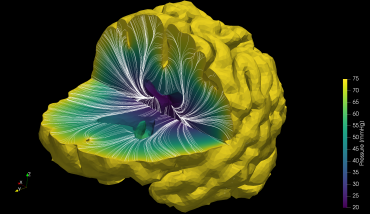 Capiliary velocity
The starting point for these models must be real-life data. Unfortunately, due to the low resolution of current clinical imaging modalities, the only way we can currently ‘see’ the smallest vessels in the brain (which average 1/10th the width of a human hair) is to image slices of dead human brains. Using these, researchers construct networks on a computer and simulate blood and oxygen transport. However, we quickly run into the problem of scaling up these networks to encompass the billions of blood vessels that make up the human brain.
Our team is using mathematical tools developed for use in the oil and gas industry, who have been trying to model water and oil flow through rock for decades. We treat the brain as a chunk of porous rock and hence approximate the flow through our brain, as opposed to modelling the flow in each individual vessel. This allows us to rapidly produce full brain computer models of blood and oxygen transport!
The models that we are developing, along with models of clot formation, clot removal using a stent and thrombolysis (dissolving the clot with drugs), will be used to run clinical trials on computers that can be personalised and help to inform real-life clinical trials. For example, certain geometries of blood vessels or certain clot positions may be more amenable to a certain treatment.
This knowledge, from the in-silico clinical trial, can then inform a real-life trial to target treatment to those people and hence improve the chances of that stroke treatment being brought to market and used to save lives. In the future, these models could be used to simulate a variety of neurological diseases and help us to understand the human brain, in both health and disease.
Read more about the Cerebral Haemodynamics Group’s research.
Find out more about Brain Awareness Week at Oxford.
This article was published to mark Brain Awareness Week, a global campaign running from 11-17 March.

The concept of equilibrium is one of the most central ideas in economics. It is one of the core assumptions in the vast majority of economic models, including models used by policymakers on issues ranging from monetary policy to climate change, trade policy and the minimum wage. But is it a good assumption? In a recently-published Science Advances paper, Marco Pangallo, Torsten Heinrich and Doyne Farmer from the University of Oxford, investigate this question in the simple framework of games, and show that when the game gets complicated this assumption is problematic. If these results carry over from games to economics, this raises deep questions about when economics models are useful to understand the real world.
Kids love to play tic-tac-toe, aka noughts and crosses, but when they are about 8 years old they learn that there is a strategy for the second player that always results in a draw. This strategy is what is called an equilibrium in economics. If all the players in the game are rational they will play an equilibrium strategy. In economics, the word rational means that the player can evaluate every possible move and explore its consequences to their endpoint and choose the best move. Once kids are old enough to discover the equilibrium of tic-tac-toe they quit playing because the same thing always happens and the game is really boring. One way to view this is that, for the purposes of understanding how children play tic-tac-toe, rationality is a good behavioural model for eight year olds but not for six year olds.
In a more complicated game like chess, rationality is never a good behavioural model. The problem is that chess is a much harder game, hard enough that no one can analyse all the possibilities, and the usefulness of the concept of equilibrium breaks down. In chess no one is smart enough to discover the equilibrium, and so the game never gets boring. This illustrates that whether or not rationality is a sensible model of the behaviour of real people depends on the problem they have to solve. If the problem is simple, it is a good behavioural model, but if the problem is hard, it may break down.
Doyne Farmer, Professor of Mathematics at the University of Oxford, said: ‘Many of the problems encountered by economic actors are too complicated to model easily using a normal form game. Nonetheless, this work suggests a potentially serious problem. Many situations in economics are complicated and competitive. Our research raises the possibility that many important theories in economics may be wrong. If the key behavioural assumption of equilibrium is wrong, then the predictions of the model are likely to be wrong too. In this case new approaches are required that explicitly simulate the behaviour of the players and take into account the fact that real people are not good at solving complicated problems.’
Theories in economics nearly universally assume equilibrium from the outset. But is this always a reasonable thing to do? To get insight into this question, the researchers studied when equilibrium is a good assumption in games. They didn’t just study games like tic-tac-toe or chess, but rather they studied all possible games of a certain type (called normal form games). They made up games at random and had two simulated players play them to see what happens. The simulated players used strategies that do a good job of describing what real people do in psychology experiments. These strategies are simple rules of thumb, like doing what has worked well in the past or picking the move that is most likely to beat the opponent’s recent moves.
The researchers demonstrated that the intuition about tic-tac-toe vs. chess holds up in general, but with a new twist. When the game is simple enough, rationality is a good behavioural model: players easily find the equilibrium strategy and play it. When the game is more complicated, whether or not the strategies will converge to equilibrium depends on whether or not the game is competitive. If the incentives of the players are lined up they are likely to find the equilibrium strategy, even if the game is complicated. But when the incentives of the players are not lined up and the game gets complicated, they are unlikely to find the equilibrium. When this happens their strategies always keep changing in time, usually chaotically, and they never settle down to the equilibrium. In these cases equilibrium is a poor behavioural model.
A key insight from the research is that cycles in the logical structure of the game influence the convergence to equilibrium. The researchers analyse what happens when both players are myopic, and play their best response to the last move of the other player. In some cases this results in convergence to equilibrium, where the two players settle on their best move and play it again and again forever. However, in other cases the sequence of moves never settles down and instead follows a best reply cycle, in which the players’ moves keep changing but periodically repeat – like “ground hog day” over and over again. When a game has best reply cycles convergence to equilibrium becomes less likely.
Using this result the authors have been able to derive quantitative formulas for when the players of the game will converge to equilibrium and when they won’t, and show explicitly that in complicated and competitive games cycles are prevalent and convergence to equilibrium is unlikely.
Read the full paper: 'Best reply structure and equilibrium convergence in generic games' in Science Advances.
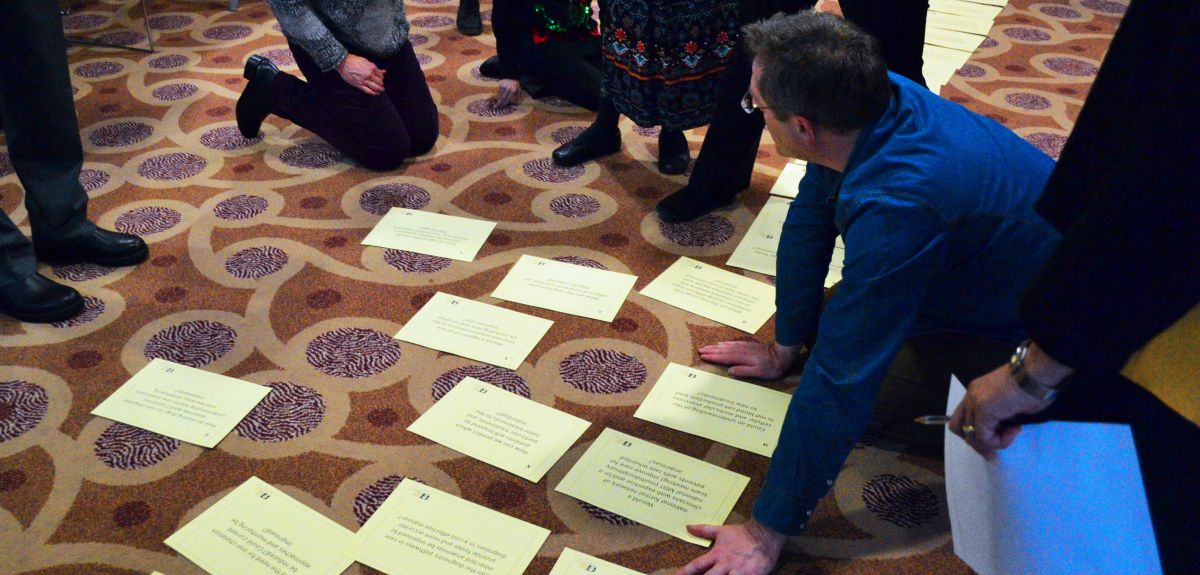
To mark rare disease day, Dr Noemi Roy talks about a two year project working with patients with rare forms of anaemia, and how she hopes this will translate into research in this area.
Rare Disease Day. It’s only one day, right? Like yesterday was International Polar Bear day, and tomorrow will be Employee Appreciation Day. Now, I have nothing against polar bears, and I’m all for appreciating employees. But let’s spend more than a day thinking about rare diseases. Rare diseases sound, well, rare, and “nothing to do with me, really.”
In fact, there are “over 6,000 rare diseases that affect over 300 million people worldwide”. This works out to 1 in 17 people being affected by a rare disease at some point in their life.
I am a researcher at the MRC Weatherall Institute of Molecular Medicine at the University of Oxford, but also a clinician looking after patients with rare inherited anaemias. These patients are born with a genetic abnormality that means they either can’t make red blood cells at all, can’t make enough normal ones, or their red blood cells are fragile and get destroyed too early. Not enough red blood cells means not enough oxygen to the body. Some patients suffer with fatigue and weakness and can’t keep up with their peers in normal daily activities, while others need blood transfusions. At the worst end of the spectrum are patients whose lives depend on blood transfusions every three weeks from birth.
Research into rare anaemias (as with all rare diseases) is poorly funded. Furthermore, patients’ opinions about what aspect of their condition warrants most urgent research are not heard. Mostly because nobody has asked them, or perhaps no one has thought to ask. Perhaps there is worry that the issues raised may be inconvenient for doctors and researchers alike. Whether conditions are common or rare, the research agenda (the hypotheses being tested) is set by the researchers themselves or pharmaceutical companies. All on behalf of the patients, of course. But doing things on behalf of the patients is no longer acceptable- we need to do things with patients.
Hard work
There are a lot of valid concerns raised about asking patients for what they think the research questions should be for their condition. Which patients are we asking exactly? How do we know they are representative of all the patients with that condition? How will patients know enough about fundamental science to even raise some critical issues that warrant research for new therapies to be discovered?
Even so, a nation-wide survey into topics identified by patients as being priorities topics for conditions they live day with everyday out has yielded important results. One method of carrying this out is via a James Lind alliance Priority Setting partnership. These partnerships have been used to gather patient-driven research priorities in over 90 conditions ranging from acne, through to depression, stillbirths and schizophrenia. Interestingly, a common theme in all the results from these surveys is that patients repeatedly say that they want further research into how their quality of life can be improved and symptoms controlled, rather than research on just finding a new cure.
In 2016, we set about carrying out a James Lind Alliance Priority Setting Partnership survey into rare inherited anaemias.
I won’t lie, it is hard work. It is very time consuming and because it’s done in partnership with patients, it follows a different format compared to a group of doctors getting together and doing the same thing on their own.
But the whole point is that the end result is different from what it would be if it was doctor-driven. Not only different, but better.
We put together a steering committee of patients, patient support groups, carers, charities, doctors and researchers, and then ran a nation-wide survey asking patients and doctors what they thought were the key questions that should feature on the research agenda. Once we received about 500 answers, we sifted through them to remove anything out of scope and grouped similar questions together. This left us with 75 questions.
We then ran another, separate survey asking people to prioritise all 75 of these research priorities, ending up with 25 key questions. Our project culminated in a one-day workshop where patients, carers, charity representatives and doctors discussed and debated the merits of all 25 questions and came up with a mutually agreed Top 10.
Very nice, beautiful. A lovely list. Developed with patients. We can feel good about ourselves.
But what next? Well, research money needs to be funnelled into projects that address these topics. Part of that will rely on the funding bodies preferentially giving money to projects that tackle these questions. Part of that will depend on charities and patient organisations fundraising specifically for these questions to be answered.
And part of that will result from a change in culture. Because everyone who participated in this project came out a different person. During the 2 years working together and at the final workshop, I heard doctors telling patients they hadn’t realised how important some symptoms were to their lives, and I saw doctors change their opinions after listening to patients. Not only in a specific scenario, but more generally in their attitude to patient involvement in research. Likewise I saw patients grow in confidence and start to believe that they can change the way things are done and the path of research in the future.
I will end with a patient’s voice- someone who was part of this two-year process:
'I can help future generations and raise the profile of rare anaemias. This work makes me feel like I have a part to play and that even though you’ve got a rare condition, you can still make a difference' - Rachel
- ‹ previous
- 58 of 252
- next ›
 Learning for peace: global governance education at Oxford
  What US intervention could mean for displaced Venezuelans
  Setting the agenda for the next century of quantum
 10 years on: The Oxford learning centre making an impact
 Mapping the Moon: the world’s first lunar atlas goes digital
  Oxford and The Brilliant Club: inspiring the next generation of scholars
 New course launched for the next generation of creative translators
 The art of translation – raising the profile of languages in schools
  Opening a window into the quantum world
 Tracking resistance: Mapping the spread of drug-resistant malaria