Features

Prof Armand D’Angour tells Arts Blog about the power, excitement, and drama of ancient Greek music
Thinking about ancient Greek poetry and drama, we tend to overlook a very important aspect. 'All the great poetry, from Homer through to the lyric age, and the great Greek tragedians – most of that was music,' says Professor Armand D'Angour. It was sung, played, and even danced.
Armand D’Angour is a Professor in Classical Languages and Literature (Faculty of Classics) at Jesus College. Formerly a professional cellist, he is currently engaged on a project to reconstruct ancient Greek music.
'I try to bring together all the different elements,' he says. 'My particular expertise is in ancient metre and rhythm. The rhythms are quite complicated and their names are quite off-putting, so my approach is to say "Let’s just hear what we’re talking about".'
Experts on ancient music theory have long understood the general principles of Greek melody. 'Ancient Greek has a natural melody - there was a pitch change on different syllables of words,' says Prof D'Angour. Ancient documents confirm that song melodies generally imitated the natural rising and falling pitch of words.
Prof D’Angour is working on scores and literary texts preserved on papyri and stone with musical notation above the words. 'When you have an ancient text, very often it’s got bits missing, but because we know the rhythms, we can conjecture what was in the gaps,' he explains. 'So also with the music.'
The ultimate goal is not an ‘accurate’ reconstruction, which is not only impossible but would misrepresent what ancient Greek music was like. 'Music was mostly orally transmitted. It wasn’t written down, it wasn’t recorded,' says Prof D'Angour. 'You cannot ‘recapture’ any single performance, and they were all different. Music was variable, but within the framework of an idiom.'
'What I'm trying to do is understand the musical idiom of ancient Greece – the general melodic and rhythmic principles of music. I want to say: Look, this isn’t the way it was sung, but this accords with the prevalent melodic idiom. If ancient Greeks heard it now, they would understand it to be their kind of music.'
It is not that an understanding of ancient Greek music and musical notation has ever really been lacking. Thanks to treatises like that of Alypius (5th century AD), following on the Elements of Harmony by Aristoxenus of Tarentum (4th century BC) and Harmonics by Ptolemy (2nd century AD), we know what the signs mean and how the modal systems worked. What Prof D’Angour is doing is trying to make coherent musical sense of what we have.
Now that there is music to play, Prof D’Angour’s reconstructions can be performed with a whole chorus and the two main instruments that were used in ancient Greece: lyre (or kithara) and double pipes (aulos). 'We don’t have any archaeological records of lyres, because they were made from wood and animal gut which perished,' he says.
But from ancient vase painting and descriptions in texts we can tell more or less what the size, shape, and look they would have had. 'We can then make them and play them.'
We tend to talk as if there was just one kind of Greek music, but in fact 'there were hundreds of different kinds of music'. And it was as ubiquitous as it is now: you could hear it in the home, in the temple, in the theatre. 'And of course ancient authors tell us what effect it had: it was moving, it sounded tragic, it was joyful or triumphant,' says Prof D'Angour.
Ancient Greek conservatives like the philosopher Plato thought that the kind of music you listened to affected your character. “Popular” music wasn’t beautiful, therefore it was bad. However, it could be effective, exciting, sublime. 'It wasn’t beautiful according to traditional canons of beauty.'
Looking at contemporary times, Prof D'Angour notes that 'the same aesthetic debate was going on: is beauty the criterion of goodness in art and music? Music is also about power, excitement, drama, which may be no less important.'

The discovery of a new species of pistol shrimp off the coast of Panama by a team of researchers including Dr Sammy De Grave of Oxford University’s Museum of Natural History was announced yesterday.
The news made headlines across the world – partly because of the shrimp’s bright pink claw, but also because Dr De Grave and his colleagues decided to name the shrimp Synalpheus pinkfloydi after the band Pink Floyd.
This gave journalists the chance to flex their headline-writing muscles. ‘Shrimp found on the Dark Side of the Lagoon,’ said the Oxford Times. Many went for the less imaginative ‘Shrimp Floyd’.
In trying to think of a headline for this article, Arts Blog came up with Brine On You Crazy Diamond, Goodbye Krill World, Fish You Were Here, Dark Side Of The Tuna and Another Shrimp In The Wall. All ended up in the bin.
Although this all seems like a lot of fun, naming the shrimp after Pink Floyd actually helped Dr De Grave and his team to get across the shrimp’s features: by closing its enlarged claw at rapid speed, the shrimp creates a high-pressure cavitation bubble.
When this bubble implodes, it creates one of the loudest sounds in the ocean, which is strong enough to stun or even kill a small fish.
That never happened to any of Pink Floyd’s fans who stood next to the amps during a gig.

100 years ago this week, the poet Edward Thomas died at the Battle of Arras in World War One.
Although he is celebrated as a war poet, Thomas’ poems rarely dealt directly with the conflict.
Dr Stuart Lee of the Faculty of English Language and Literature and IT Services started the First World War Poetry Digital Archive, which crowdsourced over 7,000 items of text, images, audio and video related to the First World War for teaching, learning and research.
Dr Lee says Thomas is a significant poet from the war era because, unlike the war-focused poems of Wilfred Owen and Siegfried Sassoon, his poetry represents what so many people back in the UK felt during the war.
'I think he’s a wonderful poet and he certainly deserves recognition because from that period he points us to another side of the war, the people who were at home who could just see the effects and playing on their mind,' he says.
'In poems like Rain and Owl he clearly is at home but his mind is going to those men on the front who are suffering for him and suffering for his country.
'He also presents probably what many people felt in terms of the attitudes of the war – he is not jingoistic and at the same time he’s not a pacifist, he’s right in the middle saying I don’t hate Germans and I don’t love England in the way the newspapers want me to, but I need to fight.
'It focuses us on the discussion of what we mean by a war poet and war poetry. We tend to think of Wilfred Owen and Siegfried Sassoon and the likes because they were competent poets and they write about their experience in the trenches, but of course the war like all wars affected people who never actually served, who were on the home service, or who just experienced the war.
'Thomas was one of those men who was tackling a great problem which many people had to face up to, of what involvement he should have in the war.'
Dr Lee was interviewed about Edward Thomas on the BBC World Service this week. The full interview can be found at 48 minutes 30 seconds.

A new seminar series at Oxford explores different perspectives on violence.
It was set up by Rachel Kowalski at the beginning of this academic year, just a few weeks after beginning her doctorate in Irish history as a Wolfson Scholar.
‘I spoke to The Regius Professor of History, Lyndal Roper, about wanting to bring people from different disciplines together to talk about violence,’ she says. ‘She suggested that I start a reading group but I decided to take it a step further and launch a seminar series.
‘I enjoy the discursive element of a seminar, as opposed to that of a reading group or a lecture series. Each academic who featured spoke for an hour and then led 30 minutes of discussion, a format that proved to be successful.’
The purpose of the series is to study violence in its own right.
‘It is important to study 'violence' as a separate phenomenon to 'war', 'terrorism' or 'genocide', in order to understand why and how it happens,’ says Rachel. ‘The external factors and personal idiosyncrasies which drive and individual to commit violence can become lost in the greater narrative of a war or conflict.
'And the dynamics which shape the nature of any violent attack can only be surmised from understanding violence at a local or individual level. Why, for instance, are some attacks especially brutal, exceed what would be clinically required to take the life of an individual, and venture into what can only be perceived as cruelty?'
The series began with Dr Kieran Mitton from King's College London talking about ‘Irrational Actors in the Theatre of War’ focusing on Sierra Leone and the psychology behind violence. Many of Dr Mitton’s ideas about violence are found to be at the core of Rachel’s series as he argues that ‘normally when we delve into seemingly senseless acts of violence we can find a logic to them’.
The series has been varied in its content. It has covered Irish history, with Rachel’s own seminar on ‘Ethical Guerrilla Warfare, Terrorism, and the Provisional IRA’, Latin American topics, and other more general themes such as genocide.
A key feature of the series is that it is interdisciplinary. Many of the seminars were led by historians, but a number were conducted by political scientists and sociologists. A particular highlight for Rachel was managing to involve a literature specialist in the project.
'Matthew Voice, a Wolfson Scholar and PhD Candidate at Sheffield University, came to speak about ‘Contemporary attitudes towards marital violence in twentieth-century Ireland’ focusing on its depiction in memoirs,' she says.
'I wanted to take a step away from specific conflicts and look at violence generally. This meant I was able to look for speakers from different disciplines, as violence is relevant in many spheres.
'My only regret is that the series focuses solely on modern topics. I would have liked to have involved medievalists and classicists as violence is in no way a product of modernity.
'In the future I would like to collaborate with someone from another field to create an even broader series. This would hopefully allow me to advertise the series in a number of departments, which proved difficult this time round.'
It is rare for a DPhil candidate to launch a whole series of seminars that covers a multitude of disciplines and features a range of speakers from all over the country. With the attendees being a mixture of academics, postgraduates, undergraduates and members of the general public, Rachel’s audience has proven to be just as varied as her content.
Find out about the remaining four seminars here.
Rachel has previously been interviewed for our 'student focus' series.
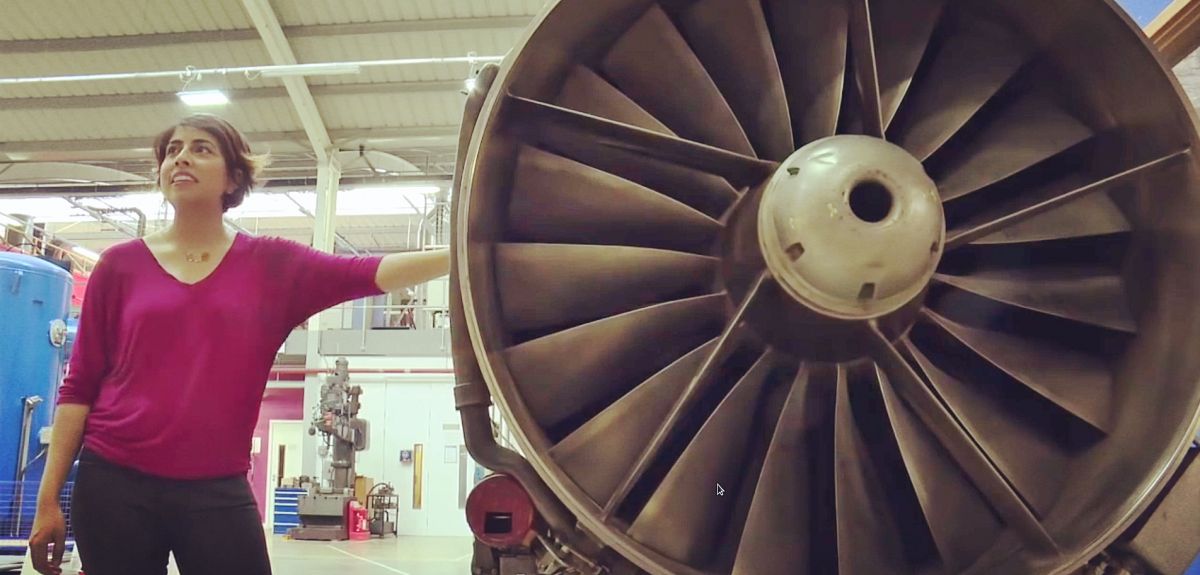
Many female scientists now have inspiring stories to tell, but all the science disciplines still need to make progress on gender equality. With the lowest percentage of female professionals of all the STEM areas (9% in UK universities), engineering is one of the most scrutinised specialisms.
As a Canadian woman of South Asian heritage, Dr Priyanka Dhopade, Senior Research Associate at Oxford University’s Osney Thermo-Fluid Laboratory, is breaking down barriers in more ways than one. She talked to Scienceblog about her journey so far and how she is using her own experience coming from a minority background to create a brighter future for female engineers to come.
What does your work involve?
Most of my work is in partnership with Rolls-Royce plc, and focuses on the aerodynamics of jet engines, specifically controlling the temperature inside the engine. Jet engines are designed to operate at extremely high temperatures and pressures to be efficient. This means that some parts of the engine are exposed to temperatures higher than the melting points of those parts. This requires some creative cooling methods e.g. internally cooling the turbine blades using a complicated network of passages. My research focuses on finding the novel cooling methods, preventing overheating but at the same time not making it too cool that you decrease its thrust or efficiency.
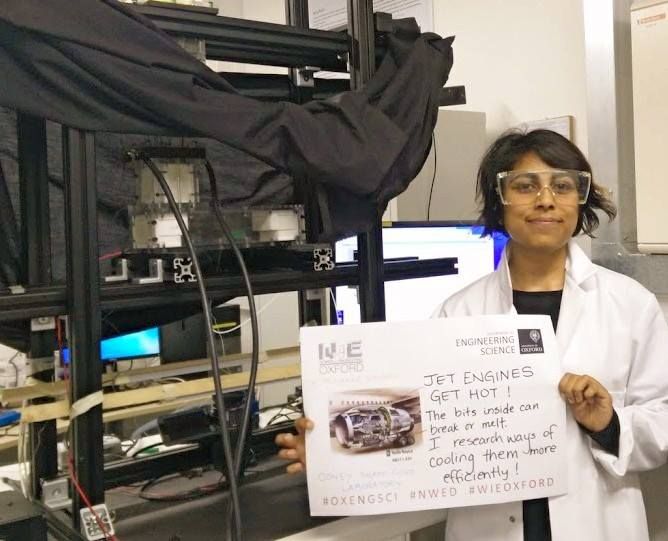 Dr Priyanka Dhopade is an aerodynamics engineer Credit: Dr Priyanka Dhopade
What is your take on diversity in general at Oxford?
I think Oxford has come a long way, but there is still more to be done. It’s a diverse and inclusive environment for research and collaboration and I work with people from various ethnicities on a daily basis. However, given the historical context, I do recognise that there is still this perception that Oxford isn't open to everyone. It can be difficult to change these perceptions and it takes time.
The Diversifying Oxford Portraits initiative is a great example of a tangible change that can help. Outreach programs targeting BME groups and communities that are outside the "Oxbridge" network can also help. The University can only benefit from diversity in all forms - ethnicity, class, gender, disability and sexual orientation. Given the current political climate, I think it's important for educational institutions, especially those as prestigious as Oxford, to set an example of an open, diverse and inclusive community.
The University can only benefit from diversity in all forms - ethnicity, class, gender, disability and sexual orientation. Given the current political climate, I think it's important for educational institutions, especially those as prestigious as Oxford, to set an example of an open, diverse and inclusive community.
What has it been like being a woman studying, working and now teaching engineering?
I have studied and worked in engineering in Canada, Australia and the UK, and the experience has been fairly similar, I have always been in a minority in my industry. After a while that gets hard to ignore. I don’t think it is so much a reflection on the universities themselves, but more to do with the level of my position within them. As my career has progressed, it has become more and more noticeable that I am in a minority in my field.
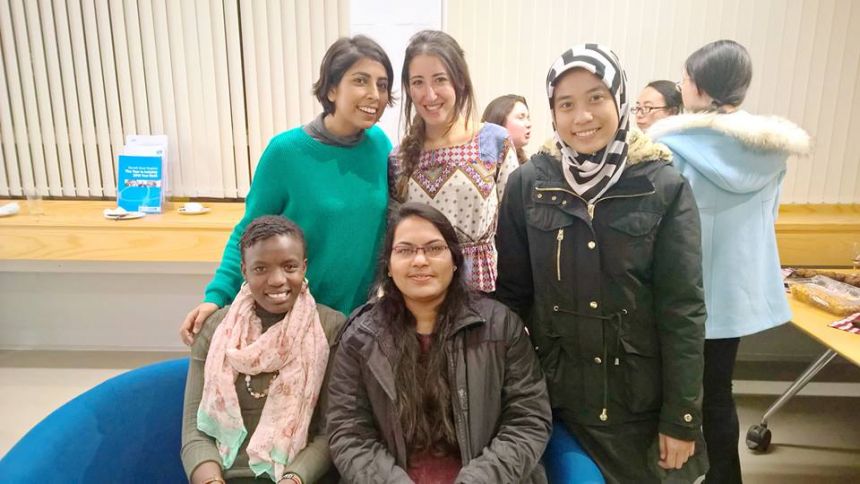 Dr Priyanka Dhopade coordinates the Women in Engineering at Oxford group, which organises talks, social events and other networking activities for women in the field.
Credit: Dr Dhopade
Dr Priyanka Dhopade coordinates the Women in Engineering at Oxford group, which organises talks, social events and other networking activities for women in the field.
Credit: Dr DhopadeHow has it become more noticeable?
As an undergraduate in Canada, I never felt or experienced discrimination. If anything, it was a very positive time for me. I worked hard to really understand the material, and helped other students along the way. When studying for my PHD I was one of the only females in the research group and now as a senior researcher I am the only female - in a group of eighty personnel. Numbers like that are hard to ignore, and you become more aware and frustrated by these issues.
I coordinate the Women in Engineering Oxford group and think I am more of a feminist and an advocate for women in STEM now, than I ever was before, because of my own journey. After a while you just start to think ‘this is not right, I should not be the only woman here.’
Do the women in the group have similar experiences?
There is real camaraderie between the women in my field, which is something I never expected. We are all tied by a common bond, and so understand the issues and support each other. I have made so many female friends across STEM and other PHD areas because of what I do, probably more than I have ever had. It's been great to watch the Women in Engineering at Oxford group, initially created to support the Athena SWAN initiative, grow over the last few years, as more women have joined the research team. Though we still have some work to do to help them progress to high level positions.
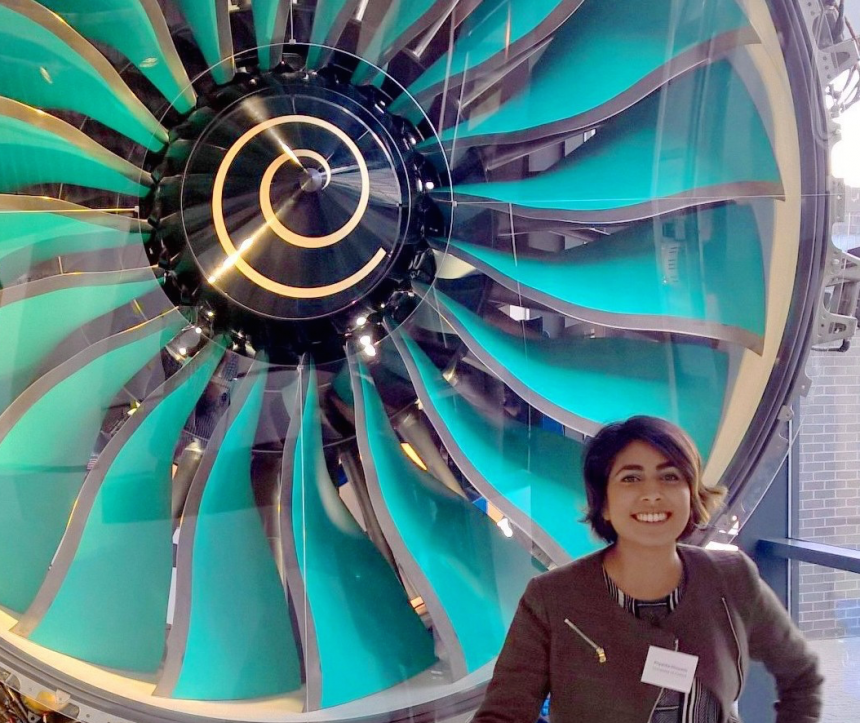 Dr Priyanka Dhopade is an aerodynamics engineer, who works in collaboration with manufacturers like Rolls-Royce plc. Her research focuses on finding cooling methods for jet engines that strike a balance between preventing overheating and not making it so cool, that it impacts thrust and efficiency. Credit: Dr Priyanka Dhopade
How do you think these issues and the general imbalance of women working in engineering can be addressed?
It has to be tackled collaboratively by employers and on a policy level. Maternity leave policies are set by the government but have a major impact on how employers view family responsibilities. I know women who have been asked in interviews, directly, if they plan to have children, and if they answer yes, they are seen as not being serious about their careers. I feel that the government sets the tone, and needs to make parental leave a shared responsibility, (as it is in Scandinavia for example). If both men and women had the option of appropriate parental leave it would be seen more as a natural progression of life for those that choose to do so, not just something that women want. I think things are moving in the right direction, but it is a long process.
Unconscious bias is a big issue that does not get much attention. It is difficult to get people to challenge and face up to their own implicit biases, everyone has them, but are rarely willing to admit to them. There is already some great training underway, like the Royal Academy of Engineering and Royal Society of Science, who are rolling out unconscious bias recruitment programmes. But more is needed to encourage panellists to be open minded, particularly at higher levels of academia.
Unconscious bias is a big issue that does not get much attention. It is difficult to get people to challenge and face up to their own implicit biases, everyone has them, but are rarely willing to admit to them.
Speaking to senior academics at Oxford, I know that the University wants to hire more women, but they just aren’t getting the applications. I’m not entirely sure why that is, but I think confidence has a lot to do with it. Having been in their shoes, without my PHD supervisor recommending me I probably wouldn’t have applied myself. There are not many women in top tier engineering research positions and for that to change there has to be some degree of head hunting for female scientists as well.
How would you describe your experience of Oxford?
I’ve been at Oxford for four, very positive years. We work closely with partner organisations, which means I get to have direct impact on Rolls-Royce plc next generation technology, which is so rewarding.
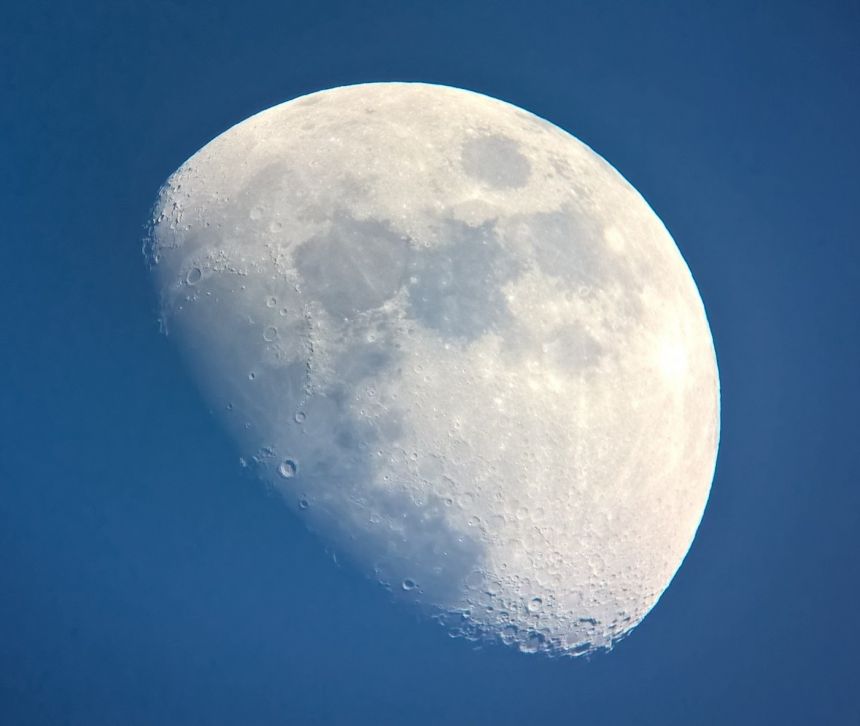 Dr Dhopade has a passion for astronomy, and in her spare time takes in some spectacular views of the moon, with her telescope from her balcony.
What is the biggest challenge in your job?
The biggest challenge is also the biggest blessing; working directly with sponsors. Large external organisations work to their own deadlines, so we have to adapt our working styles and be more flexible.
Where do you see yourself in 10 years?
In academia, continuing my research career at Oxford hopefully. My work has the potential to significantly reduce the environmental impact of civil aviation, which, as air passenger travel continues to rise, is critical. More efficient engines consume less fuel and emit less greenhouse gases. I also want to get more involved in conveying the importance of engineering research to the general public.
Did you always want to be an engineer?
Growing up in a South Asian family, the cultural connotations of a career in science were very positive and encouraged, which I think isn’t always the case in the West. STEM fields were seen as stable, financially rewarding professions for boys and girls. My Dad is an engineer too, so I am lucky to have supportive parents who understand the field.
One of my earliest role models was Roberta Bondar, the first Canadian woman in space, and I had a signed poster of her on my wall growing up. Every time I looked at it, I’d get inspired and think; ‘if she can do it, so can I!’ Female role models play such an important role in a young girl’s life.
Engineering is mentally taxing, how do you like to unwind?
I love travelling and also have a telescope that I am always looking for an opportunity to use (even though Britain's climate is largely uncooperative in this aspect!) and so far, I've seen some spectacular views of the moon and sun from my balcony.
What is your favourite thing about your job?
Working with so many smart people is so inspiring. I feel like I am getting smarter everyday just from being around them.
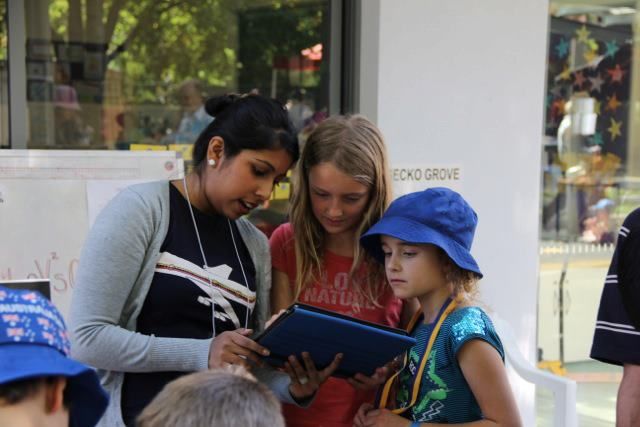 Dr Dhopade is a an advocate for STEM, and involved in community outreach, conveying the importance of engineering research to the general public.
- ‹ previous
- 100 of 253
- next ›
 What Louise Thompson’s campaign tells us about the national maternity crisis
 Celebrating 25 Years of Clarendon
  Learning for peace: global governance education at Oxford
  What US intervention could mean for displaced Venezuelans
  Setting the agenda for the next century of quantum
 10 years on: The Oxford learning centre making an impact
 Mapping the Moon: the world’s first lunar atlas goes digital
  Oxford and The Brilliant Club: inspiring the next generation of scholars
 New course launched for the next generation of creative translators
 The art of translation – raising the profile of languages in schools