Features
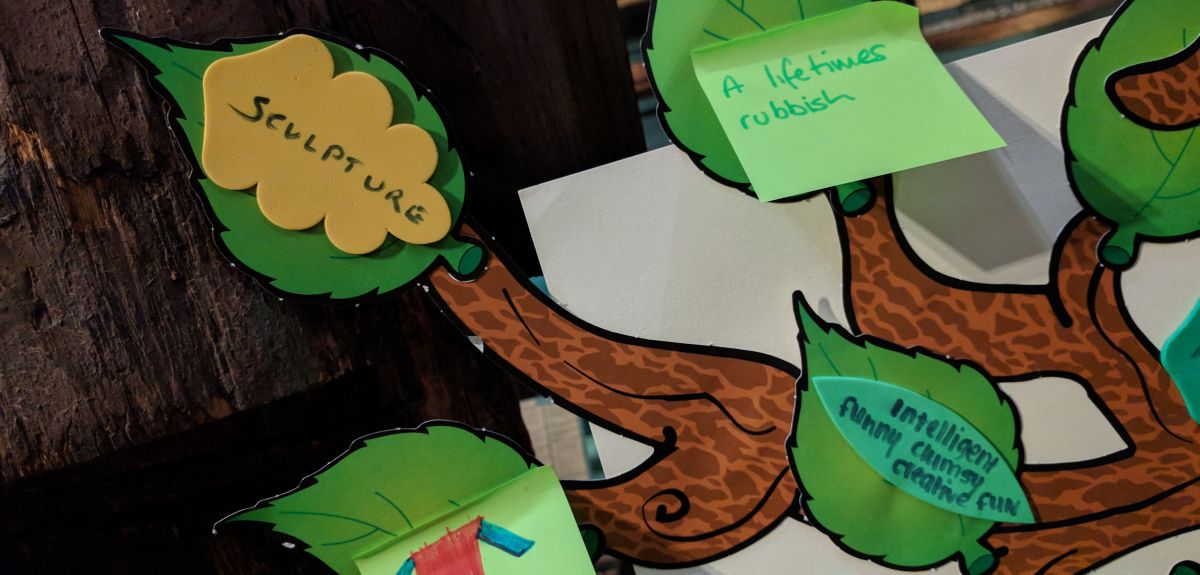
If you had to sum up your identity with only a pen and a post-it note – or a tweet – what would you write?
This was the challenge set for visitors to the University’s largest ever public engagement event last month, the Curiosity Carnival.
Helen Swift and Jessica Goodman are experts in Medieval and Early Modern French literature, and explore themes like identity, memory, and posterity, to reveal how unstable and precarious they are.
To get people thinking about these themes, they asked them to draw one object – or write up to five words – that would represent their legacy.
Several people drew a physical object – a wedding ring, a football, a favourite T-shirt.
“The blue-and-red T-shirt was clearly an important projection of an identity this person was very happy with,” says Helen.
Some people left their favourite inspirational quote, or a message. “Words: treasure them,” wrote one visitor.
Before they drew on the post-it note and added this ‘leaf’ to the legacy tree, visitors were asked to think about what happens to someone’s identity after they die, and the objects and words through which we construct stories about people from the past, and ourselves.
This led to a lot of thought-provoking conversations. A teenager told Jessica that he often deleted his Instagram pictures because they didn’t represent him anymore. An older woman decided she needed to think about what she could leave her children.
Others “were inspired to think environmentally about our individual and collective impact on the world in what we leave,” says Jessica. “Some people made very honest admissions that what our generation will leave will be a lot of rubbish.”
One person left an ellipsis… “This was an outcome of a very interesting conversation about how much what we call someone’s identity is or isn’t identical with that person’s sense of self,” says Helen.
“Even when you’re projecting your own identity, it’s still a projection, inevitably partial – and so identity is revealed as a slippery and uncertain entity insofar as it can be defined.”
Jess says the exercise was a great way to introduce visitors to timeless themes of literary study. “It was fantastic to spark people’s interest in the themes we work on in French texts from the past, which might initially seem inaccessible,” she says.
“I found it exciting to see people applying the idea of ‘You are what you leave’ to their own lives”.
“And some people also just had fun with our sticky shapes,” adds Helen.
What would you leave behind? Put it in a tweet and use the hashtag #cclegacy
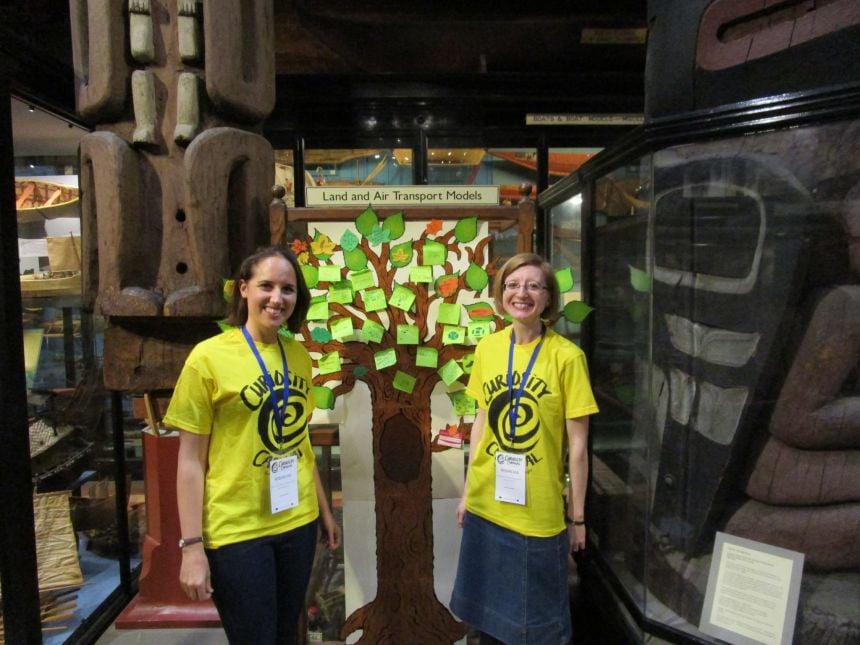 Jessica Goodman and Helen Swift during the Curiosity Carnival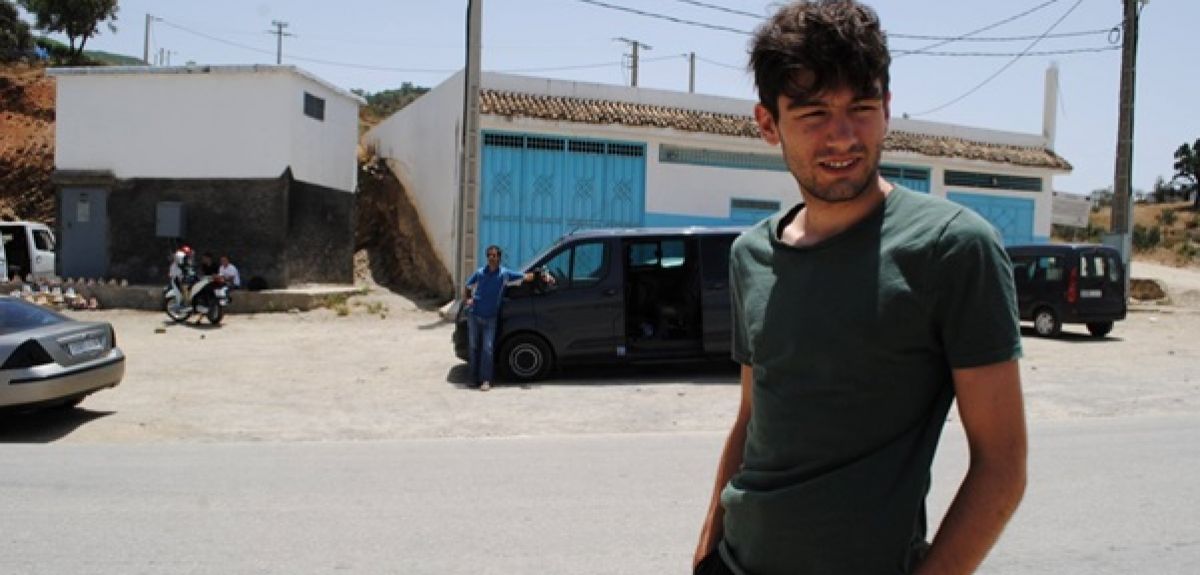
This is the latest in the Artistic Licence series.
Chris Smart had only been in Oxford for a week when he joined one of Oxford’s most innovative student-led campaigns.
At the fresher’s fair, packed into a hall full of the University’s societies and sports clubs, Chris met DPhil student Thais Roque and a group of students who all had a clear objective: to help refugees study in Oxford.
Two years later, Chris is now one of the key figures running the Oxford Students Refugee Campaign (OxSRC), and the only undergraduate committee member. The campaign, which is entirely student-run, helps refugee students from abroad, and asylum-seeking students in the UK, continue their studies in Oxford.
Chris and his colleagues began by targeting the student body. During his first year, alongside the obligatory essay crises and weekly tutorials, Chris went from college to college pitching the campaign. The reception was overwhelmingly positive, and by the end of the year around half of students across the University had committed to annual donations of £12.
With these donations, and other fundraisers, the campaign has now raised an impressive £70,000, and is hoping to see its first funded students arrive in Oxford in October.
Meanwhile, Chris has just started the third year of his History degree at Mansfield College, and he’s managed to pack a lot into his two years here.
Originally from Cornwall, where he spends his free time in the sea, he’s also a keen photographer, and has acted in student theatre. But it’s OxSRC that has had the biggest impact on his Oxford experience.
“I learnt a huge amount very quickly,” he says. “And not just essential skills, like teamwork and organisation.
“I’ve also gained a far better understanding of what life is like for at risk students. I’m in contact with applicants via e-mail, and sometimes hearing what they’re going through is hard-hitting.”
After finishing his first year exams, Chris headed to Calais to volunteer at the refugee camp.
While there, Chris worked with the charity L’auberge des migrants, recycling waste wood for cooking fuel and distributing it within the camp alongside food deliveries. It was a steep learning curve, but one that OxSRC had prepared him well for.
Now back in Oxford, Chris is focused on the campaign again. He’s currently working on an emergency fundraising appeal, which is raising urgent funds online and was recently featured in Vice magazine.
In the long-term, the campaign hopes to establish a permanent, sustainable scholarship fund that will be able to anticipate the needs of future refugee students.
“It’s so important to reach out to refugee groups in need of education,” he says.
“The demonstration of this in history is huge— the scientists and mathematicians and Abstract Expressionist artists who fled authoritarian regimes in the USSR and Europe had a massively important impact on the societies they settled in. We should avoid the negative stigma that now exists around migrants and refugees.”
And being involved in the campaign has helped Chris too. “I think the impact of my work with OxSRC will continue to positively affect my entire self for a long time to come,” he says.
To learn more about the campaign’s goals and achievements, visit their website here. You can also contribute to their emergency campaign, and watch their campaign video, here.
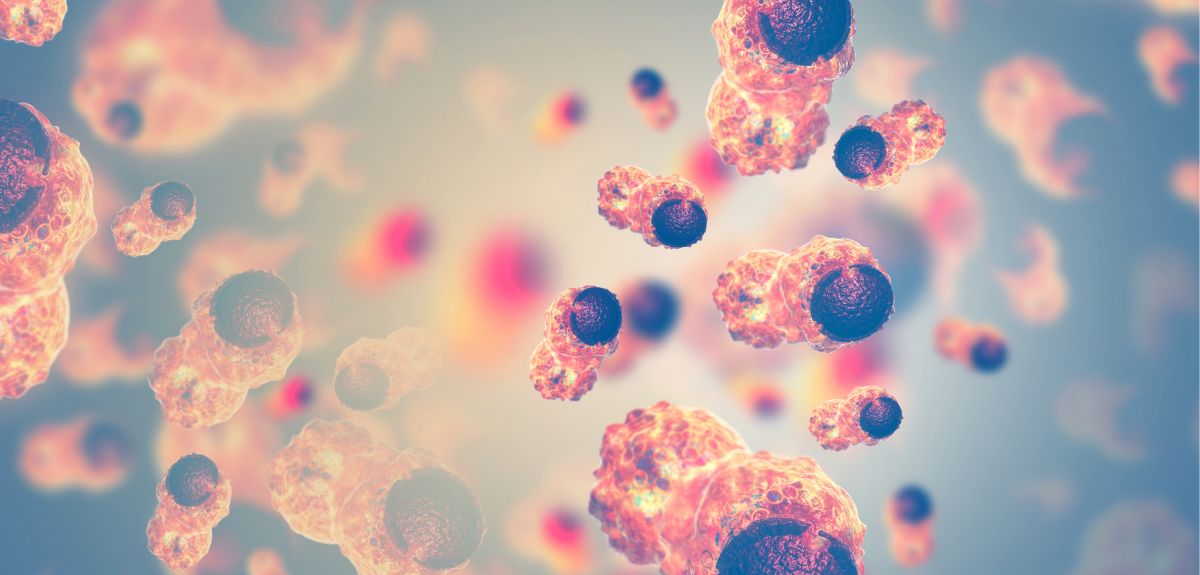
Researchers at the MRC Weatherall Institute of Molecular Medicine have developed a new platform based on the revolutionary CRISPR/Cas9 technology, to alter the way human cells respond to external signals, and provide new opportunities for stopping cancer cells from developing.
Cells are constantly monitoring the environment around them and are programmed to respond to molecular cues in their surroundings in distinct ways – some cues may prompt cells to grow, some lead to cell movement and others initiate cell death. For a cell to remain healthy, these responses must be finely balanced. It took evolution over two billion years to tune these responses and orchestrate their interplay in each and every human cell. But what if we could alter the way our cells respond to certain aspects of their environment? Or make them react to signals that wouldn’t normally provoke a reaction? New research published by scientists at the University of Oxford takes cellular engineering to the next level in order to achieve just that.
In a paper published in Cell Reports, graduate student Toni Baeumler and Associate Professor Tudor Fulga, from the MRC Weatherall Institute of Molecular Medicine, Radcliffe Department of Medicine, have used a derivative of the CRISPR/Cas9 technology to rewire the way cells respond to extracellular signals. CRISPR/Cas9 frequently makes the headlines as it allows medical researchers to accurately manipulate the human genome – opening up new possibilities for treating diseases. These studies often focus on correcting faulty genes in crops, livestock, mammalian embryos or cells in a dish. However, not all diseases are caused by a defined error in the DNA. In more complex disorders like diabetes and cancer, it may be necessary to completely rewire the way in which cells work.
Cells are exposed to thousands of different signals – some they will have encountered before, while others that are entirely new. Receptors that sense these signals form one part of a complex modular architecture created by the assembly of building blocks like in a Lego design. It is the precise combination of these ‘Lego bricks’ and the way in which they are built that dictates how a cell responds to a given signal.
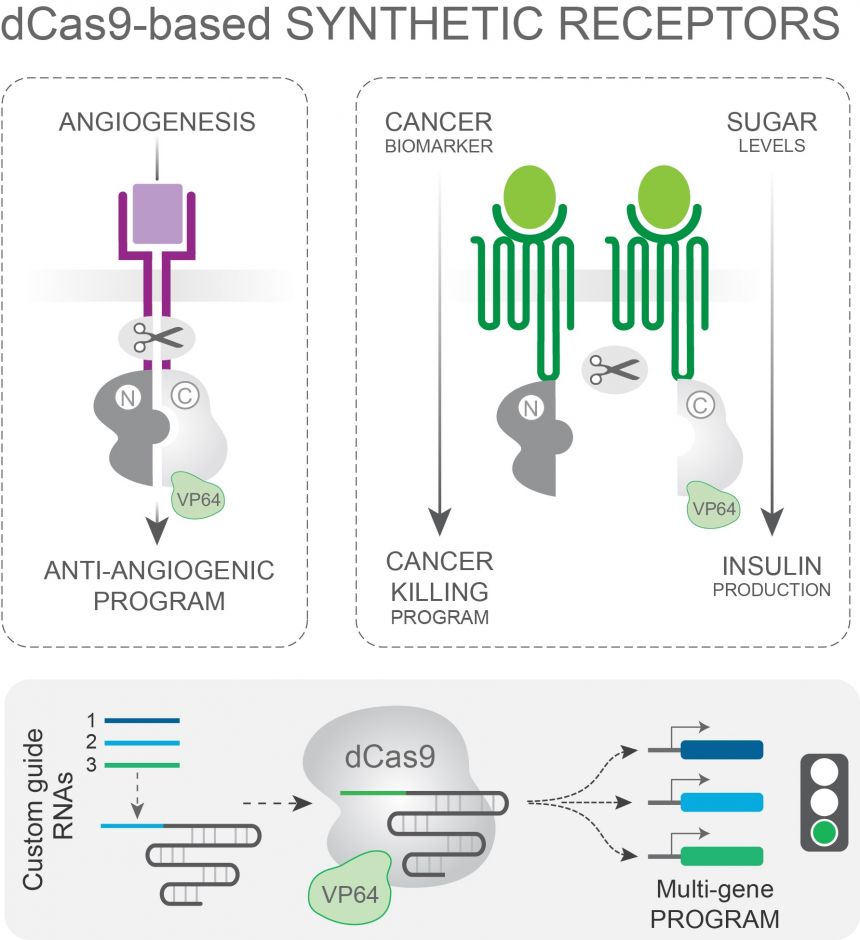 Changing the way cells interact with each other
Image credit: Tudor Fulga
Rather than using the traditional CRISPR/Cas9 system, the team used a version of the Cas9 protein that cannot cut DNA. Instead, it switches on specific genes, depending on the guide RNA (navigation system) it is associated with. Using this approach, the researchers altered the Lego bricks to build a new class of synthetic receptors, and programmed them to initiate specific cascades of events in response to a variety of distinct natural signals.
So could this innovative cellular tinkering improve human health? To answer this question, the team sought to re-program the way in which cancer cells respond to signals that drive the production of new blood vessels (a key step in cancer development). Using a rationally designed synthetic receptor they created in the lab and delivered into cells in a dish, the team converted a pro-blood vessel instruction into an anti-blood vessel response. To test the limits of the system, they then went on to engineer a receptor complex that responds to a signal enriched in the tumour environment by eliciting simultaneous production of multiple ‘red flags’ (effector molecules) known to attract and instruct immune cells to attack cancer. These initial experiments in the lab open up a whole range of possibilities for next-generation cancer therapy.
The system also has potential applications for other systemic diseases, like diabetes. To demonstrate this potential, the team engineered another receptor complex that can sense the amount of glucose in the surroundings and prompt insulin production – the hormone that takes glucose up from the blood stream. In people with diabetes, this mechanism does not work correctly, leading to high levels of glucose in the blood. While a long way from the clinic, the work suggests that this technology could be used to rewire the way that cells in the body function.
The ability to edit the human genome has transformed the way scientists approach some of our biggest medical challenges. With this new technique developed in Oxford, the team hopes that genome engineering does not have to be limited to correcting DNA faults but altering the way that cells work – regardless of the root cause of disease.

Understanding when and how genes first came together to form genomes is a fundamental puzzle in the study of the origin of life. Genes are naturally selfish, and yet, life started with cooperation between genes. So, why did these first living molecules sacrifice their selfish interests to form genomes?
Sam Levin, a DPhil student in Oxford’s Department of Zoology, discusses his new study: 'The evolution of cooperation in simple molecular replicators’, written in collaboration with Professor Stuart West, which addresses this very question.
Contemporary life forms, from bacteria to bonobos, are made up of genomes. A genome is a collection of replicating units, or genes, which specialise on different aspects of making an organism. Some genes focus on making an eyeball, and others on producing a lung. We don’t think of these genes as individuals in their own right - they are simply parts of the larger whole - the organism.
The origin of the first genomes billions of years ago required gene cooperation, but life itself started with simple, independent genes, or replicators. These replicators were ‘naked molecules’, which were capable of little more than making copies of themselves. Early replicators were individuals in their own right. They competed, with replicators that were better at making copies of themselves, out-competing those that were less fit.
At some point, before the last common ancestor of all living things, independent replicating molecules - naked genes, had to come together to form the first genomes. In the process, they subjugated sacrificed their own interests (reducing their own replication rates, helping copy other replicators) to become part of the larger whole, or genome.
In our paper, published in Proceedings of the Royal Society B, we use mathematical models to show why these primitive life forms might have cooperated, and reveal the link between their behaviour and that of birds, bees, microbes and humans.
Offspring copies sticking around and parent copies surviving both increase ‘relatedness’ between replicators (sharing the same genetic sequence). This shows that the forces that favour cooperation are the same across the tree of life.
The puzzle of cooperation
Darwin (1859) showed us that, all else being equal, we expect selfish individuals to outcompete cooperative ones. Imagine a soup of replicators in the primordial sea, where replicators act cooperatively (reducing their own replication rate) to help copy others. Suppose a mutant arises, which, rather than help others, selfishly copies itself. This mutant reaps the benefits of others being cooperative, but doesn’t incur any cost of helping others. This mutant will outcompete the rest, sweep through the population, and cooperation will disappear. What, then, could explain the continued cooperation between replicators?
We used simple mathematical models of evolution to analyse this question. Previous work by Paul Higgs and colleagues using simulations suggested that replicator cooperation could be explained by replicator copies staying nearby to each other (limited diffusion). When this happens, because copies are essentially clones of their parents, cooperators find themselves near other cooperators, and selfish molecules find themselves near other selfish molecules. Cooperators reap the benefits of cooperation, and selfish molecules have no one to exploit. Soon there are only cooperative molecules and no selfish ones.
Instead of using complex computer simulations, we used simple, pen and paper mathematical models. We found several results. First, when replicator copies stay near each other, this always leads to cooperation. Although it leads to cooperators helping other cooperators, it also leads to cooperators competing with other cooperators, instead of competing with selfish individuals. We found that these two effects exactly cancelled each other out. Instead, an additional biological feature of replicators is necessary for cooperation to evolve: the survival of replicators after they copy themselves (overlapping generations). This also leads to like-individuals being together, but it reduces the negative impact of competition. We showed that the survival of copies after reproduction and offspring copies remaining nearby, are both necessary to favour cooperation at the start of life.
A common thread in the tree of life
Surprisingly, the simple models that we used are the same as those used to understand cooperation across the tree of life, from bacteria to humans. Cooperation didn’t just happen in replicators, it’s everywhere in nature, from cooperatively breeding birds to complex ant colonies. The problem of cooperation in higher organisms has long been understood using the theory of kin selection, developed by Bill Hamilton in 1964 and popularised by Richard Dawkins in The Selfish Gene. Organisms cooperate due to shared genes. A bird can get copies of its genes into the next generation by reproducing itself, or by helping a relative, who shares genes, to reproduce. In other words, genes acting selfishly (getting copies of themselves to the next generation) leads to organisms appearing cooperative. Relatedness (shared genes) favours cooperation.
Our work shows that the same kin selection approach used in birds and bees can be used to understand the first replicators. Offspring copies sticking around and parent copies surviving both increase ‘relatedness’ between replicators (sharing the same genetic sequence). This shows that the forces that favour cooperation are the same across the tree of life, from early human societies to the origin of life.

This is the latest article in Bethany White's Artistic Licence series.
Donald Trump invented a new word this summer. “Covfefe!” he tweeted, and we were all a bit confused.
But could Trump’s covfefe one day find its way into the dictionary?
Simon Horobin, Professor of English Language and Literature at Magdalen College, has spent years studying the English language, and he thinks that technology is changing how we use it.
On social media, e-mail and WhatsApp, speed is important. This means we often use abbreviations, make new words up entirely, or fall victim to the typo.
But, Professor Horobin says, in some ways this doesn’t actually matter. “In certain media, it’s almost expected and understandable.”
And, for what it’s worth (FWIW), there are a few examples of internet slang creeping into the dictionary. In case you missed it (ICYMI), both FWIW and ICYMI made it into the Oxford English Dictionary in 2016.
So did ‘listicle’—which, for those of you who don’t live on Buzzfeed, is not a sea creature but “a journalistic article or other piece of writing presented wholly or partly in the form of a list.”
Professor Horobin argues that technology and social media can make these new words more visible. “This kind of slang has always been around, but the difference is that now it spreads much more quickly,” he explains.
But who is in charge? Who decides what ends up in the dictionary? The answer might surprise you.
To decide what goes in a dictionary, editors analyse a huge amount of data, including printed material, websites, social media feeds, forums, blogs, and e-mails. They look at how often words are used, and how people are using them.
This is because dictionaries are descriptive rather than prescriptive—they don’t tell us what to do, they just describe what we’re already doing. This means that, ultimately, new words and spellings come from us—the users.
So does this mean covfefe is going to worm its way into the OED?
Well—no. Compiling the dictionary is a complex process. “It doesn’t mean that every time you fire off an e-mail, you create a word,” Professor Horobin says. “Or that covfefe is going to appear in the dictionary.”
And while spelling mistakes are often more expected on social media, this doesn’t mean they go unnoticed.
“The internet has also given a new lease of life to correcting people,” Professor Horobin says. “Just look at #spellingfail on Twitter. There are a lot of people policing other’s mistakes.”
Ultimately, Professor Horobin says, “it’s still going to be important to get a good grip of standard English.”
Mr Trump might have covfefe to himself for now. But technology is still changing the English language in ways we haven’t seen before.
“The technological revolution means that spelling is much more fluid and there’s a different attitude to correctness,” Professor Horobin argues. “English is changing very rapidly.”
So you’d better keep practising your spelling—but you can also keep on abbreviating, inventing, and firing off misspelt tweets. In fact, you never know—as you do, you could be creating the English of the future.
- ‹ previous
- 88 of 252
- next ›
 Learning for peace: global governance education at Oxford
  What US intervention could mean for displaced Venezuelans
  Setting the agenda for the next century of quantum
 10 years on: The Oxford learning centre making an impact
 Mapping the Moon: the world’s first lunar atlas goes digital
  Oxford and The Brilliant Club: inspiring the next generation of scholars
 New course launched for the next generation of creative translators
 The art of translation – raising the profile of languages in schools
  Opening a window into the quantum world
 Tracking resistance: Mapping the spread of drug-resistant malaria