Features
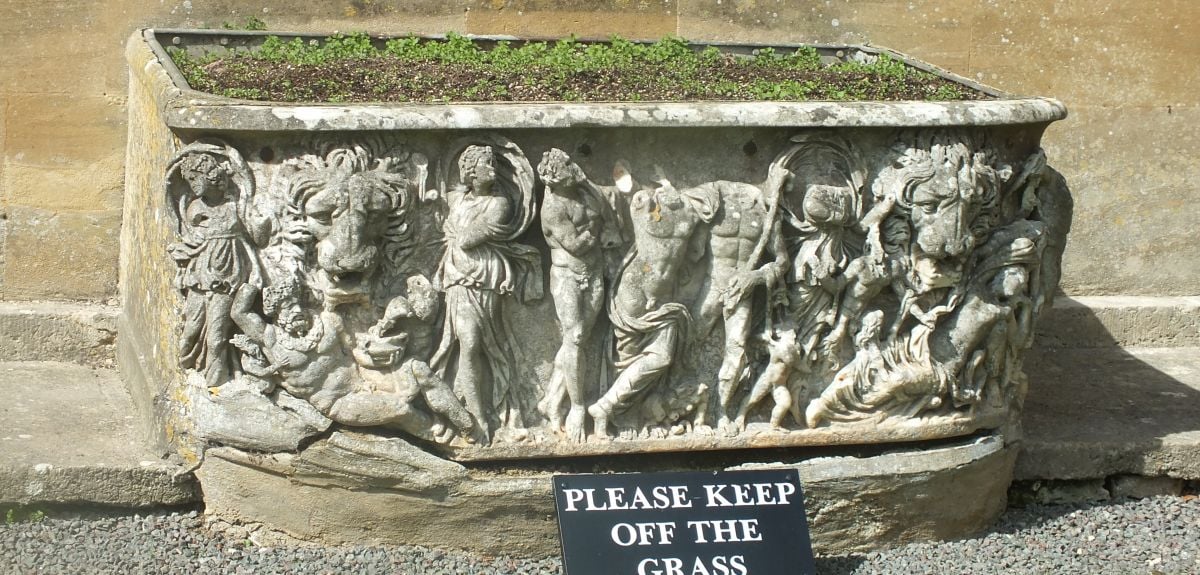
A 1,700-year-old Roman sarcophagus was recently 'discovered' at Blenheim Palace. It had been 'hiding in plain sight' - it had been used as a flowerpot in Blenheim's grounds for the last 200 years. It was noticed by an antiques expert who was visiting the palace on unrelated business.
In a guest blog post, Dr Christopher Dickenson, Marie Curie Fellow in the Faculty of Classics and Hardie Postdoctoral Fellow in the Humanities at Lincoln College, discusses the Blenheim sarcophagus and asks the question: why wasn't I the one to report it?
'Last month a story that made a splash in the national and international press and that was all over my Twitter feed was the ‘discovery’ of an ancient Roman sarcophagus at Blenheim palace. The story was reported by the Daily Mail, the BBC, the Oxford Mail, ITV News, the Times and the New York Times among others.
The newspapers reported that an antiques expert has identified the piece, finely carved with Dionysiac reliefs being used as a flowerpot in the palace grounds. The managers of the estate were apparently unaware of what the object really was and have since had it restored and moved to inside the palace.
The thing is, I remembered seeing the sarcophagus myself on my first visit to Blenheim last April. Above is the photo I took of it – you can see the date if you want proof I really spotted it before it made the news.
My first reaction was to think that I should have been the one to ‘discover’ the sarcophagus and have had my fifteen minutes of fame (the antiques expert who did discover it remains anonymous). I soon realised, however, how extremely unlikely it is that I really could have been the first one to have realised that this plant box was really a 1700 year old Roman grave monument.
Blenheim is within a short bus ride of Oxford, home to the largest Classics Faculty in the world. Over the years countless academics and students must have visited the palace and known immediately what they were looking at. Among the hundreds of thousands of tourists who go to Blenheim each year there must also have been quite a few who knew what it was.
When I mentioned to my wife that I was going to write this blog piece and told her about the Blenheim sarcophagus she said nonchalantly ‘Oh yes, I remember seeing that’. She’s not an archaeologist but she’s been with me to quite a few museums and the truth is that you really don’t need to be an expert to recognise a Roman sarcophagus once you’ve seen a few.
I’ve now done some very superficial internet research to see if anybody else had mentioned the object anywhere prior to the discovery and sure enough they had. Zahra Newby, an expert in Roman Art based at Warwick University discusses it in an article in a book on sarcophagi published in 2011. It is also mentioned in the 1882 publication Ancient Marbles in Great Britain by Adolf Michaelis (sadly the page in question isn’t viewable online so I’ll have to wait till I can get to the library to see what it says).
By searching through Twitter I found that Peter Stewart, head of CARC (the Classical Art Research Centre at the Classics Faculty in Oxford) pointed out there that the sarcophagus is included in this publication when news of the ‘discovery’ broke two weeks ago. I’m sure he must have visited Blenheim and seen the sarcophagus himself.
I also found a drawing of the sarcophagus in the collection of the Art Institute of Chicago (viewable on their website) by the early 16th century artist Girolamo da Carpi. The drawing is particularly interesting because it preserves details that have now been lost to damage or to wear. The website calls the picture the ‘Blenheim Sarcophagus’. That can’t of course be what it was known as when the drawing was made because the sarcophagus must still have been in Italy at the time and because Blenheim Palace wouldn’t even be built for another century and a half (between 1705 and 1722 and named after the Battle of Blenheim of 1704).
It seems unlikely, however, (and I should follow this up) that the name has only been given to the drawing in the last few weeks so this too seems to be further evidence that the sarcophagus was already rather well known. Finally, in 2010 somebody anonymously posted a photo of the flowerpot on TripAdvisor with the comment that it ‘looks like a Roman lenos sarcophagus’.
So, it is clear enough that over the years plenty of people – probably far more than my brief survey uncovered – have recognised the sarcophagus for what it really was. So why is it only now that it made the news?
The truth must surely be that everybody who saw it and recognised it simply assumed that the people at Blenheim were fully aware what it was. That was certainly my assumption.
I found it a shame that it was outside and exposed to the elements and would have preferred the board in front of it to have given some information about it instead of saying ‘Keep off the grass’ but I thought that the sarcophagus had probably been placed there on a whim of one of the past Dukes of Marlborough and had been left there because it was now part of the history of the place and everybody had grown used to it.
Not for a moment did I think about approaching someone who worked at the palace and saying ‘Hey, do you realise that ornamental plant box is really a Roman tomb monument?”
I also suspect that the monetary value of the sarcophagus is a big part of the story. I was drawn to the object by its historic interest as a relic of both the ancient world and the great period of the gentleman collectors in the 18th century when I would imagine it was brought to Britain. I had no idea that it would be valued, as it now has been, at £300,000.
It took a very particular kind of expert for the alarm bells to start ringing at the thought of this rare, and extremely expensive object, being slowly but steadily worn away by the British rain – somebody who knows both about the market value of ancient art and knows that people who run historic properties sometimes don’t understand the nature of the objects they house.
In other words it wasn’t so much a question of ‘discovering’ the sarcophagus as having the insight not to take for granted what so many others evidently have taken for granted over the years.
I suppose that the lesson to be drawn here is: never be afraid to point out the obvious. The next time I visit a stately home and see the marble head of an emperor being used as a doorstop or an Athenian kylix put down as a dog bowl I’ll make sure I speak up.'
The original version of this article can be found on Dr Dickenson's blog.
In a guest blog, Professor Stephen Baker from the Centre for Tropical Medicine and Global Health, Nuffield Department of Medicine, explains the importance of monitoring the emergence of infectious diseases in Asia.
Zoonotic diseases that pass from animal to human are an international public health problem regardless of location – being infected with Campylobacter from eating undercooked chicken in the UK is not uncommon, for example – but in lower-income countries the opportunities for such pathogens to enter the food chain are amplified.
Where I currently work in Vietnam, and across the region, humans have a very different way of interacting with animals being bred for food than would be familiar to those in the UK. If one were to travel to the Mekong Delta region (in the south of Vietnam) it would not be uncommon to see people who keep a large variety of farm animals in, or in close proximity to, their houses. It comes as little surprise that in a country where raw pig blood and pig uterus are commonly consumed, the number one cause of bacterial meningitis is Streptococcus suis, a colonising bacterium of pigs.
The major problem of researching emerging infections is predicting how they arise and how we respond to them once they do.
Given the complexity of zoonotic disease emergence and transmission, it is very rare that an outbreak can be traced back to the first identified human or animal case – known as the ‘index case’ and this remains a substantial challenge. A lack of effective health and surveillance infrastructures in many lower income countries compounds this issue, as we are wholly reliant on individuals entering the healthcare system and getting diagnosed, which seldom happens.
The ideal scenario is that we can identify new pathogens with zoonotic potential in animals prior to them spilling over into humans. However, if we cannot achieve this we need to be aware of their existence and be able to respond by treating people effectively once they are infected. This means rapidly identifying patients with a particular infection, assessing the severity of their condition and diagnosing the agent. Therefore, having sentinel hospitals with well-trained clinical staff, good diagnostics and microbiology facilities is the best opportunity we are going to have to detect diseases.
The most recent example of this is a case of Trypanosoma evansi infection – a protozoan disease of animals and, rarely, humans – that we identified in a woman attending our hospital with an atypical disease presentation. Ultimately, we were able to trace this infection back to her cutting herself when butchering a buffalo in her family house during New Year celebrations – this was the first reported human case of T. evansi in Southeast Asia. Our ability to interact with animal health authorities permitted access to sampling bovines in the proximity of the patient’s house. We found a very high prevalence of the parasite in the blood of cattle and buffalo close to where the woman lived, highlighting a new zoonotic infection in the region and likely a sustained risk.
Diagnostic information has also been vital in data we published detailing an outbreak of fluoroquinolone-resistant Shigella sonnei. The reason we found this organism was that one of my clinical colleagues was culturing organisms from children with severe diarrhoeal disease, and realised that these samples had come from children who had been admitted to hospital with a more persistent form of the infection, and several appeared to relapse with the same syndrome. When we investigated the antimicrobial susceptibility profile of the isolated Shigella, we observed that the bacteria were highly resistant to fluoroquinolones – the antimicrobials that are used routinely to treat this infection in Vietnam (and indeed globally). We then conducted more clinical and laboratory investigations and found more cases in Vietnam and further afield. Through genome sequencing and a group of international collaborators, we could accurately piece together the emergence of this novel strain into Vietnam, other parts of Asia, Europe and Australia.
These finding were largely serendipitous, but if you are not looking then you cannot find. Unfortunately, this approach is not a long-term strategy for monitoring and preventing the emergence of such pathogens. Sadly, the infrastructure improvements and long-term health studies that are needed to achieve a more sustainable model in lower income countries are an expensive undertaking, but without them healthcare improvements and changes to infectious disease policy will be difficult to achieve.
Vietnam has changed beyond recognition since my arrival in 2007. Huge economic investment and political stability has had positive effects on healthcare in the country, and across the region. However, many challenges remain; a growing population, increasing demands for animal protein and the looming cloud of antimicrobial resistance in everyday pathogens suggest that Southeast Asia will continue to be a key region in driving global health security.
The full article, ‘Emerging infectious diseases in Asia,’ appeared in the latest edition of the Microbiology Society’s quarterly magazine, Microbiology Today.
Yesterday, Britain triggered Article 50 to begin the formal process of leaving the European Union. To mark the occasion, our guest author today is Katrin Kohl, Professor of German Literature at Oxford, who leads a major research project into languages called Creative Multilingualism.
'Creative Multilingualism – Oxford’s biggest ever Humanities research programme – got off the ground on 1st July 2016, a week after the Referendum vote to leave the European Union. The nature of the research, and the funder’s requirement that it should have an impact on UK society, have made it impossible to ignore the interplay between research and politics.
The programme is being funded by the Arts and Humanities Research Council as part of their ambitious Open World Research Initiative. At a time when the political emphasis has been on strengthening borders and building walls, the only option for our research team has been to embrace the connection between research and politics as part of multilingualism’s rich tapestry.
Languages are inherently and inexorably connected with the cultures of the people who learn them, care about them, and use them. And culture is never apolitical – as we have seen in recent months, cultural identity matters, and a passion for status can drive political decisions.
The British people (or just over half of them) decided that even though it made no economic sense to many experts, would tie up British energies for years to come in cutting and creating red tape, and would pose immeasurable difficulties for organisations ranging from the civil service through orchestras to the NHS, the time had come to put the Great back into Britain.
It has become clear that the fault lines within the British nation are complex and by no means reducible to class difference or education. An intriguingly large number of politicians on both sides of the Brexit fence were educated at Oxford.
And the Government’s commitment to hardening borders seems to have as much to do with Britain’s island identity and distrust of globalisation as with evidence concerning national interest. When Michael Gove said that “people in this country have had enough of experts”, he was responding to the fact that appealing to emotions can be more persuasive in politics than rational evidence.
Over the many years of EU-membership, the British never overcame the tendency to refer to ‘Europe’ as a continent beyond Britain – Europe still begins at Calais. Successive governments rarely made a positive case for EU membership that might have fostered a sense of common identity or purpose.
Even the Remain camp side-lined the role of emotional factors in the nation’s decision-making, and failed to appreciate the effectiveness of a Leave campaign based on the community-building vision of enhanced national status outside a Union that was bigger than Britain, or England.
There are lessons to be learned here for the current crisis in Modern Languages. The more languages have been reduced in schools and society to being fostered only as a useful practical skill, the less they have appealed to learners who choose their subject because they enjoy them.
Like the economic arguments underpinning the Remain campaign, the argument that Britain needs language skills to improve its exports has fallen on deaf ears because it fails to touch emotions and appeal to personal identities.
The argument that language skills might one day be useful for their careers has likewise proved ill-suited to persuading young learners that the hard graft is worthwhile. If young people are to be sustained through the long process of learning a language, they need to be rewarded by a richer, more engaging experience of the many ways in which languages contribute to our lives as human beings.
When languages engage you at a deep level, they start interacting with all those human capabilities that make each human different, and each cultural group distinctive. They also interact with what makes each of us creative in an individual way. Creative Multilingualism is designed to tap into these interactions and give them space to flourish.
Nine months into the project, we can look back on a highlight that inspired hearts and minds as they transcended cultural divisions while celebrating cultural diversity – LinguaMania, which brought some 2500 people together from many cultural provenances. Oxford’s Ashmolean Museum became a setting that was alive with cultural expression – from the Afro-Brazilian samba rhythms, language tasters and cuneiform tablets to a crowd-sourced translation of Harry Potter into 52 languages contributed by the visitors in the course of the evening.
Languages build channels through time, and thankfully they don’t stop at borders any more than cultures do. Britain is no more separate from Europe linguistically and culturally than it is separate from the continent and bigger world of which it forms a part.
LinguaMania visitors looking at an Aramaic fragment of pottery experienced a glimpse of the concerns people had in Egypt around 475 B.C: “To Hoshayah: greetings! Take care of the children until Ahutab gets there. Don’t trust anyone else with them!”
And on the reverse, following a recipe for bread: “Tell me how the baby is doing!” As we renegotiate our relationships within Europe and a rapidly changing world, it’s worth thinking about the values, cultures and languages we share with ancient and contemporary peoples.
Britain right now is a good place to start exploring the multicultural and multilingual riches that are, and will remain, part of our country.'

The Red Mansion Art Prize Exhibition 2017 is on display at the Kendrew Barn in St John's College this week.
The exhibition is being presented by the Ruskin School of Art and the Red Mansion Art Foundation, and displays work by the winners of the Red Mansion Prize 2016.
The Prize is awarded to one student from each of the UK's seven leading art schools every year. Each of these students visited China for a fully-funded residency in the summer of 2016. They were given studio space and the opportunity to work alongside local artists.
The results of this work have been brought together in this week's exhibition.
This year's winner from the Ruskin School of Art is Olivia Rowland.
'The cultural experience really made me reexamine not only my own practice and processes, but the way I examine and take in the world at large - both as an artist, and as an observer,' she says.
The exhibition has been curated by Ian Kiaer, an artist and tutor at the Ruskin School of Art.
He says: 'The Red Mansion Prize provides an opportunity for selected students across seven of the UK’s major Fine Art programmes to work and exhibit together, allowing them exposure to, and dialogue with, some of their most promising peers, as well as artists in China.
'It is also significant that this is the first time the event is happening in Oxford, bringing early-career artists to the heart of the collegiate University.'
The exhibition closes this Friday (31 March) at St John's College.
 DYSPK by Natalie Skobeeva
Scientists have long understood how oxygen deprivation can affect animals and even bacteria, but until recently very little was known about how plants react to hypoxia (low oxygen). A new research collaboration between Oxford University and the Leibniz Institute for Plant Biochemistry, published this week in Nature Communications, has answered some of these questions and shed light on how understanding these reactions could improve food security. Dr Emily Flashman, the lead author of the study and a research lecturer at Oxford’s Chemistry Department, breaks down the key findings:
Why is this study so important?
Most living things need oxygen to survive, including plants but flooding is a major threat to agriculture and vegetation. A plant's oxygen levels are jeopardised during a flood, and they basically can't breathe. To protect themselves from flooding and survive longer, plants have a built-in stress response survival strategy, which re-configures their metabolism and supports them to generate more energy.
Scientists knew about this stress response, but they didn’t know exactly how it was controlled. Our research underpins not only an understanding of how plants respond to loss of oxygen, but also how this response could be manipulated to protect them long term. With climate change of increased prevalence in today’s society, flooding is a constant source of concern, so it is even more important for us to understand how hypoxia affects plants and crops, so that we can find new ways to preserve and protect them from it. Manipulating the enzymes involved in the process may help us to cultivate new crops and even to weather-proof them.
How does this reaction affect them?
When oxygen is in short supply a plant’s stress response effectively shuts down its metabolism, and activates an alternative pathway that allows it to live for a short amount of time, with reduced oxygen. During this time the plant has much less energy, but is still able to survive and function on a basic level. Much like when someone holds their breath underwater, their oxygen reserves allow them to survive for a short amount of time, even though they cannot breathe in fresh oxygen.
 Image copyright: OU
Our research underpins not only an understanding of how plants respond to loss of oxygen, but also how this response could be manipulated to protect them long term. Manipulating the enzymes involved in the process may help us to cultivate new crops and even to weather-proof them against climate change.
What was the aim of your research?
We wanted to analyse this process, and understand how the enzymes that trigger it work. Once you know this information, you can then work out how to inhibit the enzymes and control the flood response pathway, and in doing so, keep the plant alive for longer. The overall aim being to genetically modify crops to make them flood tolerant. Understanding how these processes work is the first step in achieving this. Until now the molecular details of the plant stress response to hypoxia were not proven, but our research changes this.
Scientists understood that a plant’s response to hypoxia is controlled by ERF transcription factors, proteins which trigger changes in gene expression. In turn, the stability of the ERFs is controlled in an oxygen dependent manner by a set of enzymes, the Plant Cysteine Oxidases (PCOs). The PCOs speed up the break down (degradation) of these transcription factors, via one of the cell’s protein removal and recycling systems, called the proteasome.
Crucially, our research showed how PCOs use oxygen to work, and how this allows the ERFs to be recognised by the next step of the degradation pathway. Thus the whole pathway needs molecular oxygen to work. So in times of regular oxygen supply, the ERFs are degraded before they reach the cell nucleus and before they can activate the stress response genes. However, when oxygen is limited, as is the case during flooding, the PCOs cannot work, efficiently, so the ERFs will not be flagged for degradation and can activate the hypoxic stress response required for the plant to survive.
With climate change causing increasingly frequent flooding events worldwide, understanding how crops respond to flooding is important, in order to control or manipulate the process.
How can the findings be used to improve food security?
With climate change resulting in increasingly frequent flooding events worldwide, understanding how crops respond to flooding is important, in order to control or manipulate the process. Our research supports the understanding of this response on a molecular level – down to the role played by individual enzymes in the process. Stabilising the ERF transcription factors has been shown to enhance flood tolerance, so the targeted inactivation of the enzymes that regulate its stability may assist in cultivating crops that are able to withstand flooding longer and more efficiently.
How can the findings be built on in the future?
Now we understand what the enzymes do, we are looking further into the details of their structure and mechanism to understand precisely how they work. This will help us target the most effective way to manipulate them to artificially inhibit their activity and enhance ERF stability, first using the isolated components of the pathway before testing in plants.
- ‹ previous
- 101 of 253
- next ›
 What Louise Thompson’s campaign tells us about the national maternity crisis
 Celebrating 25 Years of Clarendon
  Learning for peace: global governance education at Oxford
  What US intervention could mean for displaced Venezuelans
  Setting the agenda for the next century of quantum
 10 years on: The Oxford learning centre making an impact
 Mapping the Moon: the world’s first lunar atlas goes digital
  Oxford and The Brilliant Club: inspiring the next generation of scholars
 New course launched for the next generation of creative translators
 The art of translation – raising the profile of languages in schools