Features

There were 451 million clinical cases of Plasmodium falciparum malaria globally in 2007, according to new research by the Malaria Atlas Project [MAP].
The new study was led by Simon Hay of Oxford University's Department of Zoology and is published today in PLoS Medicine.
This estimate of how many people become ill because of the disease (which kills about 1m people a year) is almost double the previous one provided by the World Health Organization (it estimated 247m for 2007) and highlights the difficulties of tracking a global disease.
MAP, which is mainly funded by the Wellcome Trust, set out to tackle some of the uncertainties surrounding the number of cases of malaria gobally: estimates for the disease are made particularly difficult because in places where it is endemic diagnosis is often inaccurate and national reporting of cases incomplete.
The researchers used a recently published map of modern-day malaria risk and more advanced statistical techniques that better describe uncertainty. They found that there could have been between 349-552m clinical cases of P. falciparum worldwide in 2007 and came up with a combined estimate of 451m cases.
They also discovered that more than half of the estimated malaria burden and its associated uncertainty was contributed by India, Nigeria, the Democratic Republic of Congo, and Myanmar (Burma).
'The uncertainty in our knowledge of the true malaria burden in a mere four countries, confounds our ability to assess progress in relation to international development targets at the global level. It is clear that we urgently need an increased focus on reliably enumerating the clinical burden of malaria in these nations,' Simon told us.
'The divergence in our estimates and those of the World Health Organization is greatest in Asia and acute in India. We have sought to explore on a country by country basis how these differences arise, the relative uncertainty in the alternative burden estimation approaches and the potential insights that could be gained by hybridising the two.'
Oxford University's Bob Snow, who leads the MAP group in Kenya, said: 'Our estimates for P. falciparum malaria alone are almost twice those provided by the WHO, which include both P. falciparum and P. vivax malaria.'
Bob added: 'Getting the numbers right is fundamental to reporting on success or otherwise of increased donor funding. A valid question remains about whether agencies charged with the responsibility of supporting the delivery of malaria interventions should be the same ones expected to report progress.'
They're stars that never quite made the big time: mysterious cosmic objects known as 'brown dwarfs'.
Today the team behind the CoRoT space telescope report that they have found a rare example of a brown dwarf tightly orbiting its star.
I asked CoRoT team member Suzanne Aigrain of Oxford University's Department of Physics about 'brown dwarf deserts', the gap between giant planets and stars, and what would happen if our solar system had its very own brown dwarf...
OxSciBlog: What is a brown dwarf?
Suzanne Aigrain: A brown dwarf [BD] is a celestial object intermediate in mass between a planet and a star. It's helpful to recall the definition of a star: a star is a ball of gas held together by its own gravity and which radiates light produced by thermonuclear reactions in its core, mainly burning Hydrogen to produce Helium. A brown dwarf is an object very much like a star, but which is not massive enough to burn Hydrogen in its core.
As such, brown dwarfs are faint and radiate mainly in the infrared, slowly releasing the heat they accrued during their formation. On the other hand, according to the International Astronomical Union's definition, a planet is also held by its own gravity but it is a) in orbit around a star or brown dwarf and b) not massive enough to burn Deuterium (Deuterium is an element which burns even more easily than Hydrogen). Any object which has a mass below the Hydrogen limit but above the Deuterium limit is thus a brown dwarf. This is the case for CoRoT-15b.
The definitions I have given above leave a rather fuzzy area for the case of object which are below the Deuterium burning mass limit but are not in orbit around a star or brown dwarfs - these are sometimes called sub-brown dwarfs or free-floating planets.
OSB: What is the significance of CoRoT finding a BD? Are they rare?
SA: Brown dwarfs are not rare in themselves, on the contrary. It is difficult to detect and study them, because they are faint compared to stars, so we don't know as many of them as we know stars, but over the past 20 years, with the advent of better and better infrared detectors, we have been discovering many of them.
What is extremely rare, however, is to find one in a tight orbit around a star, as in the CoRoT-15 system. Until a few years ago, we knew of none at all, and this absence was called the 'brown dwarf desert'. Now we know of a handful, but CoRoT-15b has the shortest orbital period of any known brown dwarf. The very existence of CoRoT-15b in its tight orbit is interesting (see below), but the fact that it transits across the disk of its parent star makes it even more useful, because it enables us to measure its radius.
OSB: What can they tell us about how planets & stars evolve?
SA: Systems like CoRoT-15 are very important to understand star and planet formation as well as evolution. The majority of brown dwarfs are thought to be the result of the same process which forms stars. Stars form from giant clouds of gas and dust. Regions in these clouds which are marginally more dense than their surroundings attract more material onto themselves, and these over-densities grow and grow until thermonuclear fusion ignites in the core, and a star is born.
If a clump never grows large enough for that to happen - because the material within its gravitational influence runs out - you get a BD. So, from the formation point of view, there is nothing fundamentally different between a star and a brown dwarf, but whilst tight binary stars are quite common, tight binary systems involving a star and a brown dwarf are rare.
Why is CoRoT-15b different? Did it get kicked into its current orbit by a close encounter with another star? Could it have formed like a planet, which forms in the disk of material accreting onto a star, instead?
There are very few BDs in close binaries, and even fewer which transit their parent star. These are the only BDs whose radii we can measure, so they are very valuable. If you make a plot of radius versus mass for stars and planets, stars all more or less fall on a single line, which basically is the line you expect for a self-gravitating ball of Hydrogen. This line flattens out at low masses - from 0.1 solar masses to a Jupiter mass, the expected radius is about 1 Jupiter radius.
However, the measurements for exoplanets are scattered, with a range of radii observed for a given mass. This is because the radius of a planet is affected not just by its mass, but also by its composition (how much solid versus gaseous material it contains) and by the amount of light it receives from its parent star. CoRoT-15b fills an important gap in this diagram, between low-mass stars and planets. It's also extremely close to its star, so extremely hot, and hence a particularly strong test of just how much intense irradiation can affect the radius of an object of that mass.
OSB: How might our solar system be different if it contained a BD?
SA: We know that having a binary companion does not prevent planet formation, since we know of stars which have both one or more planets and a binary companion. If the Sun had a wide BD companion, the solar system would not necessarily be very different. We would definitely know about it, however: BDs are faint compared to stars, but a BD that close to us would not be missed.
On the other hand, if the BD was very close-in like CoRoT-15b, things would be very different. I'll consider two possibilities: If the BD formed in-situ, there would be no disk, or very little of it, around the Sun, for the planets of the solar system to form out of. There might have been a disk around the binary (we have seen such disks around other binaries) and it's conceivable that this disk might form planets. We currently know of no such circum-binary planets, but this is at least in part because it is harder to detect them.
But if the BD was captured (or kicked into a close orbit from a wider one) after the Sun had formed its planets, then that would most probably have a very dramatic impact, as the gravitational influence of the inbound BD would wreak havoc on the planets and most likely eject them from the solar system!
OSB: What do we hope further CoRoT finds could reveal about BDs?
SA: CoRoT already found another transiting BD, CoRoT-3b. It is less massive and less close in than CoRoT-15b, but the fact that CoRoT found two of these very rare systems shows that it is well-suited to detecting them. Along with the NASA mission Kepler, which is also searching for transiting planets, CoRoT can hope to discover several more systems like these in the next few years. They will tell us more about how these rare systems form, about what forms the difference between a massive planet and a BD, and about how BDs evolve when very close to their host star.
Dr Suzanne Aigrain is based at Oxford University's Department of Physics.
As England's footballers struggle to deal with the effects of altitude on their bodies ahead of their first World Cup match in South Africa, they may wonder how people living day in day out at even higher levels get by at all.
A new study published this week in PNAS reveals that natural selection has enabled humans to better cope with living in Shangri La.
Shangri La here is not the mythical Eastern earthly paradise, but the very real province high up in the Tibetan plateau where the indigenous population lives at altitudes of 3,200m to above 4,000m – much greater than the 1500m Gerrard, Lampard and the rest will be playing at on Saturday.
The international team of researchers from the UK, Ireland, China and the US searched for evidence of selection at the genetic level among people living at these high altitudes where there is so little oxygen.
The study’s corresponding author, Professor Peter Robbins of Oxford’s Department of Physiology, Anatomy and Genetics, confirms that ‘Tibetans are better equipped for life at high altitude.’
People who move to live at high altitudes tend to be at risk of a chronic mountain sickness. The body makes too many red blood cells, giving excessive levels of haemoglobin, in an attempt to capture the little oxygen there is in the air. But native Tibetans manage to remain unaffected.
So the scientists compared the genetic profiles of groups of Tibetans living at these high altitudes with nearby populations in lowland China, and they found changes in a single gene were present at high frequency among the Tibetans.
The researchers showed that having a different version of the EPAS1 gene gives Tibetan populations an advantage: it keeps levels of haemoglobin low and so protects them against developing chronic mountain sickness. ‘This is where individuals make too many red cells and the blood becomes very sticky,’ says Peter Robbins. ‘[Having the EPAS1 variant] may also help with reproductive fitness at high altitude, but that is more speculative.’
This is good evidence that the lack of oxygen at these altitudes has exerted an evolutionary selection pressure over the 10,000 years or more people have been living in these areas.
‘There are probably not more than a handful of definitive examples of human evolution to their environment at the genetic level that have so far been described,’ says Peter Robbins. ‘There are genes for variation in skin colour, certain genes that confer protection against malaria (for malaria infested environments) and possibly one or two dietary adaptations (but these are a bit more speculative).’
There may also be some pay off from this work for future English footballers (or, depending on the result, fewer excuses):
EPAS1 – also known as HIF2a (hypoxia-inducible factor 2) – is a major gene involved in keeping oxygen levels stable, explains Peter Robbins. ‘As oxygen transport is the principal limiting factor to much endurance exercise, everything we can understand in relation to human variation here will probably help us to understand better the constraints on athletic performance.’
‘In addition, as low oxygen (hypoxia) is a feature of so much disease (eg lung disease, heart disease, vascular disease, cancer), understanding human variation in the response to low oxygen may help us to understand why some people seem so much better at surviving conditions of low oxygen than others.’
Great news: our post about Oxford & the Royal Society's origins has been nominated for the 3quarksdaily science blogging awards.
These annual awards celebrate the very best in blogging and this is the second year that 3quarksdaily have given a prize for science posts. We're in excellent company with posts from such great blogs as The Loom, Bad Astronomy, and Not Exactly Rocket Science.
Our post delved into the fertile chaos of 1650s Oxford and how an eclectic mix of figures from the University would go on to play a key role in the founding of the Royal Society (which celebrates its 350th birthday this year) and set Britain on the path to becoming a scientific superpower.
But of course, to stand any chance of winning, we need your votes! So if you'd like us to win go to the 3quarksdaily voting page, look for 'University of Oxford Science Blog', and vote for us!
UPDATE: 8 June: Thanks to everyone who voted for us! Our post came 7th in the public vote and made the semi-final.
UPDATE: 11 June: A nice surprise, our post has made the final.
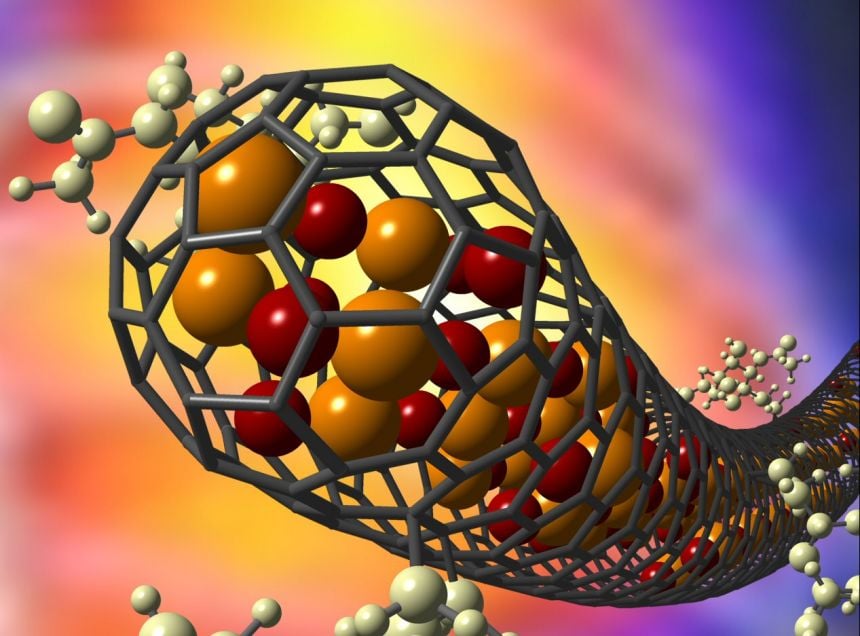 Nanocapsules
‘Hot’ nanocapsules can deliver targeted radiotherapy to individual organs, new research has shown.
A team, including Ben Davis and Malcolm Green of Oxford University’s Department of Chemistry, report in Nature Materials how they created a ‘cage’ out of a single-walled carbon nanotube and then filled this tube with molten radioactive metal halide salts.
Once the cage, and its cargo of salts, cooled the ends of the tube sealed to create a tiny radioactive nanocapsule with a ‘sugary’ outer surface that helps to improve its compatibility inside the body.
Using this method the team were able to create nanocapsules that could deliver a highly concentrated dose of radiation (800% ionizing dose per gram) of the kind needed for radiotherapy. They then used mice to test how these radioactive nanocapsules would be taken up by the body.
They found that the nanocapsules accumulated in the lung tissue but not in the thyroid, stomach, or bladder as occurred with ‘free’ doses of radioactive salts introduced without first being encapsulated. Even after a week in the body the nanocapsules remained stable without any significant leaking of radiation beyond the lung.
Whilst a lot of further work would be needed to create a treatment for humans, it’s the first time that researchers have shown how such a nanocapsule system for targeted radiotherapy might be made to work inside the body.
As the accompanying News & Views article notes this demonstration shows that: ‘radiosurgery at the nanoscale, from within the human body may have moved a step closer from science fiction to clinical practice.’
- ‹ previous
- 214 of 253
- next ›
 Celebrating 25 Years of Clarendon
  Learning for peace: global governance education at Oxford
  What US intervention could mean for displaced Venezuelans
  Setting the agenda for the next century of quantum
 10 years on: The Oxford learning centre making an impact
 Mapping the Moon: the world’s first lunar atlas goes digital
  Oxford and The Brilliant Club: inspiring the next generation of scholars
 New course launched for the next generation of creative translators
 The art of translation – raising the profile of languages in schools
  Opening a window into the quantum world