Features
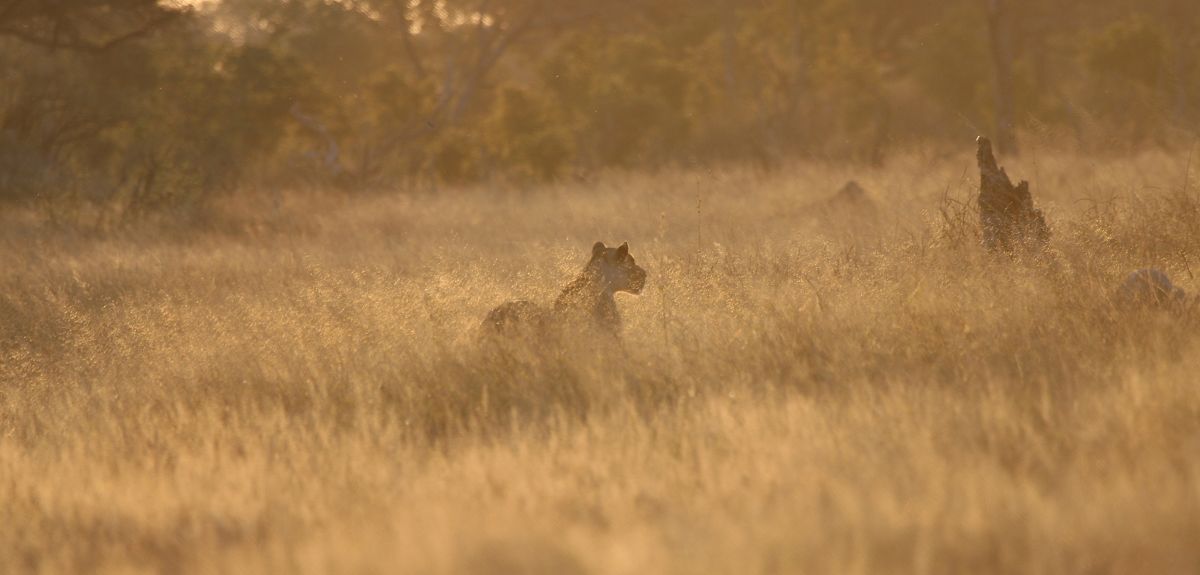
The killing of Cecil the lion has caught the public's attention: he was one of the lions fitted with a GPS collar as part of Oxford University research led by Andrew Loveridge.
UPDATE: You can read a response to Cecil's death from Oxford's Wildlife Conservation Research Unit (WildCRU).
Below we revisit an interview with Andrew about his research first published in 2012. You can support WildCRU lion research here.
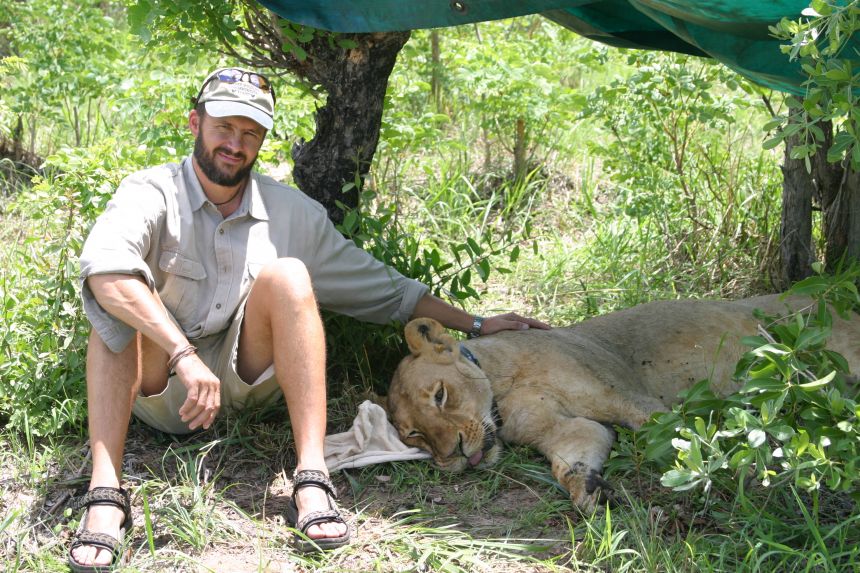 Andrew Loveridge with GPS collared lioness
Photo: Andrew Loveridge
They are one of the world’s most charismatic big cats, but what does it take to understand the lives of wild lions?
Someone who knows is Andrew Loveridge of Oxford University’s Wildlife Conservation Research Unit (WildCRU), who has been studying lions in Zimbabwe for over a decade and recently won the SATIB Trust Award for his lion biology and conservation work.
I asked Andrew about how he tracks and studies lions, gaining insights into lion behaviour, and how people can live alongside these iconic predators…
OxSciBlog: What are the challenges of studying lions in the wild?
Andrew Loveridge: Lions tend to live in the last wilderness areas of the planet - and these are naturally remote and often fairly inhospitable to people (the reason they remain wilderness areas in the first place). Most people visualise Africa as being Disney-like wide open plains, and while plains habitats do exist in Africa, much of the continent is more densely wooded.
Hwange, the National Park we work in, is one such place being thickly wooded bushland-savannah with very few access roads. Lions in this ecosystem have home ranges in excess of 300km2 so they are typically tricky to find and study.
Monitoring enough of the population to provide a meaningful scientific insight into population processes and behaviour presents quite severe logistical challenges. We overcome this by covering extensive areas in 4X4 vehicles - often spending weeks at a time camping in remote areas of the park, by using technology such as GPS radio-collars (and recently GPS collars that return our data via satellite) and having access to a micro-light aircraft which helps us locate lions more easily.
Of course all this requires considerable funding to put in place and maintain, so outside the field the biggest challenge is raising the funding to maintain the study. We have been very fortunate in recent years to have received substantial grants from Panthera, Thomas and Daphne Kaplan, and recently the Robertson Foundation, as well as ongoing support from the SATIB Trust.
OSB: How can fieldwork studies help to inform conservation efforts?
AL: A common misconception is that lions are common and widespread in Africa. Whilst it is true that lions are commonly sighted in some of Africa’s well protected photographic safari destinations they fare less well in areas with limited or no protection. In such areas they compete with burgeoning human populations for limited space and resources. In the last 50-100 years the geographic range of the African lion is thought to have declined by 80%.
Surprisingly, for such an iconic and well known species, even basic biological statistics such as population size and crude population trends are unknown for many (if not most) lion populations in Africa. Along with our more academically-orientated scientific work we provide local managers and decision makers with the baseline information they need to adequately manage lion and other wildlife populations. In this way our work has a direct influence on conservation planning and policy.
We are only just learning what long term effects human activities, such as trophy huntingand retaliatory killing over livestock loss have on lion populations. A better understanding of these issues helps African conservationists to preserve and manage a species that has huge economic, ecological and cultural importance. Robust conservation decisions need to be based on reliable and detailed biological information.
OSB: What surprises about lion behaviour has your research revealed?
AL: Lions are probably one of the best-studied mammalian species, nevertheless, they still do things that surprise and intrigue our research team. Possibly one of the most intriguing aspects of lion behaviour is their wide ranging behaviour and ability to move over extensive areas. Understanding these movements is one of the key challenges in protecting lion populations because wide ranging carnivores frequently come into conflict with people. Protected areas need to be large to accommodate the ranging behaviour of large carnivores.
The surprisingly extensive movement of our lions was recently illustrated by a male lion that moved from our study area in Hwange National Park, Zimbabwe, to Livingstone town in Zambia. This movement took just over a month and in this time the lion walked around 220km. He crossed the 100m wide Zambezi River below Victoria Falls, negotiating the substantial white water rapids.
We have recorded extensive ranging movements in the past particularly in young dispersing males. However, this is longest movement and this particular study animal was 10 years old - which makes this behaviour even more intriguing. This demonstrates how little we actually know about movements of lions between regional populations. This is crucial information if we are to avoid population isolation which could spell disaster for the genetic health and long-term viability of large carnivore populations.
The other unique aspect of lion behaviour revealed by our study is the lions’ unusual behavioural responses to the local ecosystem. In the dry season in Hwange National Park water is provided for wildlife at artificially pumped waterholes. These attract high abundances of prey species and our research has revealed that lions configure their rangesto ensure access to this rich prey resource.
Elephants are the most locally abundant herbivore in the area. Because of their massive size elephants are usually not troubled by lions, however lions in our study area have learned to pick out and kill even quite large elephant calves. Elephants make up a significant proportion of lion diet in the ecosystem, particularly in dry years when elephants are stressed by shortage of browse and water.
OSB: How can this research help people to live alongside lions?
AL: The research team in Hwange has just completed the first phase of a human-wildlife conflict project, focused on conflict with lions, but also including species such as the spotted hyaena in the research. This phase has focussed on understanding both the ecological and human economic and sociological factors that contribute to conflict situations. Understanding the root causes of human-wildlife will hopeful allow us to implement locally suitable interventions in the next three-year phase of the project, funded by Panthera and the Robertson Foundation.
In the nearby Makgadikgadi ecosystem in Botswana a recent WildCRU study discovered that lions feed almost exclusively on wild prey when it is seasonally abundant, but in periods of wild prey shortage they switch to killing perennially abundant domestic livestock. Lions appear to weigh up the considerable risks of killing domestic stock by only doing so in times of wild prey scarcity. This pattern is mirrored in the Hwange ecosystem. Here we have found that lion predation on livestock peaks in the wet season.
There are two reasons for this: Firstly water is freely available in thousands of ephemeral waterholes and wild prey disperses widely throughout the ecosystem. This makes wild prey more difficult and less predictable for lions to find. At the same time people in surrounding communities plant their crops in the wet season. Livestock guarding is neglected as people focus on tending their fields, leaving domestic animals vulnerable to predation.
Understanding the underlying ecological processes is the key to putting in place appropriate and successful interventions to ease or eliminate human-wildlife conflict. It would be pointless and expensive to implement inappropriate or ill conceived interventions that do not address the root causes of the problem. To address some of the conflict problems we are designing suitably targeted livestock husbandry systems, investigating the potential use of predator proof fencing and seasonal protective structures. We are employing local men to assist villagers to improve livestock protection and to deter predators.
OSB: How will the SATIB award/land rover help in your work?
AL: It is a huge honour to accept the 2012 SATIB Award, especially knowing how passionate and dedicated Brian Courtenay and the other Trustees of the SATIB trust are to conservation of African wildlife and wild places. It has also been a great opportunity to raise the profile of the lion project and what we are trying to achieve in conservation of the species and its habitat.
Like the species we study, lion researchers have to cover extensive areas of remote and often inhospitable wilderness. Having a tough and reliable off-road-capable research vehicle, such as the specially fitted Land Rover Defender LWB that came with the SATIB award, is an absolutely essential part of undertaking research on this species. In the coming year the project team will also be undertaking survey work in the surrounding region, so having a new vehicle will be extremely helpful.
OSB: What's next for the Hwange Lion Project/your research?
AL: Long-term biological studies are relatively rare. The Hwange Lion Project has been running for just over 12 years, during which time we have gained a unique insight into the population dynamics and conservation of this particular lion population.
The core of our effort is to maintain the monitoring work and continue to add to this long-term understanding. In addition to this we are continuing undertake research on human-wildlife conflict at the borders of Hwange National Park and this year we will be embarking on some exciting new initiatives to work with local communities to reduce levels of human-lion conflict. In doing so we hope to reduce the number of lions killed by angry herders over loss of domestic stock.
Another exciting component of the project is an initiative to identify and conserve habitat corridors that that link the core Hwange lion population with other regional protected areas. We have already found evidence that these exist and it is important that habitat corridors are recognised and protected in the face of ever expanding human populations.
My other research includes a three-year project, funded by the Darwin Initiative for Biodiversity, on the sustainable management of leopards in Zimbabwe.
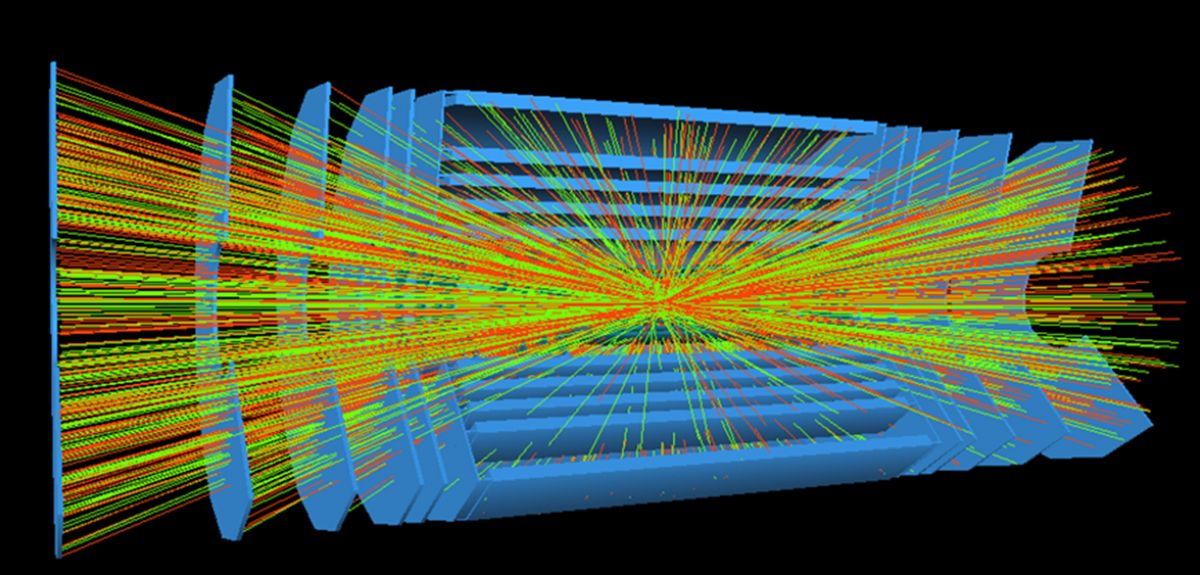
In 2012 CERN's Large Hadron Collider (LHC) discovered the Higgs boson, the 'missing piece' in the jigsaw of particles predicted by the Standard Model.
Last month, after two years of preparation, the LHC began smashing its proton beams together at 13 Trillion electron Volts (TeV), close to double the energy achieved during its first run.
'We do not know what we will find next and that makes the new run even more exciting,' Daniela Bortoletto of Oxford University's Department of Physics, a member of the team running the LHC’s ATLAS experiment, tells me. 'We hope to finally find some cracks in the Standard Model as there are many questions about our universe that it does not answer.'
One of the big questions concerns dark matter, the invisible 'stuff' that astrophysicists estimate makes up over 80% of the mass of the Universe. As yet nobody has identified particles of dark matter although physicists think it could be the lightest supersymmetric (SUSY) particle.
'In the new run, because of the highest-ever energies available at the LHC, we might finally create dark matter in the laboratory,' says Daniela. 'If dark matter is the lightest SUSY particle than we might discover many other SUSY particles, since SUSY predicts that every Standard Model particle has a SUSY counterpart.'
Then there's the puzzle of antimatter: in the early Universe matter and antimatter were created in equal quantities but now matter dominates the Universe.
'We still do not know what caused the emergence of this asymmetry,' Daniela explains. 'We have finally discovered the Higgs boson: this special particle, a particle that does not carry any spin, might decay to dark matter particles and may even explain why the Universe is matter dominated.'
Discovering the Higgs boson was a huge achievement but now the race is on to understand it: a prospect that Daniela is particularly excited about.
'This particle is truly fascinating,' she says. 'Spin explains the behaviour of elementary particles: matter particles like the electron have spin 1/2 while force particles like the photon, which is responsible for the electromagnetic interaction, have spin 1. Spin 1/2 particles obey the Pauli principle that forbids electrons to be in the same quantum state.
'The Higgs is the first spin 0 particle, or as particle physicists would say the first 'scalar particle' we've found, so the Higgs is neither matter nor force.'
Because of its nature the Higgs could have an impact on cosmic inflation and the energy of a vacuum as well as explaining the mass of elementary particles.
Daniela tells me: 'Because of the Higgs the electron has mass, atoms can be formed, and we exist. But why do elementary particles have such difference masses? The data of run 2 will enable us to study, with higher precision, the decays of the Higgs boson and directly measure the coupling of the Higgs to quarks. It will also enable us to search for other particles similar to the Higgs and determine if the Higgs decays to dark matter.'
Daniela is one of 13 academics at Oxford working on ATLAS supported by a team of postdoctoral fellows, postgraduate students and engineering, technical, and computing teams. The Oxford group plays a lead role in operating the SemiConductor Tracker (SCT), most of which was assembled in an Oxford lab. This provides information on the trajectories of the particles produced when the LHC’s beams collide, which was crucial to the discovery of the Higgs boson.
Whilst the next few years will see the Oxford group busy with research that exploits the LHC’s new high-energy run, the team are also looking ahead to 2025 when the intensity or 'luminosity' of the beams will be increased.
The LHC is filled with 1,380 bunches of protons each containing almost a billion protons and colliding 40 million times per second. This means that every time two bunches of protons cross they generate not one collision but many, an effect called 'pile-up'.
'After this luminosity upgrade the LHC will operate at collision rates five to ten times higher than it does at present,' Daniela explains. 'In run 1 of the LHC we had a maximum of 37 pile-up collisions per crossing but with the upgrade to the High Luminosity LHC, or 'HL-LHC', this will increase to an average of 140 pile-up events in each bunch crossing.'
With the HL-LHC generating many more collisions, the international Oxford-led team are designing and prototyping parts of a new semiconductor tracker that will be needed to help reconstruct particles from the complex web of decay trails they leave inside the machine.
As the LHC ramps up both its energy and luminosity it promises to give scientists working on experiments such as ATLAS answers to some of the biggest questions in physics. One thing is certain: this new physics will also lead to a whole set of new questions about the matter that makes up us and the Universe around us.
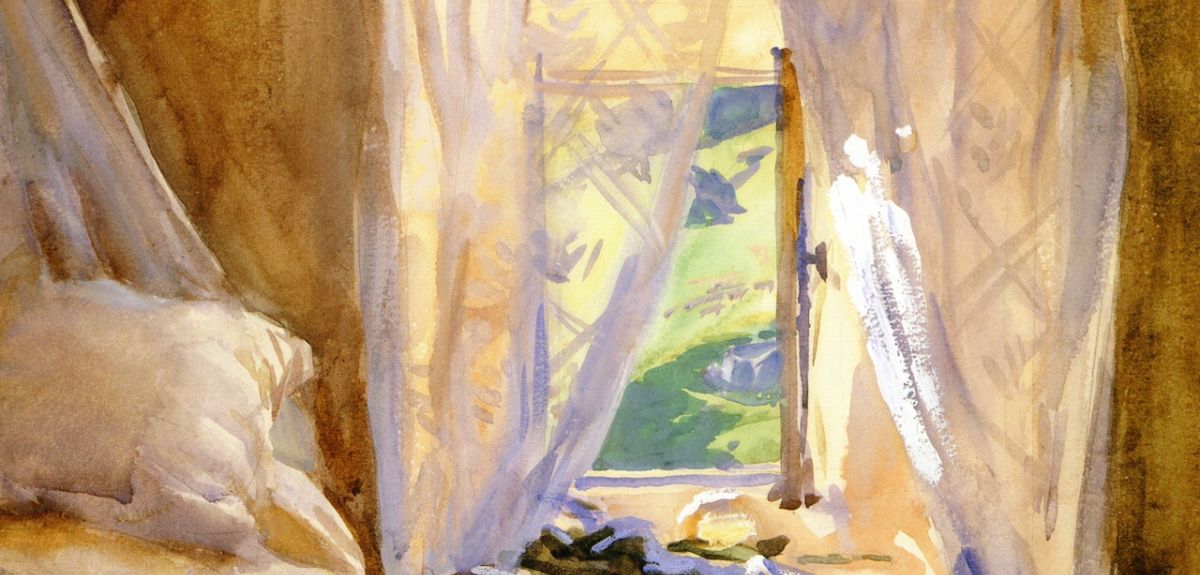
Jackson Pollock, Jasper Johns, Andy Warhol, John Singer Sargent. American artists have produced some of the most popular works of art in galleries across the world.
But to date the subject has been 'largely absent' from Oxford’s research and teaching programmes, according to the Head of the History of Art Department.
'Oxford is arguably the most important centre for the study of American history, politics, and culture outside North America,’ says Professor Geraldine A. Johnson. ‘Until now, however, American art has largely been absent from the University’s research and teaching programmes.'
This is due to change with the establishment of two one-year Visiting Professorships for scholars of American art.
In 2016/17 and 2017/18 the visiting professors will help to establish American art from the colonial period onwards as a new field of study for Oxford Master's students in Art History, introduce the visual arts of the United States to undergraduate students in History and Art History, and provide new global perspectives on American art to scholars and curators in Oxford and beyond.
'The Terra Foundation for American Art Visiting Professorships at the University of Oxford will allow the study of the visual culture of the United States to become a key component of Oxford’s world-class American studies agenda,' says Professor Johnson.
'We also hope that these posts will allow new initiatives to be developed in collaboration with the University’s museums and collections.'
The visiting professorships have been established by the Terra Foundation for American Art, which describes its mission as 'fostering exploration, understanding, and enjoyment of the visual arts of the United States for national and international audiences'.

The Ashmolean Museum has raised the money needed to acquire an iconic painting of Oxford’s High Street by JMW Turner.
The Museum launched a public appeal in June to acquire the painting of 1810 called The High Street, Oxford.
The painting was offered to the nation in lieu of inheritance tax, meaning the Museum needed to raise only £860,000 to acquire it. Grants of £550,000 from the Heritage Lottery Fund, £220,000 from the Art Fund and £30,000 from the Friends and Patrons of the Ashmolean meant that £60,000 was required. Local people and museum visitors exceeded this target in only four weeks.
'The Museum has been overwhelmed by public support,' says Dr Alexander Sturgis, Director of the Ashmolean.
'With well over 800 people contributing to the appeal, it is clear that the local community, as well as visitors to the Museum from across the world, feel that this picture, the greatest painting of the city ever made, must remain on show in a public museum in Oxford.'
The Museum plans to lend the painting to regional museums so as many people as possible will be able to see it. The painting will also be at the heart of a new series of educational activities for schools and young people, and it will be part of the Museum’s Nineteenth Century Gallery which will be refurbished and reopened in early 2016.
The Future of Humanity Institute at Oxford University and the Centre for the Study of Existential Risk at Cambridge University are to receive a £1m grant for policy and technical research into the development of machine intelligence.
The grant is from the Future of Life Institute in Boston, USA, and has been funded by the Open Philanthropy Project and Elon Musk, CEO of Tesla Motors and Space X.
This grant will allow Oxford University's Future of Humanity Institute, part of the Oxford Martin School and Faculty of Philosophy at the University, to become the world’s largest research institute working on technical and policy responses to the long-term prospect of smarter-than-human artificial intelligence.
This growth follows the Institute Director Professor Nick Bostrom's bestselling book “Superintelligence”, which was endorsed by both Elon Musk and Bill Gates.
Professor Bostrom said: 'There has much talk recently about the future of AI. Elon - characteristically - decided to actually do something about it.
'This grant will enable Oxford to expand its research in this area, forming the largest group in the world of computer scientists, mathematicians, philosophers, and policy analysts working together to ensure to that advances in machine intelligence will benefit all of society.'
The funding is part of an international grant programme dedicated to “keeping AI robust and beneficial”, which today awarded nearly $7m. The programme had nearly 300 applicants this round, which were subject to a thorough academic review process. The joint Oxford-Cambridge research centre will be the programme’s largest grant. Three other Oxford-based projects also received funding.
Andrew Snyder-Beattie of the Future of Humanity Institute said: 'The joint centre between Oxford and Cambridge universities will allow a team of computer scientists, mathematicians, philosophers, and policy analysts to collaborate and help ensure that advances in machine intelligence will benefit all of society.'
- ‹ previous
- 148 of 252
- next ›
 What US intervention could mean for displaced Venezuelans
  Setting the agenda for the next century of quantum
 10 years on: The Oxford learning centre making an impact
 Mapping the Moon: the world’s first lunar atlas goes digital
  Oxford and The Brilliant Club: inspiring the next generation of scholars
 New course launched for the next generation of creative translators
 The art of translation – raising the profile of languages in schools
  Opening a window into the quantum world
 Tracking resistance: Mapping the spread of drug-resistant malaria