Features

Philosophers take on the world. This isn’t a doomsday news story, but the title of a new book which has been published by Oxford University Press today.
The chapters have been adapted from pieces written for the popular Practical Ethics blog, run by the Uehiro Centre for Practical Ethics in Oxford University’s Philosophy Faculty.
The authors are experts in ethics, medicine, politics and current affairs – and many are academics at Oxford University.
To mark the launch of the book, its editor Dr David Edmonds has written a guest post for the Arts Blog.
Dr Edmonds is a Senior Research Associate at Oxford’s Uehiro Centre for Practical Ethics, as well as a BBC documentary-maker, podcast producer and author. Here is his post, which is titled 'In defence of moral experts':
I’m no expert. Still, I reckon the notorious claim made by Michael Gove, a leading campaigner for Britain to leave the European Union, that the nation had had enough of experts, will dog him for the rest of his career. In fact, he wasn’t alone. Other Brexit leaders also sneered at the pretensions of experts, the majority of whom warned about the risks – political, economic, social - of a Britain outside the EU.
Those who dismiss experts have a habit of using the prefix “so-called”. Time will tell (probably not much time) whether Gove was right to dismiss the anxieties of “so-called experts”. Still, despite the beating he received in sections of the press, his was on politically safe ground. There is a suspicion of experts in Britain, part of a more general suspicion of elites and of the establishment.
The world of philosophy suffers from a similar malaise. There are few philosophers who can claim to be public intellectuals, at least in the Anglo-American world. As we know, the French are willing to embrace and celebrate their philosophers in a way that the British find uncomfortable. We have one or two philosophers with the flowing locks of Bernard-Henri Lévy but none with his profile or standing.
It’s not just that the British public has a strain of anti-intellectualism, and a weaker appetite than the French for philosophical input to the national debate. It’s also that the few philosophers who do attempt to contribute to the world beyond the Academy risk ridicule within the profession. No doubt this is driven in part by an unworthy, if natural, envy. “They’re not serious” is the sotto voce (and sometime not so sotto voce) verdict of colleagues who appear in print or on TV or radio.
Within my sub-genre of philosophy – practical ethics – the suspicion of public engagement has a more specific cause. It’s often asserted that moral philosophers can’t claim expertize in ethics in the same way a chemist, for example, can be an expert on a molecule.
That’s a concern that puzzles me. Certainly there’s some evidence – from the UC Riverside philosopher Eric Schwitzgebel - that those who write about and teach courses in ethics are no more ethical than anybody else. And it’s true that specializing and so commanding authority in trichloro-2-methyl-2-propanol is disanalogous in various ways to being an authority in some corner of practical ethics – not least in how this expertize can be tested.
Still, I want to defend the expertize of moral philosophers, to maintain that their views in their chosen field merit respect and at least a degree of deference. We should heed attention because they have mastered the relevant information on their topic and brought to bear the philosopher’s chief tools, depth and clarity of thought. They have marshalled arguments and ironed out inconsistencies. And practical ethics is tough. To take just one example – trying to work through the metaphysics of what gives human beings moral status, and the implications of this for a variety of non-standard cases, is hugely complex.
I endorse what the White's Professor of Moral Philosophy at the University of Oxford, Jeff McMahan, says: “Questions about abortion and termination of life support, and euthanasia, and so on, are really very difficult. We are right to be puzzled about these issues, and people who think that they know the answers and have very strong views about these matters, without having addressed these issues in metaphysics and moral theory are making a mistake. They should be much more sceptical about their own beliefs.”
Sometimes the philosopher’s arguments about an issue merely shores up common-sense. But the role of the philosopher cannot merely be to describe the standard position. That would reduce philosophy to a branch of psychology, or anthropology, or sociology. The moral philosopher does not just ask how much people give to charity, or want to give to charity, relevant though these questions are, but how much should they give to charity.
But whether it be John Stuart Mill on women’s rights, or Peter Singer on animal rights, philosophical reasoning can produce results that the then majority find objectionable, even repugnant. My appeal is that in such cases we should pay close attention to the philosophy, to how conclusions are reached. Our prima facie position should be that the philosopher has a good case.
There is some evidence that in their quiet way, British philosophers are beginning to assert themselves. I was delighted to see that in a recent week of five BBC essays devoted to post-Brexit Britain - three of the authors, John Gray, Onora O’Neill and Roger Scruton - were philosophers. In the book I’ve just edited, Philosophers Take On the World, over forty philosophers address stories in the news and argue for often counter-intuitive positions.
Counter-intuitive perhaps, but my starting position is that we should take ethics experts seriously. Who knows, Mr Gove, they may even be right.

On World Alzheimer's Day (21 September), Oxford scientists are beginning a new study in the battle to beat the increasing issue of dementia.
Dementia is a truly global issue and to tackle it, we need a joined-up approach. Oxford is leading the way in dementia research and this funding will help us to continue to make progress for all those affected.
Professor Richard Wade-Martins, Coordinator, Oxford Alzheimer's Research UK Network Centre
Charity Alzheimer's Research UK, the UK’s leading dementia research charity, have increased their support for Oxford dementia research with two awards. One will support the community of dementia researchers in Oxford to work together towards the goal of defeating dementia. The second award will allow a team to study whether taking aspirin and omega-3 fish oils can improve people's memory and thinking skills.
Dementia is one of the greatest challenges facing modern medicine and there are currently 850,000 people in the UK living with dementia. For example, Oxfordshire alone has more than 8,000 people with dementia.
In the first ever project awarded by Alzheimer's Research UK's Global Clinical Trials Fund, Professor Jane Armitage at the University of Oxford will study whether aspirin or omega-3 fish oils have an effect on memory and thinking skills in people with diabetes. As an add-on to an existing clinical trial called ASCEND, funded by the British Heart Foundation, Prof Armitage and her team will test the memory and thinking skills in around 10,000 people who have taken aspirin, omega-3 fish oils or a placebo for 6.5 years.
Having poor heart health is associated with an increased risk of dementia, and diabetes is a risk factor for both heart health and dementia. Both aspirin and omega-3 fish oils are thought to reduce complications resulting from poor heart health, such as heart attacks and stroke, but previous studies looking at their effects on memory and thinking have been too small to detect what may be small but worthwhile benefits.
We are beginning to unravel the links between cardiovascular health, diabetes and dementia, and this trial will provide important insight into this relationship.
Professor Jane Armitage, Nuffield Department of Population Health
Prof Jane Armitage explains: 'We are beginning to unravel the links between cardiovascular health, diabetes and dementia, and this trial will provide important insight into this relationship. This is an excellent opportunity to study an existing group of around 10,000 people who have been taking aspirin or omega-3 fish oils for 6.5 years and examine the effects on their memory and thinking skills. Although these drugs are not being investigated for their potential to treat dementia, if they are found to reduce the risk of developing the condition then this could be of significant benefit in supporting healthy ageing.'
Oxford is home to the Alzheimer's Research UK Oxford Research Network Centre. The charity’s Research Network is the largest community of dementia researchers in the UK, with over 1,000 members across 15 virtual Research Centres. Being part of the Network provides researchers with unique access to funding for small grants to support travel, equipment and networking.
Prof Richard Wade-Martins, Coordinator of the Oxford Network Centre, welcomed the new funding. He said: 'We are delighted that Alzheimer's Research UK has continued to support pioneering research in the city. Being part of a UK-wide Network of dementia researchers is a real boost to us, enabling us to collaborate with other scientists and explore new avenues of research. Dementia is a truly global issue and to tackle it, we need a joined-up approach. Oxford is leading the way in dementia research and this funding will help us to continue to make progress for all those affected.'
Dr Rosa Sancho, Head of Research at Alzheimer's Research UK, said: 'We are dedicated to funding the best minds and forging the most effective partnerships, and so are very glad to be supporting the vital work of scientists in Oxford. There is currently no way to prevent dementia, and so research into the factors that affect a person’s risk of the condition is crucial if we are to help people achieve a better quality of life for longer. Dr Armitage has a wealth of experience of clinical trials relating to diabetes and cardiovascular disease, and it’s fantastic that she is now applying her skills to addressing important questions in dementia research.
'We know that we will not defeat dementia in isolation, which is why initiatives such as the Research Network are crucial to support researchers at a grass-roots level. Sharing of ideas and resources will spur scientists on to think more ambitiously and help us progress faster towards our goal.'

An Oxford University professor will be taking Radio 4 listeners on a journey through the history of the concept of infinity for the next fortnight.
Philosopher Professor Adrian Moore will present a 15-minute programme at 1.45pm from Monday to Friday this week and Monday to Friday next week.
In today’s episode of A History of the Infinite, Professor Moore explores why the idea of infinity made the Ancient Greeks so uncomfortable.
Oxford University academics contributing to the programmes include Ursula Coope, Professor of Ancient Philosophy, Cecilia Trifogli, Lecturer in Medieval Philosophy, and Professor Richard Sorabji, Honorary Fellow of Wolfson College.
Professor Moore says: 'This series is based on my book The Infinite (Routledge, 2nd edn 2001). The first four programmes are concerned with the remarkable turnaround between the time of the early Greeks, when various puzzles and paradoxes associated with the infinite had made it an object of abhorrence and distrust, to the early modern period, by which time it had come to be associated with the divine and had become an object of veneration and awe.
'In the next three programmes listeners are introduced to some of the extraordinary mathematical results concerning the infinite, including the discovery that some infinities are bigger than others.
'In the final three programmes attention shifts to the cosmos and our place in it. I consider questions about the age and size of the universe, about death and immortality, and about our basic urge to seek meaning for our lives in something infinitely greater than us.'
All programmes will be available to listen to or download from the BBC website over the next month.
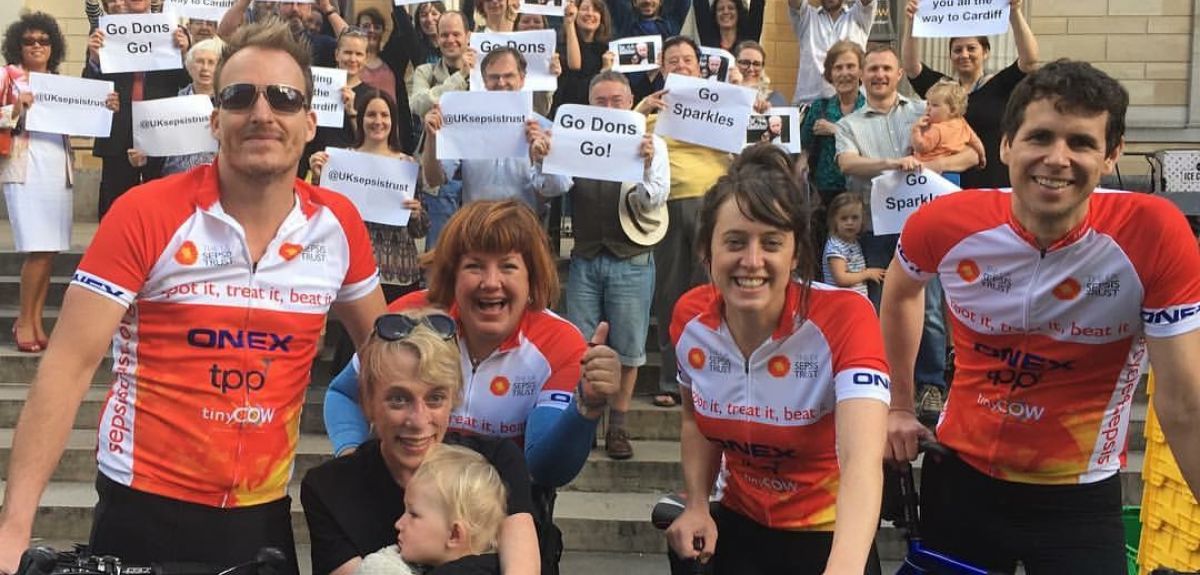
Many academics have recently come back to Oxford after a summer holiday. But Professor Liz Frood’s return to work (part-time) as Professor of Egyptology last week is a much more remarkable story.
Professor Frood contracted sepsis in August 2015. Her cousin Jane Wynyard picks up the story: ‘She spent ten days in the ICU, five months in hospital, had her legs amputated below the knees, lost her hearing in one ear, her nose collapsed and her hands were damaged almost beyond repair,’ she says.
This left Professor Frood severely disabled, with both legs amputated, no dexterity in my hands, partial deafness, and a reconstructed nose.
Miss Wynyard adds: 'Before Liz’s illness, none of our family had ever heard of sepsis or understood the life-changing and devastating effects this terrible infection could have.
‘In just one year, Liz has totally inspired and humbled us with her amazing will to survive and courageous battle to live a normal life despite her terrible injuries. Her bravery and determination have been matched by the incredible work of the NHS staff, doctors, surgeons and specialists whom we will always be indebted to for saving Liz.’
Some of Professor Frood’s family and friends set off today (Friday 9 September) on a bike ride beginning at the Ashmolean Museum and due to end in Cardiff. They are due to arrive in Gloucester this evening after completing the arduous first stage of their trip.
‘It’s been brilliant so far,’ Professor Frood reports. ‘We had a great send-off! The cyclists have been riding through gorgeous countryside, which seems to have them all very excited.’
The team, called the Dons of Oxford, hopes to raise awareness of sepsis and to raise money for the UK Sepsis Trust. They would welcome donations here.
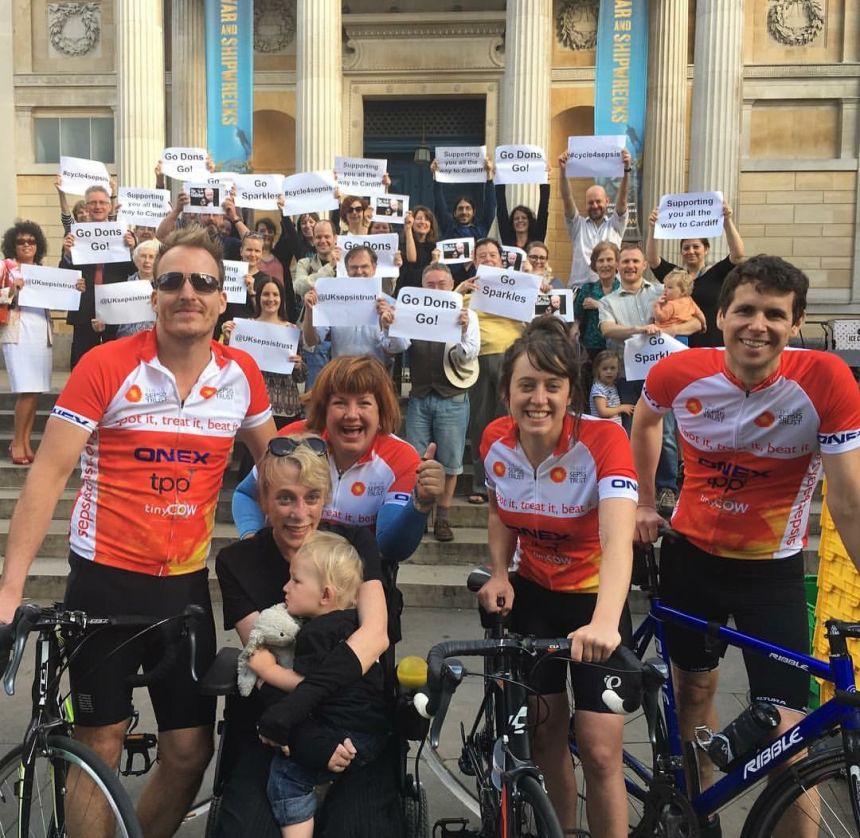 'The Dons of Oxford' cycling team, with Professor Frood (front), set off from Oxford
A little over a year ago, Professor David Macdonald of Oxford University's Wildlife Conservation Research Unit (WildCRU) spoke of his desire to harness the global interest in the killing of Cecil the lion, creating a movement rather than simply a moment.
That journey continues this week with the Cecil Summit, a workshop held in Oxford that will bring together leading figures from across the world to consider future initiatives to preserve the African lion.
The summit will culminate in a free public event on Wednesday 7 September at the Blavatnik School of Government in which anyone interested in conservation will be able to hear the thoughts of top lion experts, as well as a variety of innovative thinkers from fields as diverse as economics, development, international relations and ethics.
The discussion, to be introduced with an illustrated talk by Professor Macdonald, will be chaired by Alan Rusbridger, Principal of Lady Margaret Hall, Oxford and former editor of The Guardian. It will take place from 5pm to 7pm. The summit follows more than a year of sustained interest in the story of Cecil, who was killed by a big game hunter outside Hwange National Park, Zimbabwe on 2 July 2015. Researchers from WildCRU were studying and tracking Cecil and his pride as part of their lion conservation research.
Professor Macdonald, the founding Director of WildCRU, explained the context for the summit: 'Lions, arguably the most iconic species in the world, are doing badly. That understatement captures the shocking fact that wild lions nowadays roam in only 8% of their historic range. Last year, researchers from WildCRU and Panthera, the big cat charity based in New York, published the finding that whereas a hundred years ago it is widely thought there were about 200,000 lions, today there are closer to 20,000.
'Against this distressing but widely ignored background, suddenly everything changed with the killing of Cecil, a fascinating elderly male Zimbabwean lion that WildCRU had been satellite tracking since 2008. Cecil's death prompted unprecedented media interest globally, and so with the world's attention focused on lions, WildCRU and Panthera resolved to hold the Cecil Summit with the purpose of asking whether the morbid trajectory of the lion's fate could be reversed, breaking the mould of conservation by seeking new, innovative approaches from beyond the realms of dedicated field biologists.'
The summit is a joint venture between Oxford and Panthera, whose President Luke Hunter said: 'The tragedy of Cecil's death spurred a unique sea change moment for global awareness of the lion's precarious state. But over a year later, the species is still in freefall in many places. The lion is running out of time.
'We hope that the Cecil Summit's brain trust of conservationists and innovators can spur a new infusion of support for African governments and people working to save the magnificent African lion.'
Speaking from WildCRU's centre at Tubney House near Oxford, Professor Macdonald said: 'In my experience, this summit is unique: we take 30 innovative minds, present them with a new problem, mix them with some conservation specialists, shake and stir, and hope for a breakthrough. It may work, it may not, but at least we will have tried. We'll have grasped the unique Cecil moment and challenged ourselves to find a new way ahead for the Cecil movement.
'Perhaps the unique feature of our approach, forcing inter-disciplinarity between those who know about lions and those who know about delivering high-level change to the human enterprise, will itself become a way ahead in conservation: the Tubney Format!'
He added: 'We believe that the more brains are involved the better, which is why we've arranged a public session in which Alan Rusbridger will lead a conversation with such guests as Rory Stewart, the UK's Minister for International Development; Achim Steiner, Director of the Oxford Martin School and recently head of the United Nations Environment Programme; Wilson Mutinhima, the Director General of Zimbabwe's National Parks; Craig Packer, the world's leading lion biologist; and Tom Kaplan, WildCRU's patron and the greatest benefactor in history to big cat conservation.'
The Cecil Summit's public event will take place at the Blavatnik School of Government from 5pm UK time on Wednesday 7 September. Attendance is free, but booking is required via the Oxford University website. The event will also be live-streamed on WildCRU's YouTube channel.
- ‹ previous
- 119 of 253
- next ›
 Celebrating 25 Years of Clarendon
  Learning for peace: global governance education at Oxford
  What US intervention could mean for displaced Venezuelans
  Setting the agenda for the next century of quantum
 10 years on: The Oxford learning centre making an impact
 Mapping the Moon: the world’s first lunar atlas goes digital
  Oxford and The Brilliant Club: inspiring the next generation of scholars
 New course launched for the next generation of creative translators
 The art of translation – raising the profile of languages in schools
  Opening a window into the quantum world