Features

Politics, elections, Donald Trump, and Pokémon GO are just some of the events, people, and subjects that influence British children’s creativity and use of language, says a report published today by Oxford University Press (OUP).
Following OUP's analysis of the 131,798 fabulously inventive, funny and politically astute short stories for the 2017 BBC Radio 2 Chris Evans’ Breakfast Show’s 500 Words competition, a wealth of fascinating insights into the lives of British children and their imaginative use of English have emerged.
The Children’s Word of the Year is trump, picked because of its significant increase in use (a total rise of 839 per cent on 2016) by entrants writing in this year’s competition and the sophisticated way in which children used it to convey humour and satire, and evoke powerful descriptive imagery.
Every year children show a keen interest in contemporary affairs and world events from sinkholes and the London Olympics to the Ebola crisis, refugees and Tim Peake’s spacewalk. This year, Donald Trump took office as President of the United States in the same week that 500 Words launched.
Trump is mentioned in a wide variety of contexts, from the US elections and politics, to tales of space, aliens, and superheroes, giving expression to children’s creativity, playfulness, and humour. Children also use the noun to invent new character names including Boggle Trump and Snozzle Trump.
Vocabulary associated with the US presidency was far more prevalent in 2017 than in 2016, including president, America, wall, Hillary Clinton, White House, Trump Towers, Obama, Mexico and Putin. Displaying an ear for Trump’s particular use of words and catch phrases, one entry stood out for its ability to brilliantly capture the rhythm of his speech. In Donald J Trump Goes to the Moon, a 12-year old girl wrote: “10... 9...8 ‘my hair is so amazing’...7. ‘And real’. 6... 5 ‘I am going to make the moon great again!’. 3... 2...1 blast off!!”
Political vocabulary is a notable area of growth in 2017, showing children’s engagement with the news and media. The words politics and political show an increase of 115 per cent and 78 per cent respectively since last year, and an analysis of a cluster of around 30 words relating to contemporary politics (for example president, vote, election, campaign) shows a 58 per cent increase in frequency since 2016. New words and phrases in this year’s stories include Brexit, Article 50, fake news, and alternative facts.
Vineeta Gupta, Head of Children’s Dictionaries at Oxford University Press, says: 'This year, the stories demonstrate creativity, style and wit, all underpinned by a sophisticated use of grammar and language. From humorous punning to creating their own words, children have played and experimented with language with impressive results. The stories have not only provided us with infinite entertainment, but also contributed to language research for children’s dictionaries. As well as this, 500 Words has led to academic research at Oxford University which will support teachers and schools.'
Chris Evans, presenter of BBC Radio 2's Breakfast Show, said: 'The OUP’s research is always such a fascinating insight into the minds of children today. This year’s analysis reveals just how tuned in they are to what’s going on in the world. It’s so inspiring to see how they use language so creatively, having fun with words, using humour and bringing them to life through their wonderfully unconstrained imaginations.'
500 Words is the BBC Radio 2 Breakfast Show’s short story writing competition for children aged 5-13, launched by Chris Evans back in 2011. Earlier this year, children were invited to compose an original work of fiction, using no more than 500 words.
OUP analysed the entries using its Oxford Children’s Corpus—a large electronic database of real and authentic children’s language—the only one of its kind in the world. It contains language written for children (54 million words) and also language written by children (284 million words).

From the books we read, to the films and programmes we watch, and the theatre productions we attend, the arts’ have the power to get us all talking and thinking. But can they actually influence our perceptions of real issues?
Using the play 'Brainstorm', (a Company Three production about teenage brain development), as a litmus test, recently published Oxford University research examines exactly that.
The study set out to see if watching a play about the teenage brain, could impact how people felt about criminal responsibility. Because of the nature of the production, perceptions of offences committed by children under the age of sixteen were of particular interest.
From hormonal outbursts, to rash decisions and bouts of expression, it is well known that young people go through a lot of behavioural changes during adolescence. How much people understand that it is the brain’s natural mechanisms that cause these changes, as it develops, with age, is less well known. Produced in collaboration with neuroscientists at UCL, and teenage performers, ‘Brainstorm’ supports this understanding, communicating complex scientific knowledge and highlighting the various developmental changes that adolescents experience as their brains change.
An adult might find it easier to resist the urge to lash out, or respond to confrontation. But, for a teenager, that impulse is likely to feel stronger and much harder to resist. Their brains naturally respond to impulses, and the part of their brain that would ordinarily resist them is still developing, and therefore much weaker.
When considered in the context of criminality, if people are not truly responsible for their brains and the brain influences whether or not we offend, it could be argued that teenage offenders may not be truly responsible for their crimes.
‘Brainstorm’ audience members were asked to complete a survey of questions, either before or after watching the play. A total of 728 respondents shared their views on four questions, framed around three key issues; the age of criminal responsibility, moral responsibility and the likelihood of reoffending.
Results revealed that the play did affect audience attitudes to crime, and particularly youth crime. After watching the play, participants perceived a hypothetical young offender as less likely to reoffend than an adult offender. They also perceived the young, but not adult offender, as less morally responsible for their actions, especially those who had committed a first time offence.
Robert Blakey, the study’s author and a DPhil student at Oxford’s Centre for Criminology, said: ‘We all have this feeling that when we resist an impulse, we are deciding to resist that impulse – not our brain, but this mental sense of me that makes decisions free from biological constraints. But neuroscience suggests this just isn’t true. We are always affected by our brain – in every decision that we make.
‘After learning about the science of the teenage brain, the public may change how it views teenage offenders. And that’s exactly what happened after these theatre goers watched 'Brainstorm'. They changed how they viewed teenage offenders.
‘In the future, I expect neuroscience to change our priorities, so that we think more about why teenagers offend, and how we can help teenagers choose the right path, rather than ignoring the cause and closing the cell door completely’.
The full study is available to download from the online journal Frontiers in Psychology
Learn more about the teenage brain in this Oxford Sparks animation:
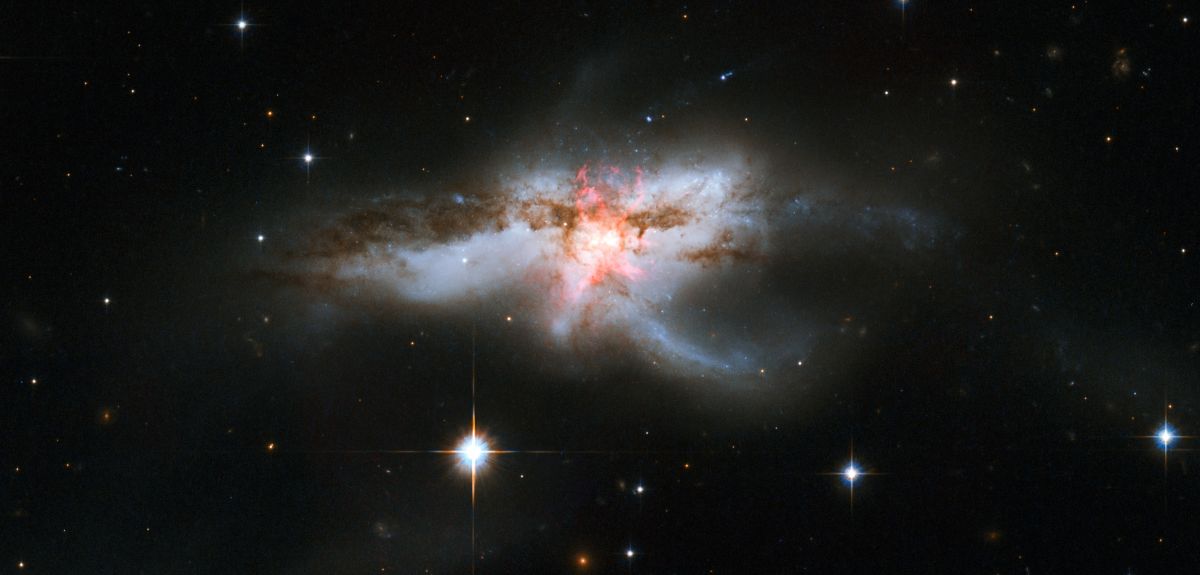
Miguel Pereira Santaella, Research Associate at the Oxford University Department of Physics, discusses his newly published work observing never before seen water transitions in space. He breaks down how the discovery will help scientists to answer big planetary questions and build a more accurate understanding of the universe.
From clouds to rivers, and glaciers to oceans, water is everywhere on Earth. What’s less well-known, though, is how abundant the molecule is in space.
Unlike on Earth, most of the water in space takes either the form of vapour or forms ice mantles stuck to interstellar dust grains. This is because the extremely low density of interstellar space - which is trillions of times lower than air, prevents the formation of liquid water. the birth of star formations can tell us about how the Universe behaves. But, since the only way to study them in such dust obscured environments is through the infrared light, detecting water transitions capable of detecting this light, is of vital importance.
Observing the birth of star formations can tell us a great deal about how the Universe behaves. But, since the only way to study these events in such dust obscured environments is through the infrared light, detecting water transitions capable of capturing this light, is vital.
Water molecules experience fluctuating quantum energy levels. This activity allows us to observe them and is known as a water transition. The term refers to the best point for scientific observation, which is the exact wavelength at which water molecules go from one quantum state to another, emitting light and increasing their visibility as they do so.
The majority of these transitions are not very energetic so they appear in the far-infrared and sub-millimetre ranges of the electromagnetic spectrum, with tiny wavelengths (ranging from 50 μm and 1000 μm (1 mm)). Observing these water transitions from the ground is very difficult because the thick vapour in Earth’s atmosphere almost completely blocks the emission from view.
Improvements in technology and the development of super telescopes offer an increasing gateway to the universe, and planetary insights are moving at rapid pace. We can now detect water transitions in ways that we just could not before. They are best seen from telescopic observatories situated at high-altitude, in extremely dry sites. Such as, the Atacama Large Millimeter Array (ALMA), which is located in the Atacama desert (Chile) at 5000 m above sea level.
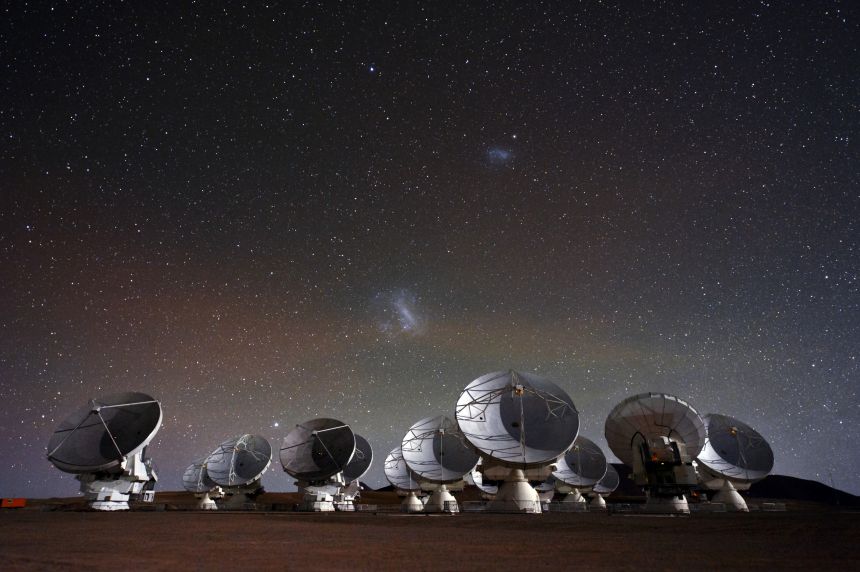 Image of the Atacama Large Millimeter/submillimeter Array (ALMA), showing the telescope’s antennas under a breathtaking starry night sky. Image credit: Christoph Malin
In our study published in Astronomy & Astrophysics, we used ALMA and detected the (670 μm) water transition in space, for the first time. The molecules were spotted in a nearby spiral galaxy (160 million light years away) at a point where the Universe is vastly expanded, and the atmosphere is therefore at its most transparent (red-shifted at 676 μm).
The water vapour emission in this galaxy originates at its core, in its nucleus, where most star formation takes place. To give you an idea of how enormous this galaxy is, the nucleus contains an equivalent amount of water 30 trillion times that of Earth’s oceans combined, and has a diameter 15 million times the distance from Earth to the Sun.
So what sets this water transition apart from others observed in the past? Our analysis revealed that these water molecules intensify their rate of emission when they come into contact with infrared light photons. This increase in activity makes it easier for scientists to observe them. Water molecules are most attracted to photons with specific wavelengths of 79 and 132 μm, which, when absorbed, strengthen the transition’s outline, therefore increasing its visibility. For this reason, this specific water transition has the ability to show us the intensity of the infrared light in the nucleus of galaxies, at spatial scales much smaller than those allowed by direct infrared observations.
Infrared light is produced during events like the growth of supermassive black holes or extreme bursts of star-formation. These events usually occur in extremely dust obscured environments where the optical light is almost completely absorbed by dust grains. The energy absorbed by the grains increases their temperature and they begin to emit thermal radiation in the infrared. Capturing these events can tell us a great deal about how the Universe behaves, so detecting water transitions that can capture this infrared light, is vital.
Moving forward we plan to observe this water transition in more galaxies where dust blocks all the optical light. This will reveal what hides behind these dust screens and help us to understand how galaxies evolve from star-forming spirals, like the Milky Way, to dead elliptical galaxies where no new stars are formed.
Oxford academics give lectures all around the world – but this must be a first.
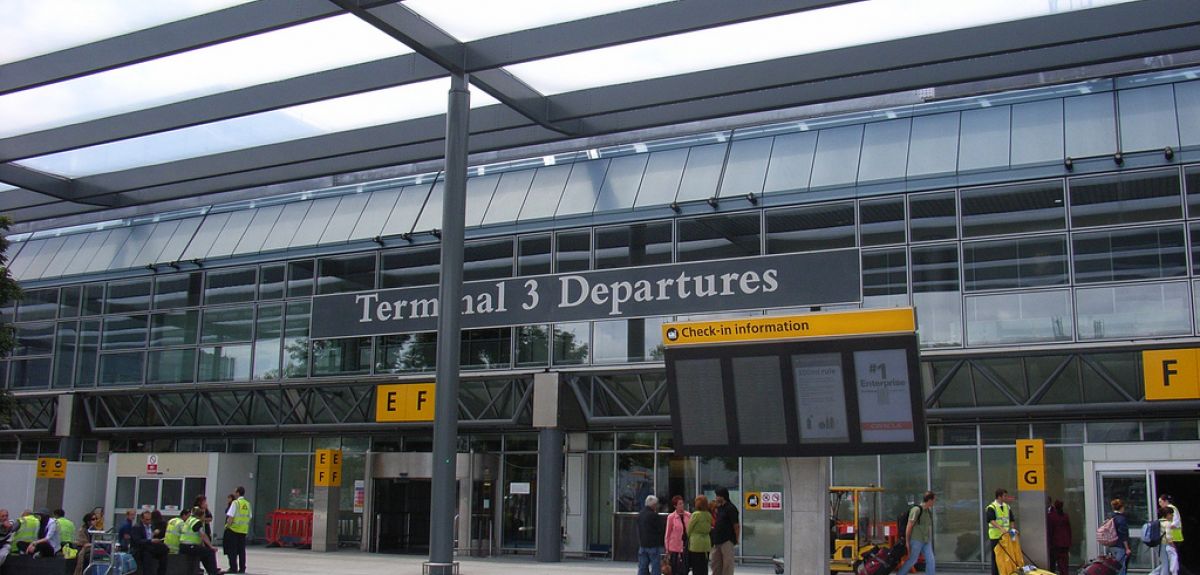
Dr Anders Sandberg, Senior Research Fellow at the Future of Humanity Institute in the University’s Philosophy Faculty, gave a lecture over Skype from Terminal 5 of Heathrow Airport recently.
He had intended to give the lecture in Madrid, but his flight was one of many to be delayed by a computer bug which struck British Airways during the last Bank Holiday.
When it became clear he was not going to make it to Spain, Dr Sandberg took it in his stride. ‘My dad worked for a Scandinavian airline and so when I was younger my time was spent waiting at airports,’ he said.
‘So I took a quite phlegmatic approach to it. It was probably the first time anybody has given a lecture at a departure gate. Maybe we should have them more often.’
Dr Sandberg’s lecture was titled ‘Reviewing the methods of slowing ageing’. No doubt his audience in Madrid were hooked by the content, but his fellow passengers were baffled.
‘People were wondering what was going on when I started talking about stem cells and ageing,’ he said. 'It must have looked quite weird.’
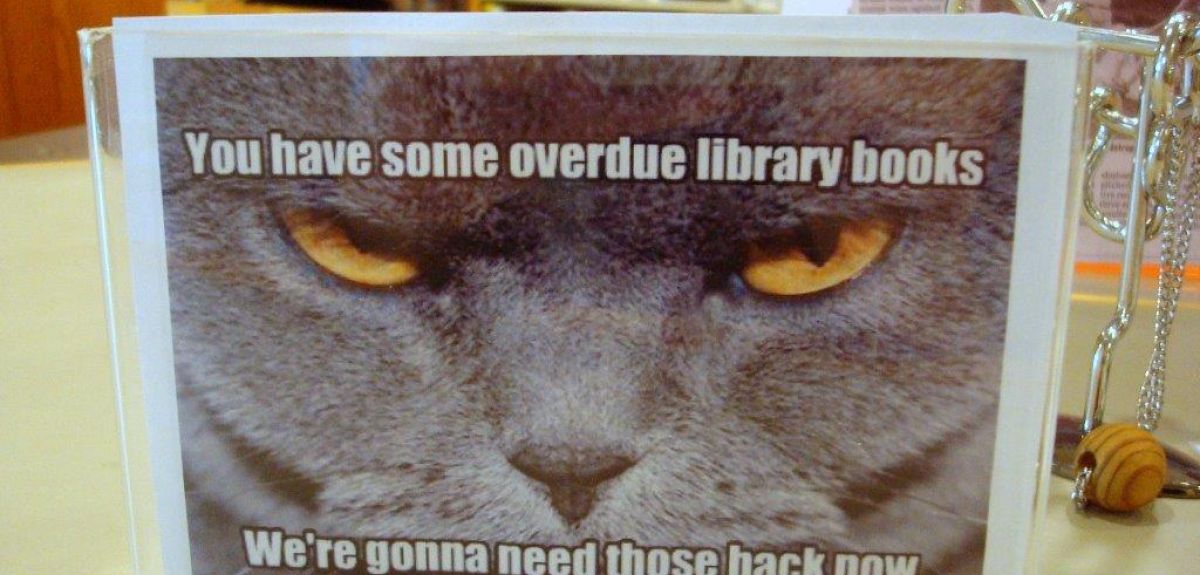
A library copy of a book written by Oxford University historian Dr Roderick Bailey has been returned eight years overdue – and 4,000 miles from where it was borrowed.
A copy of Dr Roderick Bailey’s ‘The Wildest Province: SOE In the Land of the Eagle’, was lent out by Dudley Library in the West Midlands in 2009, and was recently returned to the Boone County Public Library in Burlington, Kentucky.
Luckily for the reader, Dudley Library caps fines at £4.
Dr Bailey, who is Lecturer in the History of Medicine at Oxford University, is happy to speculate about why the reader held onto his book for so long.
‘The book was based on my PhD research (which I did at Edinburgh University) although it took me several years to turn my thesis into something readable,’ he says. ‘At least, I think it was readable.
‘Hopefully this story doesn't suggest that it takes eight years for readers to fight their way through it. Or perhaps, in this case, they so loved the book that they couldn't bring themselves to part with it? I prefer that explanation, although I'm aware that it doesn't really explain its reappearance in Kentucky.’
Dr Bailey has continued to specialise in the study of unconventional warfare and the Second World War in Europe. His last book, published in 2014, was 'Target Italy: The Secret War on Mussolini' (Faber & Faber) which was about Britain's clandestine war on Fascist Italy.
He has also completed a three-year, Wellcome Trust-funded study of the wartime work of professional psychologists and psychiatrists engaged by Britain's Special Operations Executive.
He looked into how they assessed and selected prospective personnel for hazardous, high-risk, high-strain operations in enemy territory, and to do what they could to help those who came home with psychological problems.
- ‹ previous
- 96 of 253
- next ›
 Celebrating 25 Years of Clarendon
  Learning for peace: global governance education at Oxford
  What US intervention could mean for displaced Venezuelans
  Setting the agenda for the next century of quantum
 10 years on: The Oxford learning centre making an impact
 Mapping the Moon: the world’s first lunar atlas goes digital
  Oxford and The Brilliant Club: inspiring the next generation of scholars
 New course launched for the next generation of creative translators
 The art of translation – raising the profile of languages in schools
  Opening a window into the quantum world