Features

Alberto Lazari of the Nuffield Department of Clinical Neurosciences explains the importance of insulation in our brains' wiring.
Our brains contain a striking amount of ‘brain wires’, which allow electrical signals to send important information from one corner of the brain to another. Although these brain wires are made up of biological material, they also bear surprising resemblances to the electrical wires you can see when you do a DIY job in your home. For instance, one key feature that allows the brain wires to work is that they are tightly insulated. A little bit like metal wires are coated with plastic, brain wires are also wrapped in an insulation material, called ‘myelin’. Myelin is essentially a fatty layer of insulation, wrapped around many of the wires in your brain.
Myelin is incredibly important. When this insulation layer breaks down, the brain struggles to transmit signals at its usual speed, which is what happens in conditions like multiple sclerosis. However, the insulation of brain wiring has often been overlooked by scientists. It is particularly difficult to measure non-invasively in a live human. On top of that, this insulation has long been considered a static part of the brain which is not particularly relevant to understanding the brains of healthy adults. While myelin is clearly important in multiple sclerosis, until recently very few scientists had studied myelin beyond the realm of disease.
However, recent studies have now called some assumptions about myelin into question. In particular, in the past decade many labs around the world, including here at Oxford, have shown that myelin is more complex and dynamic than previously thought. Ground-breaking new methods have also been developed to effectively measure fat-rich insulation through magnetic resonance imaging (MRI), allowing us to ask new questions about this ever-elusive insulation layer that envelops our brain wiring.
For example, we know that everyone has a different brain, and brain wiring is one way that our brains differ from each other. Do different people have different levels of wiring insulation? And do these differences between individuals influence how our brains work? As simple as these questions may sound, they had not been asked before - until now.
At the Wellcome Centre for Integrative Neuroimaging, we set off to find an answer, using new MRI techniques to study myelin. First, we scanned a large group of participants and captured detailed MRI brain scans which gave us information about myelin. We then tested the same participants with a type of non-invasive brain stimulation called Transcranial Magnetic Stimulation, or TMS. Using TMS, we can create fast electrical signals and track them across the brain on a millisecond scale. This technique allowed us to capture fast electrical communications between brain areas – even those on opposite sides of the brain. This was particularly useful, because this very rapid electrical communication along brain wires is exactly what we expect would be influenced by insulation, very much in the way that the insulation of metal wires in our homes changes their electrical conductance.
Our findings showed for the first time that variation in brain wiring insulation between people is associated with significant differences in how brain areas communicate. For example, participants with more myelin in a given “brain wire” connecting two brain regions also tend to have a stronger electrical connection between those two brain regions. This is important because it confirms the significance of myelin not just to disease, but also to the everyday functioning of the brain. It also demonstrates the utility of studying myelin to understand the fine details of how different regions of the human brain communicate with each other.
Finally, our results also carry important practical implications. If our individual brain wiring insulation is linked with how we respond to brain stimulation, could information about myelin be used in the future to study clinical responses to brain stimulation? For example, TMS is already being used as a promising therapy for major depression, but with huge variability in how people respond to this treatment. Could information about brain wiring insulation tell us more about why some people respond better than others to TMS? And could this eventually help us better tailor treatment? We still do not have answers to these questions. However, what is certain is that this fat-rich insulation of our brain wiring, once thought to be a totally uninteresting part of the brain, is likely to have some more exciting surprises in store for us.
The paper, 'A macroscopic link between interhemispheric tract myelination and cortico-cortical interactions during action reprogramming', can be read in Nature Communications.
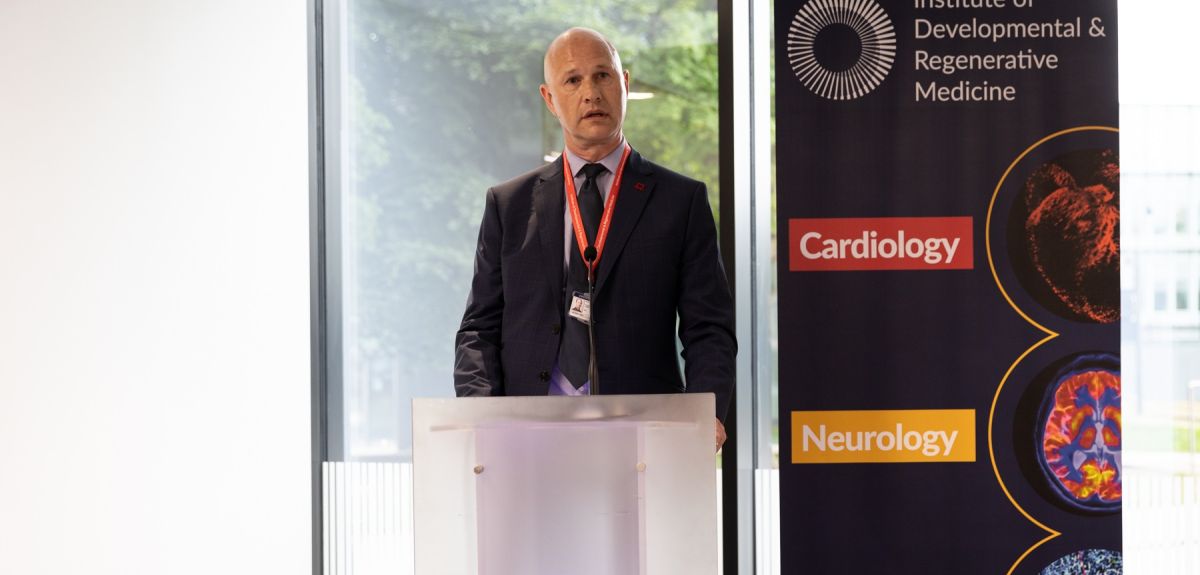
Professor Paul Riley, Director of the Institute of Developmental and Regenerative Medicine discusses how better-designed research buildings can help scientists break out of their silos.
The advances made in medical and biological sciences within our lifetime are staggering. It seems strange to think that the project to sequence the human genome took over a decade to complete back in 2001, yet similar sequencing technology is now portable and is used daily in the field.
Each advance in research has opened up new avenues of exploration and with each new stride whole new research disciplines have emerged. Sadly, in modern science it is impossible to be an expert in more than a few things, despite the fact that most scientists will have chosen their careers early on because of a fascination with all things to do with science, and a desire to keep learning and making new discoveries themselves.
Yet we are increasingly finding, in areas such as our response to pandemics or cancer treatments, it is vitally important that these related avenues of research should remain in contact with one another. The discovery of a new technique in one area could be just as useful to another, and research into complex medical issues is increasingly becoming multi-disciplinary.
Some years ago we began to plan a way of creating a new type of working environment for researchers, which could encourage scientists to mingle more with people from outside their own niche discipline. The logic is simple – scientists are passionate about their work and love talking about it. But the problem with many labs is that most researchers find themselves surrounded only by others from their own field and much of what is going on elsewhere is behind closed doors.
This was the idea behind the Institute of Developmental and Regenerative Medicine (IDRM) – to bring the related disciplines of cardiovascular science, immunology and neuroscience together under one roof, and to design it in a way that increases the chances of these groups mixing socially and professionally, promoting conversations to stimulate new ideas and collaborations between students, post-docs and PIs.
The newly-opened IMS-Tetsuya Nakamura Building is the home for the IDRM, and has been designed around shared common and break-out spaces which differ across each floor in flavour thus linking the laboratories and offices within each discipline vertically to promote mixing and collaboration from the ground-up.
My own research in cardiovascular science involves regular collaboration with colleagues in neuroscience and immunology, who I will now have on my doorstep, and who I can see coming and going each day. Georg Holländer’s group work on how immune cells learn ‘self’ from ‘non-self’ during development. Following a heart attack release of certain proteins from damaged heart muscle triggers a ‘non-self’ reaction, worsening the outcome and promoting heart failure. We can now work together to ask broad questions as to how cells identify ‘self’ and how can we intervene to ensure the body’s own immune response does not react badly during a heart attack. Each experiment and subsequent discovery can be discussed with the immunologists on the floor above in our breakout space.
The siting of the IDRM was also designed to put the researchers at the heart of the science and technology cluster in the Old Road Campus, and between the Headington hospitals where many researchers also work. For example, combining state-of-the-art imaging facilities across the road in the Kennedy Institute with newly purchased microscopes in the IDRM into a new Centre of Excellence will be a powerful tool for many researchers across both institutes and the wider campus.
But the drive to improve cross-disciplinary collaboration goes far beyond just the new building. We are working to improve our links to disciplines within maths to model disease, and the social sciences, such as law and ethics, which will have a major role in shaping and guiding research, as well as collaborations with industry on site, such as Novo Nordisk, and the BioEscalator facility to help turn new research into successful spinout companies that can develop real-world applications.
How effectively we manage to our cross-disciplinary collaborations will play a large part in the speed and efficiency of future research and development and the delivery our findings into clinical care but it will also make a career in science even more engaging.
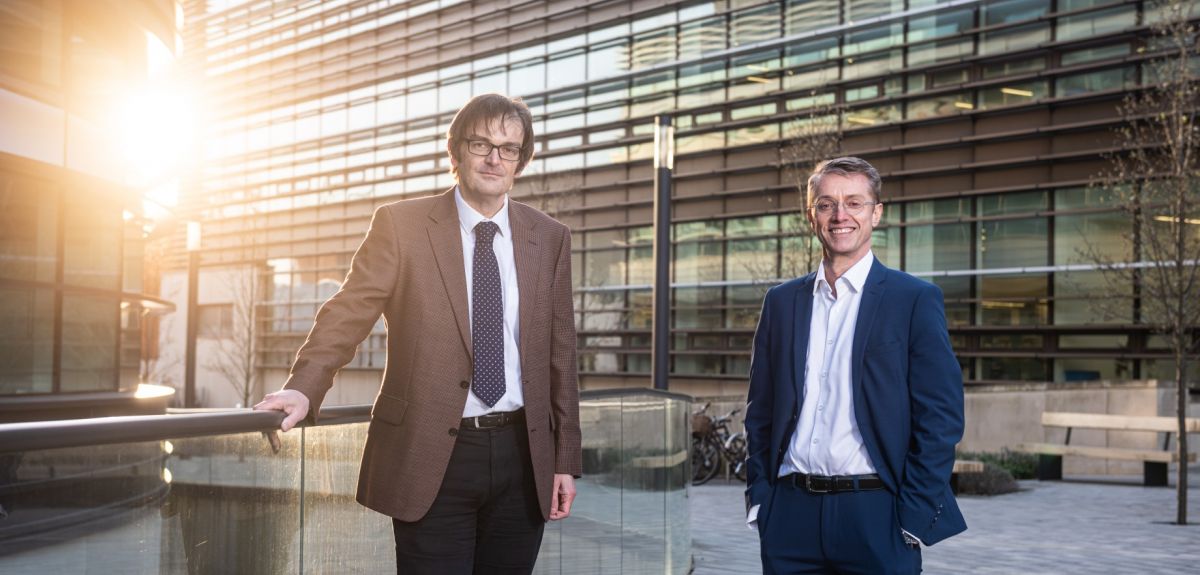
One trial. Over 47,000 participants. Nearly 200 hospital sites, across six countries. Ten results. Four effective COVID-19 treatments. And behind them all, an army of countless researchers, doctors, nurses, statisticians and supporting staff.
On the second anniversary of its official launch, the Randomised Evaluation of COVID-19 Therapy (RECOVERY) remains an exceptional study that is leading the global fight against COVID-19. The study is continuing to adapt to the changing dynamics of the pandemic, adding new promising candidate treatments, and launching in new countries with different population and healthcare systems.
It is likely that the true impact of RECOVERY can never be fully measured. But through discovering four treatments that effectively reduce deaths from COVID-19, it is certain that the study has saved thousands – if not millions – of lives worldwide. Crucially, low- and middle-income countries have shared these benefits, particularly since dexamethasone (the first treatment to be discovered) is inexpensive, easily administered and readily available in most hospitals.
The numbers are impressive, but each RECOVERY Trial participant has their own unique story, with many showing immense courage and altruism during one of the most difficult and frightening times of their life. As RECOVERY Trial participant John Hanna, who was put in an induced coma due to severe COVID-19, said: ‘Without the RECOVERY Trial, I don’t think I’d be here today, so I’m very grateful for all the work the team has done since the pandemic struck. I had minimum knowledge of clinical trials before COVID-19, but now I understand the important role these play, and that future studies will be needed to prepare the world for the next pandemic. Since taking part in the trial, I have become a member of the RECOVERY Trial’s Public Advisory Panel, and this gives me a feeling of involvement, belonging and pride to be contributing to something that has been so successful and continues to be.’
But the RECOVERY Trial’s impacts go far beyond saving lives and improving treatment of COVID-19 patients. Through pioneering a simplified, streamlined approach to running clinical trials, RECOVERY has redefined the speed at which life-saving results can be delivered. As Sir Martin Landray, Professor of Medicine and Epidemiology at Oxford Population Health, and Joint Chief Investigator for RECOVERY, said: ‘In 2019, I had no idea that I would be setting up a trial of treatments for an infectious disease, let alone a pandemic virus. I certainly would not have thought it possible to go from a blank piece of paper to enrolling the first patient in nine days, to finding the first life-saving treatment within ten weeks, and for it to be made standard NHS policy within three hours.’
Through integrating into routine care within NHS hospitals, RECOVERY has also shown the power of engaging front-line clinicians in research. Sir Martin Landray added: ‘For many doctors and nurses, their involvement with RECOVERY was their first experience of clinical research, and many have expressed an enthusiasm to continue. This experience could herald a new age for research, not just for this pandemic and the next but for other common infections such as influenza and chronic diseases.’
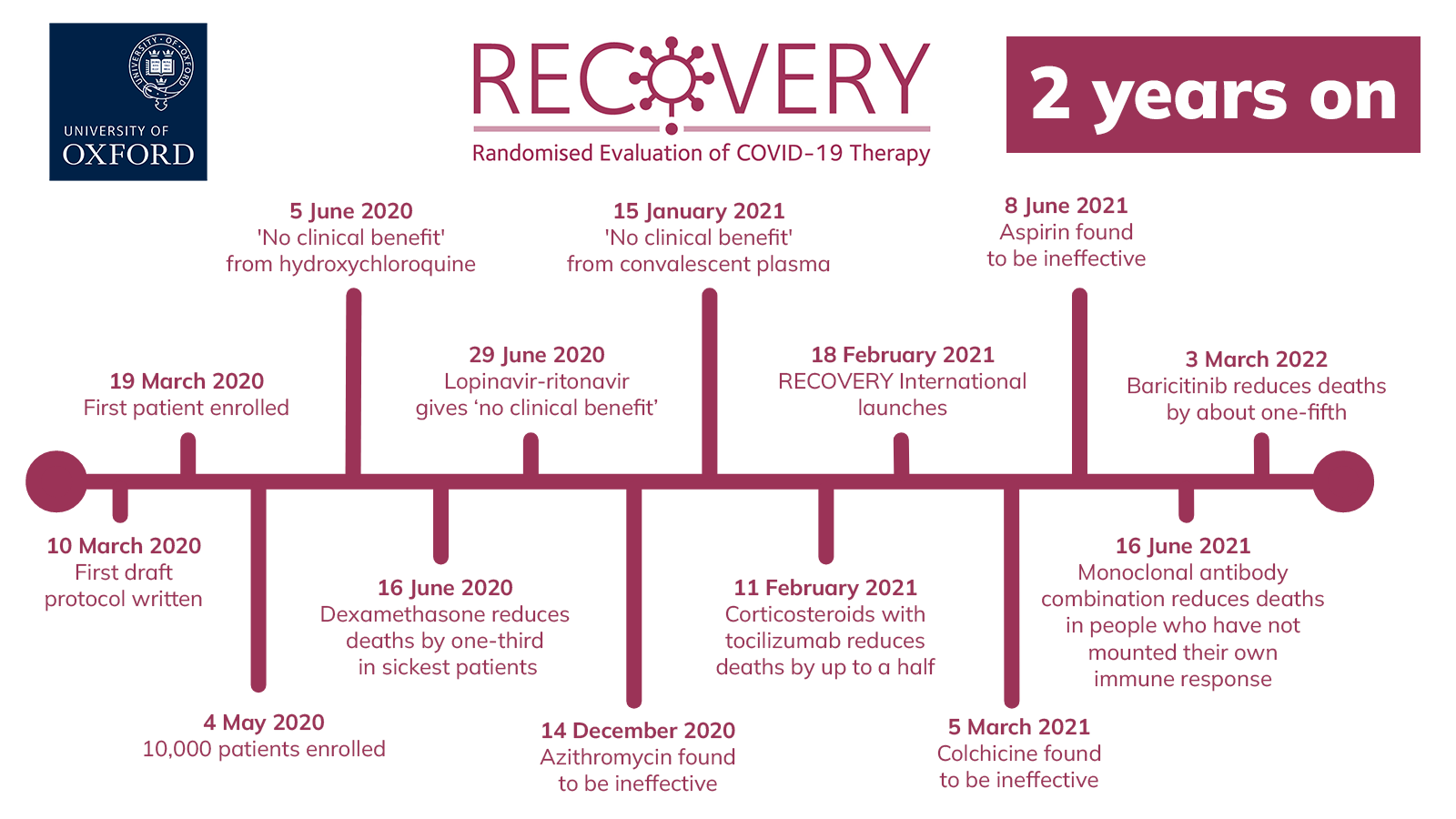
Timeline showing the development of the RECOVERY trial, from March 2020 to March 2022, including key drug discoveries
Dr Marion Mafham, Data Linkage Team Lead for RECOVERY, said: ‘RECOVERY brought clinical trials into everyday healthcare delivery, with frontline doctors and nurses consenting and enrolling participants directly at 177 hospitals across the UK. By integrating data from multiple sources, RECOVERY has produced rapid, reliable results improving outcomes in patients admitted to hospital with COVID-19. This required our team to use innovation and effective collaboration, identifying the right datasets, linking them to the trial participants and processing the data, while ensuring data security and quality - all whilst working remotely.’
Health and Social Care Secretary Sajid Javid said: 'Throughout the pandemic, the government has supported the UK’s world-leading research sector, with millions of pounds of funding for clinical trials into the most promising and innovative medicines. This includes around £2.1 million for the RECOVERY trial which has saved countless lives across the world.
'I am extremely grateful to the team at the University of Oxford – the brilliant work on RECOVERY has cemented the UK’s position as a global leader in identifying safe and effective treatments for Covid, helping the UK to live with this virus.
'I look forward to continuing to collaborate to identify more lifesaving treatments.'
For the wider public, the extensive media coverage of the study’s impacts has helped to increase awareness of the importance of clinical trial research, and the need for volunteers to take part in these. Meanwhile, beyond the UK it is hoped that the hospital sites participating in RECOVERY International will benefit from a long-term increased capacity for leading randomised controlled studies.
The RECOVERY Trial team extend their thanks to the many clinical staff who have made this trial possible, the thousands of patients who have taken part, and the funders for the study, particularly the National Institute for Health Research (NIHR), Wellcome, and UK Research and Innovation (UKRI).

Right now, there is arguably no greater technical challenge for the UK, and the rest of the world, than the energy systems transition. Radical challenges require radical solutions.
The way we source energy, the way we use it domestically, at work, the way transport is powered...and how this is all financed and implemented – are all pieces of an extremely complex puzzle
The way we source energy, the way we use it domestically, at work, the way transport is powered and how this is all financed and implemented – are all pieces of an extremely complex puzzle.
Recent international diplomatic crises, surges in UK energy prices and political lobbying have starkly highlighted this.
Each component of our energy system presents its own challenge, with its own stakeholders, and yet each needs to work seamlessly together in a unified system, if we are to meet our carbon reduction commitments.
Everyone needs to be able to adapt to the changes and they need to benefit those at all stages of life, financial situations and geographical locations.
Such complexity requires the minds of many, and for all considerations to be represented in the thinking. Technological innovation and changes in habit will only be embraced if they work on the ground and benefit lives already stretched with demands on time and money.
A new world-leading multi-disciplinary hub and co-working space in Oxford, Mini TESA - The Energy Systems Accelerator pilot - aims to...tackle the challenge. And this month, it opens its doors
A new world-leading multi-disciplinary hub and co-working space located in Oxford, Mini TESA - The Energy Systems Accelerator pilot – aims to bring such minds together to tackle the challenge. And this month, it opens its doors.
Located in a converted 1960s building on an industrial estate, that is home to an assorted mix of research labs, start-ups, social enterprises and wholesale food markets, a stone’s throw from the city’s rail station, the refitted interior is a vision for a new way of working and a catalyst for change.Inside this building three exciting things are happening simultaneously, which could just lead the way to creating a blueprint for the UK’s energy systems transition.
Firstly, in a unique working arrangement, scientists are sharing space with social enterprises, industrial and local government stakeholders. Concerns about intellectual property (IP) which have traditionally funnelled scientific groups into tightly protected groups, working in highly specialised siloes, have been re-thought so a shared mission enables collaborations previously thought impossible.
Secondly, scientists, researchers and university academics from a wide variety of disciplines are physically working together to pool expertise and think through problems from multiple perspectives – from the sharp end of technological challenges and the economics of how this works in financial systems, to the human behaviour considerations needed for adaptation.
Thirdly, teaching and research are flourishing side by side with the University of Oxford’s MSc in Energy Systems led by Professor Wallom, taught in open, adaptable learning spaces right across the hall from one of the country’s most prestigious energy research labs led by Malcolm McCulloch - Associate Professor in Engineering Science and head of the Energy and Power Group at the University of Oxford.
This is one of many innovative projects that aims to accelerate the UK’s economic revival while delivering sustainable growth across the country
Greg Hands MP, Minister for Energy, Clean Growth and Climate Change
Greg Hands MP, Minister for Energy, Clean Growth and Climate Change, said on its launch: ‘Today marks an exciting new chapter for Oxfordshire with this flagship project set to make waves across the UK energy sector and local economy.
‘As part of the Government’s ‘Getting Building Fund’, this is one of many innovative projects that aims to accelerate the UK’s economic revival while delivering sustainable growth across the country.’
Professor Chas Bountra, Pro-Vice Chancellor (Innovation) for the University of Oxford, said: ‘The University is proud to be leading this project, bringing together engineers, scientists and social scientists from within the University to work closely with businesses and civic stakeholders.
‘The Oxford innovation ecosystem is the perfect place for this collaboration to ensure we make the very best improvements to energy systems that will contribute to a zero-carbon future. Not only that, but TESA will support entrepreneurs building new businesses, create jobs, and encourage investment and economic growth in the local community and across the UK.’
The Oxford innovation ecosystem is the perfect place for this collaboration....Not only that, but TESA will support entrepreneurs building new businesses, create jobs, and encourage investment and economic growth
Professor Chas Bountra, Pro-Vice-Chancellor, Innovation
The radical approaches piloted here are part of a distinct and focused vision which has its sights on a new, permanent building, employing 800 people from a broad spectrum of professional backgrounds to make the energy systems transition happen in the most efficient, sustainable and equitable way possible.
Mini TESA has four years to prove its approach will lead to the outcomes the country and our planet need to safeguard the future. And while ‘serendipitous innovation’ is a watchword of what is hoped will happen within these walls, there is nothing accidental about its development.
With Oxford spearheading two of the country’s major demonstrator clean growth projects funded through Innovate UK’s Industrial Strategy Challenge Fund – Project Local Energy Oxfordshire (LEO) and Energy Superhub Oxford, the city is fast becoming a sustainable energy pioneer by making itself both the subject and instrument of research and planning. The aim is that by fusing the vision, the precision and the pragmatism, its solutions will be ready to scale up with speed when the policy lights turn green.

As part of their research project Amanda Matthes and Jonas Beuchert, supervised by Professor Alex Rogers, developed ‘SnapperGPS’, a low-cost, low-power wildlife tracking system based on satellite navigation. In summer 2021, they deployed it for the first time on wild animals: endangered loggerhead sea turtles in Cape Verde.
Location tracking devices are an important tool for biologists to study animal behaviour. Usually, they use global navigation satellite systems like the GPS for this. However, existing devices are often expensive and come with heavy batteries for long-term deployments. One tag can easily cost more than $1000, which prohibits studies with many animals. That is why SnapperGPS was developed.
Location tracking devices are an important tool for biologists to study animal behaviour.
The aim was to create a cheap, small, and low-power tracking solution. The core idea is to make the hardware simple and energy efficient by doing as little signal acquisition and processing on the device as possible.
Instead, they created a web service that processes the signals in the cloud. This allows them to build a bare-bone receiver for less than $30, which runs for more than ten years on a single coin cell.
The concept they employ is known as snapshot GNSS. Its advantage is that a few milliseconds of signal are enough to locate the receiver. With SnapperGPS they faced the particular challenge that the hardware records signals at a much lower resolution than existing receivers. To address this problem, they developed and implemented three alternative algorithmic approaches to location estimation from short low-quality satellite signal snapshots, which are all based on probabilistic models.
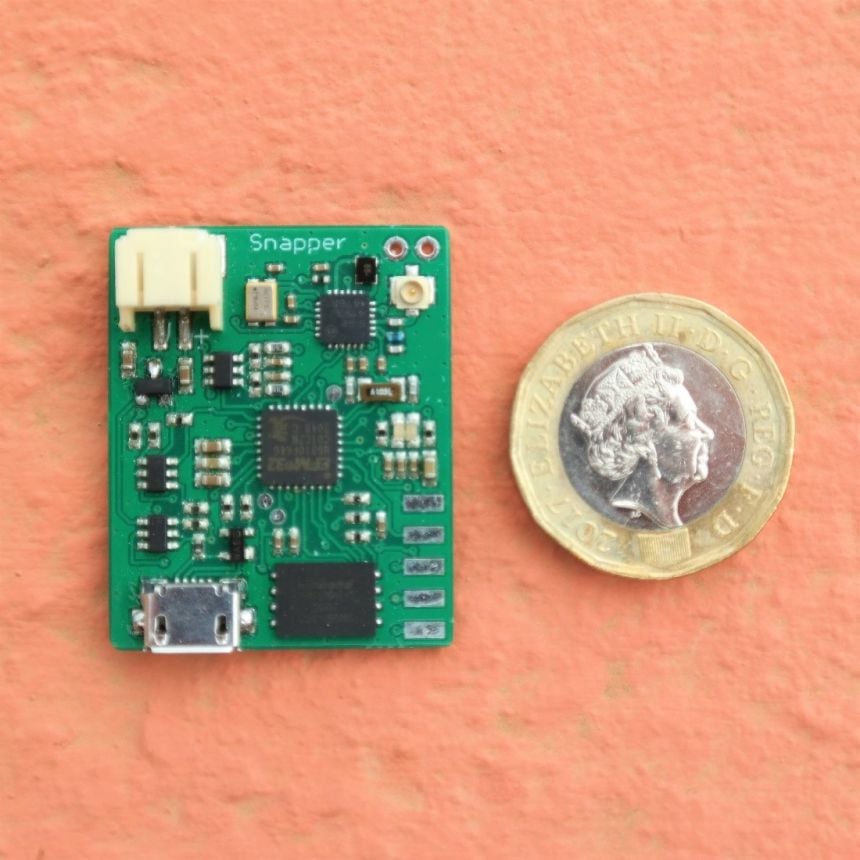 A SnapperGPS board next to a £1 coin. It measures only 3.5 cm x 2.8 cm.
Image credit: SnapperGPS team
In summer 2021 SnapperGPS was deployed on nesting loggerhead sea turtles (Caretta caretta) on the island of Maio in Cape Verde.
Loggerhead sea turtles spend most of their life in the ocean, but every two to three years mature females come to a beach to nest. They lay several clutches of eggs separated by roughly two weeks, which makes it possible to recover the hardware and any data it captured.
Navigation satellite signals cannot travel through water, but sea turtles regularly come to the surface to breathe. These short windows of opportunity may not always be enough for traditional GPS methods to resolve the position of the receiver. But a snapshot method only requires milliseconds of the signal which makes them ideal for such marine applications.
For this turtle deployment, the SnapperGPS tags were placed into custom-made enclosures that were tested to be waterproof to at least 100 m.
Due to the COVID-19 pandemic, they had to deploy the tags late in the nesting season which negatively affected our recovery rate as many turtles were already laying their last nest when they were tagged.
In total twenty tags were deployed and nine recovered. Some experienced unexpected technical failures but the tags that survived were able to capture several location tracks that showed unexpectedly diverse behaviour among turtles.
Wildlife location tracking data can inform conservation policy decisions that help protect habitats and prevent human-wildlife conflicts.
This data provides novel insights into the loggerhead sea turtle population on Maio. The exercise also taught the team important lessons about the specific challenges of deploying SnapperGPS on a sea turtle and they are working on an improved version for next year’s nesting season.
Wildlife location tracking data can inform conservation policy decisions that help protect habitats and prevent human-wildlife conflicts. In the case of loggerhead sea turtles, understanding their movements can inform where to direct anti-poaching measures and it can identify important marine habitats that may need special protection.
SnapperGPS is supported by an EPSRC IAA Technology Fund. Additionally, Amanda and Jonas receive support from the EPSRC Centre for Doctoral Training in Autonomous Intelligent Machines and Systems (AIMS CDT). The field work was made possible through a cooperation with the Maio Biodiversity Foundation and the Arribada Initiative.
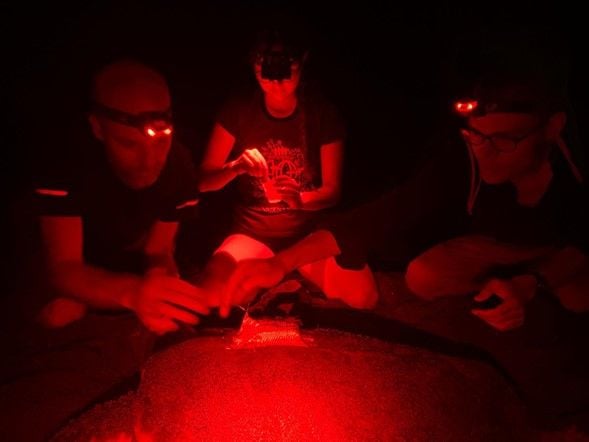 SnapperGPS team has tracked to a location of a loggerhead sea turtle captured by a SnapperGPS tag.
 Image credit: SnapperGPS team
- ‹ previous
- 6 of 9
- next ›
 25-year Oxford study finds the effects of conflict last for generations
 What Louise Thompson’s campaign tells us about the national maternity crisis
 Celebrating 25 Years of Clarendon
  Learning for peace: global governance education at Oxford
  What US intervention could mean for displaced Venezuelans
  Setting the agenda for the next century of quantum
 10 years on: The Oxford learning centre making an impact
 Mapping the Moon: the world’s first lunar atlas goes digital
  Oxford and The Brilliant Club: inspiring the next generation of scholars
 New course launched for the next generation of creative translators