
Department of Oncology
The Department of Oncology has an established graduate training programme for science graduates and clinical research fellows. It is one of the largest departments in the University of Oxford’s Medical Sciences Division.
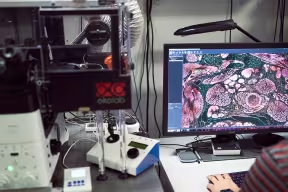
Looking at samples through a microscope, Department of Oncology

Overview
The department houses over 400 staff and graduate students, both clinical and non-clinical, and brings together research and clinical groups from across Oxford who are based at the:
- Old Road Campus Research Building (ORCRB);
- Radiobiology Research Institute (RRI);
- Weatherall Institute for Molecular Medicine (WIMM); and
- NHS Cancer and Haematology Centre.
The Department of Oncology is located in the Old Road Campus Research Building, which includes a large communal atrium containing seating and a cafeteria, and houses the Old Road Campus Library, one of the Bodleian Health Care Libraries, which offers workspaces and subject collections.
The department offers promising research graduates a broad range of multidisciplinary and translational cancer research projects. As a result, its graduates come from a wide range of scientific backgrounds, including biology, medicine, engineering, mathematics, chemistry, and physics. The department prides itself on supporting and training the next generation of world leaders in cancer research to ensure its research continues over the long term.
The department's ethos is to improve treatment of cancer patients by harnessing Oxford University’s scientific research prowess and translating this into an impactful benefit to cancer patients through our own clinical trials. Working together to achieve this aim, we have renowned experts alongside cutting-edge scientists that collaborate across the university to understand the biology of cancer and how to best adopt new therapeutic strategies in medical and clinical oncology.
Research in the department is focused on the biology of cancer and how to translate discoveries into better treatments for patients. The department research strategy centres around the three core themes of DNA (including DNA damage, repair, and replication), cell and tissue biology (tumour microenvironment), and immuno-oncology (including cancer vaccines and virotherapy).
Students work alongside and learn from leaders in their field. They benefit from excellent support services, including a comprehensive portfolio of personal and professional skills development.
Courses offered
The courses shown below are offered at postgraduate-level.
- MSc in Applied Cancer Science (full time)
- Doctor of Medicine (DM) (variable intensity)
- MSc in Medical Physics with Radiobiology (full time)
- DPhil in Oncology (full time)
- MSc by Research in Oncology (full time)
- MSc in Precision Cancer Medicine (part time)
- MSc in Radiobiology (full time)
Medical Sciences Division
The Medical Sciences Division houses some of the strongest biomedical research in the world; Oxford is repeatedly placed first in clinical, pre-clinical and health in the Times Higher Education World University Rankings.
The Medical Sciences Division's departments and institutes in Oxford and overseas are home to some of the strongest biomedical research in the world, regularly appearing at the highest levels in world rankings and rated world-leading and internationally excellent.
The division’s 2,000 researchers cover a wide range of research, from atomic-resolution molecular structural biology to epidemiology as applied to very large populations. This enables students to work on virtually any biomedical problem.
The division provides a stimulating and challenging environment for more than 2,000 talented graduate students with excellent new facilities and close personal supervision by world-class researchers. To complement research supervision and course teaching there is a wide range of facilities aimed at the personal and professional development of students, strengthening their existing skills and developing new skills.
All candidates who apply by the December or January deadline shown on the course page are automatically considered for full funding awards, irrespective of their nationality.