
Department of Computer Science
The world-leading Department of Computer Science is at the heart of computing and related interdisciplinary activity at Oxford and topped the Times Higher Education World University Rankings by Subject for Computer Science for the eighth year in a row in 2025.
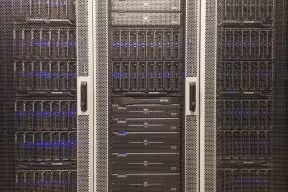
A computing cluster at the University. Credit: Oxford University Images / John Cairns Photography

Overview
The department is home to a community of world-class researchers and is consistently ranked in the Times Higher Education University Rankings amongst the very best computer science departments in the world, for both teaching and research.
The Department of Computer Science is committed to attracting the world’s most talented students and working with them to continue the success of the field of computer science. As a student here, you will join a vibrant community working in research areas including:
- algorithms and complexity theory
- artificial intelligence and machine learning
- automated verification
- computational biology and health informatics
- data, knowledge and action
- human centred computing
- programming languages
- quantum
- security
- systems
The department’s strength comes from its firm grounding in core computer science disciplines, a high degree of mathematical sophistication among its researchers, and its committed engagement with applications and interdisciplinary work.
At present there are over 70 members of academic staff and over 140 research staff. The department has close links with government, industry, and other departments within the University, including the Department of Mathematics, Engineering, Physics, Statistics and a number of life sciences departments.
The Computer Science Graduate Society (COGS) is an organisation within the department that provides organised events and outings for the graduate students and research assistants within the lab. The Oxford Women in Computer Science Society (OxWoCS) aims to support and promote women in computer science. The OxWoCS society organises events throughout the year, where you will have the opportunity to meet other students and staff working across different research areas. These events may include coffee meetings, talks by distinguished female speakers, and industry sponsored events.
Courses offered
The courses shown below are offered at postgraduate level.
- MSc in Advanced Computer Science (full time)
- MSc in Artificial Intelligence for Business (part time)
- Autonomous Intelligent Machines and Systems (EPSRC CDT) (full time and part time)
- DPhil in Computer Science (full time)
- Intelligent Earth (UKRI CDT in AI for the Environment) (full time and part time)
- MSc in Mathematics and Foundations of Computer Science (full time)
- Quantum Informatics (EPSRC CDT) (full time)
- MSc in Software and Systems Security (part time)
- MSc in Software Engineering (part time)
Mathematical, Physical and Life Sciences (MPLS) Division
MPLS is proud to be home to some of the most creative and innovative scientific thinkers and leaders in academia, whose interdisciplinary research is tackling major societal and technological challenges.
The quality and impact of the division's work have been recognised by successive rounds of the national Research Excellence Framework and Teaching Excellence and Student Outcomes Framework exercises, and its departments frequently top the major higher education league tables. Its research is also regularly identified as one of the most significant recipients of grant funding in Europe.
The division’s 9 departments and interdisciplinary doctoral training centre span the full spectrum of the mathematical, computational, physical, engineering and life sciences, and undertake both fundamental research and cutting-edge applied work.
The MPLS Division has a vibrant and exciting research environment, offering frequent opportunities to share your research and engage with scientists working across the research spectrum. It has extensive links with other leading universities, research institutes, public sector bodies, business and industry, in the UK and abroad. Research at the interface between disciplines is strongly encouraged, both within the mathematical, life and physical sciences, and within the medical and environmental sciences.
Teaching is a major part of the division’s activities. It teaches around 7,300 students (including around 3,400 graduate students) and is playing a key part in training the next generation of leading scientists.
The division is striving to create and sustain an inclusive culture where diversity is valued and equity prevails, so that individuals of all backgrounds can fully contribute to its scientific community in a safe and supportive culture. All academic departments in the division hold Athena Swan Awards. Diversity matters and benefits everyone. Scientific and technological innovations change the world and everyone should have access to participate and engage in that change.