
Nuffield Department of Clinical Neurosciences
The Nuffield Department of Clinical Neurosciences (NDCN) comprises around 500 staff, including nearly 200 graduate students.
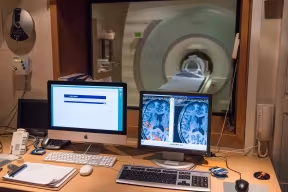
The FMRIB scanner at the John Radcliffe Hospital site in Oxford. Credit: Oxford University Images / John Cairns Photography

Overview
The department was formed in 2010 and incorporates the Centre for Prevention of Stroke and Dementia, the Division of Clinical Neurology, the MRC Brain Network Dynamics Unit, the Nuffield Division of Anaesthetics, the Nuffield Laboratory of Ophthalmology (which also houses sleep medicine research) and the University of Oxford Centre for Integrative Neuroimaging.
NCDN has state-of-the-art laboratories with most of its staff housed in the West Wing and the adjacent OxCIN (University of Oxford Centre for Integrative Neuroimaging) building at the John Radcliffe Hospital site, as well as laboratories in the Dorothy Crowfoot Hodgkin Building. The West Wing also includes the in- and outpatient facilities for the clinical Departments of Neurology, Neurosurgery, Neuroanaesthetics, Ophthalmology and ENT, which are closely integrated with the Nuffield Department of Clinical Neurosciences (NDCN). This provides the perfect setting to share facilities, expertise and knowledge.
The department usually admits students from both scientific and clinical backgrounds. Each research student will work on a specified research project with close supervision from one or more of the department’s principal investigators and their teams, and become part of a vibrant research community both within the department and the wider University.
Courses offered
The courses shown below are offered at postgraduate-level.
- DPhil in Clinical Neurosciences (full time and part time)
- MSc by Research in Clinical Neurosciences (full time and part time)
- Doctor of Medicine (DM) (variable intensity)
- PGDip in Healthcare Systems Safety (part time)
- PGCert in Healthcare Systems Safety (part time)
- MSc in Pain Neurosciences (part time)
- MSc in Sleep Medicine (part time)
- PGDip in Sleep Medicine (part time)