
Faculty of Classics
Oxford offers classical studies in two broad segments: ancient history and classical archaeology; and Greek and Latin languages and literature. The faculty’s core interests lie in the crossovers and synergies between Greek and Roman cultures.
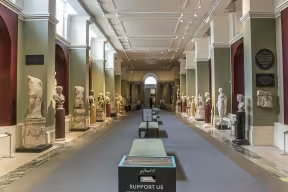
Greek and Roman sculpture gallery in the Ashmolean Museum

Overview
The academic study of ancient Greek and Roman civilisation - thought, society, language, culture, literature, history, art - spans nearly two millennia (c. 1200 BC to AD 600), and is tightly interwoven with most branches of humanities. The faculty also specialises in all the disciplines needed to comprehend these two worlds in their wider context in time and space. These include:
- the study of language, inscriptions and papyri, of texts preserved in the medieval scribal continuum, of literary form, of material culture and field archaeology
- the histories of landscape and of cognition, word and image, scholarship and performance, production, consumption and power
- the reception of antiquity in subsequent periods
The crossovers and synergies also situate core Greek and Roman literature and culture in a wider world reaching from Mycenaean palaces to Egypt, Bactria or India.
In the 2021 Research Excellence Framework exercise, the faculty presented the largest number of academics in UK Classics (91). 52% of the submission was rated 4* (world-leading) and 32% 3* (internationally excellent), giving the faculty by far the highest quantity of 4* or 3* research in UK Classics.
The faculty has an unusually large and wide-ranging body of scholars and graduates. It offers a packed and varied programme of seminars and abundant informal interaction, make this an exciting and stimulating community in which to study Classics.
The faculty is fortunate in having two world-class research libraries close at hand, the Bodleian and the Bodleian Art, Archaeology and Ancient World Library. The Bodleian Art, Archaeology and Ancient World Library is an open-shelf lending library indispensable to anyone studying ancient history, archaeology and art; it is also extremely useful for those studying literature or philology.
Courses offered
The courses shown below are offered at postgraduate level.
- DPhil in Ancient History (full time and part time)
- MSt in Ancient History (full time)
- MPhil in Ancient History (full time)
- DPhil in Classical Languages and Literature (full time and part time)
- MPhil in Greek and/or Latin Languages and Literature (full time)
- MSt in Greek and/or Latin Languages and Literature (full time)