
Department of Chemistry
Oxford’s Department of Chemistry is one of the leading chemistry research departments in the world, with around 80 academic staff carrying out international-level research and an annual research income of around £28 million.
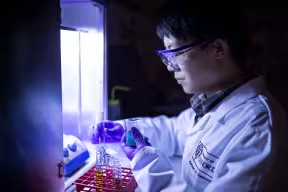
Working in the Chemistry Research Laboratory. Credit: Yunli Song / Graduate Photography Competition

Overview
In the 2021 Research Excellence Framework exercise, 66% of the department's research output was judged world-leading, and 32% was judged internationally excellent. The department has a number of research themes, including:
- catalysis
- synthesis
- chemistry at the interface with biology and medicine
- sustainable energy chemistry
- kinetics, dynamics and mechanism
- advanced functional materials and interfaces
- innovative measurement and photon science
- theory and modelling of complex systems
The facilities at Oxford for research and teaching are among the best available in the UK, with a wide range of the latest instrumentation and a huge computational resource networked throughout the University and beyond to national computing centres. Among the facilities available are the latest in automated X-ray diffractometers, electron microscopes, scanning tunnelling microscopes, mass spectrometers, high-field nuclear magnetic resonance (NMR) spectrometers and specialised instruments for the study of solids.
Courses offered
The courses shown below are offered at postgraduate level.
- Chemical Synthesis for a Healthy Planet (EPSRC CDT) (full time)
- MSc by Research in Chemistry (full time)
- DPhil in Chemistry (full time)
- Generative Biology (EIT DTP) (full time)
- Inorganic Materials for Advanced Manufacturing (EPSRC CDT) (full time)
- MSc in Theoretical and Computational Chemistry (full time)
Mathematical, Physical and Life Sciences (MPLS) Division
MPLS is proud to be home to some of the most creative and innovative scientific thinkers and leaders in academia, whose interdisciplinary research is tackling major societal and technological challenges.
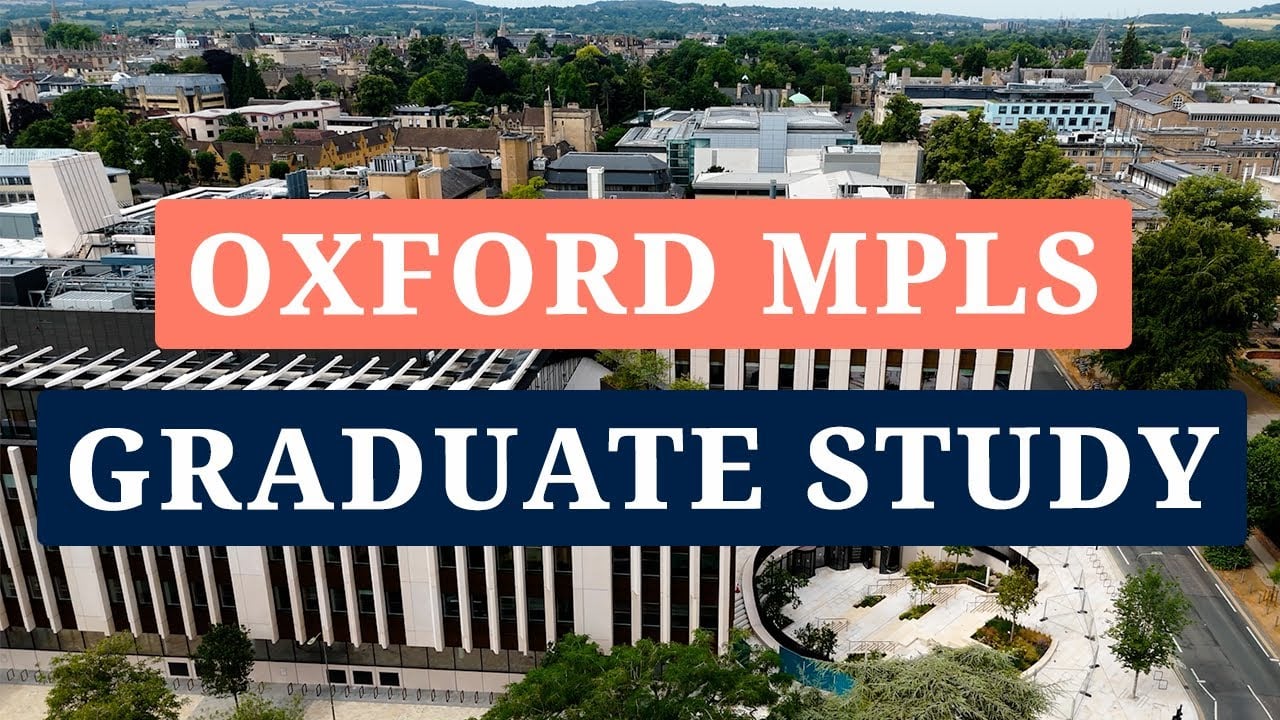
The quality and impact of the division's work have been recognised by successive rounds of the national Research Excellence Framework and Teaching Excellence and Student Outcomes Framework exercises, and its departments frequently top the major higher education league tables. Its research is also regularly identified as one of the most significant recipients of grant funding in Europe.
The division’s 9 departments and interdisciplinary doctoral training centre span the full spectrum of the mathematical, computational, physical, engineering and life sciences, and undertake both fundamental research and cutting-edge applied work.
The MPLS Division has a vibrant and exciting research environment, offering frequent opportunities to share your research and engage with scientists working across the research spectrum. It has extensive links with other leading universities, research institutes, public sector bodies, business and industry, in the UK and abroad. Research at the interface between disciplines is strongly encouraged, both within the mathematical, life and physical sciences, and within the medical and environmental sciences.
Teaching is a major part of the division’s activities. It teaches around 7,300 students (including around 3,400 graduate students) and is playing a key part in training the next generation of leading scientists.
The division is striving to create and sustain an inclusive culture where diversity is valued and equity prevails, so that individuals of all backgrounds can fully contribute to its scientific community in a safe and supportive culture. All academic departments in the division hold Athena Swan Awards. Diversity matters and benefits everyone. Scientific and technological innovations change the world and everyone should have access to participate and engage in that change.