
Leading in Academic Research Environments
This innovative pilot programme recognises the central role of academic leaders in fostering positive, collaborative and constructive environments. It provides experienced academic leaders from across the University with the time and resources to strengthen their leadership approaches and impact, while contributing to the development of Oxford’s research culture.
Co-designed by Oxford academics and leadership experts, and funded by Wellcome, the programme focuses on the relational side of leadership. It supports participants in moving from reaction to intentional response, enhancing how they lead collaborations, partnerships and relationships with clarity and impact in complex academic contexts.
"This new programme is targeted to help academics at the forefront of their field to deepen their leadership practice and to amplify and accelerate their wider contributions to the evolution of our research culture."
Patrick Grant, Pro-Vice-Chancellor (Research)
Programme Vision
Investing in Oxford’s people leadership to foster positive, effective, and collaborative research environments in which individuals, partnerships, and research can flourish.
Modular Series Booking
The modular series offers an opt-in opportunity for academic leaders to explore and develop their leadership practice in a flexible format. Each module combines focused input with self-reflection, peer exchange, and active experimentation, enabling participants to apply insights directly to their current contexts and challenges.
Through collaborative in-person discussion and practical activities, participants will refine their leadership approaches and enhance their capacity to foster effective and collaborative research environments across the University.
For more information please download the brochure.
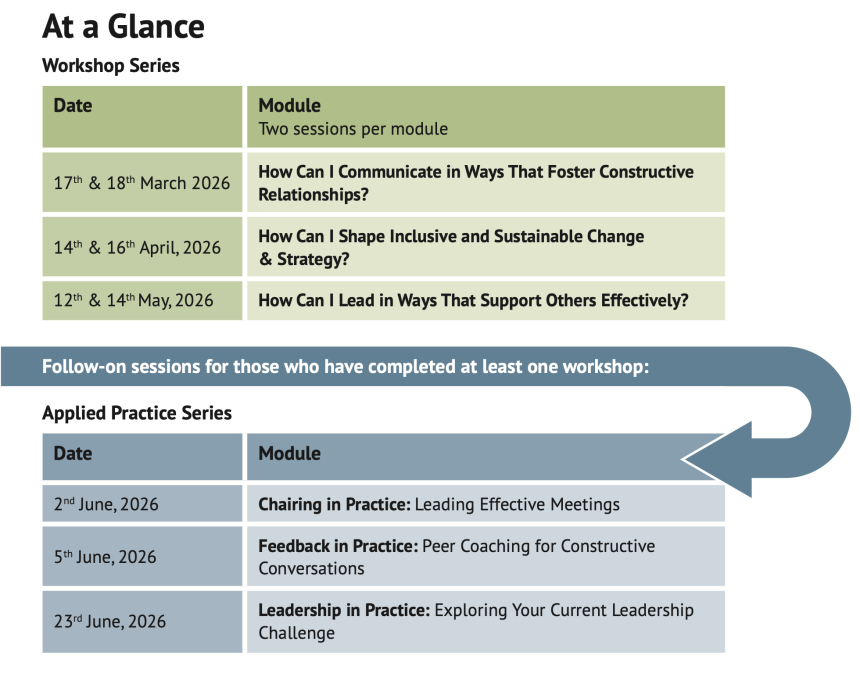 .
.Click here to book your spot on the Modular Series
(Select 'Leading in Academic Research Environments' under the Training Provider dropdown)
Programme Rationale and Focus
Oxford’s world-renowned research is founded on its inspiring innovative research environments.
Our researcher leaders work across complex, interdisciplinary environments managing people, partnerships and delivering impact, often against a context of high change and uncertainty.
Co-created with and for academics, this tailored and context-specific programme provides participants with the space and resources to:
- Increase their leadership influence and impact and lead by example
- Create highly collaborative work relationships and environments
- Effectively navigate complex and interdisciplinary contexts
- Reflect on current leadership challenges and opportunities and identify practical and individually tailored solutions
Co-create thriving, inclusive research environments and contribute to the evolution of Oxford’s research culture(s) Leading in Academic Research Environments is delivered in two strands running throughout 2025.
| Modular series | Advanced programme |
|---|---|
| On the modular series, academics will be able to choose from a range of standalone thematic modules delivered in-person, in peer participant groups. A booking form will be added to this page and divisions will be notified when the links are live. | On the advanced programme, a select pilot group of academics from across the academic divisions will be invited to participate in scheduled group development and individual coaching sessions over 3 months as a peer cohort. |
How is the programme designed?
| To October 2024 | November 2024 – January 2025 | February 2025 | March 2025 onwards |
|---|---|---|---|
Consultation & planning with stakeholders | Co-creation of programme content and delivery approaches with academics from across the divisions | Programme Pilot with first participant cohort | Programme iterations (modular series and cohorts) |
The overall programme shape and principles were informed by consultations with over 80 stakeholders working across Oxford’s research environments and with input from leadership development experts.
During November 2024 a co-design phase will take place with participant representatives from across the University. This will ensure that programme content and delivery is tailored to the research leadership needs of participants, is highly relevant, and context specific.
The programme focuses on practical and context-relevant applications, providing a space for deepening leadership thinking alongside peers from across the divisions. It is designed to be highly applied, emphasising real-world challenges and solutions to enhance participants' leadership impact and influence in a collaborative setting.
Who is the programme for?
The programme is designed for full or associate professors from all academic divisions who are committed to delivering excellence in academic leadership. It is also for those looking to contribute to the development of an effective, positive, and inclusive research culture within their discipline and across the wider University.
Who is involved?
Programme & Delivery Team
- Jenny Conrads, Programme Director, People and Organisational Development
- Louisa Chandler, Events & Logistics Manager, People and Organisational Development
- Carol Barker, Programme Administrator, People and Organisational Development
- Kiri Holmes, Interim Operations Administrator, People and Organisational Development
- Maddie Mitchell, Facilitator, Medical Sciences Division
- Justin Hutchence, Facilitator, Mathematical, Physical and Life Sciences Division
Divisional Contacts
- Mary Muers, Research Culture Facilitator for Medical Sciences Division
- Lindsey Spriggs, Research Culture Facilitator for Social Sciences Division
- Natia Sopromadze, Research Culture Facilitator for Mathematical, Physical & Life Sciences
- Jenny Winsland, Research Culture Facilitator for Humanities Division
- Emma Webster, Research Impact and Support Officer for Gardens, Libraries & Museum
Advisory Group
- Chair: Tim Soutphommasane, Chief Diversity Officer
- Jenny Conrads, Programme Director
- Justin Hutchence, Researcher Training and Development Manager for Mathematical, Physical and Life Sciences Division
- Karla Miller, Professor of Biomedical Engineering; Associate Head for EDI for Medical Sciences Division
- Sue Dopson, Professor of Organisational Behaviour, Social Sciences Division
- Katherine Collins, Research Fellow, Faculty of English Language and Literature
- Rachel Bray, Consultant and former Researcher Hub Lead, People and Organisational Development
Governance Group
- Chair and Principal Investigator: Patrick Grant, Pro-Vice-Chancellor for Research
- Associate Heads (Research) of Divisions: Tamsin Mather, Mathematical, Physical and Life Sciences; Louise Slater, Social Sciences; Heidi Johansen-Berg, Medical Sciences; Andrew Thompson, Humanities.
How can I find out more or express interest in participating?
If you would like to find out more or participate in the co-creation sessions or the pilot programme, please contact the LARE team via [email protected]
Leading Across Boundaries Qualitative Study
Alongside the co-created Leading in Academic Research Environments programme there will be a qualitative study of the broader context. This study will explore those aspects of academic leadership that relate to new insights and ways of working, the institutional and interpersonal boundaries that might intersect with these ideas, values, and practices, and how change might be possible. This is an area of research leadership about which we know much less, and therefore a worthwhile contribution to knowledge to offer alongside, and as a compliment to, the programme as it evolves.
The study will prioritise the experiences of influential mid-career researchers, across all four divisions, who are likely soon to become senior. In other words, those researchers not currently eligible for the programme, but who have potential to be included in future iterations. As with the programme, the study will adopt a co-creation of knowledge approach and will be enacted over three interactions: an exploratory interview; a second meeting to reflect on the initial analysis using a graphic elicitation technique; and lastly, an optional public-facing podcast.
Combined with the programme team’s evaluation, the outcome of this study will add important insights for the programme’s future development, as well as offering its own contribution to knowledge on research leadership and culture. To find out more about this study, please contact Katherine Collins, at [email protected].
Central University Research Ethics Committee Approval Reference: R95782/RE001
"It was so much fun, engaging, challenging and really enriching – it felt just like I’d got a new pair of glasses that are enabling me to see things with more clarity.”
Academic participant, LARE
“I was dreading it in advance, but I ended up really enjoying the sessions and got a lot out of it. Congratulations on designing a leadership programme that even an introverted and sceptical academic can enjoy!”
Academic participant, LARE
“I have a tendency for my interactions with others to be reactive to how I am feeling, so it has been very valuable to think through how to make them more intentional. Thank you all, as I learned a lot!”
Academic participant, LARE
“I found it enormously valuable and really appreciated having the space to think and reflect”
Academic participant, LARE
For further information
- Contact: [email protected]
