Features
A new tag-team approach to combating a type of skin cancer is showing early promise in the lab. The scientists in Oxford and Spain investigated a two-drug combination to better target cancer cells in melanoma.
The approach uses one drug to drive melanoma cancer cells that are invasive to become sensitive to a second drug. This second drug is a new compound that is activated very specifically in melanoma cells and not other cells in the body.
'Importantly, because the new drug is only activated in melanoma cells, there should be no side effects,' says Professor Colin Goding from the Ludwig Institute for Cancer Research at the University of Oxford.
The first drug, methotrexate, is an existing one that is currently used for diseases such as arthritis and psoriasis. The researchers found that methotrexate stops melanoma cells spreading to other parts or the body, and also sensitises the cells to the second drug, a new compound called TMECG, which kills the cancer cells.
When given alone, neither drug has any effect. But together, the researchers show that the two drugs kill melanoma cells very effectively in the laboratory and also in animal models – including cancer cells that are resistant to current therapies.
The research team – jointly led by Professor Goding and Professor José Neptuno Rodriguez-López from the University of Murcia in Spain – have shown the potential of the technique in human cells in the lab and in mice. They have published their findings in the journal Cancer Cell.
'The work is still at an early stage,' cautions Professor Goding. 'Although this combination treatment works very effectively in animals, we still need to improve the stability of the new drug in the blood to make it effective in patients. We also need to check that there is no toxicity associated with the new drug, though our preliminary results look very good.'
The researchers believe that it will be combinations of treatment approaches like this one that will help floor cancer, and deal with the great problem of tumours acquiring resistance to cancer therapies.
'The major problem with cancers is their capacity to become resistant to therapy and to spread to many parts of the body,' explains Professor Goding. 'Resistance is caused by there being different kinds of cancers cells within tumours, some of which may be resistant to therapy.'
Melanoma is a rare and serious type of cancer that begins in the skin and can spread to other organs in the body. The most common sign of melanoma is the appearance of a new mole or a change in an existing mole. Melanoma caught early can be treated very effectively by surgery. But unfortunately there is no long-term effective therapy once the disease has spread.
'There is a new drug called vemurafenib that gives a good response for the 50% of patients whose cancers have a mutation in the BRAF gene, but resistance occurs within some months,' says Professor Goding. 'Chemotherapy is largely ineffective, and though there is some success with a new form of immunotherapy, this is still at a very early stage.'
He outlines how cancers like melanoma may need to be treated in future: 'We envisage that treating cancer must be done using combinations of therapies that work by completely different mechanisms, such that cells resistant to one therapy would be sensitive to the other.
'We may need to give these combinations sequentially or in combination. So, if therapy A kills the vast majority of cancer cells there will be only few left that are resistant to therapy A, but should still be sensitive to therapy B. Since after therapy A there are few cells that survive, there is much less chance of resistance to therapy B occurring.
'In other words to treat cancer successfully we may need to think about the way we treat a bacterial infection, with combinations of antibiotics. Combinations of anti-cancer therapies may have much more success than giving one treatment alone.'
The researchers hope that the new strategy they have identified will form one treatment approach that, in combination with others, may contribute to a successful anti-melanoma therapy that is effective in the long-term.
Once upon a time all cells were solitary, going about the everyday business of life on their own.
Then, perhaps as many as 25 times in the history of life, some cells tried something different: banding together into groups. A few of these attempts gave rise to groups of cells that worked together rather like bees in a beehive, eventually resulting in the trillions-strong communities of cells that make up complex multicellular organisms like us.
So how did cells learn to stop 'being selfish' and embrace the multicellular lifestyle? In this week's Current Biology a team from Oxford University and Lund University report research using data from 168 species to examine the role genetic relatedness may have played in this transition, I asked team member Roberta Fisher of Oxford's Department of Zoology about this work…
OxSciBlog: How do we think cells made the leap to multicellular life?
Roberta Fisher: Multicellularity has evolved many times, and so it's likely that lots of different factors have favoured single cells becoming multicellular. It's thought that clumping together as a defence mechanism against predation may have favoured multicellularity in the green algae. There are also several species where multicellular behaviours help dispersal and reproduction, e.g. slime moulds.
OSB: Why is understanding genetic relatedness key to understanding this leap?
RF: We know that relatedness is important for social behaviours (you're more likely to help your relatives than a stranger), and multicellularity is essentially a social behaviour. Cells are joining together and interacting, much like bees in a hive or ants in a colony. So, we expect that genetic relatedness will be key in determining when multicellularity can evolve.
OSB: How did you investigate the role of relatedness in this process?
RF: The way multicellular groups form is key in determining whether cells will be highly related or not. If groups form by cell division, then the cells will be clonally related, whereas if groups form by aggregation then the cells will be less related. So, we don't directly measure relatedness, but look at how the multicellular groups form. And, luckily, multicellular organisms do tend to fall into the broad categories of ones that form via cell division (like us!) and ones that form by aggregation (like slime moulds).
OSB: What did you discover about how sterile/different 'castes' of cell might arise?
RF: Sterile cells are behaving altruistically, because they are giving up reproduction in order to help other cells. We found that sterile castes are much more likely to arise when cells are highly related. This is somewhat expected, because we know from theory and experimental work that altruistic behaviour is much more likely to evolve when you have high relatedness, but it has not been examined in this context before.
OSB: What does this tell us about the evolutionary costs/benefits of single cells teaming up?
RF: The benefits and costs of teaming up will vary from species to species. For some, there may only be a benefit of being multicellular for certain parts of the life-cycle and so the major transition to multicellularity is never made, because there are still big benefits to being unicellular. However, if the costs of being multicellular are low enough and benefits big enough, then cells can be selected to team up and help each other out.
OSB: How could your study guide further research in this area?
RF: Our study is the first of its kind looking at such a broad scale comparison of lots of different multicellular organisms. I think that other interesting evolutionary questions could be answered using this kind of comparative data.
A report of the research, entitled 'Group Formation, Relatedness, and the Evolution of Multicellularity', is published in Current Biology.
With batteries still struggling to pack the same power as petrol one of the great challenges for electric vehicles is extending their range.
A team led by researchers at Oxford University's Department of Engineering Science and The Oxford Martin School has been pushing the boundaries of what such machines can do with their prototype electric vehicle PEGGIE.
The PEGGIE crew had a successful debut at last year's Shell Eco-marathon Europe competition, a showcase for ultra energy-efficient vehicles built by student teams, and entered this year's event in Rotterdam on 19 May.
The Oxford team won the Technical Innovation Award ahead of nearly 200 other teams from across Europe for a series of innovations:
This year the car sported a photovoltaic array of 130 individual cells which continually reconfigure themselves for maximum efficiency, improving efficiency by over 5%: the team compare it to getting rid of your car's gearbox and instead having an engine that continually rebuilds itself so that its performance is optimised for the vehicle's speed and torque requirements at all times.
Not only does PEGGIE's design enable regenerative braking – recovering energy during braking – and free-wheeling but it also features a 'smart' clutch that electronically synchronises the speed and position of the clutch teeth and controls how they engage. Because this design minimises the forces at work inside the clutch the entire drivetrain can be built from smaller and lighter teeth, gears, and actuators.
To help the driver adopt the most efficient driving style possible she gets a handy Android app to refer to on a mobile handset attached to the controls. The app delivers a colourful map plotting torque along one axis and speed along another – rather like playing a computer game the aim is to drive keeping the crosshairs in the map's 'green zone' which indicates the most efficient style.
The Oxford team also improved PEGGIE's range by over 50% on last year, delivering a performance of 564 km/kWh (the equivalent of Oxford to Minsk on a pint of petrol) coming seventh in the solar electric class, an improvement on last year's twelfth place.
'The Shell Eco-Marathon was a fantastic, if at times traumatic, experience,' said Pete Armstrong, Team Technical Manager. 'It was an honour to be awarded the technical innovation prize, we were very impressed by other vehicles who had developed a range of exciting ideas and techniques in areas such as real-time throttle control and 3D printed components that could be swapped out quickly.
'We owe our result this year to the inspiration drawn from other teams when we debuted last year. Although there is a very competitive atmosphere, the overriding experience is one where hundreds of teams help each other out in the face of all the inevitable challenges that arise, exchange ideas and try to have fun in the process.'
If you are interested in getting involved in the PEGGIE team email [email protected] For sponsorship opportunities email [email protected]
At Friday's launch of the Li Ka Shing Centre for Health Information and Discovery at Oxford University, researchers spoke about the potential to revolutionise health research and offer patients better, safer and more personalised treatments through 'big data' and improved approaches to drug discovery.
The new centre is being supported by a £20m gift from the Li Ka Shing Foundation and £10m from the Higher Education Funding Council for England.
Professor Peter Donnelly, who will be involved in the analysis of large health-related data sets in the new centre, said Oxford is achieving something by bringing all these elements together that has not been done anywhere in the academic world before, 'moving forward understanding of human biology and turning this into new treatments'.
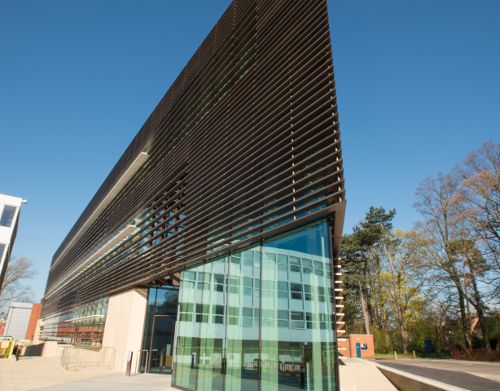 Target Discovery Institute
Credit: John Cairns
The Li Ka Shing Centre is being developed in two phases on the University's Old Road Campus. The first phase, the Target Discovery Institute under Professor Peter Ratcliffe, is now complete (above) and researchers will shortly start moving in. The Institute will use high-throughput biology to define better drug targets in collaboration with industry, addressing a critical 'blockage' in the existing drug development process.
The Target Discovery Institute will generate comprehensive data about disease using genomic and chemical screens – important data for the early stages of drug discovery.
The second phase will focus on the analysis of large data sets in a Big Data Institute, bringing together leading researchers from across genetics, epidemiology and public health, clinical medicine, computer science and IT, statistics and bioinformatics.
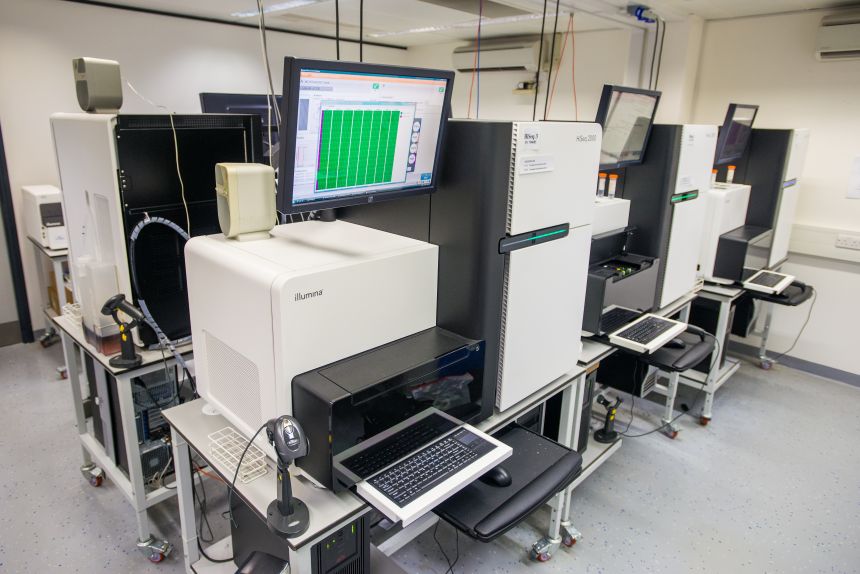 DNA sequencers
Credit: John Cairns
Very large sets of medical data are now routinely collected – through electronic patient records, DNA sequencing (the image shows genome sequencers at Oxford University), comprehensive biological data on disease mechanisms, treatment monitoring, clinical trials, pharmacy records, medical imaging, and national registries of hospitalisations, cancers and other outcomes.
Bringing health-related datasets together for researchers to use in an anonymised way, and making use of new tools to scrutinise that data to gain insights, will provide powerful new insights into who develops illnesses and why.
Oxford University already has world-leading expertise in these areas: pioneering the introduction of genomics into medical care, leading giant cohort studies like the Million Women Study and UK Biobank, running some of the largest clinical trials of treatment worldwide, and establishing methods for global disease surveillance in malaria and other major infectious diseases.
Being locked in a cell with three companions can be a good thing if you are a component of a quantum computer.
These components, called quantum bits, are fragile and susceptible to outside interference, making them easier to control when isolated in cells of four.
Now scientists from Oxford and Singapore report in Nature Communications a way these cells could be networked up with light even if these links are 'noisy' and unreliable.
I asked Simon Benjamin of Oxford University's Department of Materials and National University of Singapore, an author of the report, about quantum cells, noisy networks, and computing with pink diamonds…
OxSciBlog: What are the problems with conventional designs for a quantum computer?
Simon Benjamin: One way to build a quantum computer is similar to how today's microchips work: thousands or millions of basic components, all laid out in a dense pattern like buildings in a city. There are two problems with doing this:
First, the basic components of a quantum computer, called qubits, are hard to control and need to be kept as isolated as possible. Ideally you'd like to have each qubit in its own space with its own dedicated control systems around it.
The second problem is that some of the best candidate systems for qubits cannot be formed into ordered patterns, even if we want to. An example is something called an 'NV centre' which can occur naturally in diamond (technically it's a 'defect', but a very useful one!) Experimentalists can locate the NV centres in a piece of diamond and control them, but we can't force them to appear in specific places. Not yet anyway.
OSB: How might cells and a 'noisy network' overcome these problems?
SB: The approach we advocate is to replace that pattern of millions of qubits with many little chunks, or 'cells'. Each cell would only have a few qubits in it, for example four. It is a manageable task to control four qubits with a single set of control equipment, and most physical systems (like the NV centres mentioned above) can manage to store four qubits.
But of course this leaves us with a problem: how to link up the little cells? We know that linking quantum systems is possible using photons but sadly those links tend to be quite prone to errors. Fortunately we've found that it's ok to use those 'noisy' links: we can put up with them going wrong 10% of the time, or even more. And the qubits inside each cell can go wrong too, although they need to be better behaved, let's say they should go wrong less than 1% of the time.
The upshot of all this is that replacing the big, complex system with lots of little cells linked by noisy connections is fine - you don't really lose any performance, and the targets for how well behaved the qubits should be don't change much either.
OSB: What sort of systems might a noisy network work best with?
SB: Well I've already mentioned NV centres in diamond. The NV stands for Nitrogen-Vacancy, and this means that inside the diamond there is a place where a Nitrogen atom has replaced the normal Carbon, and beside this intruder atom there is a 'hole' where another Carbon is missing.
It turns out that this tiny structure has amazing properties: it can store several quantum bits, and they can be read out using a pulse of laser light. In fact, if you look at a diamond with a pink hue in a jewellery shop then the pink colour is typically coming from NV centres!
As well as NV centres, another good quantum system is the ion trap, where a few atoms are held frozen in a vacuum by an electromagnetic trap. It's hard to make a trap that can hold hundreds of atoms in an ordered way (let alone the millions that might be needed for computing). But it's not so hard to build many traps, each holding a few atoms, and link them with light.
OSB: What other types of 'noise' or 'error' does your approach not account for?
SB: In our study we've tried to be pretty general and put in all kinds of noise. Also, there are kinds of noise that we don't need to worry about because of the network architecture: something called 'correlated noise' can cause a lot of trouble, it means errors clumping together instead of appearing randomly. But in our system this shouldn't happen between different cells of the network, because they are far apart and disconnected except when we want them to communicate.
OSB: What does your work tell us about how hard it will be to build useful quantum computers?
SB: I would say that this work helps to show that the network approach (connecting lots of little computers) is very practical. Since some of the most promising candidate systems work well in the network picture, this is very encouraging.
One exciting recent result is that researchers in the Netherlands have just successfully shown a quantum link between two pieces of diamond, each inside its own fridge! So the idea of linking quantum systems definitely works... now we'll have to see how rapidly we can progress to a real network with lots of cells in it. A few years perhaps!
The paper, entitled 'Topological quantum computing with a very noisy network and local error rates approaching one percent', is published in Nature Communications.
- ‹ previous
- 181 of 253
- next ›
 Celebrating 25 Years of Clarendon
  Learning for peace: global governance education at Oxford
  What US intervention could mean for displaced Venezuelans
  Setting the agenda for the next century of quantum
 10 years on: The Oxford learning centre making an impact
 Mapping the Moon: the world’s first lunar atlas goes digital
  Oxford and The Brilliant Club: inspiring the next generation of scholars
 New course launched for the next generation of creative translators
 The art of translation – raising the profile of languages in schools
  Opening a window into the quantum world