Features
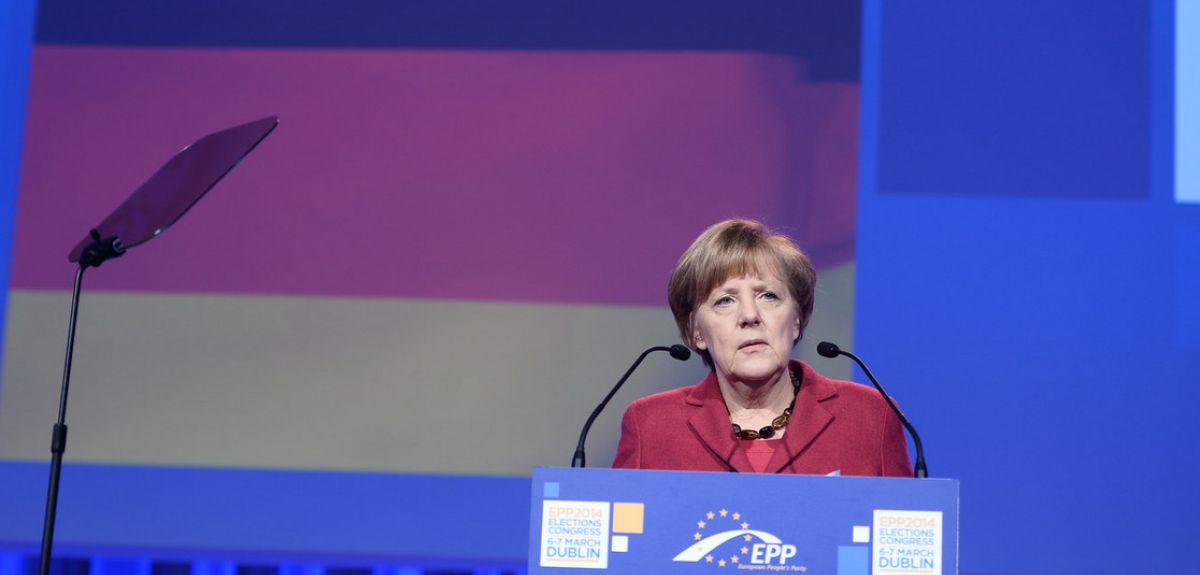
A Europe-wide project which began at Oxford University has received the backing of Germany’s Chancellor Angela Merkel.
Europeana 1914-1918 makes digital copies of material related to the First World War and makes them freely available online. It follows the model of Oxford University’s Great War Archive, which digitised more than 6,500 items contributed by the British public between March and June 2008.
Europeana 1914-1918 extended this project across Europe, and more than 90,000 items have now been added to the website. Oxford University is still involved in this wider project, helping to run family history roadshows across Europe to which members of the public bring memorabilia and stories of their family’s life during the Great War.
Speaking in her weekly video podcast, Ms Merkel said: 'I am happy that many people participate and that history also becomes more comprehensible … This is a great thing.' She added that such a project makes clear that it is 'better to negotiate 20 hours longer and talk, but never come back to such a situation in the middle of Europe'.
Dr Stuart Lee of Oxford University’s English Faculty and IT Services said: 'It is wonderful to see an Oxford-initiated project now being picked up and discussed by one of the main leaders of a European country. More so that this is in Germany where we are witnessing possibly the first engagement by the general public in Germany with the memory of the war.'
He added: 'The centenary of the First World War offers us an important opportunity to reflect on the war but also to challenge prejudices across Europe, and Oxford's Great War Archive project which led to the Europeana 1914-1918 initiative had this as one of its main aims by allowing the public to expose material they had held for nearly a century and explain its importance.'
The archive has already turned up some interesting discoveries, including two postcards written by Adolf Hitler in 1916 to his comrade Karl Lanzhammer.
Anyone who has items relating to the First World War is encouraged to add these to the website.
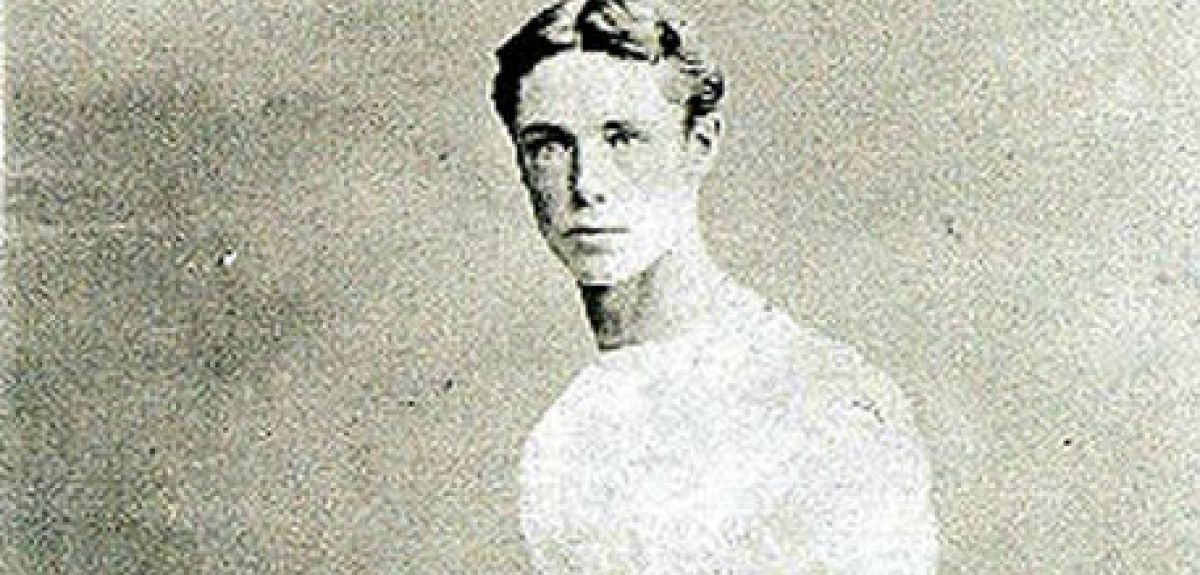
The Oxford undergraduate recently commemorated by the Football Association (FA) as 'England's first football captain' is among the new lives added in the latest update to the Oxford Dictionary of National Biography today.
Cuthbert Ottaway (1850-1878) was in his final year studying classics at Brasenose College when he captained the England association football side against Scotland at Glasgow on 30 November 1872 in what sports historians regard as the first ever official international football fixture. The match ended in a 0-0 draw.
In the 150th anniversary year of the Football Association, in 2013, a restored memorial to Ottaway was unveiled in Paddington Old Cemetery, London, where he is buried. At the time, current England captain Steven Gerrard said: 'I never knew Cuthbert Ottaway's story before. He had the honour of being the first England captain and it is great that what he achieved is being recognised in this way.' Now, as the FIFA World Cup approaches, Ottaway has found a place in the Oxford DNB.
In his own lifetime, Ottaway was better known as a cricketer, batting alongside W G Grace for the 'Gentlemen of England'. He captained Oxford University Cricket Club to victory over Cambridge University at Lord’s in 1873.
In total, Ottaway represented Oxford at five sports against Cambridge: cricket, real tennis, rackets, athletics, and association football. He also captained the newly-founded Oxford University Association Football Club to victory in the FA Cup final in March 1874.
When Ottaway returned to Oxford in June 1874 to take his BA degree, there was a great ovation for him in the Sheldonian Theatre in recognition of his sporting achievements. The degree ceremony was held in the morning; that afternoon, Ottaway was back in London, where he scored a century at Lord’s for the Bar against the Army. His legal career was sadly cut short by his early death, aged only 27, in 1878.
Dr Mark Curthoys, an Oxford University historian who wrote the Oxford DNB entry for Ottaway, says: 'Ottaway was well known in his own lifetime as a sporting phenomenon, representing his university at five sports. He can now be viewed in the longer term as one of the first generation to organize and play association football on the national stage.'
The Oxford DNB is freely available through public libraries, and by remote access to public library members. It is the national record of men and women who have shaped British history and culture, worldwide, from the Romans to the 21st century. It is overseen by academic editors at Oxford University, UK, and published by Oxford University Press.

The Oxford Research Centre in the Humanities (TORCH) was officially launched a year ago. Arts Bloglooks back at 12 months of interdisciplinary research, knowledge exchange and thought-provoking public events...
TORCH was launched in May last year with the aim of stimulating, supporting and promoting high-quality humanities research that would transcend disciplinary boundaries and engage with a wider audience. There are now 18 research networks operating with the support of TORCH, covering subjects as diverse as ancient dance, medieval mysticism, the works of Henrik Ibsen and war crimes investigations. That's in addition to eight major programmes including the recent Humanities and the Public Good series of events and the Digital Humanities initiative.
In short, it has been a busy, exciting and successful 12 months for the Radcliffe Humanities-based centre, which was officially opened a year ago at a launch event attended by the Vice-Chancellor.
Among the highlights was the opening night of the Humanities and the Public Good series, which featured a keynote presentation by Earl Lewis, President of the Andrew W. Mellon Foundation, and a round-table discussion on the value of the humanities. The event was the hottest ticket in town on 27 January, with an audience of 450 people packing into Examination Schools (and scores more left disappointed as the venue reached capacity).
The Humanitas Visiting Professor programme also achieved impressive numbers – more than 2,500 people attended the 2013/14 series, which included lectures by the former Archbishop of Canterbury Dr Rowan Williams.
And last month the centre was given a boost with the news it had been awarded more than $560,000 in funding by the Andrew W. Mellon Foundation towards the forthcoming Humanities and Science programme.
Dr Stephen Tuck, Director of TORCH, said: 'We have been somewhat astonished and absolutely delighted by the enthusiasm for TORCH and the high quality, originality and importance of so many new interdisciplinary research projects. Taking advantage of the generous grant from the Andrew W. Mellon Foundation, we look forward to working with colleagues in the social, life and medical sciences in 2014-15.'

Oxford University's unique collection of Victorian lantern slides will go on show to the public later this year as part of Being Human, the UK's first national festival of the humanities.
The Historic Environment Image Resource, based in the Institute of Archaeology within the University's School of Archaeology, has been awarded funding to host a series of events in November.
Making use of the University's vast collection of late 19th and early 20th-century teaching lantern slides, the events will include a week-long exhibition, a workshop, a citizen science 'tagathon' and an authentic Victorian lantern slide performance.
Known together as 'The shock of the old: glass plate negatives and photographs of late 19th-century England', the events have been made possible by a grant from the festival organisers and the School of Advanced Study, University of London, supported by the Arts and Humanities Research Council and the British Academy.
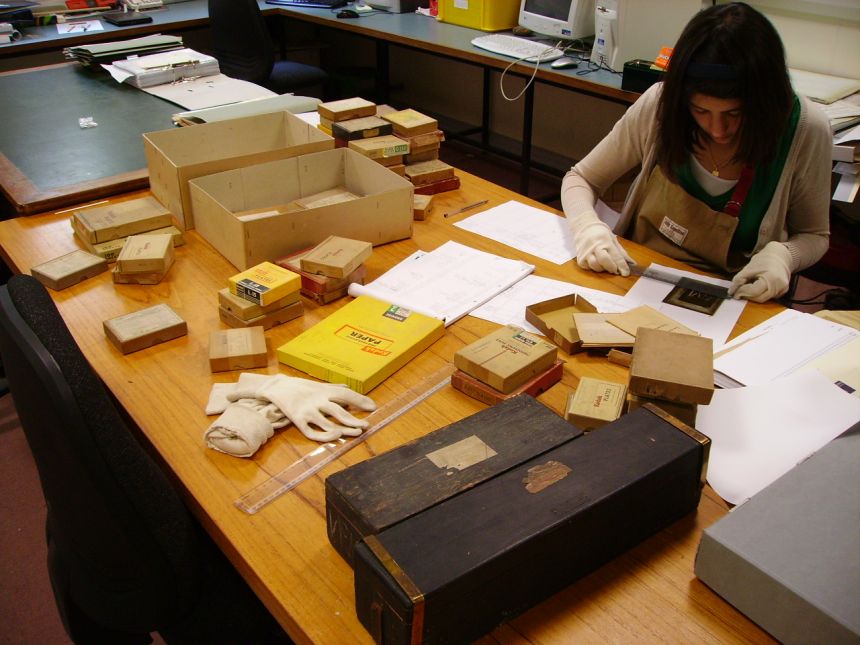 HEIR volunteer Marissa helps sort some of the lantern slides.
Although full details of the events are still to be confirmed, the free public exhibition will be held in a University museum and will feature life-size panels – startling in their detail – highlighting everyday life in Victorian times. The authentic Victorian lecture performance, based on an original 1880s travel series, will recreate a sense of the original excitement and wonder of pre-cinema lantern slide shows by taking the modern audience on a trip through the past, from London to Constantinople, with live musical accompaniment.
The citizen science project will take the form of a 'tagathon' in which volunteers around the world can help enhance the lantern slide resource by tagging the contents of images and using web resources to locate and identify mystery images. The workshop, meanwhile, will be hosted by The Oxford Research Centre in the Humanities (TORCH) and will bring together leading international academics and collaborators to explore ways of exploiting this innovative collection.
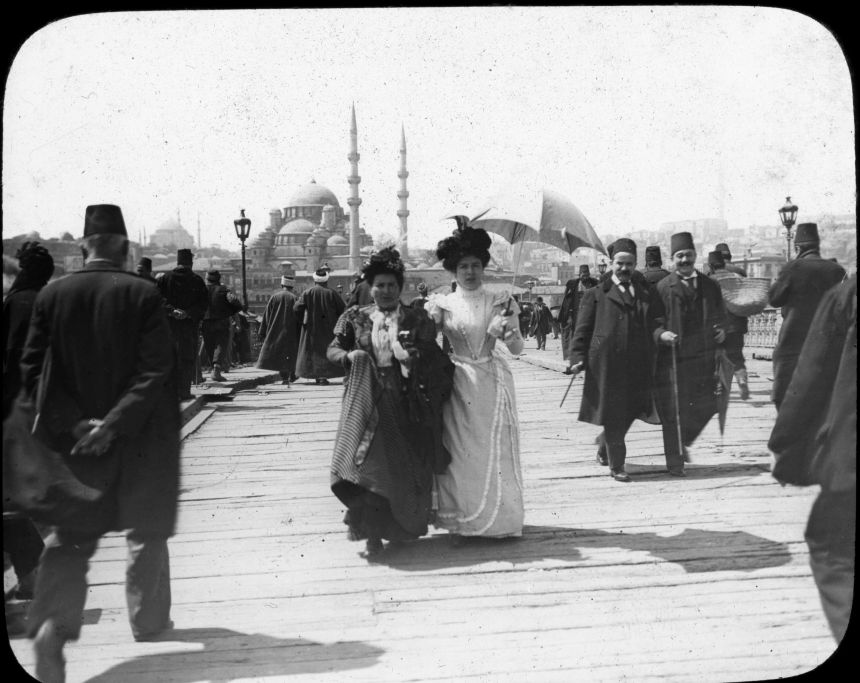 An image of tourists in Istanbul from Oxford University's collection of Victorian lantern slides.
The Being Human festival programme will focus on activities that make humanities research accessible to the general public and demonstrate the role of the humanities in the cultural, intellectual, political and social life of the UK.
Thirty-six grants have been awarded to universities and arts and cultural organisations across the UK to participate in the nine days of festival events taking place across the UK from 15–23 November.
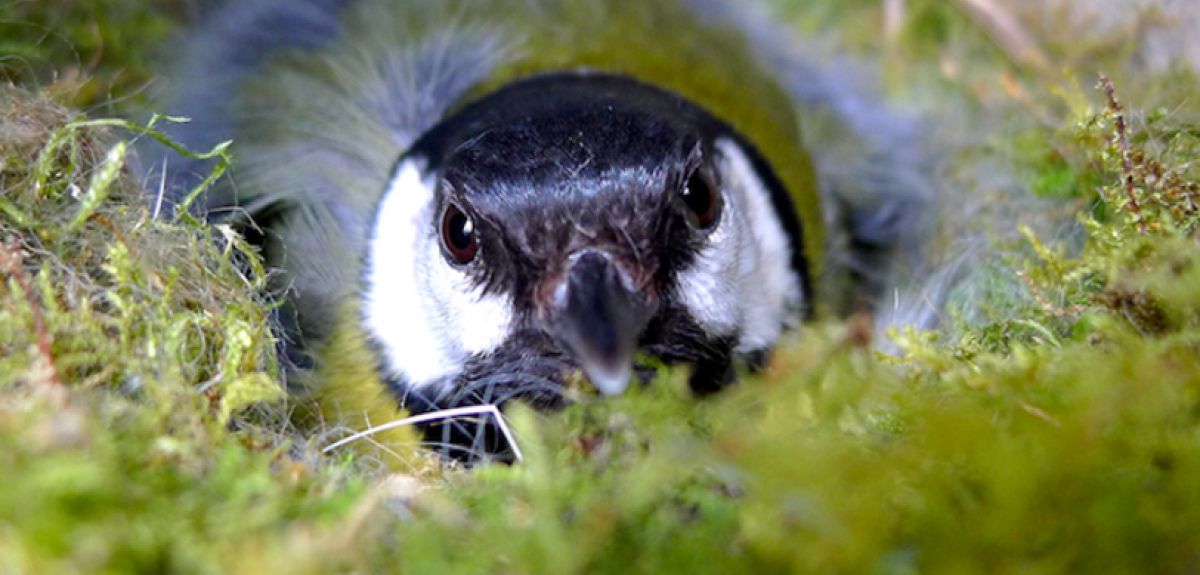
Birds previously identified as having a 'bold' personality return to their nests more rapidly after being faced with a threat than their 'shy' counterparts.
The finding comes from a study of wild great tits in Oxford's Wytham Woods which recorded the responses of 43 female great tits to a simulated threat during the breeding season and then compared the time it took for birds with shy or bold personalities to return to incubate their eggs.
A report of the research, undertaken by Ella Cole of Oxford University's Department of Zoology in collaboration with John Quinn, is published today in Biology Letters. I asked Ella about shy and bold birds, taking risks, and where personality and ecology collide…
OxSciBlog: How do you determine if birds have a 'shy' or 'bold' personality?
Ella Cole: We measure personality by temporarily taking birds into captivity and releasing them into a room containing five artificial trees. We then record how they explore this new space for eight minutes using a handheld computer.
Birds vary considerably in their behaviour in this test, with some bold individuals quickly exploring every corner of the room, and other, more cautious birds staying in one place for the majority of the test. If individuals are tested again, weeks, months or even years later, they tend to behave in a similar way.
Previous work in captivity has shown that great tits that explore more quickly in this test are also more aggressive, less wary of novel objects and more likely to take risks than slower exploring birds. We therefore use this test as a measure of 'boldness'.
OSB: How did you test the link between personality and risk-taking behaviour?
EC: We wanted to measure risk-taking behaviour in the context of reproduction to test whether bold and shy birds differed in the amount of risk they will take to protect their offspring. Birds are very vigilant for any potential threats at their nest which may endanger themselves or their young.
We measured risk-taking by attaching a small black and white flag, representing an unknown threat, to the roof of birds' nestboxes and recording the time it took for females to return to the nest and resume incubating their eggs. We then tested whether the time it took a bird to re-enter the nestbox could be predicted by their personality score.
OSB: What did your experiments reveal about this link?
EC: We found that relatively bold females were quicker than shy birds to resume incubation in the face of perceived risk, with some shy females not returning until the flag was removed. Although it is not known how long these birds would have stayed away if the threat had not been removed, we do know that tits can abandon their breeding attempts completely in response to novelty at the nest.
Our results therefore suggest that shy individuals may prioritise their own survival over that of their offspring, while bold birds do the opposite. These findings support the idea that different personalities may reflect different approaches to life, where bold individuals adopt a 'live fast, die young' strategy, while shy individuals are more cautious and reserve more of their resources for the future.
OSB: Why is understanding birds' personalities important for ecology/conservation?
EC: The existence of animal personalities has wide reaching implications for the study of ecology and evolution. The environment an individual experiences in its life - both in terms of habitat and who it interacts with - is largely determined by its behaviour. Personality has been linked to a wide range of important behavioural traits such as dispersal, habitat choice, social behaviour, feeding, and mate choice.
As a consequence knowledge of personality can help scientist understand how species invade new habitats, how information or diseases spread through groups of animals, the stability and growth rates of populations and ultimately how behaviours evolve. Knowledge of personality even has implications for conservation; in many species personality is related to reproductive success, meaning that conservation breeding programmes can target individuals with certain personality types.
OSB: How do you hope to explore birds' personalities in future research?
EC: One area we hope to explore further is how shy and bold personality types might differ in how they find food in the wild. Work in captivity suggests that shy individuals may be more thorough when searching for food, while bold animals search more quickly but also more superficially. However, very little is known about how personality influences natural foraging behaviour, despite the fact that foraging performance is well known to influence both survival and reproduction, and is therefore a likely mechanism linking personality to fitness.
- ‹ previous
- 170 of 252
- next ›
 Learning for peace: global governance education at Oxford
  What US intervention could mean for displaced Venezuelans
  Setting the agenda for the next century of quantum
 10 years on: The Oxford learning centre making an impact
 Mapping the Moon: the world’s first lunar atlas goes digital
  Oxford and The Brilliant Club: inspiring the next generation of scholars
 New course launched for the next generation of creative translators
 The art of translation – raising the profile of languages in schools
  Opening a window into the quantum world
 Tracking resistance: Mapping the spread of drug-resistant malaria