Features
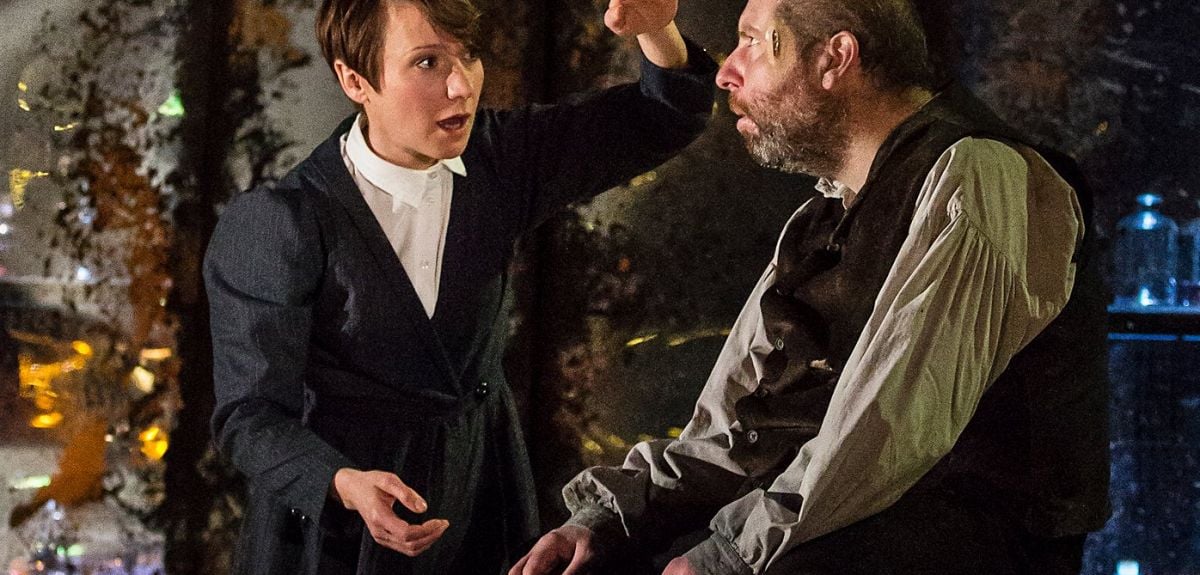
The doctor who created Frankenstein’s monster has been played on stage by a woman, for what is believed to be the first time.
A new play at the Northern Stage in Newcastle, features one Dr Victoria Frankenstein as the lead role in Selma Dimitrijevic's adaptation of Mary Shelley's iconic novel.
It's a fascinating idea, according to two of Oxford University’s experts on Mary Shelley.
‘The original novel is about a perverse, lone, male scientific kind of creativity, embodied in the character of Victor Frankenstein,’ says Professor Karen O’Brien, an expert in eighteenth-century literature and Head of Oxford’s Humanities Division.
‘Victor's creativity cuts him off from the normal, domestic world of women and female fertility. He gives life to the monster, not coincidentally, shortly after the death of his own mother.
‘So a female Frankenstein is a fascinating idea. How might the female fertility and genius be linked? In the novel, the Creature, or Monster, actually resembles the female heroines in Mary Shelley's mother's novels - isolated, sensitive, forever excluded from mainstream society by their inability to find happiness on the unequal terms offered by men.
A female Frankenstein is a fascinating idea
Professor Karen O'Brien
‘This adaptation transfers that outsider role to the scientist character. So how are we to interpret the Creature?’
Fiona Stafford, Professor of English Language and Literature at Oxford University, was interviewed about the casting on BBC Radio 4’s Today programme.
She says: ‘Mary Shelley would have been aware growing up in an unusual, avant garde household that, although she was a very intelligent woman, there was no opportunity for her to train as a doctor or to go to university.
‘In many ways you can read Frankenstein as a critique of male obsessive pursuit and of not thinking through the consequences of his actions, so it is interesting to see how that translates into Victoria Frankenstein.’
‘You can read the book in many different ways and I think that is part of the secret of its enduring success, it is extraordinary that a novel that was published in a fairly modest form in 1818 should still have this afterlife.
'In a way that is something that Mary Shelley’s myth is visiting, the idea that you can create something and then you don’t actually have control of it, it has a life of its own.
‘In some ways you can see a parallel between Mary Shelley the novelist and Frankenstein. Although we tend to think of him as a scientist, she too is bringing together something and bringing it to life, and then it has taken on a life of its own to the extent that the Creature is often thought of as Frankenstein.’
Professor Stafford's interview can be heard here.
Professor O'Brien will also be interviewed by BBC World Service's The Forum on Saturday 18 February. The recording will be found here.
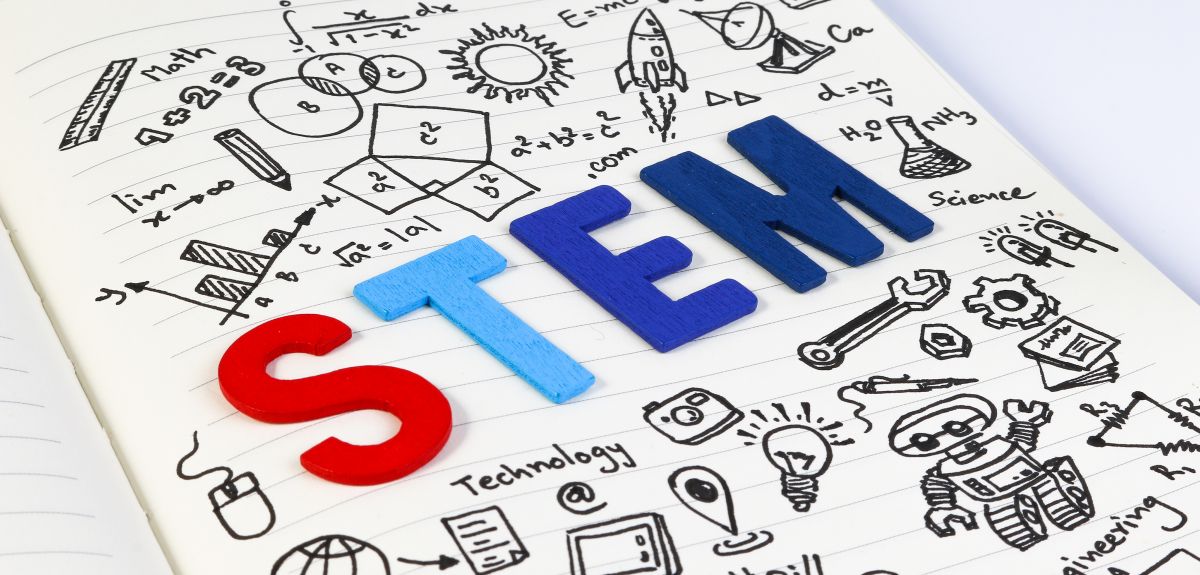
From Bob Dylan, to today's post-disciplinary world, Alain Goriely, Professor of Mathematical Modelling, Oxford Mathematics, University of Oxford, gives a brief introduction to applied mathematics. Discussing its role and evolution in society, he shares how maths defies simple categorisation, underpinning all STEM (science, technology, engineering, maths) specialisms.
In an interview with Rolling Stone Magazine in 1965, Bob Dylan was pushed to define himself: Do you think of yourself primarily as a singer or a poet? To which, Dylan famously replied: Oh, I think of myself more as a song and dance man, y’know. Dylan’s attitude to pigeonholing resonates with many applied mathematicians. I lack the coolness factor of Dylan, but if pushed about defining what kind of mathematician I am, I would say: Oh, I think myself more as an equation and matrix guy, y’know.
One of the greatest strengths of applied mathematics is that it has established itself by defying simple categorisation. Applied mathematics, be it an art, a craft, or a discipline, is not bound to a particular scientific application, a particular mathematical universe, or a well-defined university department. The drawback is that applied mathematics usually gets no mega-funding or the limelight associated with big scientific breakthroughs. But its biggest advantage is that it can insert itself into all scientific disciplines and easily reinvent itself by moving fluidly from one field to the next, guided only by methods, theory, and applications: it is all equations and matrices. Many applied mathematicians see new challenges as an opportunity to expand their mathematical horizons, and in our rapidly changing modern new society such new challenges abound. Here are three of these:
Major scientific efforts are required for major society challenges. These include fighting climate change, optimising new renewable energy sources, developing new medical treatments, and understanding the brain. Traditionally, applied mathematicians involved with these collaborative efforts were considered a useful but small cog in a huge scientific machine, but it is now appreciated that quality science requires clever modelling, state-of-the-art numerical methods, and fundamental theoretical insights from simplified models. This is the realm of applied mathematics, and accordingly our role in these endeavours is bound to increase. By the end of the day, we may not get the fame, but we’ll certainly have the fun.
A second relatively recent development of applied mathematics is the theory of networks. Networks represent connections between multiple physical or virtual entities. They are found in information theory (web links, social connections), biological systems (gene regulatory networks, metabolic networks, evolutionary trees), and physical systems (axon connections, electric grid). Regardless of their origin, these networks share common mathematical features. Their analyses span many different fields of study, and network theory has now established tentacular connections to various parts of pure and applied mathematics, a network of its own.
For about five years there has been much excitement about BIG DATA. The initial hope was that one could go straight into data and use empirical methods to unravel the mysteries of the universe. Quite the opposite is happening. The success of many methods has shed a bright light on the need to understand the underlying mathematical structure of both data and methods. The subject now presents a rich field of study that brings all mathematical sciences together, including statistics and computer science.
Applied mathematics, be it an art, a craft, or a discipline, is not bound to a particular scientific application, a particular mathematical universe, or a well-defined university department.
These examples share a common thread that highlights a new trend in mathematical and scientific discoveries: beyond inter-, multi-, and supra-disciplinarity, we live in a post-disciplinary world. Things have changed, and Oxford University with its collegiate system, and the Mathematical Institute with its collegial atmosphere, are particularly well equipped to thrive in this new scientific world. But despite all the hype, we’re also fully aware that there’s nothing wrong with the old world, the old problems, or the old conjectures. We have an intellectual responsibility to promote and cherish these areas of knowledge defined by the great thinkers, past and present, especially if they are believed to be useless or irrelevant.
Bob Dylan in the same interview, foresaw yet another possible application of mathematics: What would you call your music? His reply: I like to think of it more in terms of vision music – it's mathematical music.
For more discussion around understanding applied mathematics, you can watch the author’s video via the Oxford Mathematics YouTube page.
Alain Goriely is the author of the forthcoming book: 'Applied Mathematics: A Very Short Introduction,' which will be published by Oxford University Press later this year.

Oxford University's Voltaire Foundation has formed a new and surprising partnership.
Their ambitious project to publish the Complete Works of Voltaire is now being supported by LVMH Moët Hennessy, Louis Vuitton and Bernard Arnault, its Chairman and CEO.
The global luxury goods brand will donate a substantial amount over the next three years to support the Voltaire Foundation as it researches and publishes the final volumes in the Complete Works of Voltaire.
The 18th-century French writer Voltaire is an iconic figure in European culture, and his thinking about freedom of expression and religious tolerance lies at the heart of Western liberal democracy.
The Complete Works is the most ambitious project in French literature currently being undertaken outside France. It aims to publish all of Voltaire’s writings with expert commentary alongside the texts. When the project is completed in 2019, it will amount to more than 200 volumes.
The next edition to be published includes key Voltaire texts such as Micromegas, a science-fiction tale about a planet-hopping giant’s visit to our world which Voltaire uses as a commentary on the society in which he lived, and man’s place in the universe.
Professor Nicholas Cronk, Director of the Voltaire Foundation at Oxford University, said: 'We are very appreciative of this supportive endorsement from such a well-known French company whose high-profile, iconic brands match the world-class cultural aspirations of our ambitious project.
'When the Complete Works of Voltaire is published in its entirety, it will change fundamentally the way we think about the Enlightenment and the importance of the Enlightenment in the modern world.'
Bernard Arnault, Chairman & CEO of the LVMH Group, said: 'The driving force for the LVMH Group’s success is based on extracting value from a unique heritage and stimulating modern day creativity and excellence.
'The unprecedented project carried out by the Voltaire Foundation to publish the complete works of Voltaire follows a similar path as it aims to make available and to promote one of the most outstanding thinkers of the 18th century, to enlighten our times. It is with pride and gratitude to the Oxford University that we embark on this adventure.'
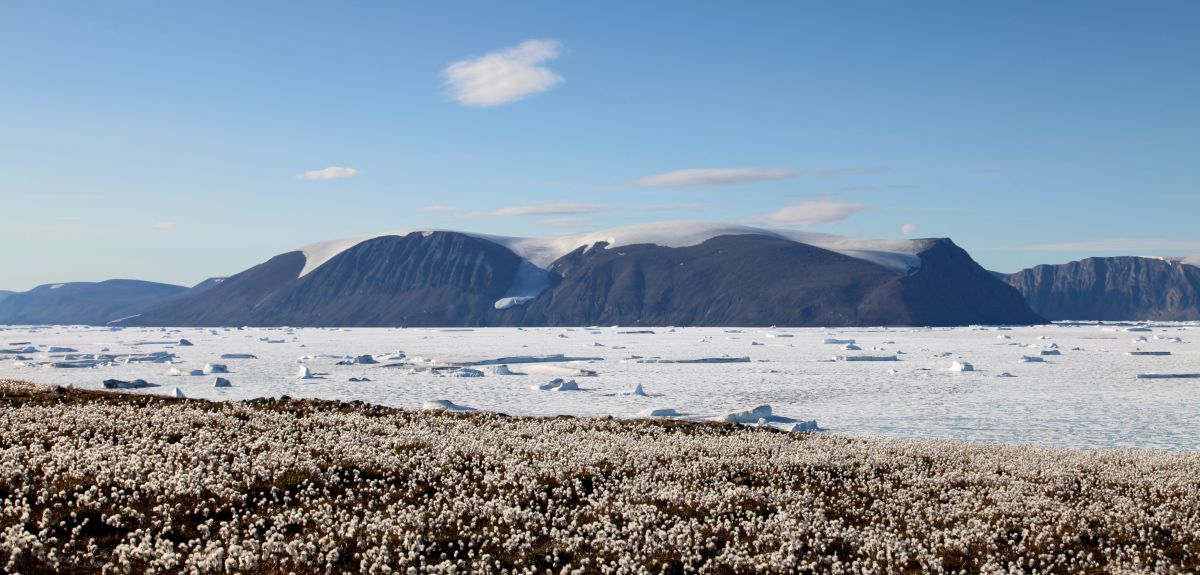
Many scientists may dream of receiving royal recognition for services to their field, but for Professor Paul Smith, director of Oxford University Museum of Natural History, it is reality. In early January he was awarded the prestigious Polar Medal by Her Majesty the Queen, in recognition of his “outstanding achievement” in the field of Arctic research.
As a palaeontologist and polar scientist, with extensive expertise working in the high Arctic, Professor Smith has over thirty years’ geological experience, particularly in Greenland. His research has informed understanding of some of the world’s most uninhabited, little known regions. His achievements include being part of the team that created the first geological maps of the northern Greenland.
ScienceBlog sat down with Professor Smith to get his reaction to winning the award and to learn more about his career.
Congratulations on this spectacular honour, where were you when you found out you had won?
I was sitting on a delayed train, on the way home, just before Christmas, when I received an email that I had won. It made a long, uninspiring journey a lot more memorable.
Picture credit: Professor Paul Smith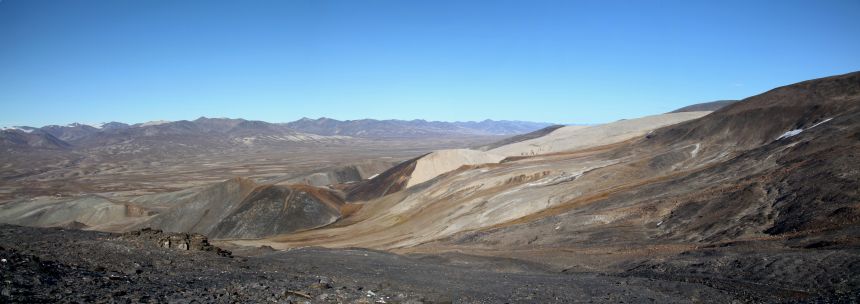 With the exception of glacial deposits, much of the Arctic landscape is exposed rock, which makes it a big attraction for geologists.
Why did you decide to specialise in Arctic research?
As a geologist and a keen climber and hillwalker interested in remote areas you could say it was a natural fit. But it was my first trip to Greenland that sealed the deal. I had just completed my PhD, when I was invited for the first time on a large-scale expedition, creating a geological map of the furthest north part of Greenland. A dream opportunity.
For those that haven’t yet had the pleasure of experiencing the polar-regions, Greenland is a landscape unlike any I have ever seen before. Unspoilt, mountainous and spectacular.
We worked remotely, in teams of two, completely isolated from the rest of the group. We would be taken by helicopter, to a remote location where we would conduct all of our mapping. Then a week later, the helicopter would return with fresh food and take us further on to map the next area, and so on.
There were twelve pairs of geologists scattered across northern Greenland, so although we were working in isolation we all kept in touch via radio, for safety and lively evening banter.
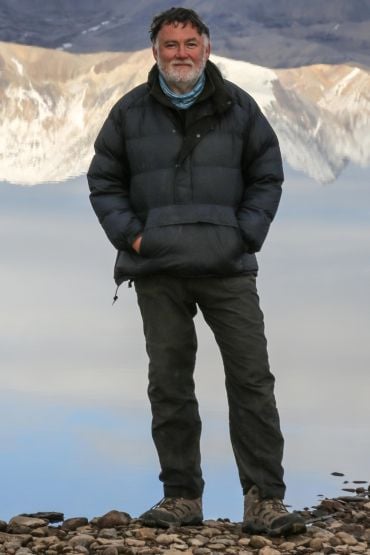 Professor Paul Smith, director of Oxford University Museum of Natural History and Arctic scientist
About 15 years ago I was involved in a highly complicated piece of geology, on the north eastern tip of Greenland. There had been a number of unsuccessful attempts to unravel the work, but my colleague and I wanted to achieve it ourselves. The bulk of the work was conducted on foot, but the helicopter was always on hand for support if needed. Over two summers we mapped an area around the size of Wales. I know that is the standard measure of land area, but it really was about the size of Wales. To this day I still consider this project one my proudest scientific achievements.
In terms of more recent work, can you tell us a little about researching the Cambrian explosion and why it has such high geological importance?
Most recently and throughout my career, I have been working collaboratively on a special locality, right above the north coast – about 500 miles from the North Pole. Here fossils are exceptionally preserved, which means geologists are not just working from shells or skeletons, but also the muscle tissues and soft tissues that aren’t normally preserved. The region is about 530 million years old, and at a point in time when most of the major groups of animals begin to appear in the fossil record.
This is an event called the Cambrian Explosion. Being able to attack a really fundamental scientific problem in a place that is so special, is very enjoyable as well as being hard work.
What is your fondest Arctic memory?
It has to be those occasions where you capture the perfect golden light in the Arctic. Photographers worldwide talk about the “golden moment.” Just as the sun’s setting, you get five minutes of really stunning light, just before the sun dips below the horizon. But in the far north, the sun never dips below the horizon, so on a nice day, the landscape is bathed in this golden light, for hour, after hour. Often, from eight o’clock at night, through to four in the morning you get to enjoy this glorious, perpetual sunset that never quite goes away. A great photo opportunity, but in my opinion, nothing compares to just sitting peacefully and absorbing it, with a small glass of whisky in hand.
Do you have any polar expeditions planned for the future?
We want to explore an area half way up the east coast of Greenland, where an ancient mountain belt called the Caledonides is well-exposed. It is a deep section through an ancient continent-continent collision zone and we are just in the planning stages of an expedition that we hope to undertake in 2019.
What is the significance of the Caledonides?
One of Greenland’s key geological features is that around 420 million years ago it had a mountain belt that was on the scale of the Himalayas, but it has now been eroded down to its roots. This level of erosion tells us about mountain belt activity, specifically how they grow and the way that they collapse.
The belt was formed by ancient North America colliding with ancient Scandinavia, and runs from the northern tip of Greenland, across the Atlantic, to Scotland, and then back across the Atlantic to the eastern cost of North America. We want to study the point where the mountain belt disappears off the shore of Greenland, to reappear next in North West Scotland. For geologists it is the missing link between the East Greenland and Scottish Caledonides.
Why is Arctic research so important in today’s world?
It is many fold really, and would inspire different answers from different scientists. For glaciologists and those interested in climate change, it is because climate change is currently at its most exaggerated in polar areas. I have been going to the Arctic for thirty years and have seen rapid polar melting at first hand. It is happening, and it shows no signs of slowing down.
Whereas, for geologists and people in my discipline, it is slightly different, the exposed rock is the real attraction. In the arctic we are not hindered by vegetation. There are of course areas covered with glacial deposits, but other than that, there is just the expanse of exposed rock that you just don’t get at lower latitudes. The far north has perfect “outcrop”, as we call it.
If you could have been a part of any scientific discovery from history, which would it be?
We have been exploring the far north since the 19th century, but even now, we get that very rare experience of walking on ground that we know no other human being has walked on before. But to have been a part of those original teams, seeing the entire landscape for the first time, must have been really special. There is one particular explorer, William Scoresby, a whaler who made the first scientific descriptions of northeast Greenland. Each year he would venture further and further north, trying to beat his previous record, constantly finding new terrain and new science. That is pretty special.
What is next for you?
A combination of organising the next expedition, researching the Cambrian explosion and of course, running this great museum (Oxford University Natural History Museum).
Do you have a personal favourite exhibit in the museum?
All museum artefacts have the power to tell stories, but very few can tell as many exceptional stories as the Dodo. Which has not only informed understanding of bird evolution, but also human induced extinctions, early trade routes and European exploration, and the creation of early natural history museums. Add to that a visit in 1860 from a certain Lewis Carrol and a little girl called Alice, and the Dodo has earned iconic status, crossing cultures, generations and the world.
What would you like your scientific legacy to be?
Someone who pushed forward a scientific understanding of Greenland and the Cambrian Explosion.
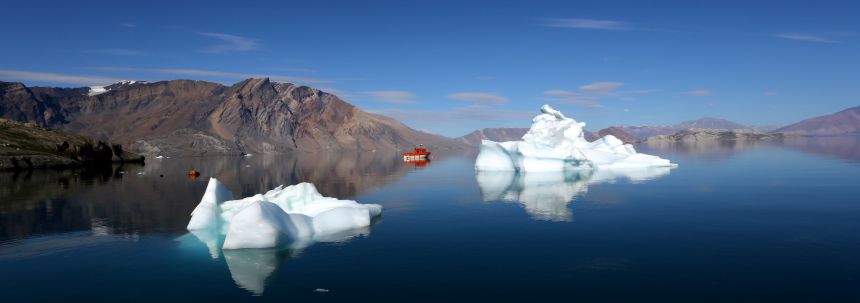 Climate change is currently at its most exaggerated in polar areas and having worked in the Arctic for thirty years, Professor Smith has witnessed rapid polar melting at first hand. Of the experience he said: "It is happening, and it shows no signs of slowing down."
Image credit: Professor Paul Smith

Academics in The Oxford Research Centre in the Humanities’ (TORCH) Race and Resistance Programme will host a discussion about the cultural value of hip hop this month.
On Friday 17th February, TORCH will host a lecture by Marcyliena Morgan, who is a professor from Harvard University’s Hiphop Archive and Research Institute.
‘The Hiphop Archive’s focus, which includes projects like analysing the poetic quality of 2Pac’s lyrics to understanding the post-civil rights dimension of Outkast’s Southern rap, demonstrates that hip hop is a source of artistic innovation and enjoyment on its own terms, while also providing us with insight into the cultural, social, and political conditions that have shaped recent times,’ says Louisa Olufsen Layne, a DPhil student in English at Oxford University.
‘Hip hop as a musical and global cultural form forces us to think critically about what we define as valuable knowledge, who we recognise as knowledge producers, and how knowledge can be created and shared. The study and archiving of hip hop encourages us to recognise how contemporary forms influence our view of the present as well as our understanding of the past.’
Harvard’s Hiphop Archive was established in 2002, and its mission is to facilitate and encourage the pursuit of knowledge, art, culture, and responsible leadership through hip hop.
Some of the questions that might be covered during the talk include: Why do universities need to archive and research contemporary popular culture? How can the study of hip hop foster new understandings of cultural value and knowledge in academia?
What kind of knowledge can be exchanged between researchers of hip hop in the US and institutions in the UK working with hip hop, British rap and grime? How can we think comparatively about similar projects and initiatives in the UK?
Hip hop is not a new subject of study in Oxford. Jason Stanyek, Associate Professor of Ethnomusicology in the Faculty of Music, has taught a course on global hip hop to first-year undergraduates since 2012, reaching almost 400 students.
The TORCH event takes place at 2.30pm on Friday 17 February at St Luke’s Chapel on Oxford University’s Radcliffe Observatory Quarter. Anyone can attend, but prior booking is required.
In the meantime, here is Hey Ya! by Outkast...
- ‹ previous
- 104 of 252
- next ›
 What US intervention could mean for displaced Venezuelans
  Setting the agenda for the next century of quantum
 10 years on: The Oxford learning centre making an impact
 Mapping the Moon: the world’s first lunar atlas goes digital
  Oxford and The Brilliant Club: inspiring the next generation of scholars
 New course launched for the next generation of creative translators
 The art of translation – raising the profile of languages in schools
  Opening a window into the quantum world
 Tracking resistance: Mapping the spread of drug-resistant malaria