Features

Mathematicians are known for having a brilliant way with numbers, but to have impact beyond their field they need to have an altogether different skill: the ability to communicate.
The George Pólya Prize for Mathematical Exposition, from the Society for Industrial and Applied Mathematics (SIAM), acknowledges and celebrates academics who are both great thinkers and writers.
This year’s recipient Professor Nick Trefethen, Head of the Numerical Analysis Group in the Oxford Mathematical Institute, has been celebrated for bridging the communication gap with his publications. The Society highlights the ‘exceptionally well-expressed accumulated insights found in his books, papers, essays, and talks... His enthusiastic approach to his subject, his leadership, and his delight at the enlightenment achieved are unique and inspirational, motivating others to learn and do applied mathematics through the practical combination of deep analysis and algorithmic dexterity.’
Professor Trefethen discusses receiving the honour and why his field is the fastest moving laboratory discipline in STEM.
Congratulations on your award, how did you react when you found out you had won?
I was thrilled. There are many accolades to dream of achieving in an academic career, but I am one of the relatively few mathematicians who love to write. So, to be acknowledged for mathematical exposition is important to me. My mother was a writer and I guess it is in my blood.
What is numerical analysis?
Much of science and engineering involves solving problems in mathematics, but these can rarely be solved on paper. They have to be solved with a computer, and to do this you need algorithms.
Numerical analysis is the field devoted to developing those algorithms. Its applications are everywhere. For example, weather forecasting and climate modelling, designing airplanes or power plants, creating new materials, studying biological populations, it is simply everywhere.
It is the hands-on exploratory way to do mathematics. I like to think of it as the fastest laboratory discipline. I can conceive an experiment and in the next 10 minutes, I can run it. You get the joy of being a scientist without the months of work setting up the experiment.
How does it work in practice?
Everything I do is exploratory through a computer and focused around solving problems such as differential equations, while still addressing basic issues. In my forthcoming book Exploring ODEs (Ordinary Differential Equations) for example, every concept measured is illustrated as you go using our automated software system, Chebfun.
How has your research advanced the field?
Most of my own research is not directly tied to applications, more to the development of fundamental algorithms and software.
But, I have been involved in two key physical applications in my career. One was in connection with transition to turbulence of fluid flows, such as flow in a pipe; and recently in explaining how a Faraday cage works, such as the screen on your microwave oven that keeps the microwaves inside the device, while letting the light escape so that you can keep an eye on your food.
You got a lot of attention for your alternative Body Mass Index (BMI) formula, how did you come up with it?
My alternative BMI formula was *not* based on scientific research. But, then again, the original BMI formula wasn’t based on much research either. I actually wrote a letter to The Economist with my theory. They published it and it spread through the media amazingly.
As a mathematician, unless you’re Professor Andrew Wiles or Stephen Hawking for example, you are fortunate to have the opportunity to be well known within the field and invisible to the general public at the same time. The BMI interest was all very uncomfortable and unexpected.
 Image credit: Nick Trefethen
Professor Nick Trefethen has won the George Pólya Prize for Mathematical Exposition from the Society for Industrial and Applied Mathematics (SIAM).
Why do you think so few mathematicians are strong communicators?
I don’t think this is necessarily the case. One of the reasons that British universities are so strong academically, is the Research Excellence Framework, through which contributions are measured. But, on the other hand the structure has exacerbated the myth that writing books is a waste of time for academic scientists. The irony is that in any real sense, writing books is what gives you longevity and impact.
At the last REF the two things that mattered most to me, that I felt had had the most impact, were my latest book and my software project, and neither were mentioned.
In academia we play a very conservative game and try to only talk about our latest research paper. The things that actually give you impact are not always measured.
What are you working on at the moment?
I just finished writing my latest book on ODEs (due to be published later this year), which I am very excited about.
Have you always had a passion for mathematics?
My father was an engineer and I sometimes think of myself as one too - or perhaps a physicist doing maths. Numerical Analysis is a combination of mathematics and computer science, so your motivations are slightly different. Like so many in my field, I have studied and held faculty positions in both areas.
What is next for you?
I am due to start a sabbatical in Lyon, France later this year. I'll be working on a new project, but if you don’t mind, I won’t go into detail. A lot of people say that they are driven by solving a certain applied problem, but I am really a curiosity-driven mathematician. I am driven by the way the field and the algorithms are moving. I am going to try and take the next step in a particular area. I just need to work on my French.
What do you think can be done to support public engagement with mathematics?
I think the change may come through technology, almost by accident. You will have noticed over the last few decades, that people have naturally become more comfortable with computers, and I think that may expand in other interesting directions.
The public’s love/hate relationship with mathematics has been pervasive throughout my career. As a Professor, whenever you get to border control you get asked about your title. ‘What are you a Professor of?’ When you reply, the general response is ‘oh I hated maths.’ But, sometimes you'll get ‘I loved maths, it was my best subject’, which is heartening.
What has been your career highlight to date?
Coming to Oxford was a big deal, as was being elected to the Royal Society. It meant a lot to me, especially because I am an American. It represented being accepted by my new country.
Are there any research problems that you wish you had solved first?
I’m actually going to a conference in California, where 60 people will try to prove a particular theorem; Crouzeix’s Conjecture. By the end of the week I will probably be kicking myself that I wasn’t the guy to find the final piece of the puzzle.
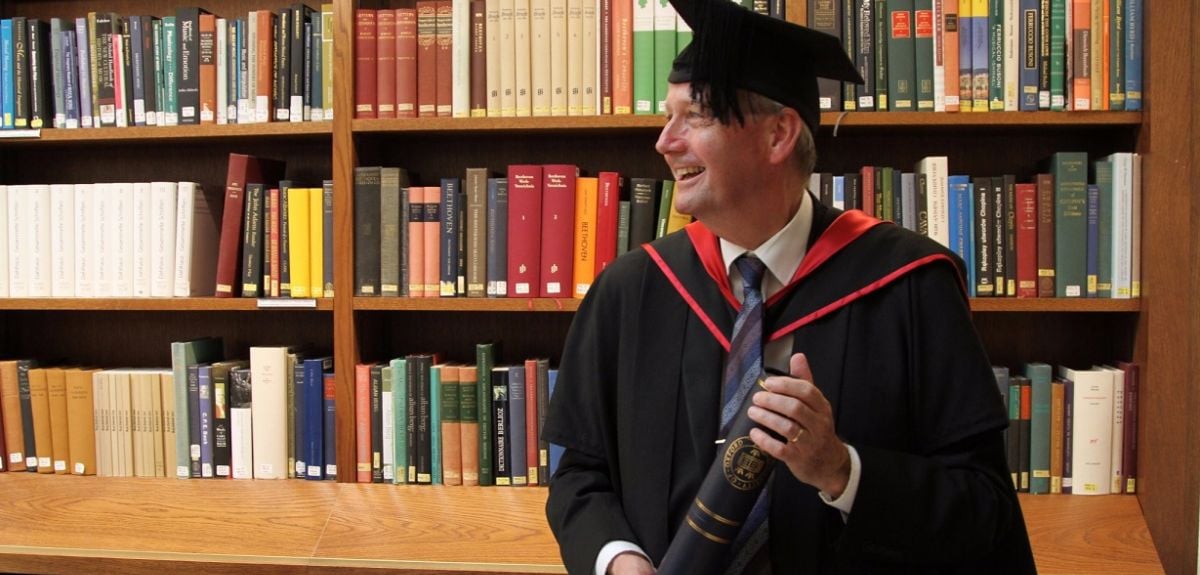
In 1967, the Beatles released Sgt. Pepper’s Lonely Hearts Club Band, Ronald Reagan became governor of California and, towards the end of the Summer of Love, Colin Harris started work at the Bodleian Library.
Fifty years later, now superintendent of the Bodleian’s Special Collections Reading Rooms, Mr Harris has received a prestigious honorary degree from the University of Oxford.
At the ceremony at the Sheldonian Theatre on 18 July, he was praised for his ”truly dedicated service to all types of library reader – from senior academics to masters' students, professional writers to amateur historians – whom he has advised with expertise and unfailing patience."
Mr Harris joined the Bodleian Library in 1967. He worked in the Duke Humfrey's Reading Room from 1968 and in the Modern Papers Reading Room in the New Bodleian from 1980.
Today, he holds the role of Superintendent of the Special Collections Reading Rooms in the Weston Library within the Bodleian Libraries.
Mr Harris, who will retire at the end of September, says the Library has been through some dramatic changes during his tenure.
‘We have gone from card index, handwritten and typewritten catalogues available only in the Library to online catalogues available worldwide on the Internet; from a typing pool serving all staff to everyone having a PC and able to type their own letters and now emails,’ he says.
‘Our readership has become much more international – for many years we were visited in great numbers from the US, Canada and Western Europe, but now researchers travel from all parts, especially from Eastern Europe, the Middle East, Asia, China and Japan.
‘We have also got an impressive social media presence and we promote wide-ranging activities such as lectures, exhibitions on diverse subjects show-casing the Library’s great wealth of collections and research opportunities such as fellowships that are available in the Bodleian Libraries.’
But he says the quality of service provided by the Bodleian has been continuous throughout his distinguished career there.
‘Throughout, the Library has gone to great lengths to further research, responding to the particular needs of the researcher and providing a very personal service’.
‘I am minded of the readers’ typing room used by researchers such as Denis Mack Smith, who died recently, and of the nascent inter-library loan system of the 1970s so efficiently established by my late wife Susan (then Susan James), which was used to great advantage by the late Sir Isaiah Berlin.’

In what was a landmark ruling, the highest court in the UK, yesterday declared employment tribunal fees to be ‘inconsistent to the access to justice.’
The decision represents a humiliating defeat for the government, who have been forced to scrap the controversial fee system.
The Supreme Court voted in favour of the trade union Unison, which argued that fees of up to £1,200 were preventing workers - particularly people on lower incomes, from getting justice.
Associate Professor Abi Adams, from the Oxford Department of Economics, and Associate Professor Jeremias Prassl, from the Oxford Faculty of Law, welcome the gravity of the ruling and what it could mean for workers who make future claims. In research published earlier this year, the two argued that the 2013 Order introducing Employment Tribunal Fees was a ‘clear violation’ of long-established UK and EU law.
Access to Justice is the bedrock of the Rule of Law. Today’s unanimous Supreme Court judgement vindicates one of the most fundamental principles of our Constitution, dating back to Magna Carta: everyone has the right to be heard before the Courts.
Everyone? Well, at least until 2013. Nearly four years ago, Chris Grayling (one of the most disastrous Lord Chancellors in recent history) introduced fees of up to £1,200 for employment tribunal claims. Even relatively straightforward claims (e.g. for unpaid wages, median value just under £600) cost £390 to bring – with no guarantee of recovery, even for successful claimants.
The impact was swift and brutal: within months, claims had dropped by nearly 80%. And it was entirely predictable: when we crunched the government’s own numbers, it became clear that 35-50% of those who won their case risked losing out financially. Most workers with low-value claims simply gave up.
Bad news for workers, of course – but also for employers. Without enforcement, employment rights are meaningless, as Matthew Taylor’s recent review of modern working practices acknowledged. Rogue employers can get away with undercutting those who comply with the law. Both the High Court and the Court of Appeal, however, upheld the government’s fees in a series of challenges brought by Unison, the trade union.
The Supreme Court’s powerful judgement could not have disagreed more strongly: the Fees Order, the Justices unanimously agreed, ‘effectively prevents access to justice, and is therefore unlawful.’ Their conclusion was built both on fundamental constitutional theory, ‘elementary economics’, and ‘plain common sense’.
Constitutional theory first: ‘It may be helpful’ Lord Reed politely suggested, ‘to begin by briefly explaining the importance of the rule of law’. There’s little to add to his powerful analysis:
Courts exist in order to ensure that the laws made by Parliament, and the common law created by the courts themselves, are applied and enforced. In order for the courts to perform that role, people must in principle have unimpeded access to them. Without such access, laws are liable to become a dead letter, the work done by Parliament may be rendered nugatory, and the democratic election of Members of Parliament may become a meaningless charade.
Whilst the Lord Chancellor’s aims of deterring vexatious litigants and raising money for the Ministry of Justice may well be legitimate in principle, in practice they had achieved something different altogether: given the financial risks even when successful, ‘no sensible person will pursue the claim’.
There was more elementary economics and plain common sense to come, demolishing the Lord Chancellor’s insistence that ‘the higher the fee, the more effective it is’ and that no public benefits flowed from the justice system, amongst others.
Where does this leave us? In the short term, things will get messy (and expensive) for the Ministry of Justice: in 2013, the Lord Chancellor undertook to repay all fees illegally levied, and there may well be further arguments about extending time limits for claimants who were deterred from bringing claims in the first place. Going forward, our rational choice model furthermore suggests that similar challenges could be brought to fees introduced in other areas of the civil justice system.
For now, it’s time to celebrate: employment tribunals have already begun to scrap the fees, and claimants across the country will once more have access to the ‘easily accessible, speedy, informal and inexpensive’ system first set up nearly 50 years ago.
‘An unenforceable right or claim’, the late Lord Bingham reminded us, ‘is a thing of little value to anyone.’ The Supreme Court did well to heed his words, and restore the Rule of Law.
This article was first published on the Huffington Post
About the authors
Abi Adams (@abicadams) is an Associate Professors in Economics at the University of Oxford, a research Fellow at the Institute of Fiscal Studies, and a Fellow of New College. She specialises in labour and behavioural economics with an empirical bent.
Jeremias Prassl (@JeremiasPrassl) is an Associate Professor in the Faculty of Law at the University of Oxford and a Fellow of Magdalen College. He writes on UK and European Employment Law, with a particular interest in the future of work in the gig economy.

Earlier today, the parents of terminally ill baby Charlie Gard ended their legal challenge for him to be taken to the US for experimental treatment.
His mother, Connie Yates, said that “to let our beautiful little Charlie go” is “the hardest thing we’ll ever have to do”.
Professor Julian Savulescu is director of the Oxford Uehiro Centre for Practical Ethics. He explores about the ethical lessons we can take from this tragic tale:
"At some point in all of our lives, we have to let go. One can only admire Connie Yates and Chris Gard who fought so hard for Charlie.
However, we should continue to question the original decision, and the way in which these decisions are made. Even if it is too late for Charlie now, we should improve how we make these decisions for the future.
Back in January, there was an option for a trial of treatment that had some chance of success, a world leading doctor willing and able to provide it, and, by April, the funds had been raised to achieve it without public funds.
There were also the means to control and minimise Charlie's suffering. I believe that a limited trial of treatment was in Charlie’s interests back then, given the only alternative for him was death.
Doctors opposed this because of the low chance of success combined with fears that the extra time in life support would be too painful.
Four months of the legal process has left us with no trial of treatment, and no chance now for Charlie. Yet Charlie had to go through all the suffering (and more) of being kept alive on life support.
No-one wanted this outcome. No-one believes this outcome was in Charlie’s best interests. There has got to be a better process. It has been traumatic for all the doctors, who have genuinely had Charlie's interests at heart, and Connie and Chris, but most of all Charlie.
It has also raised other issues.
Charlie would have been the first to receive this treatment and some have said it risked Charlie being used as a guinea pig. Medicine won't progress without experiment and innovation.
Over the years processes have been developed to protect patients and ensure the best scientific results. Double blind placebo controlled trials are the gold standard. I have argued that, for rare and deadly diseases with no existing therapies, it is in the patient's interests to access potential treatments earlier and without placebo, provided they have a reasonable scientific basis.
There is little to lose and much to gain for this group of patients, and the protections that are in place can cause more harm than good for them.
A second issue is that social media has given power to the people. Over the five court hearings, Trump and the Pope, and thousands of others have weighed in. We have had to have these discussions about how and who should decide on what makes life worth living and what kinds of chances are worth taking.
The question of who should decide is legitimate. Some people have wrongly concluded that these decisions should only be up to parents, but at the same time it is right that doctors, scientific experts and the Courts should not be considered almighty, beyond question or account.
How much should the decision–making be left to parents? While most parents want to do the best for their children, parents can abuse their children, or can be radically mistaken. We do need oversight to ensure children are protected.
If Connie Yates and Chris Gard had requested ongoing intensive care for a herbal treatment with zero scientific evidence or rationale, that would be abuse. But they weren't. They were asking for a treatment with a clear scientific rationale and some relevant evidence, with the support of a relevantly qualified medical expert.
There have to be protections. But doctors should not activate these legal mechanisms, or stop parents travelling for medical care for their child, unless there is disagreement between the parents, or they are going to an unsafe place, or they are very confident the parents' choice is unreasonable.
That requires doctors to think ethically, as well as having all the scientific evidence. The problem is not who has the power, it is how it is used and the need for robust, and humble, ethical deliberation.
Some have seen this as a further attack on ‘experts’, a current hot topic. But this case was more about disputed values than disputed facts. What has been absent, and is absent from society, is a sound secular ethical approach to these life and death issues.
I haven't seen any substantial ethical discussion of the deep ethical issues in this case like what makes a life worth living or what kinds of chance are worth taking.
Debate has been shut down in monosyllabic ethical argument: treatment is futile or it is not futile. And we have again closed our eyes to the elephant in the room: resources and justice. The NHS may not be able to afford such experimental treatments for everyone who needs them.
We should have had a debate about resources and justice. These are difficult questions but ones that must be addressed openly. It goes beyond accepting the expertise of someone else.
This has been a clash of medicine, science, politics, ethics and religion. Yes, there is always a clash of values because many people hold different values and weigh facts differently. What matters is that people's values are reasonable and they don't seek to impose them on others, or other families.
It would have been very reasonable for Charlie's parents to choose to withdraw treatment; it was also very reasonable to choose a small chance of some improvement. I wouldn't choose experimental treatment if I were Charlie's parents but that does not mean they are wrong or unreasonable to do so.
We need a bit of humility about our moral views about the good life, and about how and when to live. In Charlie's case, his parents have been accused of prioritising their own interests over Charlie's in choosing to take their child for experimental treatment that might give him a chance to live.
The courts have intervened and stopped them. However it is a reasonable view of Charlie’s interests that his parents held. I hope that there will be a review of the basis of these decisions, and how they are decided in the light of this case."
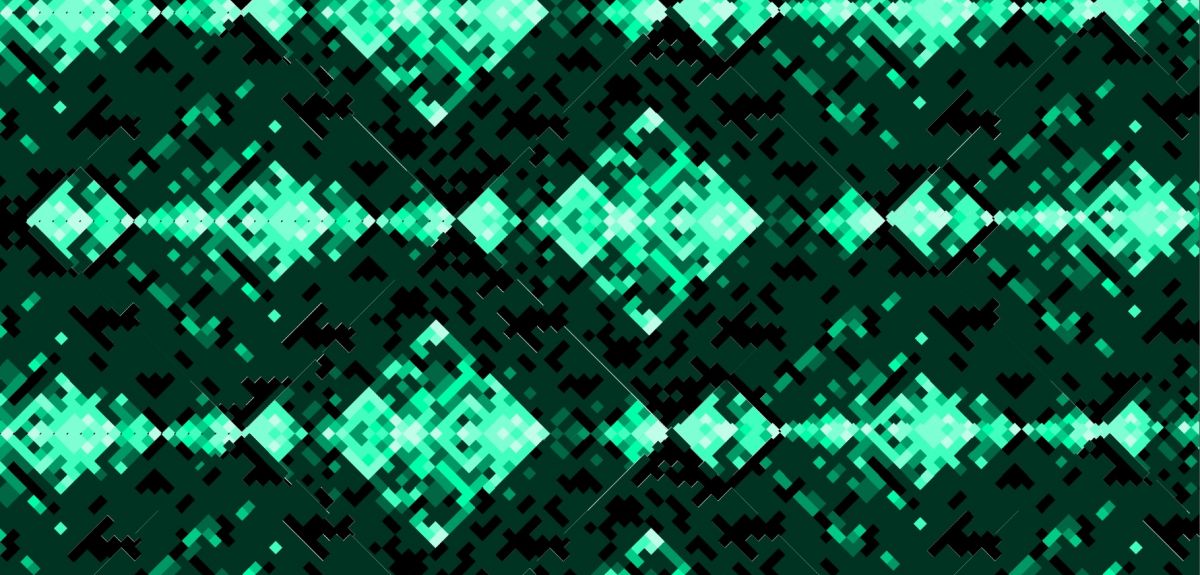
Marieke Oudelaar from the Weatherall Institute of Molecular Medicine explains how complex folding structures formed by DNA enable genetically identical cells to perform different functions.
Our bodies are composed of trillions of cells, each with its own job. Cells in our stomach help digest our food, while cells in our eyes detect light, and our immune cells kill off bugs. To be able to perform these specific jobs, every cell needs a different set of tools, which are formed by the collection of proteins that a cell produces. The instructions for these proteins are written in the approximately 20,000 genes in our DNA.
Despite all these different functions and the need for different tools, all our cells contain the exact same DNA sequence. But one central question remains unanswered – how does a cell know which combination of the 20,000 genes it should activate to produce its specific toolkit?
The answer to this question may be found in the pieces of DNA that lie between our protein-producing genes. Although our cells contain a lot of DNA, only a small part of this is actually composed of genes. We don’t really understand the function of most of this other sequence, but we do know that some of it has a function in regulating the activity of genes. An important class of such regulatory DNA sequences are the enhancers, which act as switches that can turn genes on in the cells where they are required.
However, we still don’t understand how these enhancers know which genes should be activated in which cells. It is becoming clear that the way DNA is folded inside the cell is a crucial factor, as enhancers need to be able to interact physically with genes in order to activate them. It is important to realise that our cells contain an enormous amount of DNA – approximately two meters! – which is compacted in a very complex structure to allow it to fit into our tiny cells. The long strings of DNA are folded into domains, which cluster together to form larger domains, creating an intricate hierarchical structure. This domain organisation prevents DNA from tangling together like it would if it were an unwound ball of wool, and allows specific domains to be unwound and used when they are needed.
Researchers have identified key proteins that appear to define and help organise this domain structure. One such protein is called CTCF, which sticks to a specific sequence of DNA that is frequently found at the boundaries of these domains. To explore the function of these CTCF boundaries in more detail and to investigate what role they may play in connecting enhancers to the right genes, our team studied the domain that contains the α-globin genes, which produce the haemoglobin that our red blood cells use to circulate oxygen in our bodies.
Firstly, as expected from CTCF’s role in defining boundaries, we showed that CTCF boundaries help organise the α-globin genes into a specific domain structure within red blood cells. This allows the enhancers to physically interact with and switch on the α-globin genes in this specific cell type. We then used the gene editing technology of CRISPR/Cas9 to snip out the DNA sequences that normally bind CTCF, and found that the boundaries in these edited cells become blurred and the domain loses its specific shape. The α-globin enhancers now not only activate the α-globin genes, but cross the domain boundaries and switch on genes in the neighbouring domain.
This study provides new insights into the contribution of CTCF in helping define these domain boundaries to help organise our DNA and restrict the regulation of gene activity within the cells where it is needed. This is an important finding that could explain the misregulation of gene activity that contributes to many diseases. For example in cancer, mutations of these boundary sequences in our DNA could lead to inappropriate activation of the genes that drive tumour growth.
The full study, ‘Tissue-specific CTCF–cohesin-mediated chromatin architecture delimits enhancer interactions and function in vivo’, can be read in the journal Nature Cell Biology.
- ‹ previous
- 93 of 252
- next ›
 What US intervention could mean for displaced Venezuelans
  Setting the agenda for the next century of quantum
 10 years on: The Oxford learning centre making an impact
 Mapping the Moon: the world’s first lunar atlas goes digital
  Oxford and The Brilliant Club: inspiring the next generation of scholars
 New course launched for the next generation of creative translators
 The art of translation – raising the profile of languages in schools
  Opening a window into the quantum world
 Tracking resistance: Mapping the spread of drug-resistant malaria