Features
An Oxford University researcher has won FameLab UK, a competition that aims to spot the best new science communicators by getting them to deliver a nugget of science wisdom in a talk lasting just three minutes.
In the final, which took place last night at the Royal Institution, Andrew Steele of Oxford University’s Department of Physics secured the prize ahead of nine other finalists with a talk about why carrots are a delicious testing ground for quantum mechanics.
‘Why is this carrot orange? It turns out that carrots are quantum vegetables, and their delightful colour can be understood with one of the simplest ideas in quantum mechanics: the so-called particle in a box,’ Andrew told the judges and assembled audience.
He went on to describe how the beta-carotene in carrots is a ‘molecule in a box’:
‘Think of it like an angry cat. <miaow> In fact, to squeeze an electron, or a cat, into a box so small that we knew exactly where it was would take an infinite amount of energy. And kicking a cat in an infinitely small box would just be mean…’
Andrew concluded by exploring how light interacts with carrots and tearing a spectrum printed on a card in half:
‘If you shine white light on a carrot, everything that’s green or more energetic gets absorbed by the electrons, and you’re only left with red, orange and yellow being reflected back into your eyes. And that’s why carrots are orange.’
His talk won over the judging panel of Andrew Cohen, head of BBC’s science unit, anatomist, science writer and broadcaster Professor Alice Roberts, and Oxford neuroscientist Professor Russell Foster, as well as winning the audience award.
Andrew tells me: ‘The final was pretty nerve-wracking! There was strong competition and a real diversity of styles so it must've been as hard for the judges as it was for us finalists. It was amazing to have the chance to speak in such an illustrious venue as the Royal Institution, and obviously I'm thrilled with the outcome!’
The prize includes £1000 in cash and £750 to spend on a science communication activity and Andrew will go on to compete for the title of International FameLab Champion at The Times Cheltenham Science Festival in June.
A study of chimpanzees gives tantalizing evidence that humans may have evolved upright walking in order to carry more food.
A team of scientists from Oxford University, Cambridge, and Kyoto University tested the theory that two-legged (bipedal) walking should occur more of the time when animals are carrying prized but rare resources.
The researchers put groups of wild chimpanzees in Bossou, Guinea, through their paces. First they provided either commonly-available oil palm nuts or both oil palm nuts and some rare coula nuts in a forest clearing.
They found that when more of the prized coula nuts were available the chimps concentrated on carrying these away in preference to the oil palm nuts.
Whilst overall the chimps still mostly used all four limbs, bipedal walking increased by a factor of four when coula nuts were present. The chimps also carried twice as many items when walking on two legs – often using not only their hands but also their mouths and feet.
The researchers also separately recorded crop raids by Bossou chimps over a 14-month period. They observed that over a third of chimp trips during these raids included bipedal strides and that the number of items carried during these bipedal bouts was significantly higher than exclusively four/three-legged ones.
A report of the work is published today in Current Biology.
‘This small population of chimpanzees at Bossou has already taught us a great deal about many aspects of chimpanzee behaviour and cognition, including the uniquely West-African chimpanzee tradition of using stone tools to crack open hard shelled nuts,’ team member Dora Biro of Oxford University’s Department of Zoology tells me.
‘We've known for a long time that chimpanzees carry items bipedally, but what our study has shown is that such transports increase dramatically when chimpanzees encounter resources that are rare or unpredictable in their availability.
‘In those times their behaviour resembles a "take as much as you can at once" strategy - a bit like people piling food on their plates at a buffet table. Bipedality helps because it allows you to increase the amount of things you can carry to a safe place at once.’
The results support the idea that variable food resources and uncertain environments may ‘fast-track’ adaptations such as bipedal walking. It’s possible that the extra calories gained from novel ways of carrying food eventually selects for gradual anatomical change: something that may have driven our ancestors to stand up on their own two feet and stay there.
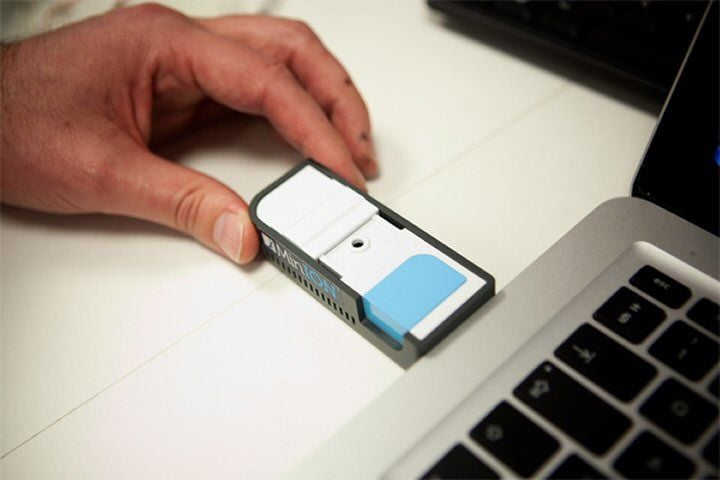 MinION DNA sequencing machine.
Last month Oxford University spinout firm Oxford Nanopore revealed that it is to produce a new DNA sequencing machine the size of a USB stick.
The announcement caught many by surprise, with the prospect of shrinking today’s bulky DNA sequencers into tiny devices that could decode the building blocks of life in hours (even seconds) instead of days, being widely reported in the media.
After articles in The Guardian, New York Times, Financial Times, and elsewhere, the blogosphere was abuzz with the exciting possibilities such machines open up.
Yet perhaps it shouldn’t have come as such a surprise: the firm’s success is built on nearly a decade of basic research at Oxford University’s Department of Chemistry.
Professor Hagan Bayley moved to Oxford in October 2003 having already done considerable research into how tiny pores in a protein might be used to detect the molecules passing through them, work he continued to develop in his Oxford lab.
In 2005, with the backing of IP Group and the help of Oxford University Innovation, Hagan founded Oxford Nanopore to commercialise his ideas.
‘We were looking at sensing a wide range of molecules, but it was work we did at Oxford which showed, for the first time, that our nanopores could identify all four bases of DNA,’ Hagan explains.
‘After that it made sense to shift the firm’s development into the area of DNA sequencing, a move which provided an impetus for many others to follow.’
Conventional sequencing requires DNA samples to be amplified (which can introduce errors), cut to the right length, attached to a bead or surface and given a fluorescent tag which has to be read with expensive imaging equipment.
The pioneering approach developed by Hagan and his team was to eliminate tags and enable individual DNA bases to be snipped off a strand one by one and then fired through a nanopore. Each base disrupts an electric current passed across the nanopore by a different amount so the DNA base ‘letter’ (A, C, G or T) can be read.
‘We found a modified pore that could clearly distinguish between the different bases,’ Hagan tells me, ‘but the big prize was strand sequencing – being able to pull a whole strand of DNA through a pore and read out the bases one at a time from that. It was work done at Oxford that first showed that this was possible.’
The University contributed in other ways too: its Begbroke Science Park would provide a home for Oxford Nanopore from July 2006-2009, during that time the workforce rocketed from 6 to 70 staff.
Despite his role as the firm’s founder, a board member, and long-time scientific adviser, Hagan didn’t become its CEO; ‘my interest was always in the basic research’ he says.
Instead, he continued to work with his team on the scientific challenges of understanding nanopores and what they can do, publishing papers that were useful to both the spinout and others interested in the potential of this emerging technology.
Yet the relationship remained a close one: former members of Hagan’s group would go on to play a significant role in the firm’s development as it grew from a small start-up to a company now employing 120 people.
Drawing on the basic research, Oxford Nanopore has been working hard for the last few years on creating the electronic hardware and software necessary to turn the nanopore concept into viable commercial devices. Its new MinION and GridION sequencers have already been hailed as ‘game-changing’ products on the road to cheaper, faster, more flexible DNA sequencing but this could be just the start, Hagan suggests: ‘we could see a high-throughput chip reading signals from hundreds of thousands of nanopores simultaneously, this could be very important for large-scale sequencing.’
After a decade of working in this area Hagan believes it is now time for him to move on and find new avenues of research.
He believes that most new commercial exploitation opportunities come from basic research, and instead of research councils and universities trying to plan ‘pathways’ to new products and services: ‘the best way to do initial research is to find good motivated scientists, give them funding and time, and leave them alone.’
Hagan tells me: ‘we need to make it simple for academics to form a company, don’t make them have to take a year out from their academic work or quit their university job to get things going.’ The support he received from Isis Innovation and others around the University indeed made spinning out a firm ‘relatively easy’.
His message to funders and universities is that it’s how you treat your researchers that counts; support them and, in time, everyone will reap the rewards.
Certain birds may have compass information mapped directly onto their vision, much as fighter pilots have ‘head up displays’ overlaying flight information on their view of the skies.
It’s well known that birds, such as the European Robin, can detect the Earth's magnetic field in order to help them navigate on long migratory flights.
This ‘compass’ sense must be associated with the eyeball, because the birds cannot detect magnetic fields in darkness.
But now scientists from the UK and Singapore have shown that birds may really ‘see’ the invisible force of magnetism, giving them a compass on top of their normal vision: rather like aircraft ‘head up displays’ which overlay crucial navigation information on a transparent screen in front of the pilot.
According to the new model, when a photon of light from the Sun is absorbed by a special molecule in the bird's eye, it can cause an electron to be kicked from its normal state into an alternative location a few nanometres away. Until the electron eventually relaxes back, it creates an ‘electric dipole field’ which can augment the bird's vision - for example altering colours or brightness.
Crucially, the alignment of the molecule compared to the Earth's magnetic field controls the time it takes for the electron to relax back, and so controls the strength of the effect on the bird's vision.
There are many such molecules spread throughout the eye, with different orientations. So from the patterns on top of its vision, and the change of these patterns as it moves its head, the bird learns about the direction of Earth's magnetic field.
A report of the research is published in Biophysical Journal.
An important consequence of the new research is that this process ‘piggybacks’ on normal vision and so could evolve quite easily - it does not require the evolution of a whole new sensory organ.
‘We can imagine that in an ancestral bird’s eye this disturbance to vision, oriented to the Earth’s magnetic field, gave some individuals an advantage when it came to navigating vast distances,’ Simon Benjamin of Oxford University’s Department of Materials and National University of Singapore, an author of the report, told me.
‘Natural selection would then favour those individuals so that the effect became stronger and stronger over many generations resulting in the powerful magnetic sense birds have today.’
The research shows that, in an ancestral bird’s eye, just a few molecules could have absorbed photons, creating electric dipoles that made the very weak magnetic field of the Earth faintly visible.
If this effect gave individuals an evolutionary advantage, the number, ordering, and characteristics of those special molecules is likely to have increased over millions of years, creating the compass used by modern birds.
Erik Gauger, of Oxford University’s Department of Materials and National University of Singapore, adds: ‘Further experiments will verify whether the mechanism we have proposed correctly describes the bird's compass.
'However, even if it doesn't, our idea could be a powerful blueprint for engineered magnetometers; for instance a compass that is integrated into a contact lens.’
Fancy making your own slime or chilling out with liquid nitrogen? How about discovering the microscopic world of magma or how plants keep us healthy?
If you do then you’re in luck as this month sees the Oxfordshire Science Festival (3-18 March) collide with National Science and Engineering Week (9-18 March).
Oxford University scientists are busy organising lots of family-friendly events around Oxfordshire. As always, one of the highlights will be the annual Wow! How? science fair at the Oxford University Museum of Natural History (Saturday 10 March) with over 30 different hands-on activities and demonstrations including slime making, live bugs, illusions, secret messages, board games, fossils, and skeletons.
Saturday is also your chance to find out about the maths hidden in the urban environment around Oxford by joining a Maths in the City walking tour.
If you fancy a greener stroll then, throughout the festival, you can take the Marvellous Medicine Trail around Oxford University’s Botanic Gardens and discover how plants are the key to many of the medicines we use today (entrance fee required).
On Saturday 17 March you could find out more about volcanoes, magma, and why some rocks float at Volcanoes: The Magical Microscopic World of Magma, an event organised by the Royal Microscopical Society.
17 March is also your chance to take it freezey with demonstrations using liquid nitrogen helping to explain the physics of very low temperatures.
Throughout March Oxford University also runs a programme of science events aimed specifically at Oxfordshire schools. Begbroke Science Park will be holding their Innovation Showcase (8 March) where pupils are invited to come up with ideas for products to pitch to a Dragon’s Den style panel of experts.
Meanwhile the Oxford University Science Roadshow (12-16 March) will be bringing the joy of science and engineering to The Marlborough School, Burford School, The Cooper School, Oxford Spires Academy, and Chipping Norton School. This year topics include playing games with DNA and how to make solar cells.
- ‹ previous
- 190 of 252
- next ›
 What US intervention could mean for displaced Venezuelans
  Setting the agenda for the next century of quantum
 10 years on: The Oxford learning centre making an impact
 Mapping the Moon: the world’s first lunar atlas goes digital
  Oxford and The Brilliant Club: inspiring the next generation of scholars
 New course launched for the next generation of creative translators
 The art of translation – raising the profile of languages in schools
  Opening a window into the quantum world
 Tracking resistance: Mapping the spread of drug-resistant malaria