Features

When it comes to spatial learning males are better than females, and bold and shy individuals are better than average ones, at least if you're a lizard.
The findings, from a new study of the Easter Water Skink (Eulamprus quoyii) - a lizard that lives throughout Eastern Australia and can grow over 12cm long - are the first evidence of sexual learning differences in a reptile. A report of the research is published in this week's Proceedings of the Royal Society B.
A team led by Oxford University and Macquarie University, Sydney, scientists took 64 skinks, 32 males and 32 females, and released them into a series of strange environments to investigate how differences in personality influence how they learn. These environments included features they would like, a 'warm' refuge made of a box with three entrances heated by an incandescent bulb, and features they wouldn't, a 'cold' refuge made of a similar box chilled with ice packs.
By introducing the skinks to simulated predator events (being chased away into a refuge) the researchers determined which returned quickly to bask in a warm refuge ('bold' lizards) and which took longer than average to return ('shy' lizards). They then tested the lizards once a day for 20 days in a setting where they were again exposed to simulated predatory attacks and given a choice between a safe refuge (chasing stopped) and an unsafe refuge (the refuge was lifted and chasing continued) that were always located in the same place.
'We found that male lizards were better at this spatial learning task than females, with twice as many males as females learning the spatial task within 20 trials,' explains Pau Carazo of Oxford University's Department of Zoology, who led the research.
'While this is the first evidence ever of sexual learning differences in a reptile, we believe it reflects the fact that males are forced to spend more time moving through their environment in search for females or patrolling their territory to guard it against other rival males. We also show that, across the sexes, the boldest and shyest individuals were overall better learners than intermediate individuals.'
According to the team this is the first evidence that individuals at the extreme ends of a personality axis are better learners than individuals with intermediate personality traits. This does not fit well with current theories about how personality and learning may co-evolve: the team proposes the idea that spatial learning ability and personality are both linked with male reproductive strategies.
'In Eulamprus, as in many other lizard species, male lizards exhibit two alternative reproductive strategies. Some male lizards defend territories, which not only requires them to be bold but also to constantly patrol their territory and remember rival males at its boundaries (which would favour good spatial learners),' Pau tells me.
'In contrast, other males adopt an alternative sneaker strategy whereby they are forced to navigate over long distances (which would also favour good spatial learning abilities) to sneak into other males' territories and try to mate with resident females. Because these males do not defend territories and normally avoid fights, they are likely to be shy.
'We suggest that males that are particularly good at either of these two strategies are likely to be good spatial learners and are either extremely bold or extremely shy individuals. This new hypothesis may help to explain how personality and learning co-evolve, and to understand the evolutionary processes that may lead to the striking individual differences in learning than can be observed in most animal species studied to date.'
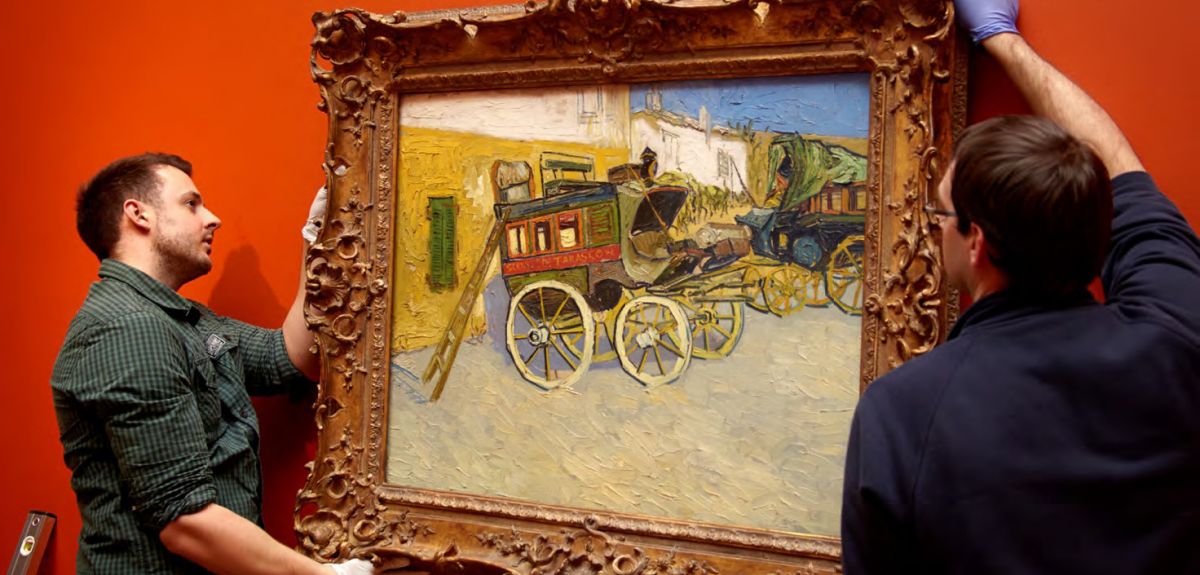
The Ashmolean Museum's new exhibition, Cézanne and the Modern, opens on Thursday and will feature 50 masterpieces of late-19th to mid-20th-century European art from the Henry and Rose Pearlman Collection.
Highlights include Paul Cézanne's Mont Sainte-Victoire, Vincent van Gogh's Tarascon Stagecoach and Amedeo Modigliani's portrait of Jean Cocteau, as well as an outstanding suite of 16 watercolours by Cézanne.
Arts at Oxford was given a behind-the-scenes look at the installation of the new exhibition…
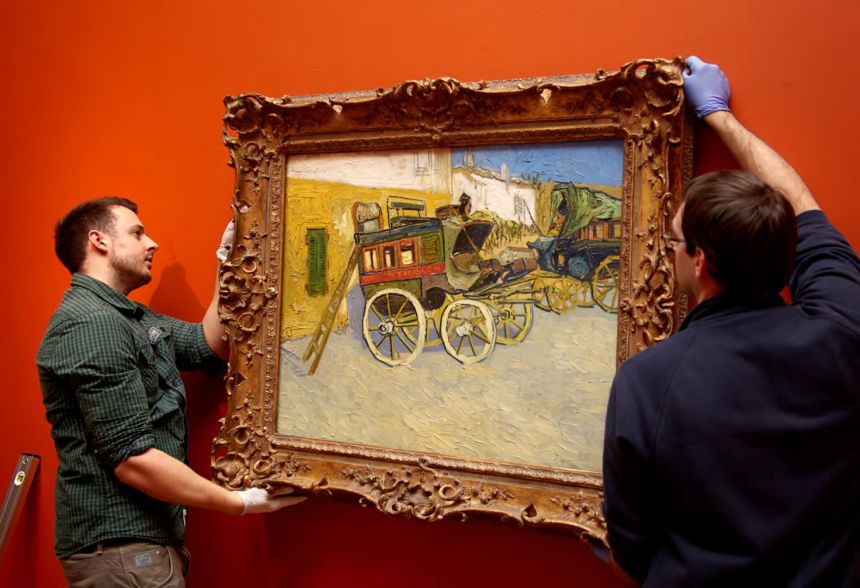 Vincent van Gogh – Tarascon Stagecoach (1888)
This painting of the Tarascon stagecoach was produced in the courtyard of the inn at Arles – probably in a single sitting on 12 October 1888. Vincent van Gogh (1853–90), the Dutch Post-Impressionist painter, spent time living and working in Paris and Arles. He is famous for his vivid use of colour and works filled with emotion. Although his artistic career only lasted for 10 years, he was highly prolific and 864 paintings of his have survived, along with many drawings and prints.
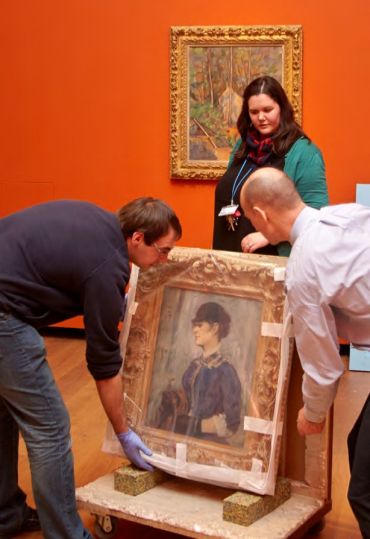 Foreground: Édouard Manet – Young Woman in a Round Hat (1877-79); Background: Paul Cézanne – Cistern in the Park of Chateau Noir (c.1900)
Foreground: Édouard Manet – Young Woman in a Round Hat (1877-79)
Édouard Manet (1832–83) lived and worked in Paris, and many of his most famous works depict Parisian society of the 19th century. At the time his paintings were considered controversial, but they are now considered by many as the starting point for modern art.
Manet often used members of his family and close friends as models in his paintings, blurring the conventional distinction between the portrait and the genre picture. Although clearly painted from life, this striking painting is not a conventional portrait, as the woman's face is hidden by a veil and by the shadow of her hat. She is seen in profile, in outdoor dress, ready to leave the apartment or studio where she is depicted.
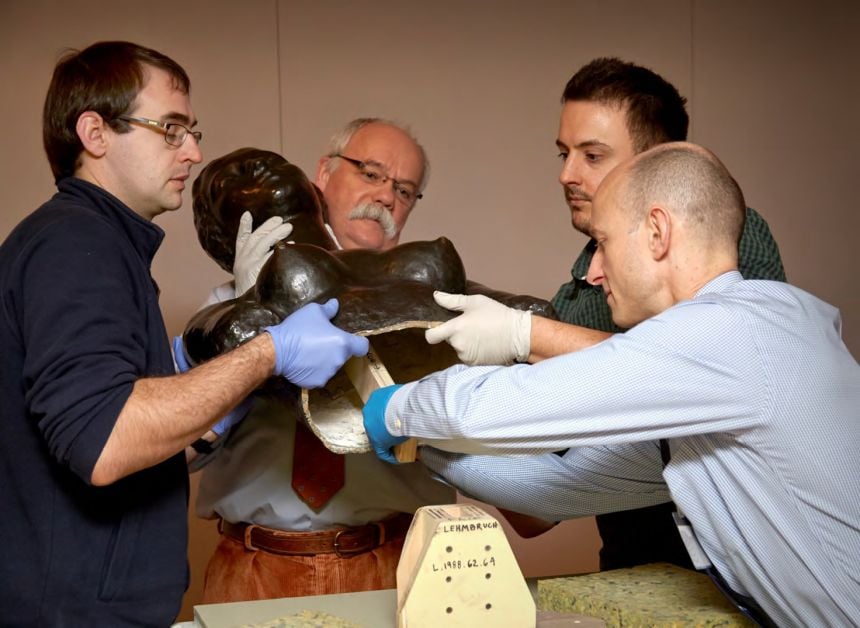 Wilhelm Lehmbruck – Buste von Frau Anita Lehmbruck (1910)
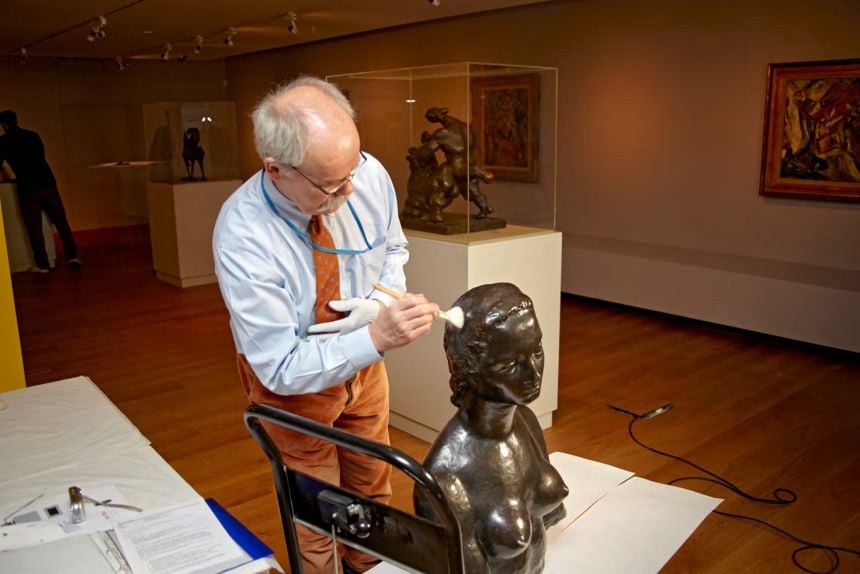 Wilhelm Lehmbruck – Buste von Frau Anita Lehmbruck (1910)
Wilhelm Lehmbruck (1881–1919) was a German sculptor who studied in Düsseldorf and also in Paris. He worked as a paramedic in a military hospital during World War I, and this had a profound effect on his later sculptures. Lehmbruck created this portrait of his wife during their four-year stay in Paris (1910–14).
Cézanne and the Modern: Masterpieces of European art from the Pearlman Collection runs from 13 March to 22 June 2014.
Images © The Ashmolean Museum and The Henry and Rose Pearlman Foundation.
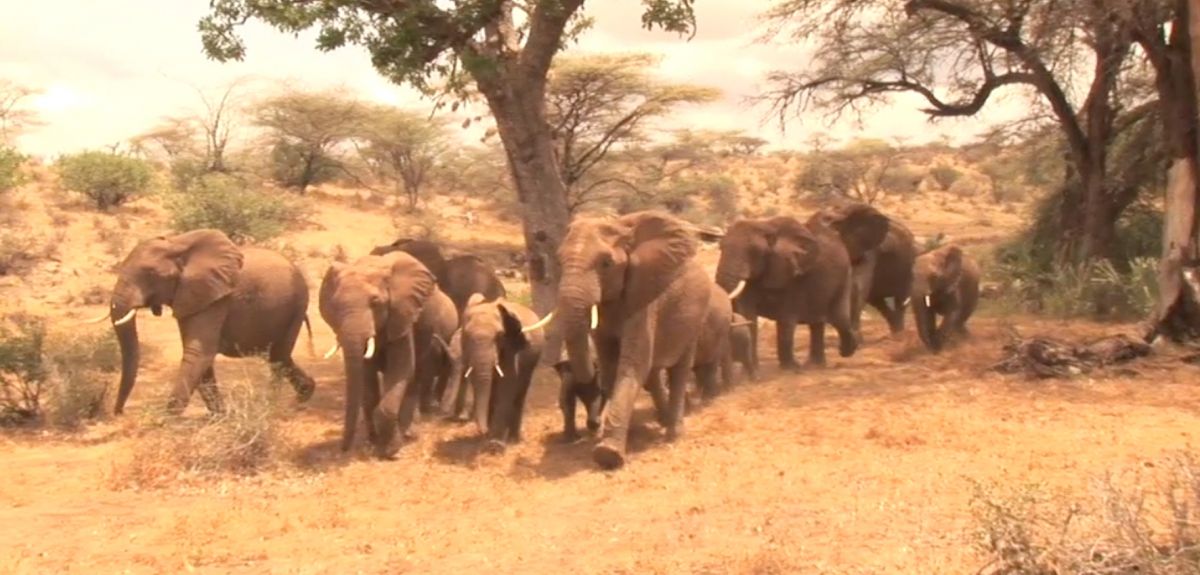
African elephants make a specific alarm call in response to the danger of humans, according to a new study of wild elephants in Kenya.
Researchers from Oxford University, Save the Elephants, and Disney's Animal Kingdom carried out a series of audio experiments in which recordings of the voices of the Samburu, a local tribe from North Kenya, were played to resting elephants. The elephants quickly reacted, becoming more vigilant and running away from the sound whilst emitting a distinctive low rumble.
When the team, having recorded this rumble [listen to the rumble here], played it back to a group of elephants they reacted in a similar way to the sound of the Samburu voices; running away and becoming very vigilant, perhaps searching for the potentially lethal threat of human hunters.
The new research, recently reported in PLOS ONE, builds on previous Oxford University research showing that elephants call 'bee-ware' and run away from the sound of angry bees. Whilst the 'bee' and 'human' rumbling alarm calls might sound similar to our ears there are important differences at low (infrasonic) frequencies that elephants can hear but humans can’t.
'We concede the possibility that these alarm calls are simply a by-product of elephants running away, that is, just an emotional response to the threat that other elephants pick up on,' Lucy tells me. 'On the other hand, we think it is also possible that the rumble alarms are akin to words in human language, and that elephants voluntarily and purposefully make those alarm calls to warn others about specific threats. Our research results here show that African elephant alarm calls can differentiate between two types of threat and reflect the level of urgency of that threat.'
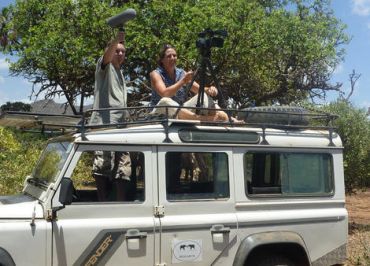 Lucy King and Joseph Soltis film elephants reacting to Samburu voices
Significantly, the reaction to the human alarm call included none of the head-shaking behaviour displayed by elephants hearing the bee alarm. When threatened by bees elephants shake their heads in an effort to knock the insects away as well as running – despite their thick hides adult elephants can be stung around their eyes or up their trunks, whilst calves could potentially be killed by a swarm of stinging bees as they have yet to develop a thick protective skin.
Lucy explains: 'Interestingly, the acoustic analysis done by Joseph Soltis at his Disney laboratory showed that the difference between the ''bee alarm rumble'' and the ''human alarm rumble'' is the same as a vowel-change in human language, which can change the meaning of words (think of ''boo'' and ''bee''). Elephants use similar vowel-like changes in their rumbles to differentiate the type of threat they experience, and so give specific warnings to other elephants who can decipher the sounds.'
This collaborative research on how elephants react to and communicate about honeybees and humans is being used to reduce human-elephant conflict in Kenya. Armed with the knowledge that elephants are afraid of bees, Lucy and Save the Elephants have built scores of 'beehive fences' around local farms that protect precious fields from crop-raiding elephants.
'In this way, local farmers can protect their families and livelihoods without direct conflict with elephants, and they can harvest the honey too for extra income,' says Lucy. 'Learning more about how elephants react to threats such as bees and humans will help us design strategies to reduce human-elephant conflict and protect people and elephants.'
Margi Blunden, daughter of the First World War poet Edmund Blunden, will be remembering her father and his work at the WW1 Poetry Spring School run by Oxford University's English Faculty on 3-5 April 2014.
Margi will recall life growing up with a father deeply affected by the Great War and shed light on his literary achievements. As our living link to this bygone age, Margi will provide a thrilling insight into the man who wrote the autobiographical Undertones of War (1928), hailed as Blunden's greatest contribution to the literature of war.
The Spring School is open to members of the public, particularly those who are seeking to challenge common misconceptions and gain a deeper critical appreciation of Great War poetry. It will bring together world-leading experts, each giving an introductory lecture on the major poets and poems. Speakers will provide reading lists and follow-up exercises for further study.
Other speakers confirmed include: Adrian Barlow, Meg Crane, Guy Cuthbertson, Gerald Dawe, Simon Featherstone, Philip Lancaster, Stuart Lee, Jean Liddiard, Alisa Miller, Charles Mundye, Jane Potter, Mark Rawlinson and Jon Stallworthy.
Aged 19, Edmund Blunden volunteered to join the army, despite winning a place at The Queen's College, Oxford to read Classics. He was commissioned as a second lieutenant and went to France in early 1916 and was eventually demobilised in mid-February 1919. During his service in France and Flanders he spent two years at the front, more than any other well-known war writer. Those two years included some of the most violent and bloody fighting in the war, including the battle of the Somme and the battle of Third Ypres.
His most famous works also include In Concert Party: Busseboom (written 10 years after the war) and The Waggoner (1920). He enjoyed a productive career as an editor, journalist, critic and biographer. Blunden was also instrumental in bringing the works of the war poets Wilfred Owen and Ivor Gurney to publication. Edmund Blunden died at his home on 20 January 1974 aged 77.
The Spring School will be held at the Faculty of English, St Cross Building, University of Oxford on 3-5 April 2014. There are a number of different ticket options, including student, senior, school and single-day rates. See the website for full details.

To commemorate the centenary of the First World War, the Oxford English Dictionary is seeking earlier or additional evidence for a host of WWI-related vocabulary, including 'shell shock', 'demob', 'skive' and 'Sam Browne'. In a guest blog post, Kate Wild, senior assistant editor of the OED, explains further...
The Oxford English Dictionary needs you!
Can you help find earlier evidence for the use of some wartime words?
To commemorate the centenary of the start of the First World War, the OED is updating its coverage of terms relating to or coined during the war.
The First World War had a significant impact on English vocabulary: new words were needed to refer to, for example, new vehicles, weapons, military strategies and trench-related illnesses; words were borrowed or adapted from other languages, especially French and German; and many soldiers’ slang terms were either coined or widely popularized.
For many of these terms, our first quotations are from newspapers and magazines, and we know that there may well be earlier evidence – especially for slang and colloquial terms – in less easily accessible sources such as private letters and diaries.
And just last month, the National Archives released a set of digitized war diaries which might contain valuable evidence of WWI-related vocabulary.
The OED has a long tradition of asking the public to help find evidence of word usage.
Back in the 19th century, the first editor of the OED, James Murray, published lists of words for which he wanted to find earlier or additional evidence, and this type of appeal has continued in recent years, first with the television programme Balderdash & Piffle, and more recently with the OED Appeals website, oed.com/appeals.
Although OED readers and researchers consult a large number of books, newspapers, and online databases, it would be impossible to read or search everything that has ever been written in English.
And given that the purpose of the OED is to show the history of each word in English, the earliest written evidence of a word is very important.
As an example, one of our appeals is for earlier evidence of the term shell shock, for which our earliest quotation is currently the title of a 1915 medical article, ‘A contribution to the study of shell shock.’
This article was written by Charles Samuel Myers, a psychologist who was commissioned in the Royal Army Medical Corps during the First World War.
Some accounts, though, suggest that Myers did not invent the term, but merely popularized it.
Certainly, shell shock sounds like a term that might have been devised by laymen rather than by a medical practitioner, and it is possible that Myers heard it being used by soldiers at the front.
Any earlier evidence of such usage – perhaps from a soldier’s letter or diary – would contribute to our understanding of the term.
A more light-hearted example is the colourful phrase Zeppelins in a cloud or Zepps in a cloud (sometimes also Zeppelins/Zepps in a fog/smokescreen and other variants), meaning ‘sausage and mash’.
Our first example at present is from a 1925 dictionary, Soldier & Sailor Words.
Given that this is a dictionary of slang terms used in the First World War, it seems highly likely that earlier evidence can be found.
This appeal has elicited a number of responses, with suggested quotations from as early as 1915 – though it is possible that there might be something even earlier out there.
For all our appeals, we check the suggested quotations to make sure they are accurate and correctly dated.
The earliest valid quotation is then added to the dictionary entry when it is published in its revised form.
The OED Appeals website always acknowledges those who have submitted usable and verifiable evidence.
The full list of WWI-related appeals can be found at oed.com/appeals.
If you think you might be able to help, please have a look and send in your evidence!
The revised WWI-related vocabulary will be published on OED online during the centenary period.
- ‹ previous
- 173 of 252
- next ›
 What US intervention could mean for displaced Venezuelans
  Setting the agenda for the next century of quantum
 10 years on: The Oxford learning centre making an impact
 Mapping the Moon: the world’s first lunar atlas goes digital
  Oxford and The Brilliant Club: inspiring the next generation of scholars
 New course launched for the next generation of creative translators
 The art of translation – raising the profile of languages in schools
  Opening a window into the quantum world
 Tracking resistance: Mapping the spread of drug-resistant malaria