Features

Oxford graduates are filling senior leadership roles in the new US government.
It is inspiring to see alumni who once took their places in Oxford’s seminar rooms and sports teams called into public leadership
Dr Edward Brooks
Oxford university’s role in educating leaders, who put their academic training to work serving societies around the world, has been underlined as the names of a dozen Oxford graduates are among President Biden’s new administration.
Dr Edward Brooks, who heads the Oxford Character Project, a major research initiative focusing on responsible leadership, argues that universities are important sites of leadership development.
Three of the 25 members of the new US Cabinet, Gina Raimondo, Pete Buttigieg, and Eric Lander are Oxford alumni - as are an array of other senior and junior appointees.
Dr Gina Raimondo (New College, 1993) was the first woman to be Governor of Rhode Island and has been praised for her firm response to the COVID-19 pandemic. She is moving to Washington, having been confirmed as Secretary of Commerce. Dr Raimondo completed an MA and then a DPhil in Sociology, focusing her thesis on single motherhood in the US, evidence of a social concern that has characterised her career.
Pete Buttigieg (Pembroke, 2005) came to public prominence in his bid for the Democrat’s Presidential nomination. Formerly a mayor in Indiana, he is the new Secretary of Transportation. Like many political leaders in the UK, Mr Buttigieg studied Philosophy, Politics and Economics, enjoying a distinguished Oxford career. He was awarded a First, following exam revision on a cargo ship moving freight across the Atlantic. The boat, it seems, afforded a prime environment for distraction-free study.
Professor Eric Lander (Wolfson, 1978), will be leading the newly-created US Office of Science and Technology Policy. A Professor of Biology at MIT, and of Systems Biology at Harvard Medical School, Professor Lander’s student days were spent at Wolfson, where he wrote a DPhil on algebraic coding theory. He has gone on to make landmark contributions to the sequencing of the human genome. As a senior science advisor to President Obama, he made an important public contribution, ensuring the proper use of scientific evidence in criminal justice.
Dr Brooks says, ‘It is inspiring to see alumni who once took their places in Oxford’s seminar rooms and sports teams called into public leadership. And it points to the importance of Oxford’s work to develop responsible leaders who are equipped to lead well in all sectors of society.’
Key to the success of Oxford’s alumni were the Rhodes and Marshall scholarships, from which all of the alumni above benefited
Beyond the US Cabinet, other Oxford graduates have been appointed to senior positions:
Dr William J. Burns (St John’s, 1981) is the incoming Director of the CIA.
Dr Elizabeth Sherwood-Randall (Balliol, 1981) is the new Homeland Security Advisor.
Jake Sullivan (Magdalen, 1998) is the National Security Advisor.
Jonathan Finer (Balliol, 1999) is the Deputy National Security Advisor.
Dr Susan Rice (New College, 1996), the former National Security Advisor, will lead the Domestic Policy Council.
Dr Kurt M. Campbell (Brasenose, 1981) will be Coordinator of Indo-Pacific affairs.
Bruce Reed (Lincoln, 1982) will serve as White House Deputy Chief of Staff.
In President Biden’s wider team are:
Megan Ceronsky (Hertford, 2001), the climate change advisor for the Obama administration, will take up a role in the Office of White House Counsel.
Machmud Makhmudov (Magdalen, 2016), who completed an MPhil in Political Theory in 2018, is serving as a Policy Advisor for the Office of COVID Response. He previously supported the Biden campaign as a Policy Analyst.
At a more fundamental level, it is bound up with the intellectual virtues the university has long sought to instil in its students: the capacity to think deeply and critically, to entertain alternative perspectives, and to undertake creative and generative research
Roger Revell
Key to the success of Oxford’s alumni were the Rhodes and Marshall scholarships, from which all of the alumni named above benefited. Yet Oxford’s contribution to the formation of leaders is not limited to these prestigious initiatives.
At a more fundamental level, says research fellow, Roger Revell, it is bound up with the intellectual virtues the university has long sought to instil in its students: the capacity to think deeply and critically, to entertain alternative perspectives, and to undertake creative and generative research.
It is connected to the array of co-curricular activities, ranging from the debates at the Oxford Union to participation in college and university sport. When it comes to this cadre of Americans, the contribution of sport to leadership development is evident. Rowing, tennis, basketball, baseball, rugby and running all feature.
While writing a prize-winning thesis on Zimbabwean politics, Susan Rice not only rowed for New College but also led the Oxford women’s Blues basketball team to victory over Cambridge. Talking of her development as a leader, she commented, ‘I think my experience as an athlete has shaped who I am in more ways than I can describe. It’s made me strong. It’s made me not fear competition or bruising here and there. But it’s also made me willing to take risks, willing to see the whole court.’
While writing a prize-winning thesis on Zimbabwean politics, Dr Susan Rice not only rowed for New College but also led the Oxford women’s Blues basketball team to victory over Cambridge
More recently, Oxford’s role in equipping future leaders from around the world has found expression in cross-university programmes including the Global Leadership Initiative (GLI) and Global Leadership Challenge.
Machmud Makhmudov participated in the 2018 GLI cohort, joining a diverse group of postgraduate students from around the world in a six-month leadership learning journey. This unique programme aims to help students develop the qualities of character needed to lead in a way that is not merely effective but also responsible - oriented towards the flourishing of all people, the broader thriving of our societies, and the vitality of our planet.
The Oxford Global Leadership and Global Leadership Challenge are initiatives of the Oxford Character Project, an interdisciplinary initiative at the University, funded by the John Templeton Foundation, which focuses on the study and practice of responsible leadership.

By Dr Alessandro Bongioanni, Department of Experimental Psychology
One thing that makes our brain so fascinating is the staggering range of behaviours it allows. We are not just good at doing things in environments we know well (such as shopping at our usual grocery store), but we are surprisingly successful at navigating novel environments (such as scrolling this blog, making new friends, finding a job, etc.).
When I was an adolescent, I went for the first time to the only Thai restaurant in my city. Every single dish in the menu was new for me. I knew oysters, I knew beef, but I had never tried fried beef in oyster sauce before. Still, I was able to make up my mind and speculate that I would probably like the fried beef more than the chicken in coconut soup. This simple anecdote illustrates something bigger: all human progress required people to leave the comfort of a familiar situation and explore new places or new ideas. Today, with social and technological changes accelerating, we are continuously exposed to novel objects and situations and we generally cope very well with them.
If the ability to make adaptive choices in novel situations is so crucial for our human exploits, surely this is a unique ability of our species? Well, no. Animals too are able to adapt to new environments and to express meaningful preferences among objects or situations that they have never encountered before, based on similarities with what they know.
In the last few decades, scientists have understood a great deal about the neural mechanisms for learning the value of things, and for making decisions based on these values. However, by necessity, most neuroscience research is done with animals, and often with monkeys who are our closest relatives. Findings in monkeys allow to get an understanding of what may happen in the human brain as well, in the case of fundamental behaviours that both species display.
To study decisions in monkeys, scientists use very simplified and abstract tasks. All the irrelevant features of the real world are stripped down, to ensure that the neural activity measured is uniquely due to the key decision process. Many classic studies, for example, required binary choices between coloured images on a screen: initially, the blue stimulus gives a larger reward (in the form of fruit juice) than the red stimulus; in the next stage, the stimulus values reverse. Because this is all so abstract and unnatural for the animals, they may need months of training before data can be collected.
With this classic approach researchers discovered that the value estimate of each option is tracked by neurons in the most anterior part of the brain, just above the eyes. We gathered a detailed understanding of how this neural circuit represents the value of each individual item, and how it allows comparing options in order to make choices. But have we learned anything about the way our brain makes choices in our daily lives?
It turns out that if we put a person into an MRI scanner and ask her to make choices based on preferences, a distinct area usually lights up: it is still in the anterior part of the brain, but in the midline, where the two hemispheres face each other. So which one is the key brain area? Because MRI scanners cannot see individual neurons but estimate activity indirectly, for the past decade animal researchers and human researchers have thought that limitations to each others’ techniques have led their colleagues to focus on the wrong areas. But reaching a firm conclusion has been difficult.
A new explanation was put forward by a group led by Matthew Rushworth, professor at Oxford University and fellow of the Royal Society. He thought that different neural circuits may be involved in familiar and novel decision-making. Familiar items have been experienced repeatedly over a long time period and therefore the consequences of a familiar choice may be easily predictable. If, for example, I go to my favourite restaurant and I order my favourite dish, I can feel in advance how the experience is going to unfold. In contrast, novel decisions require constructing “on the fly” a somewhat hypothetical expectation of how the new options may feel like. This is what I did when I went to the Thai restaurant for the first time and I had to choose between fried beef with oyster sauce and chicken in coconut soup.
An experiment run by myself (Dr Alessandro Bongioanni), Dr Miriam Klein-Flügge and others in the Rushworth team, used MRI scans of monkeys to prove that indeed we can identify a specific brain circuit for novel choice; interestingly, its location in the brain corresponds with the one found in human fMRI studies, not previous monkey studies.
This discovery was accomplished thanks to a clever experimental design allowing monkeys to express preferences among items that they had not encountered before: stimuli were made of coloured dots, where colour represented the amount of juice at stake, and dot number the probability of receiving it. Some combinations of dot number and colour were highly familiar to the monkeys, others were new. Neural recordings revealed that it was the different degree of familiarity with the task items that had caused the puzzling mismatch between brain areas activated in humans and monkeys.
The fact that monkeys could solve the novel task quite easily opens new avenues for the study of decision neuroscience in primates: they are more intelligent than they may appear when faced with abstract lab tasks, and if the task is designed carefully, it is possible to elicit and study more complex behaviours than it was previously thought possible, such as choosing among novel options. This also bridges a gap between our knowledge of the human and the animal brains: making novel choices is not a unique human ability, but instead it is rooted in a neural circuit that is already present in our primate cousins.
We did not just find out where in the brain subjective value is computed, we also attempted to find out how this happens. We found that the monkeys mentally located each item offered in the “space” of all possible items (here, dot and colour combinations) and did so using a grid code. It is as if I “placed” the value of a given dish at a location in the space of all possible dishes, where one axis may represent texture, another axis flavour, and then temperature, price, etc.
We know that the brain’s “GPS system” for spatial navigation employs a grid code, the discovery of which led to the 2014 Nobel Prize in Physiology or Medicine to professors O’Keefe, Moser and Moser. Now, our new results suggest that the brain may use the same neural code employed to represent physical position in space, also to represent the value of a novel item in the space determined by the item’s features. This is interesting because it suggests that the mechanisms used by the brain to encode information are evolutionarily preserved and transferred across domains.
As Prof. Rushworth points out: 'It is intriguing to think that mechanisms for finding one’s way in physical space also underlie our ability to navigating an abstract space of choice possibilities.'
In order to validate this result, the same team also tested what happens if one disrupts specifically this small region of the brain. In order to do that, we relied on a newly developed ultrasound technique that permits stimulating deep in the brain without any invasive surgery; such stimulation can reversibly alter brain activity for one or two hours. Ultrasound provided the final proof: when the neural circuit for novel choice was targeted, the animals’ behaviour changed, as if they were no longer able to integrate the different features of a given novel option into a single mental representation.
While ultrasound has been around for a long time in medicine, it is only in the last couple of years that it has been used to modify brain functioning in this way. Jérôme Sallet, who developed the experimental setup in Oxford, says: 'Ultrasound neurotechnologies are offering new possibilities to identify the causal roles of brain areas. It is non-invasive and could be coupled with other techniques used to record brain activity. Beyond pure research, ultrasound stimulation might prove to be also a valuable tool to help patients with pharmaco-resistant conditions such as depression.'
This is because it avoids some limitations of current techniques such as TMS, which cannot reach deep into the brain or stimulate with precision. Other techniques such as DBS are precise but require surgery. Ultrasound may have the ideal combination of depth and precision without the need for surgery.
We never stop learning novel things about the brain, and if you think about it, this is the brain learning novel things about itself!
Read the full paper, which was published recently in Nature.
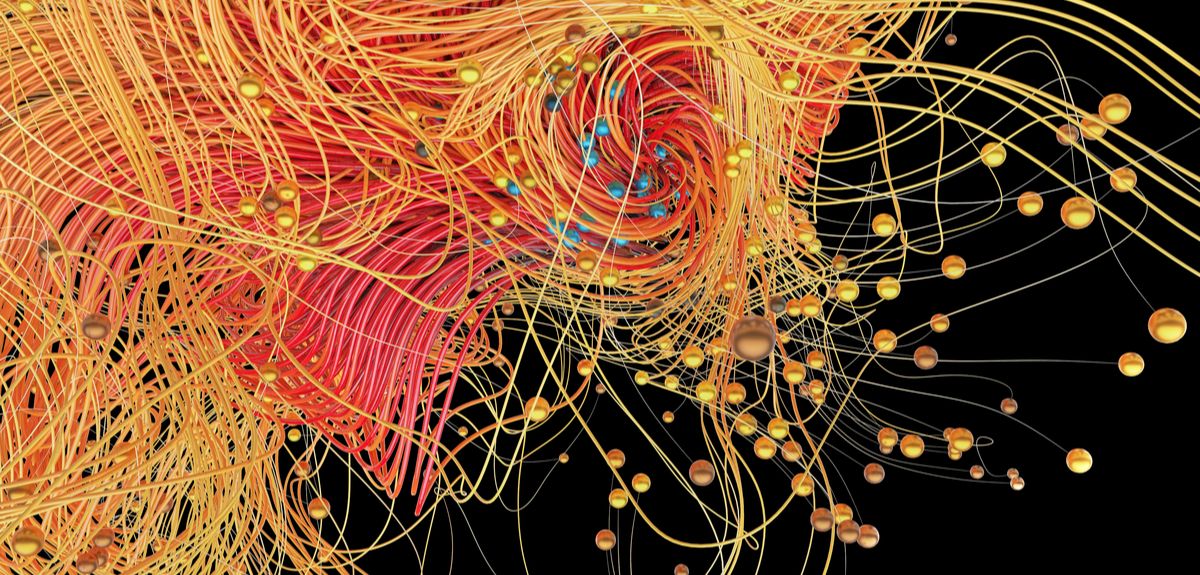
Professor Paolo G. Radaelli
Could rust be the secret to next-gen computing technology? Current silicon-based computing technology is incredibly energy-inefficient and, by 2030, information and communications technology (ICT) is projected to gobble up more than 20% of the global electricity production[1].
After the end of the pandemic, climate change is likely to resume its position as the number one challenge for humanity and finding ways decarbonise tech is an obvious target for energy savings.
Professor Paolo Radaelli from Oxford’s Department of Physics, working with Diamond Light Source, has been leading research into silicon alternatives and his group’s surprising findings are published tomorrow in Nature [4 Feb] but online today.
So just how energy-inefficient are computers? Well, the human brain uses approximately a millionth of the energy required by a computer to perform the same operation. To put that in context, the human brain uses about 12 watts of power, while an equivalent computer would use 12 megawatts: the output of a small power station. However, because of its immense success and ubiquitous nature, it is very difficult to replace silicon technology.
The human brain uses about 12 watts of power, while an equivalent computer would use 12 megawatts: the output of a small power station
The promise of oxide electronics
Researchers have been working for a long time on alternative technologies which might afford greater efficiency. Oxides of common metals, such as iron and copper, are natural targets for this research – not least because oxides are already a technology staple and are present in silicon-based computers, so there is a high chance of compatibility between the two technologies.
 Credit: Shutterstock.
How realistic are the prospects of using ‘rust’ in super-efficient computers? We are optimistic
Credit: Shutterstock.
How realistic are the prospects of using ‘rust’ in super-efficient computers? We are optimistic
The kinds of bits we are talking about here must be tiny – ten nanometres (ten billionths of a metre, about 20 times the diameter of an atom) is the typical target figure. And it must be robust even when ‘shaken and stirred’. This is very challenging, because the risk of them being simply dissipated away is very high when the bit is small. One possible solution came from the most unlikely of directions: a curious parallel between solid-state physics and cosmology. In fact, the inspiration for this project was set in the form of a challenge: can we replicate cosmic strings in a magnet?
So what are cosmic strings – and do they even exist? Cosmic strings are supposed to be filaments in space, much thinner than an atom but potentially as long as the distance between stars. But do they exist? Certain cosmological theories predict that they could have formed instants after the Big Bang, as the universe was cooling rapidly. Interestingly, once formed, cosmic strings would be stable and would not ‘evaporate’, so astronomers may be able to discover them in the future.
Cosmic strings are supposed to be filaments in space, much thinner than an atom but potentially as long as the distance between stars
But what do cosmic strings have to do with computers? The relevance comes from the fact that the mathematical description of cosmic strings is rather simple, and the same kind of mathematical conditions that favour the formations of strings may be found in many other physical systems, including magnets. It is the beauty of physics: mathematical equations describing the ‘macrocosm’ at parsec scales may also work in the microcosm at nanometre scales. With the challenge set, all that remained to do was to find a suitable magnet. Once again, the candidate turned out to be most unlikely: common rust.
It is the beauty of physics: mathematical equations describing the ‘macrocosm’ at parsec scales may also work in the microcosm at nanometre scales...all that remained was to find a suitable magnet...the candidate turned out to be most unlikely: common rust.
Rust to riches
Iron oxide (chemical formula Fe2O3) is a main constituent of rust. Each iron atom acts as a tiny compass, but this particular form of Fe2O3 is not magnetic in the ordinary sense of attracting and being attracted by other magnets: it is an antiferromagnet, so that half of the Fe compasses point ‘north’ and the other half ‘south’.
Two years ago, working at the Diamond Light Source on samples produced at University of Wisconsin, Madison, our Oxford group had already discovered the magnetic equivalent of cosmic strings in Fe2O3, and imaged them using a powerful X-ray microscope.[2]
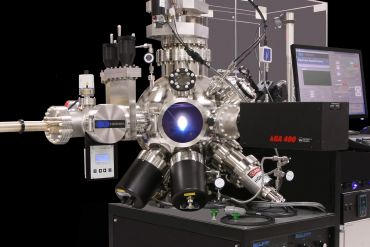 P180 laser MBE
For the paper published today, we extended our collaboration to the National University of Singapore and managed to find the key to create and destroy magnetic merons at will, exploiting the mathematical equivalent of the ‘Big Bang cooling’.
Back to the future
This is undoubtedly fascinating basic research, but how realistic are the prospects of using ‘rust’ in super-efficient computers? We are optimistic. Though very simple in architecture, the Fe2O3-based device, where merons and bimerons were found, already contains all the ingredients to manipulate these tiny bits quickly and efficiently – by flowing a tiny electrical current in an extremely thin metallic ‘overcoat’. Indeed, controlling and observing the movement of merons and bimerons in real time is the goal of a future X-ray microscopy experiment, currently in the planning phase.
How realistic are the prospects of using ‘rust’ in super-efficient computers? We are optimistic.
When moving from basic to applied research, cost and compatibility considerations are also of paramount importance. Iron oxide itself is extremely abundant and cheap, but the fabrication techniques employed by colleagues at Singapore and Madison are rather complex and require atomic-scale control. Here again, we are optimistic. Very recently, they demonstrated that is possible to ‘peel off’ a thin layer of oxide from its growth medium and stick it almost anywhere, its properties being largely unaffected. Next steps? Design and fabrication of proof-of-principle devices based on ‘cosmic strings’ to follow in short order…

Oxford study shows deaths of environmental activists affect companies' share prices.
More environmental activists have been killed since 2002 than UK soldiers in war zones. But, the truth is, murder is very bad for business, according to new research from an international team including Oxford economics professor Nathaniel Lane, which shows financiers steer clear of firms linked to deaths.
More environmental activists have been killed since 2002 than UK soldiers in war zones. But, the truth is, murder is very bad for business, according to new research from Oxford, which shows financiers steer clear of firms linked to deaths
Having studied the impact of more than 350 assassinations over a 20-year period, linked to mining and minerals sector, the researchers have found the murder of activists has had a significantly detrimental effect on the share price and business of multi-nationals which have been ‘named and shamed’, causing multi-million-pound losses.
In the pre-print study, The Value of Names – Civil Society, Information and Governing Multinationals on the Global Periphery, the team argues, ‘The natural resource industry is a stark example of the tension between society and multinational power. Home to some of the largest global firms, the sector is a flashpoint across the developing world.’
According to Professor Lane, 'Indeed, the point is that we see that human rights reporting and reporting around these events is impactful. In a realm where there is little formal accountability, the work of journalists and civil society can truly impact a firm’s bottom line.'
In a realm where there is little formal accountability, the work of journalists and civil society can truly impact a firm’s bottom line
Around the world, there has been ‘a rising trend in violence towards environmental activists....Specifically, the killing of activists connected to natural resource activity’. The report focuses on such assassinations in the global mining sector, since it is ‘one of the most deadly for activists’. But it also a sector which involves substantial investment, with many firms traded on international stock markets.
According to the report, ‘First, we consider killings that are publicly reported in media or human rights campaigns. Second, we consider events where reporting connects a victim (or victims) to local mining and mineral extraction activity. Third, we then code the location where the death occurred. Fourth, we code the mining companies or projects named (if any) in relation to the event.’
The team says, ‘Our study estimates how publicity surrounding activist assassinations impacts the stock prices of multinationals. Specifically, the mining companies—and their operations—named in international media coverage of these events....
‘Doing so allows us to explore how markets respond to news of violent events surrounding their operations.’
The researchers look at the share prices of companies ‘named’ in human rights’ reporting and international news coverage, without any judgement on the accusations. The examine how firms performed relative to their normal market performance, and also looked at how such corporations fare compared with companies which have not been connected in adverse publicity.
The report reveals, ‘On days leading up to assassinations, we find no evidence of abnormal returns for these companies. Importantly, after the event, we see significant, negative abnormal returns for “named” firms. Significant negative effects appear the day after a killing, and grow steadily for up to ten days after.’
On days leading up to assassinations, we find no evidence of abnormal returns for these companies. Importantly, after the event, we see significant, negative abnormal returns for “named” firms. Significant negative effects appear the day after a killing, and grow steadily for up to ten days after
The involvement of the media and their role in publicising events is key to the public scrutiny of firms and negative publicity once acquired can have a long lasting impact, ‘Companies named in news of assassinations have significant, negative abnormal returns directly following the assassination date–effects which accumulate through time.’
In busy news periods, the researchers found, the impact was not as great. But investors clearly take a close interest in events, ‘Our work suggests that the tools of civil society may help diminish returns to corporate misbehaviour in the developing world.’
The report shows that companies connected to events through publicity were estimated to see their market capitalisation fall by as much as $100 million
The report shows that companies connected to events through publicity were estimated to see their market capitalisation fall by as much as $100 million. The report states, ‘The informational strategies of international civil society impacts the bottom line of multinationals connected to the killing of activists.’
The researchers compared the impact on companies operating in the same vicinity and those which have been explicitly ‘named and shamed’, ‘We find that firms and operations in the vicinity event—though not named in media—are not penalised, relative to those whose operations are specifically named in publicity.’
Research has already been published, showing that ‘markets’ react negatively to bad publicity surrounding businesses. Fraud, insider dealing, environmental, social and governance issues have all been shown to be bad for business.
The researchers believe this is the first time that assassination has been directly linked with negative financial impacts
But the researchers believe this is the first time that assassination has been directly linked with negative financial impacts, ‘To the best of our knowledge, this is the first empirical study that shows that international stock markets react—dare we say penalise—companies operating in association with high profile human rights abuses. In our case, mining companies operating proximate to assassinations of civil society activists...
‘Though preliminary, our findings hint that the publicity strategies of human rights groups, which organise around and place a spotlight on such high-profile episodes, may have some bite. Specifically, by revealing information to international markets. Even where formal justice is rare, these strategies may nevertheless have impact.’
The report concludes, ‘Our findings show that informational campaigns by civil society have in fact an impact on multinational corporations and being linked to human rights abuses can significantly influence an associated companies’ stock market value.’

Dr Tessa Roynon
The US Capitol in Washington DC has been much in the public eye in recent weeks. Whether stormed by President Trump supporters on 6 January, or as the ‘hallowed ground’ that formed the backdrop to President Biden’s inauguration two weeks later, the gleaming perfection of its neoclassical architecture is an unquestioned part of its iconic status.
By contrast, in The Classical Tradition in Modern American Fiction, I take a more quizzical and, at times, sceptical approach to the American love affair with ancient Greece and Rome - and a long, hard look at American novelists’ predilection for classical allusion.
 It asks what is at stake when seven key fiction writers of the 20th/21st centuries: Willa Cather, F. Scott Fitzgerald, William Faulkner, Ralph Ellison, Toni Morrison, Philip Roth, and Marilynne Robinson, refer to the work of Aeschylus, or Homer, or Virgil, or Ovid, in their explorations of modern identity and experience.
We tend to be far too reverential when faced with allusions to Greek and Roman literature...We tend to assume that such references bestow an immediate and universal authority...We are unthinkingly impressed
The project grew out of my perception, as a reader and a teacher, that we tend to be far too reverential when faced with allusions to Greek and Roman literature, myth, history or visual art. We tend to assume that such references bestow an immediate and universal authority on a text. We are unthinkingly impressed.
My own conviction is that we need to pay close attention when modern writers invoke the ancient past, because they often reach for distant heroes and stories in order to discuss some of the most pressing ideological issues of their (and our) times.
F. Scott Fitzgerald, for example, is obsessed in his fiction with a decadent and ultimately fallen ancient Rome, and he uses this motif to bolster a nativist and anti-immigrant conception of Americanness.
Willa Cather, in Sapphira and the Slave Girl, added many of her classical allusions and framing devices in a very late re-drafting stage - almost as an afterthought, she distorts the realities of slavery and racial injustice through deploying ‘Old Southern’ nostalgic and heroic tradition.
And Philip Roth disguises a visceral misogyny as ‘masculinity’, in his much-feted novel The Human Stain, through the repeated association between his protagonist, Coleman Silk, and Zeus. In Ovid’s Metamorphoses, which Roth frequently invokes, Zeus is a voracious rapist, but Roth attempts to use him to shore up the sense of Coleman as virile hero.
Why do we tend to be such un-alert or acquiescent readers when it comes to antiquity?...we do not study Latin, Greek, or classical civilization at school
Why do we tend to be such un-alert or acquiescent readers when it comes to antiquity? One reason is that nearly all of us are hazy on the details, because we do not study Latin, Greek, or classical civilization at school. A working knowledge of the classical tradition appears now, for the most part, the preserve of an elite minority. If we are not exactly sure who Trimalchio, Hector or Leda is, when these canonical American writers call them up, we are most likely to nod our heads nervously and move quickly on.
The Classical Tradition in Modern American Fiction sets out to counter this process by insisting that the classical past is accessible to all. Complete with its own glossary of every classical name and concept discussed, as well as a guide to the best among the numerous online-resources, it is underpinned by my sincere conviction that all we need to do, when faced with an unfamiliar Greek or Roman term, is the blindingly-obvious: ‘look it up’.
My conviction is deeply-held for two reasons. First, in teaching these authors to my students over the years, I realised nearly all of them felt excluded from the entirety of classical culture. They needed encouragement to look things up but their confidence grew when they did. Second, I was inspired by my research into these each of these writers’ intellectual formation.
All we need to do, when faced with an unfamiliar Greek or Roman term, is the blindingly-obvious: ‘look it up’
In order to understand how they encountered the ancient world, I consulted archives and prior scholarship to understand how and where each studied, how they accessed the classical tradition, what they had read and what they thought about the reading that they had done.
Their contrasting backgrounds and experiences are striking. In the 1890s, Willa Cather studied Latin and Greek to a high level at the University of Nebraska in Lincoln. Philip Roth was highly-educated, including undertaking graduate studies at Chicago, but he never studied the classical languages. Marilynne Robinson has a PhD in English, but studied Latin at high school. Toni Morrison was a Classics minor at Howard. Meanwhile, neither Fitzgerald, Faulkner nor Ellison even completed their undergraduate degrees.
The time period which my chosen authors span, Cather was born in 1873, and Robinson (the only one still living) was born in 1943, encompasses a series of different eras in which classical traditions were variously significant: fin-de-siecle decadence, modernism, liberal humanism, the Great Books tradition and the culture wars of the 1980s. Yet, despite these novelists’ widely diverging contexts, and their widely diverging levels of formal education, they have in common an unqualified passion for reading, and a voracious auto-didacticism.

For me, encountering first-hand the annotations Ralph Ellison made, very often about African American life - in the margins of his translations of Aeschylus, was an unforgettable thrill. Ellison, born in 1913 in Oklahoma City, was so impoverished when he began his undergraduate degree at the Tuskegee Institute in Alabama that he rode ‘hobo’ on trains through the 1930s’ Deep South, to get there. His commitment to his own education, the extraordinary number of books he read, in numerous fields and his stalwart belief in the significance of the classical tradition to his own and to black American life, is a humbling and inspiring example I shall never forget.
Dr Roynon is a Senior Research Fellow at Oxford's Rothermere American Institute.
The RAI is hosting a webinar book launch on 11 February to which all are welcome.
Register in advance at this link: https://zoom.us/webinar/register/WN_1wCpXBqbRa-w7NkDdwSgvA
- ‹ previous
- 30 of 252
- next ›
 What US intervention could mean for displaced Venezuelans
  Setting the agenda for the next century of quantum
 10 years on: The Oxford learning centre making an impact
 Mapping the Moon: the world’s first lunar atlas goes digital
  Oxford and The Brilliant Club: inspiring the next generation of scholars
 New course launched for the next generation of creative translators
 The art of translation – raising the profile of languages in schools
  Opening a window into the quantum world
 Tracking resistance: Mapping the spread of drug-resistant malaria