Features

An Oxford University professor will be taking Radio 4 listeners on a journey through the history of the concept of infinity for the next fortnight.
Philosopher Professor Adrian Moore will present a 15-minute programme at 1.45pm from Monday to Friday this week and Monday to Friday next week.
In today’s episode of A History of the Infinite, Professor Moore explores why the idea of infinity made the Ancient Greeks so uncomfortable.
Oxford University academics contributing to the programmes include Ursula Coope, Professor of Ancient Philosophy, Cecilia Trifogli, Lecturer in Medieval Philosophy, and Professor Richard Sorabji, Honorary Fellow of Wolfson College.
Professor Moore says: 'This series is based on my book The Infinite (Routledge, 2nd edn 2001). The first four programmes are concerned with the remarkable turnaround between the time of the early Greeks, when various puzzles and paradoxes associated with the infinite had made it an object of abhorrence and distrust, to the early modern period, by which time it had come to be associated with the divine and had become an object of veneration and awe.
'In the next three programmes listeners are introduced to some of the extraordinary mathematical results concerning the infinite, including the discovery that some infinities are bigger than others.
'In the final three programmes attention shifts to the cosmos and our place in it. I consider questions about the age and size of the universe, about death and immortality, and about our basic urge to seek meaning for our lives in something infinitely greater than us.'
All programmes will be available to listen to or download from the BBC website over the next month.

Many academics have recently come back to Oxford after a summer holiday. But Professor Liz Frood’s return to work (part-time) as Professor of Egyptology last week is a much more remarkable story.
Professor Frood contracted sepsis in August 2015. Her cousin Jane Wynyard picks up the story: ‘She spent ten days in the ICU, five months in hospital, had her legs amputated below the knees, lost her hearing in one ear, her nose collapsed and her hands were damaged almost beyond repair,’ she says.
This left Professor Frood severely disabled, with both legs amputated, no dexterity in my hands, partial deafness, and a reconstructed nose.
Miss Wynyard adds: 'Before Liz’s illness, none of our family had ever heard of sepsis or understood the life-changing and devastating effects this terrible infection could have.
‘In just one year, Liz has totally inspired and humbled us with her amazing will to survive and courageous battle to live a normal life despite her terrible injuries. Her bravery and determination have been matched by the incredible work of the NHS staff, doctors, surgeons and specialists whom we will always be indebted to for saving Liz.’
Some of Professor Frood’s family and friends set off today (Friday 9 September) on a bike ride beginning at the Ashmolean Museum and due to end in Cardiff. They are due to arrive in Gloucester this evening after completing the arduous first stage of their trip.
‘It’s been brilliant so far,’ Professor Frood reports. ‘We had a great send-off! The cyclists have been riding through gorgeous countryside, which seems to have them all very excited.’
The team, called the Dons of Oxford, hopes to raise awareness of sepsis and to raise money for the UK Sepsis Trust. They would welcome donations here.
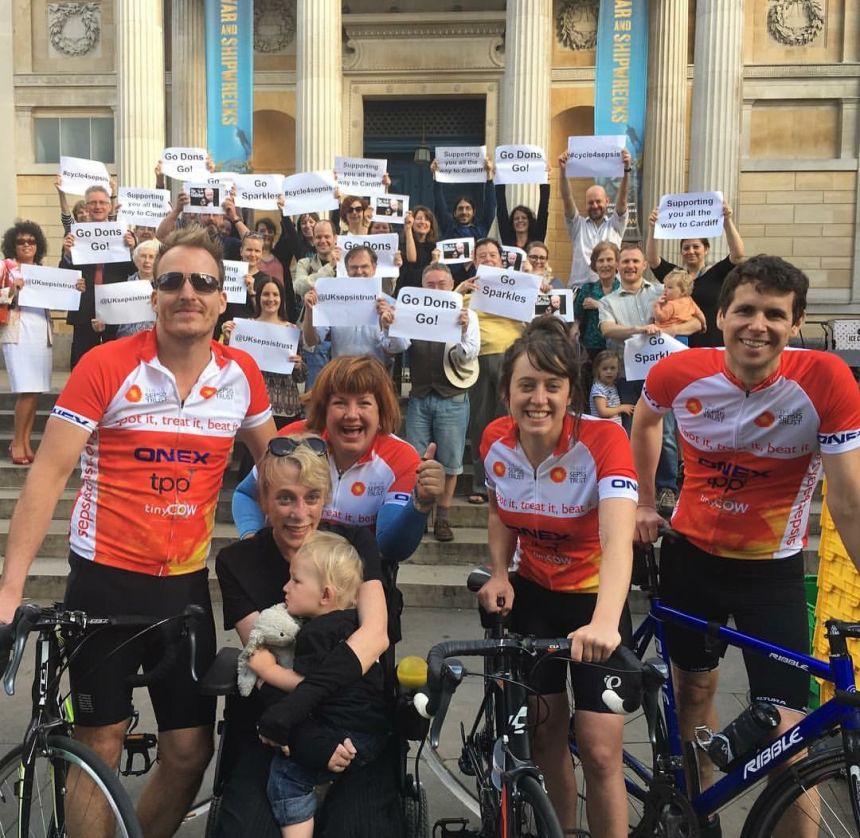 'The Dons of Oxford' cycling team, with Professor Frood (front), set off from Oxford
A little over a year ago, Professor David Macdonald of Oxford University's Wildlife Conservation Research Unit (WildCRU) spoke of his desire to harness the global interest in the killing of Cecil the lion, creating a movement rather than simply a moment.
That journey continues this week with the Cecil Summit, a workshop held in Oxford that will bring together leading figures from across the world to consider future initiatives to preserve the African lion.
The summit will culminate in a free public event on Wednesday 7 September at the Blavatnik School of Government in which anyone interested in conservation will be able to hear the thoughts of top lion experts, as well as a variety of innovative thinkers from fields as diverse as economics, development, international relations and ethics.
The discussion, to be introduced with an illustrated talk by Professor Macdonald, will be chaired by Alan Rusbridger, Principal of Lady Margaret Hall, Oxford and former editor of The Guardian. It will take place from 5pm to 7pm. The summit follows more than a year of sustained interest in the story of Cecil, who was killed by a big game hunter outside Hwange National Park, Zimbabwe on 2 July 2015. Researchers from WildCRU were studying and tracking Cecil and his pride as part of their lion conservation research.
Professor Macdonald, the founding Director of WildCRU, explained the context for the summit: 'Lions, arguably the most iconic species in the world, are doing badly. That understatement captures the shocking fact that wild lions nowadays roam in only 8% of their historic range. Last year, researchers from WildCRU and Panthera, the big cat charity based in New York, published the finding that whereas a hundred years ago it is widely thought there were about 200,000 lions, today there are closer to 20,000.
'Against this distressing but widely ignored background, suddenly everything changed with the killing of Cecil, a fascinating elderly male Zimbabwean lion that WildCRU had been satellite tracking since 2008. Cecil's death prompted unprecedented media interest globally, and so with the world's attention focused on lions, WildCRU and Panthera resolved to hold the Cecil Summit with the purpose of asking whether the morbid trajectory of the lion's fate could be reversed, breaking the mould of conservation by seeking new, innovative approaches from beyond the realms of dedicated field biologists.'
The summit is a joint venture between Oxford and Panthera, whose President Luke Hunter said: 'The tragedy of Cecil's death spurred a unique sea change moment for global awareness of the lion's precarious state. But over a year later, the species is still in freefall in many places. The lion is running out of time.
'We hope that the Cecil Summit's brain trust of conservationists and innovators can spur a new infusion of support for African governments and people working to save the magnificent African lion.'
Speaking from WildCRU's centre at Tubney House near Oxford, Professor Macdonald said: 'In my experience, this summit is unique: we take 30 innovative minds, present them with a new problem, mix them with some conservation specialists, shake and stir, and hope for a breakthrough. It may work, it may not, but at least we will have tried. We'll have grasped the unique Cecil moment and challenged ourselves to find a new way ahead for the Cecil movement.
'Perhaps the unique feature of our approach, forcing inter-disciplinarity between those who know about lions and those who know about delivering high-level change to the human enterprise, will itself become a way ahead in conservation: the Tubney Format!'
He added: 'We believe that the more brains are involved the better, which is why we've arranged a public session in which Alan Rusbridger will lead a conversation with such guests as Rory Stewart, the UK's Minister for International Development; Achim Steiner, Director of the Oxford Martin School and recently head of the United Nations Environment Programme; Wilson Mutinhima, the Director General of Zimbabwe's National Parks; Craig Packer, the world's leading lion biologist; and Tom Kaplan, WildCRU's patron and the greatest benefactor in history to big cat conservation.'
The Cecil Summit's public event will take place at the Blavatnik School of Government from 5pm UK time on Wednesday 7 September. Attendance is free, but booking is required via the Oxford University website. The event will also be live-streamed on WildCRU's YouTube channel.
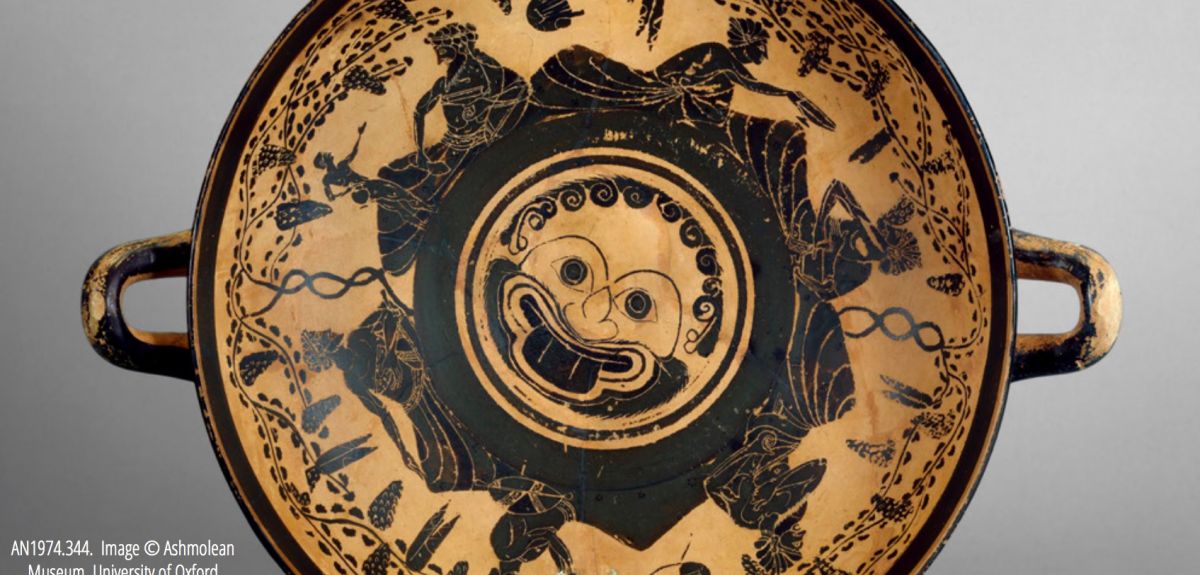
Oxford academics have teamed-up with an animator to bring ancient Greek vase scenes to life.
The images on this 2,500-year-old vase have been animated to show what life was like in ancient Greece.
The Classics in Communities project, which is led by Mai Musié of Oxford University to encourage the teaching of ancient languages like Latin and Greek, has teamed up with the Panoply Vase Animation Project following an award from the Oxford University Knowledge Exchange Fund.
The animation is freely available to watch online, and its creators hope it is used by teachers and lecturers to support their teaching of topics related to ancient Greece.
The video can be viewed here.
'Our animation features a cup that would once have been used at ancient drinking parties 2,500 years ago,' says Dr Sonya Nevin, co-director of the Panoply Vase Animation Project.
'The cup's decoration comes to life in the animation, with a scene of drinking, chatting, and playing music and games now acted out before your eyes.
'We hope it will be used by teachers, students and anyone else who has an interest in seeing classical history brought to life.'
The project is the latest initiative by Classics in Communities, a project involving Oxford University, the Iris Project, and Cambridge University.
'Our aim is to promote the teaching of Latin and Ancient Greek at state schools in the UK,' says founder Mai Musié of Oxford University’s Faculty of Classics.
'This animation is just the latest way in which we hope to engage teachers and students in these fascinating subjects.'

It probably isn't surprising to read that pharmaceutical drugs don't always do what they're supposed to. Adverse side effects are a well-known phenomenon and something many of us will have experienced when taking medicines.
Sometimes, these side effects can be caused when a drug hits the wrong target, binding to the wrong protein. However, the difficulty of tracking this process means that little research has been carried out.
Now, a new study led by scientists at the University of Oxford and published in Nature Chemistry has shown how a series of anti-HIV protein inhibitor drugs can interfere with the processing of a protein known as prelamin A, essential for maintaining the shape of human cells and directly related to ageing.
The researchers used mass spectrometry – a long-established way of identifying molecules by measuring their mass – to observe directly the drugs' 'hitchhiking' on the wrong protein.
Professor Dame Carol Robinson of Oxford's Department of Chemistry, corresponding author on the paper, said: 'The "hitchhiking" of drugs on incorrect targets is a common problem but isn't much studied, as it can be difficult to observe directly. You have to know which proteins to look for, and only then can you target these proteins for further research.
'The results of this study surprised us, as the drugs target HIV proteases and were not thought to bind the human metalloprotease that is involved in processing prelamin A.'
The researchers found that the anti-HIV drugs lopinavir, ritonavir and amprenavir each blocked the processing of prelamin A.
Professor Robinson added: 'The association between some anti-HIV drugs and premature ageing has been suspected for some time through observation of patients undergoing treatment, but it hasn't been proved at the molecular level. There have also been other highly publicised drugs with off-target protein side effects, including an anti-diabetes drug that caused heart attacks in some patients.
'Now that we have developed this mass spectrometry-based approach, we anticipate that it will have widespread application, since it is likely that many drugs that are designed with a specific target in mind end up hitchhiking on other protein targets. It could even be used during the drug development process to determine if drugs are binding to the wrong targets at the molecular level.'
- ‹ previous
- 119 of 252
- next ›
 What US intervention could mean for displaced Venezuelans
  Setting the agenda for the next century of quantum
 10 years on: The Oxford learning centre making an impact
 Mapping the Moon: the world’s first lunar atlas goes digital
  Oxford and The Brilliant Club: inspiring the next generation of scholars
 New course launched for the next generation of creative translators
 The art of translation – raising the profile of languages in schools
  Opening a window into the quantum world
 Tracking resistance: Mapping the spread of drug-resistant malaria