Features
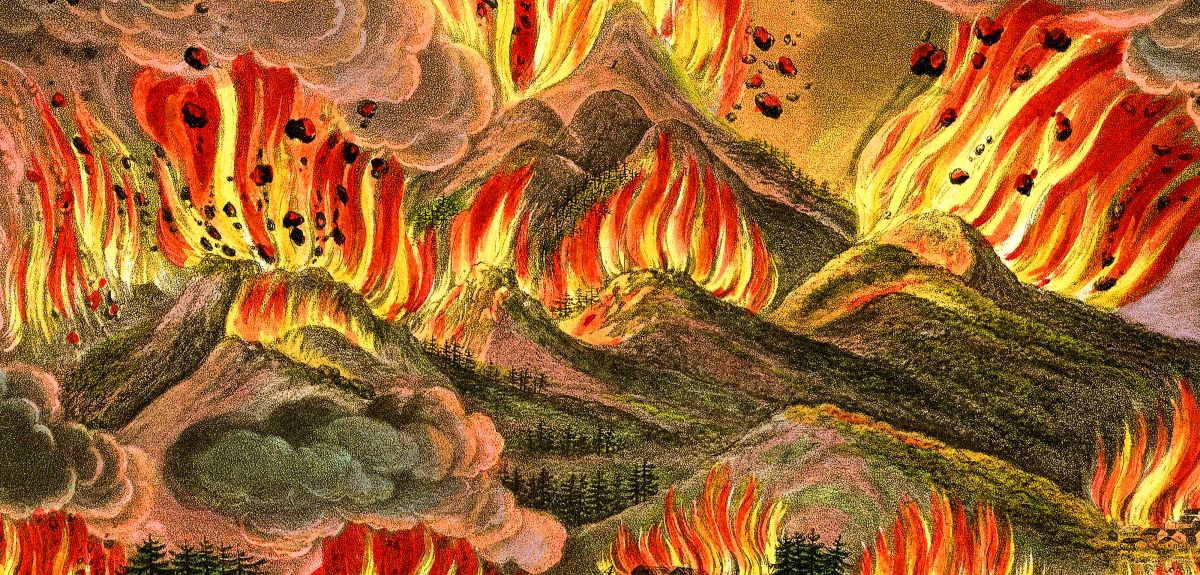
Few might connect volcanic eruptions with the Nineteenth century arts and weather change, but with its varied collection of artefacts, Volcanoes, the captivating exhibition currently running at Oxford’s Bodleian Weston Library hopes to change that. ScienceBlog met with Professor David Pyle, volcanologist and the exhibition’s curator, to find out more about how he is challenging people’s perceptions of volcanoes, and how they impact the world around us.
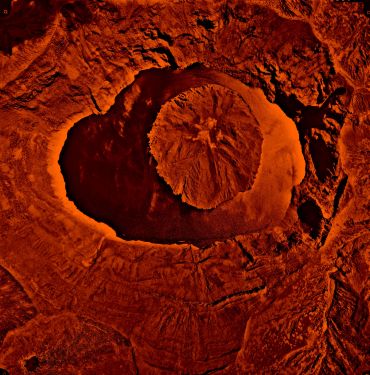 Summit crater photo of St Vincent
False colour air photo of the summit crater of St Vincent in April 1977. The crater contains a lava dome that was extruded into the lake in 1971.
Image credit: Bodleian Libraries, University of Oxford
What was the inspiration behind the exhibit?
About three years ago, Richard Ovenden, who is now the Bodleian’s Librarian, and Madeline Slaven, Head of Exhibitions floated the idea of doing something on the theme of volcanoes. This sounded like an exciting opportunity and we took it from there.
On a personal level, my work tends to focus on the geology of volcanoes, but recent projects in Santorini, Greece and St Vincent in the Caribbean, have looked at other records of volcanic activity. People’s stories and official accounts of the effects of volcanic eruptions tend not to be included in formal science evaluations, but they can tell us a lot about their human impact. The exhibition was as a great opportunity to share this perspective and surprise people.
What kind of insights can these records offer?
The colonial records of the St Vincent eruption of 1902 are extraordinary. One thing the colonial government was good at was keeping records, and this includes correspondence between the Governor, Chief of Police and other high level officials in London. The detail you can extract from official first-hand accounts, in terms of what actually happened, and how the eruption impacted communities, opened my eyes to the wealth of information available on how people have coped with and responded to volcanic activity in the past.
Instead of just focusing on explorers’ experiences we have included elements that shed light on tourists’, travellers’ and everyday people’s encounters with volcanoes – even those who came across them by accident.
How did you decide what to include?
I looked through around 400 objects in total, and the final exhibition features 80. Everyone had a role to play, and I spent three years burrowing through the Bodleian archives.
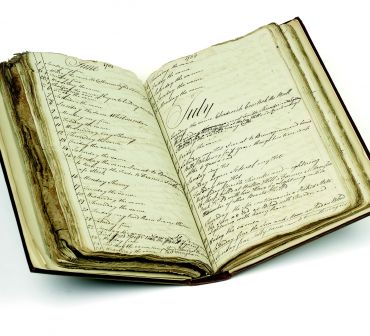 William Dunn weather diary
Image credit: Bodleian Libraries, University of Oxford
William Dunn weather diary
Image credit: Bodleian Libraries, University of OxfordWilliam Dunn’s diary for July 1783, recording the ‘putrid air’ across England following the eruption of Laki, a volcano in Iceland. It was only later, in the 1800s, that scientists began to understand the relationship between major volcanic eruptions and freak weather conditions that can occur hundreds of miles away from the site of the eruption.
As a volcanologist, I was in my element and found the volume of material incredible. Handling old books and manuscripts evokes a tangible connection between you, now and then, it’s an immense privilege to hold an object with such tremendous history.
I’m not sure what other people expect when they come to an exhibition called volcanoes, but I imagine people would envision vivid colours and descriptions of violent eruptions. The vivid colours are carried through the exhibition in its design, but the arts’ pieces selected show that volcanoes have had an entirely different impact socially. Instead of just focusing on explorers’ experiences – which are well documented, we have included elements that shed light on tourists’, travellers’ and everyday people’s encounters with volcanoes – even those who came across them by accident.
Can you tell us about the structure of the exhibition?
There are 10 differently sized cases in the exhibition - small, large, long, 3D etc. Of course we have the Bodleian’s printed materials (books and manuscripts etc.) and physical rock samples from the Museum of Natural History, but it also features things that you might not expect; Victorian poetry, art, film posters, match box lids and even tourist trinkets.
Which display are you most pleased with?
The volcano weather exhibit surprises people. An eruption takes place thousands of miles away, but its impact is often felt across the globe, through climate change. From fiery sunsets, to torrential storms, they have had great impact on the weather of the natural world. On the one hand there is the devastating immediate impact on the people living around the eruption, but the effect socially, on the other side of the world was entirely different, and often quite sublime.
An after effect of the eruption of Mount Krakatoa in 1883 were spectacular sunsets across Europe. These sunsets were the inspiration for some of the most celebrated poetry of the time, such as Tennyson and Gerard Manley Hopkins, and stunning watercolour paintings.
People might not connect art and volcanic experience, but the sheer volume of material inspired by them, tells us a lot about international communication in the 18th century. The international telegraph network meant telegrams could be sent quickly across continents. Whether people experienced eruptions first hand, or heard about them on the social grapevine, they clearly developed their own feelings about them and expressed them in memorable ways.
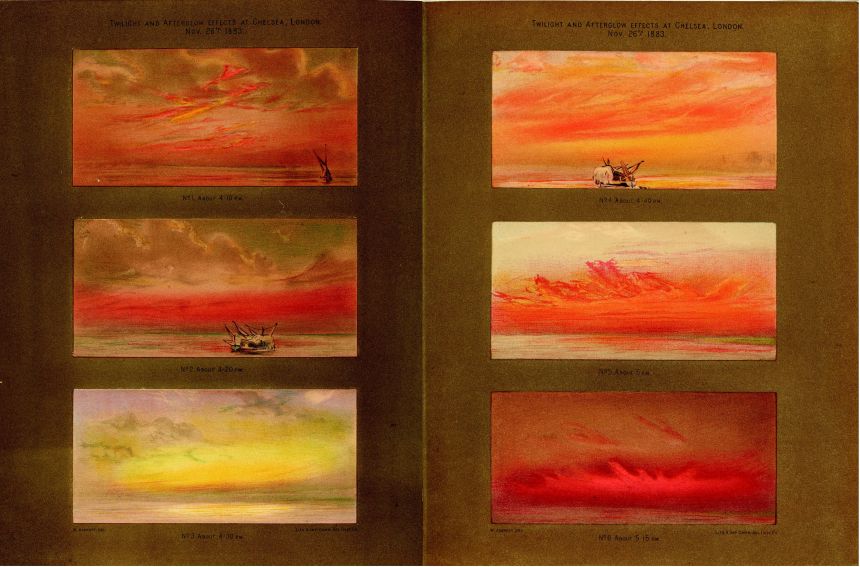 Red sunsets in Chelsea
Image credit: Bodleian Libraries
Red sunsets in Chelsea
Image credit: Bodleian LibrariesWilliam Ascroft’s watercolours of vivid sunsets seen from Chelsea, London, in autumn 1883 after the great eruption of Krakatoa in Indonesia. The image is found in a book called The eruption of Krakatoa and subsequent phenomena published in London in 1888 by Symons et al.
The weather diaries are fascinating, and show the impact of climate change physically and socially, at a time when no one really understood what it was.
Do any of the pieces tell us anything particularly interesting about how perceptions of volcanoes have changed?
The weather diaries are fascinating, and show the impact of climate change physically and socially, at a time when no one really understood what it was.
One from 1783 details the aftereffects of an eruption in Iceland, which triggered a hazy smog, so thick it could almost chock you. The diaries build a picture of an unbearably hot climate, complete with violent thunderstorms and an unusually red sun. Fast forward a few hundred years and we recognise these unusual weather conditions as air pollution induced climate change. But, at that time no one really knew about it, or had an explanation for the unusual weather, the explanations came later.
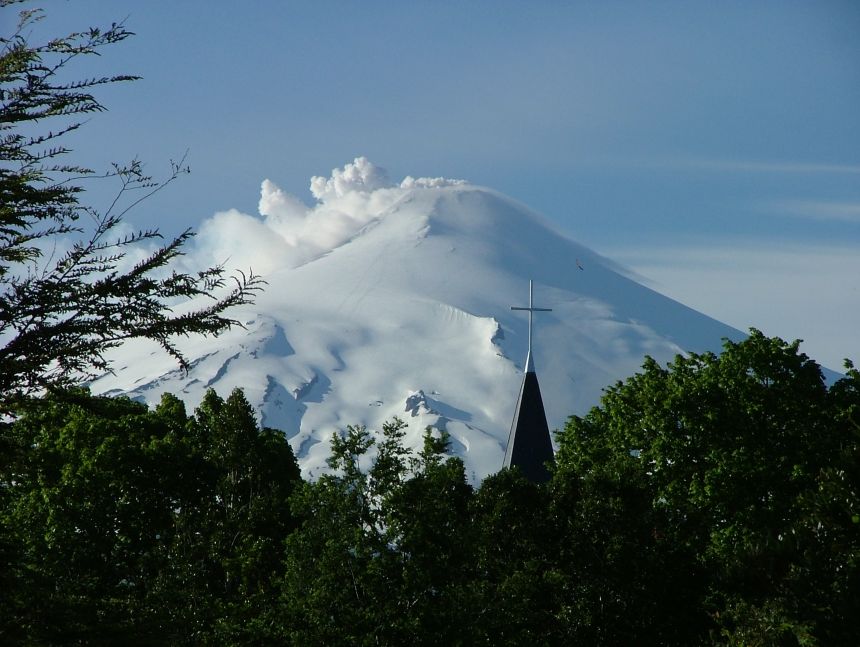 (Villarrica) volcano, Chile
Image credit: Professor David Pyle
(Villarrica) volcano, Chile
Image credit: Professor David PyleProfessor Pyle was just seven years old when he discovered his first and fondest volcano, Villarrica, while living in Chile with his family. It has been love at first sight ever since.
Another focuses on the impact of an eruption in 1816, which became known as the year without a summer in Northern Europe. In the Northern US conditions were so bad, it was dubbed: “Eighteen hundred and froze to death.” From the same period we have two pages of Mary Shelley’s diary, who of course wrote Frankenstein. She’s writing from Switzerland, in July 1816 - one of the worst affected places. Making these connections goes some way to explaining the morose tone and scenery depicted in the book, and the literary impact of eruptions.
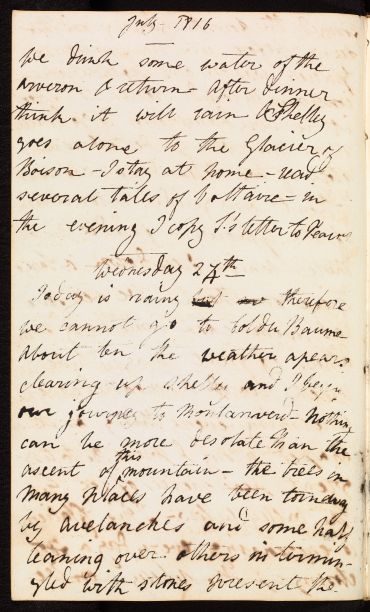 Mary Shelley journal
Image credit: Bodleian Libraries, OU
Mary Shelley journal
Image credit: Bodleian Libraries, OUA page from Mary Shelley’s journal from her entry on Wednesday 24 July 1816 when she writes of the terrible rain during her holiday at Lake Geneva. It was at this time that Shelley came up with idea for her novel Frankenstein. 1816 was known as ‘the year without summer’ due to the 18165 eruption of Mount Tambora in Indonesia. It was only in the 1800s that scientists began to understand the relationship between major volcanic eruptions and weather conditions that can occur hundreds of miles away from the eruption site.
Favourite piece from the exhibit?
One of the most significant elements is the oldest, a carbonised scroll from Herculaneum, located in the shadow of Mount Vesuvius. It is a piece of papyrus that contains a book that would have been rolled up and stored in a library in Herculaneum. It was buried by and preserved by the eruption of Vesuvius in 79AD. When the library was excavated in the late 1750s, the King of Naples gave away some of these scrolls to passing dignitaries, one of whom was Prince George of England, who then gifted the scroll to the Bodleian Library.
There is something quite special about holding a volcano exhibition in a library, where the oldest item in the show is also from a library, and was preserved because of a volcanic eruption.
Storytelling is a powerful way of communicating how volcanoes behave, and starting conversations about how society can prepare for an unexpected eruption.
How did you come to be a volcanologist?
I saw my first volcano aged seven, when my family lived in Chile for a year, and I have been obsessed ever since. It’s a place where you can’t escape mountains and there are volcanoes everywhere, including my favourite, Villarrica. I’ve been back as adult, and fulfilled my childhood dream of climbing the summit and peering into the crater.
What is your proudest achievement to date?
An academic’s career is long and potentially lonely, so you have to celebrate everything along the way. I don’t look back on anything that I have done with rose tinted spectacles because there are so many things that I want to do next.
I have been very close to the exhibition for a long time, and now we have finally opened, it is delightful to see other people enjoying and responding to it.
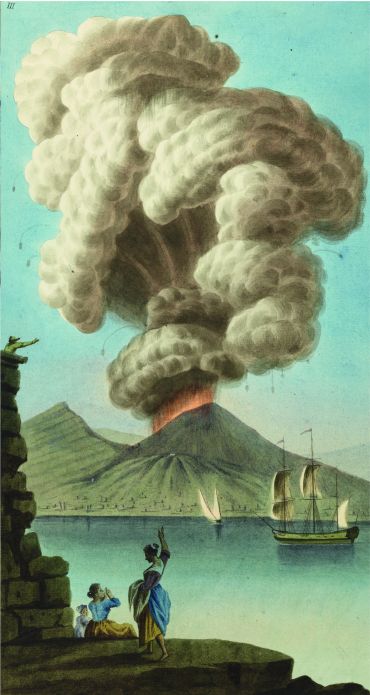 Vesuvius eruption_Campi Phlegraei
Image credit: Bodleian Libraries
Vesuvius eruption_Campi Phlegraei
Image credit: Bodleian LibrariesEruption of Vesuvius on 9 August 1779, seen from Naples. Gouache by Pietro Fabris, from the supplement to the 1779 edition of William Hamilton’s Campi Phlegraei. Hamilton (1730-1803) was a Scottish diplomat who was posted to Naples in the 18th century. From his country house at the foot of Vesuvius, Hamilton was ideally placed to witness and investigate the eruptions of the 1770s. He wrote a number of papers, books and letters documenting the 18th century eruptions of Vesuvius. Campi Phlegraei (meaning flaming fields, the local name for the area around Naples affected by Vesuvius eruptions) is a beautifully illustrated scientific treatise that contains 54 hand coloured plates by the artist Peter Fabris.
What is next for you?
My next project focuses on better telling and sharing people’s stories and experiences of volcanoes. Storytelling is a powerful way of engaging with people, communicating how volcanoes behave, and starting conversations about how society can prepare for an unexpected eruption. The official records of the St. Vincent eruption are a great testament to events, but they are not easily accessible to people actually living on the island, so impossible for them to learn from.
Storytelling is a powerful way of engaging with people, communicating how volcanoes behave, and starting conversations about how society can prepare for an unexpected eruption.
In collaboration with researchers from the University of East Anglia, who are leading a project on strengthening resilience in volcanic areas, we have been running workshops on the island, speaking to residents about their own experiences, and sharing our research.
Like many other Caribbean islands there are much more pressing needs - annual hurricane season being one of them. The volcano hasn’t actually erupted for forty years, so we were expecting it to be low on their list of priorities, but actually people have been really engaged and eager to think about it. Particularly the difference between dealing with an eruption today and forty years ago.
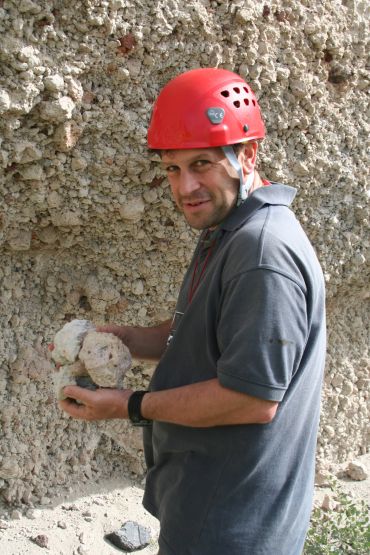 Image credit: OU
What is your favourite thing about your job?
It is a huge privilege to be able to work in places that are so captivating, visiting them with a purpose other than just travelling there for the sake of it. There are 60 or 80 volcanoes that erupt in any year, and often they are totally unexpected, so there is always something new to learn and look at.
• Volcanoes is running at the Bodleian Weston Library, Oxford until 21 May 2017
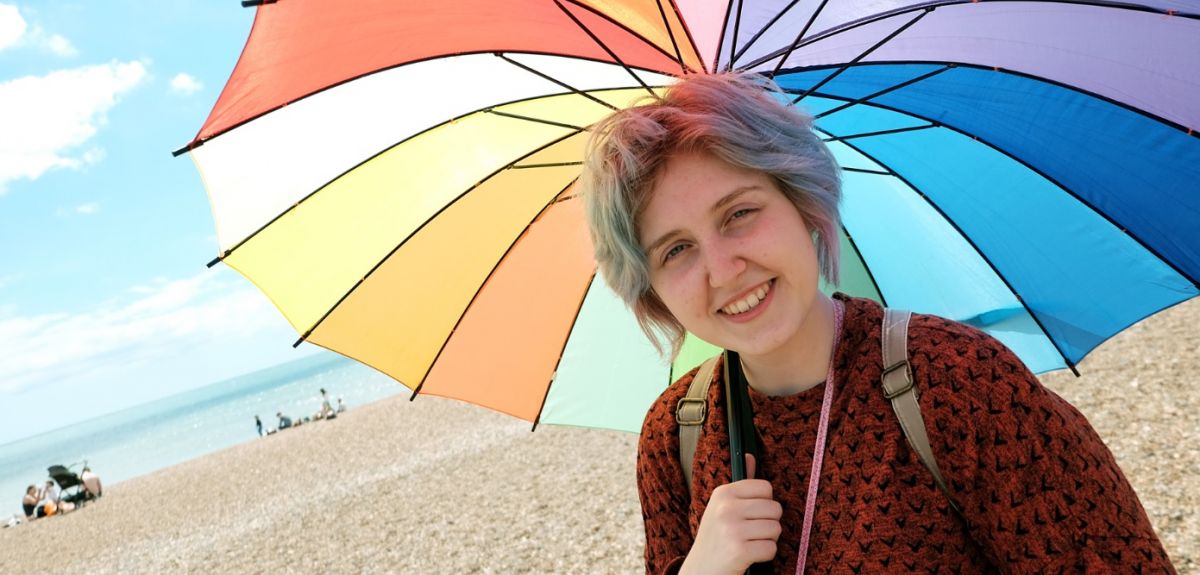
Our Student Focus series profiles the fascinating and varied activities of Oxford students. Miranda Reilly, an undergraduate studying English Literature, writes about balancing her studies with setting up a society for students with social anxiety, shyness and introversion.
'Starting my undergraduate English Language and Literature degree last academic year with undiagnosed social anxiety, an extreme shyness which I’d had since starting secondary school, I spent a lot of my first term feeling trapped in my room and isolated. I didn’t have much of a sense of purpose.
By around fifth week, I decided that I needed my own way to meet other students, so I set up SASI: the Social Anxiety, Shyness and Introversion Society. It was quite a success, and it was through this that I met a friend who introduced me to the Oxford University Student Union (OUSU)’s disabled students campaign, the Oxford Students Disability Community (OSDC).
My mum has been chronically ill since she was 20 with, among other conditions, an allergy to perfumes which ruled out being able to spend much time in rooms with air fresheners or rooms which had been cleaned with scented products, or around people who use scented laundry detergents and washing powders. I knew, therefore, a bit about invisible and rare disabilities before joining OSDC but little else, and hadn’t previously considered mental health as a disability.
Fast forward eleven months, and the majority of my friends at Oxford are involved in OSDC, working to improve things for themselves and other students, both through our campaigning and our socials which have created a strong community founded on accessibility and inclusivity.
Earlier this term we hosted our Disability Awareness Week, which included an arts exhibition which grew out of our fortnightly mental health art support group, Art for the Heart, and a panel of Oxford’s staff speaking on Pursuing Academia and Other University Careers – the audio and transcript for which will soon be available on our website.
Currently, we’ve been working on a Disability 101 Workshop to roll out across colleges and student societies because, while most students have good intentions, access needs are consistently forgotten about and events are often not accessible. Even if a student has excellent access to support for their academic studies, lack of access to the social and other student-run aspects of university life can lead to severe isolation and a lack of opportunities that can be added to a CV.
Later this year, our goal for UK Disability History Month (22nd November – 22nd December) is to get as many faculties, libraries and museums as possible involved, as some were for LGBTQ+ History Month, with displays and, hopefully, special lectures and talks.
Disability Studies is very much an emerging field and can be taken in many interdisciplinary directions including looking at representations of disability in literature, studying the role of music in deaf culture, and researching care for the disabled in ancient civilisations.
In my own academic studies, I am looking forward to being able to merge my interests in disability and English as I approach the final year of my degree, in which we have the most freedom to choose what we want to study, particularly with our dissertation.
Our Shakespeare paper consists of submitting three essays on any Shakespeare-related topics of our choice, and so I am certainly looking at staging disability in Shakespeare, such as with Othello’s epilepsy and Richard III’s scoliosis. Fiction – whether in the form of novels, television, cinema or another medium – has a massive impact on public perception, which can in turn lead to the very real consequences of changes to policies, laws and how people are treated in society.
Fictional portrayals of autism, for example, in addition to often portraying the spectrum inaccurately and as homogenous, have long perpetuated the stereotype that only Caucasian boys are affected, having the very real-world effect of BME people and girls on the spectrum being diagnosed at an older age, or not at all.
During my final year, I’m hoping to run for OUSU’s Vice President for Welfare and Equal Opportunities, an elected, paid position which lasts for a year after my degree and would allow me to dedicate a full-time job to working with the liberation campaigns, including OSDC, and welfare contacts across colleges.
Other than that, I’ve been looking into MA and MSc courses in Disability Studies, which go down a social policy route, but also haven’t ruled out an MA in English and a variety of career paths which do not require further academic study.
Outside of Oxford, people may assume that the university is all about academic work and nothing else, but it was only as a student here that I realised extracurriculars could be just as important and fulfilling as academic work, and could be combined with it to pursue paths which are still yet to be widely pursued.'

Two Oxford academics have been selected as this year's New Generation Thinkers by BBC Radio 3 and the Arts and Humanities Research Council (AHRC).
Eleanor Lybeck and Thomas Simpson are among ten early career researchers selected by an expert panel, after a nationwide search for the best academic ideas to be shared through broadcast. They will have the opportunity to make programmes for BBC Radio 3 and other outlets.
Eleanor Lybeck is a lecturer in English in the Faculty of English Language and Literature and Trinity College. Her research is on the history and practice of popular performance from the turn of the 19th century, including the story of her great-grandfather who made his name as a stage clown and joined the D’Oyly Carte company performing around the world in comic operas.
When Eleanor’s father disappeared from her own life in 1993 he took with him the remnants of her great-grandfather’s career, which she has now recovered and stitched together to tell the tale of this once celebrated and now forgotten figure of the theatre. She has explored how the circus has been a theme running through Irish culture. Her new project will explore how contemporary political rhetoric has, since Margaret Thatcher’s premiership, appealed to voters through literary and cultural allusion.
She says: 'I’ve been researching the biography of my great-grandfather, the comic actor and patter baritone Albert James, for more than a decade. In that time, I’ve told his story and the story of the marvellous worlds in which he moved at the turn of the nineteenth century through poetry, creative non-fiction, and theatre itself. Becoming one of BBC Radio 3’s New Generation Thinkers is such an exciting opportunity, as it’s a chance for me to reintroduce Albert and other once famed, now forgotten stars of Edwardian London’s theatreland to an international audience.'
Tom Simpson is a lecturer in Philosophy and Public Policy at the Blavatnik School of Government. He is engaged on research into trust; how it works, what is its significance in society and how cultures of trust can be restored. As a former officer with the Royal Marines Commandos he also worked on the ethics of war, exploring the intersection of war and technology. This includes the ethics of lethal automated weapons and surveillance and how this raises political questions far deeper than those considered in the public debate up to now such as what liberty is and why it matters.
He says: ‘I’m delighted by the chance that being one of BBC Radio 3’s New Generation Thinkers gives to explore some of the deeper issues behind the headlines. Trust has steadily declined in the last decades, and this is affecting our economy, our politics, and life in local communities. I’m interested in how we can restore trust. As a former Royal Marine, I’m also concerned by questions around how the military and security agencies use technologies like artificial intelligence and the internet. Some of these questions are new, and others are as old as philosophy.'
Previously Oxford winners include Leah Broad, Kylie Murray, Daniel Lee, Will Abberley, Eleanor Rosamund Barraclough and Jonathan Healey.
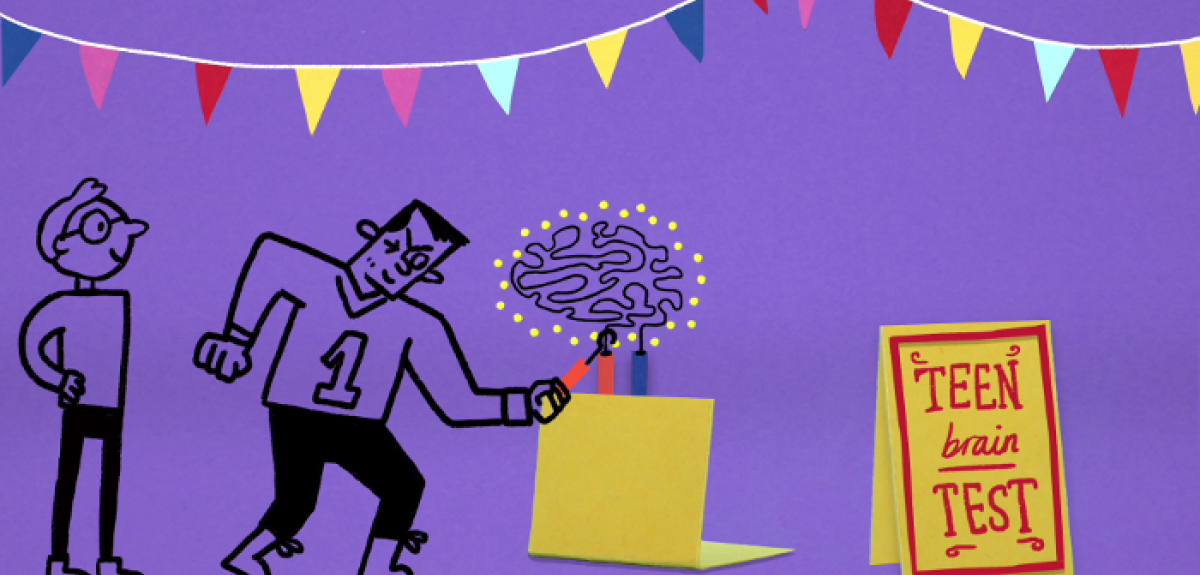
‘I would not be a teenager again if you paid me.’ If this statement perhaps sounds familiar, it is with good reason.
When people reflect on their teenage years it is not always in the fondest context. Along the journey from childhood to teenager, and then finally, onto adulthood, the brain changes in a lot of ways. Known as the control centre of the human body, the brain is responsible for our thoughts, actions and how we function in general.
Researchers at the University of Oxford have been working to understand this pivotal developmental period and a new animation from Oxford Sparks, the University’s popular digital science portal, has shone a light on this project. The animation offers a glimpse inside the teenage mind, and highlights the team's efforts to understand these developmental changes, and how much they influence peoples' behaviours during this time.
During this time three key changes take place, that combined, go some way to explaining the rollercoaster of emotions experienced during adolescence:
- Development slows down in the parts of the brain that control our attention span, impulsive behaviours and the ability to both resist distraction and make decisions;
- Increased development and functional ability in the areas of the brain that control people's 'gut reactions', such as emotions, appetite and mood;
- The communication ('cross-talk') between these parts of the brain becomes increasingly efficient.
In terms of brain development, adolescence represents a ‘perfect storm’ for teenagers, which explains some of the highs and lows associated with the period. These include, the pitfalls of taking more risks and increased social anxiety or, on a more positive note, the desire to try new things and have more experiences.
View the video within the context of your own teenage years here:

As Associate Professor of Organic Chemistry, a mother of two and one of Oxford University’s most successful entrepreneurs, developing both the spinout companies MuOx and OxStem, Professor Angela Russell wears many hats. She met with ScienceBlog to discuss the progress of women in science in the 21st century, her journey from academia to a successful business woman and her advice to anyone following in her footsteps.
What does your work in Organic Chemistry involve?
I run an academic research group aiming to develop new drugs to treat devastating degenerative diseases like Alzheimer’s and heart failure. The technologies we develop are helping us to answer fundamental clinical questions and understand how different substances affect regeneration processes in the human body. Our work is incredibly rewarding and has the potential to positively impact millions of peoples’ lives.
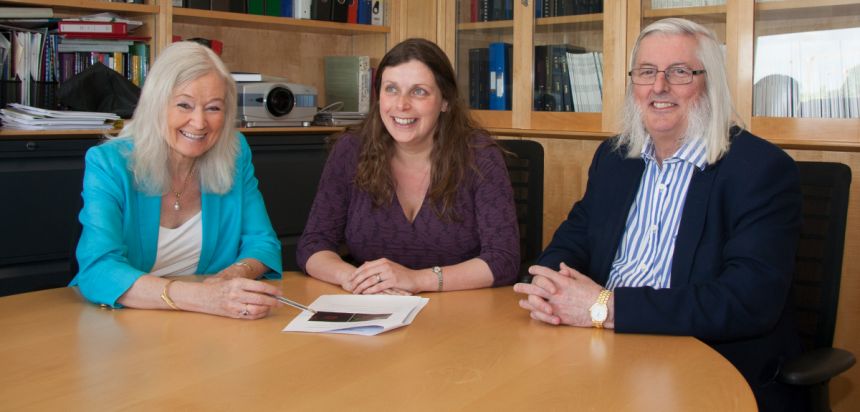 OxStem founders Professor Dame Kay Davies, Professor Angela Russell and Professor Steve Davies
Has becoming an entrepreneur always been a goal for you?
I always thought I would be a pure academic scientist, so the business side of things was totally unexpected. Often when you make a scientific discovery the most exciting part of the project is seeing it applied, but it easy to become removed from the development process in academia, and, it got me thinking why not just do it myself?
How did your journey into science commercialisation evolve?
I have co-founded two successful Biotech companies and both evolved quite organically. Mentorship has been key. Professor Steve Davies in particular has been a huge influence on my career and a co-founder of both MuOx and OxStem. As an entrepreneur himself, he has always encouraged me down the road of the commercialisation of science.
How did you go about commercialising your research and developing a spinout company?
MuOx (Muscle Oxford) built on a longstanding collaboration with Professor Dame Kay Davies, looking for a new treatment for Duchenne Muscular Dystrophy. Our original findings had led to the formation of VASTOx (now Summit Therapeutics plc) who developed the drug ezutromid into clinical trials. We wanted to discover new drugs that could improve on ezutromid’s effectiveness and went back to designing new substances that took the original research to the next level; MuOx.
Often with spinout development selling your product can be a real challenge, but our ongoing relationship with Summit meant they bought us very quickly. The company was spun out in 2012 and bought for five million pounds, by Summit in 2013. We continue to run an extremely important collaborative research programme with Summit developing these new drugs for Duchenne Muscular Dystrophy.
The technologies we develop are helping us to understand how different substances affect regeneration processes in the human body. Our work is incredibly rewarding and has the potential to positively impact millions of peoples’ lives.
What was the biggest learning curve from the development?
Building a strong case for product development that can be easily communicated to anyone - scientists, investors and general public alike is not easy. But if you don’t get it right, you won’t get the investment. As scientists, we get used to talking to each other in scientific code, but it’s just jargon to anyone else. People can’t support or engage with something they don’t understand, so I had to learn quickly how to communicate to people with varying science knowledge, like patients and the general public. You have to build an exciting case and believe in it yourself: ‘not only is this exciting science, but we can deliver on it and change people’s lives.’ If you don’t believe in your product why should anyone else?
How did OxStem evolve?
MuOx proved that we could translate science effectively, and it gave me the confidence to go for it on a big scale with Oxstem, which was effectively MuOx 2.0. It is exactly the same premise, a company developing drugs to treat diseases. But where MuOx focused specifically on muscle degenerative disease, OxStem aims to develop a platform to treat any degenerative or age-related disease.
Was building the company very different the second time around?
Oxstem isn’t a single company, it is an umbrella company, and we spinout successful daughter subsidiaries, each with a different disease focus – four so far. As an academic research development, it has been hard and time consuming to communicate the value of this structure to university stakeholders. We had to outline the structural benefits and challenges, such as how the model could work within existing financial structures, management of intellectual property and so on. It took a long time, but we achieved our goal, and in May 2016 we hit our £17 million target needed to get the company off the ground.
 Professor Russell co-founded OxStem, the company is currently working to develop a regenerative treatment that could reverse the symptoms of Alzheimer's. Photo credit: OXSTEM
Professor Russell co-founded OxStem, the company is currently working to develop a regenerative treatment that could reverse the symptoms of Alzheimer's. Photo credit: OXSTEM
What was the biggest challenge you faced setting up a spinout?
Getting people to believe in your idea in the early stages is really difficult, particularly with funders. Investment is essential to progressing opportunities from lab experiments, to something that will be of benefit to patients in the long run. It takes a lot of time and patience and you have to be up front with people, making sure that they understand what they are getting into. Yes it is a lucrative investment opportunity, but there are risks.
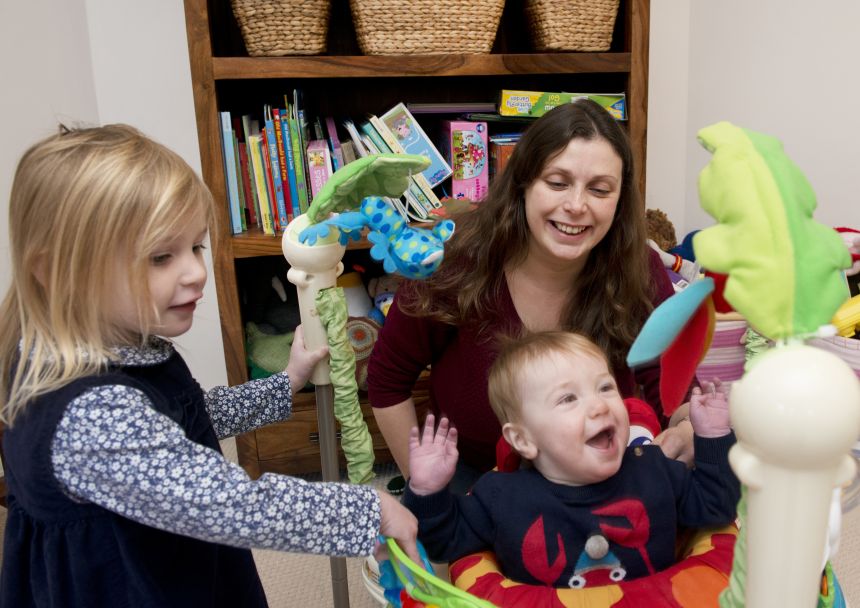 Professor Russell playing with her two children
What advice would you give to someone looking to commercialise their research?
Identify a clear market need for your product, make a clear development plan and a list of reasons why you are the only one that can deliver on it. That is the way to be successful. Being actively involved in progressing your research is so rewarding. If you truly believe in your idea, this is the route for you.
Generally getting government or charity funding for discovery science is straight forward, but doing so for an idea that you want to translate into a research led, spin-out is not so easy; dubbed the “valley of death”. You have to have proof of concept, and show that your idea is going to work.
What projects are you currently working on?
The bulk of my work focuses on the development of new drugs to tackle degenerative and age-related diseases. For instance in collaboration with Professor Francis Szele we are looking at treating diseases like Alzheimer’s and other neurodegenerative conditions and how symptoms can be reversed. A disease like Alzheimer’s is characterised by the progressive loss of neurones in the brain, and we are working to develop a regenerative treatment that will replenish these neurones, reversing the symptoms of the condition in the process. It will make a tremendous difference to people’s lives. If all goes to plan, we will be ready to run a clinical trial in the next three to five years.
You have to build an exciting case for your product, and believe in it yourself. If you don’t believe in it why should anyone else?
Has being a woman in science posed any specific challenges for you?
I have never been discouraged or made to feel that I can’t achieve things because I am a woman. Nor have I ever felt it was an advantage either. I think that is really important. We can’t solve gender bias against women, by deflecting it to men. We have to create an environment where it is better for everybody. I am heavily involved in the Athena SWAN Charter, self-assessment process, and it’s not about creating more opportunities for women, but for everybody, and achieving equality across the board.
How do you think these opportunities can be created?
I think we have to change the working culture, and focus more on valuing people for what they contribute, not how long a day they work. In the past there was a more blinkered view that a brutally long working day was the only way to succeed, which made managing a family and a career almost impossible, but that is changing.
We can’t solve gender bias by deflecting it to men. We have to build an environment that is better for everybody. Not just creating more opportunities for women, but achieving equality across the board.
What motivated you to become a scientist?
My dad was always supportive of my ambitions. When I was 14 he told me ‘you’ll never be happy with a desk job.’ He was right. I’ve always been driven by a desire to carry out research for the betterment of human health. Chemistry was a subject I absolutely loved at school and saw as fundamental to all science because it underpins and impacts so many other disciplines, including medicine.
What advice would you give to someone embarking on a career in STEM?
The decisions that you make at the beginning of your career are important, and can impact your whole future, so try and think long term wherever possible. Everyone makes mistakes, but recognising when you aren’t on the right track and correcting it quickly makes it easier to stay on course. I came to Oxford to study Biochemistry, but realised quickly that it wasn’t for me. Two weeks before my first year exams I told my tutor I wanted to change to Chemistry. I flipped straight into the second year of a Chemistry degree, and almost gave my tutor a heart attack, but it was exactly the right decision for me.
If you hadn’t been a scientist what was your plan B?
I would have been a chef. I actually think chemists and chefs have a lot in common. They experiment with flavour combinations and we scientists cook up drugs that we want to use for clinical use. There is nothing more rewarding than cooking a nice dinner and watching your children tuck in.
 In her spare time Professor Russell enjoys cooking for her family, and has found parallels between chemistry and cooking. Chefs experiment with flavour combinations, while scientists cook up drugs for clinical use. Image credit: SHUTTERSTOCK
In her spare time Professor Russell enjoys cooking for her family, and has found parallels between chemistry and cooking. Chefs experiment with flavour combinations, while scientists cook up drugs for clinical use. Image credit: SHUTTERSTOCK
- ‹ previous
- 102 of 253
- next ›
 What Louise Thompson’s campaign tells us about the national maternity crisis
 Celebrating 25 Years of Clarendon
  Learning for peace: global governance education at Oxford
  What US intervention could mean for displaced Venezuelans
  Setting the agenda for the next century of quantum
 10 years on: The Oxford learning centre making an impact
 Mapping the Moon: the world’s first lunar atlas goes digital
  Oxford and The Brilliant Club: inspiring the next generation of scholars
 New course launched for the next generation of creative translators
 The art of translation – raising the profile of languages in schools