Features
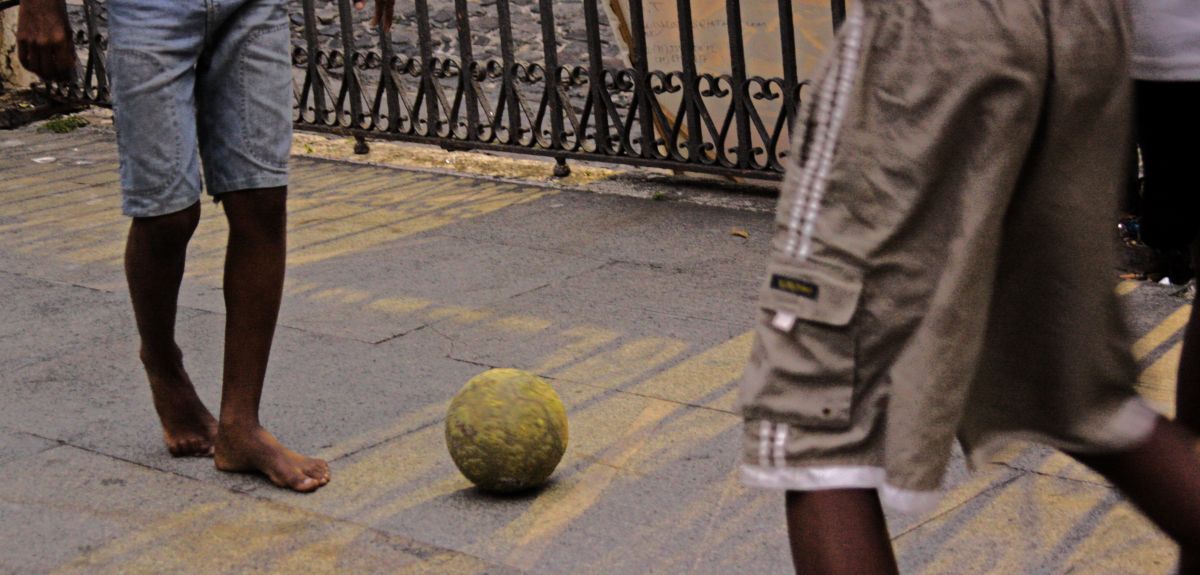
The packed stadiums across Brazil during the World Cup – and the public outpouring of grief after their 7-1 defeat by Germany – confirms just how popular football is in Brazil. It is less well known that football was brought to Brazil by an Englishman – or was it a Scotsman?
Simão Valente is a Portuguese Lector in the Faculty of Medieval and Modern Languages, whose research focuses on crime fiction in Portuguese. To engage his students, Simão uses the stories of key figures in Brazilian history and culture.
In the following blog post he explores the origins of football in Brazil.
'Charles Miller is widely regarded as the man responsible for introducing football in Brazil. The son of a Scottish railway engineer, John Miller, and a Brazilian of English descent, Carlota Fox, Miller was born in the upper echelons of São Paulo society.
Sent to school in Southampton at age ten, he remained there until February 1894, when he returned to São Paulo bringing two footballs and the book of rules of Association Football. Teams and matches were organized, drawing largely from the overwhelmingly white and British managers of local companies, factories and farms. Football in Brazil, as in most countries, was first a genteel activity.
But in April of that same year, Thomas Donohue, a Scottish dye worker in a textile factory in the gritty Bangu district of Rio de Janeiro, organized a match among fellow workers. Some of the players, reflecting the makeup of the factory, were black.
The first eleven-to-eleven match following the rules still accepted today was indeed arranged by Miller in April 1895, but the match that Donohue organized was the first to field working-class and black players in Brazil, according to historian Carlos Molinari.
In 1905, Bangu Atlético Clube became the first football team to field a black player at national competitions in Brazil, Francisco Carregal. This past June, a statue of Thomas Donohue was inaugurated in front of the headquarters of Bangu, as part of the reassessment of his part in shaping Brazilian football.
The history of Brazil is marked by sharp social inequalities grounded on class and race, an inheritance of colonialism and slavery. The more inclusive version of football practiced by Donohue in Rio has a deep resonance with the development of the game in Brazil and the role it has to this day in Brazilian society.
It paved the way for the rise to stardom of Pelé, from the 1958 World Cup onwards. The Brazilian victory at that Cup brought unprecedented global visibility to a young black Brazilian, who had grown up in poverty, famously learning how to play by kicking about socks stuffed with newspapers. Millions of underprivileged Brazilians had found a hero.
The widely covered demonstrations in Brazil in the months leading up to the World Cup were primarily directed against government corruption and mismanagement. Part of this mismanagement, protesters argued, was the overspending in a sports event that, due to the prohibitive prices of tickets and the industry set around the matches, would not be enjoyed by common Brazilians, 20% of whom live below the poverty line.
It was a reaction against the gentrification of a sport whose character is so intimately tied to the national self-image, a connection to which Donohue greatly contributed.
The spectacular end of the Seleção in the Cup led to the current period of self-reflection in Brazil, commentators arguing that it may contribute to rekindling discontent as elections loom in October.
While their pride may have been hurt, the swiftness with which Brazilians turned to self-effacing jokes after the 7-1 loss to Germany is a sign of their evolving relationship with football. The devotion and enjoyment will still be there, but the cultural politics of the game cannot be ignored.'
As we report the spread of drug-resistant malaria parasites on our news pages today – and the scale of the threat this poses to global efforts to control malaria – two other studies published today by Oxford University researchers report promising results in developing new drugs and vaccines against malaria.
While neither set of results will provide a solution in the short term, it does show there are a range of efforts in the pipeline that are showing potential against this most difficult of parasites to tackle.
It is Oxford researchers based in Thailand that have reported the spread of parasites resistant to our best anti-malarial drug, artemisinin. The same team has been involved in running a clinical trial of a new drug developed by the pharma company Novartis. The drug is currently called KAE609 and works against the malaria parasite in a new way.
'The growing menace of artemisinin resistance threatens our current antimalarial treatments, and therefore our attempts to control and eliminate falciparum malaria,' says principal investigator Nick White, who is a professor of tropical medicine at Oxford University and based in the Mahidol Oxford Tropical Medicine Research Unit (MORU) in Bangkok.
'This is why we are so enthusiastic about KAE609; it is the first new antimalarial drug candidate with a completely novel mechanism of action to reach Phase 2 clinical development in over 20 years,' he says.
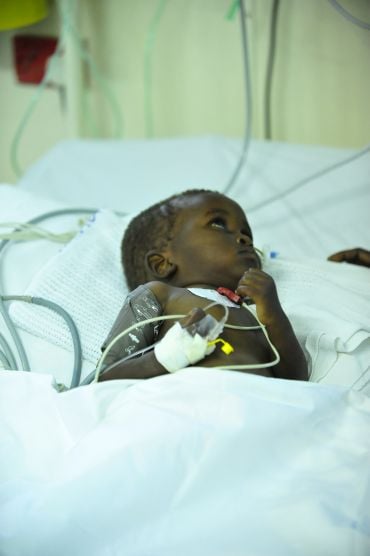 A child with malaria in Kenya
The phase 2 clinical trial the Thailand group ran gave a three day course of the new KAE609 drug to 21 adult patients with uncomplicated malaria.
The results, published in the New England Journal of Medicine, showed rapid clearance of the parasites from patients' blood - a median time of 12 hours – including in patients with artemisinin-resistant infections. The main side effects observed were nausea and vomiting.
Novartis are now planning the next stage of clinical trials of the drug to continue to test the safety and effectiveness of KAE609. The study was supported by the Wellcome Trust, Singapore Economic Development Board, and Medicines for Malaria Venture.
Meanwhile, scientists in another of Oxford's overseas research programmes have identified a number of new malaria vaccine candidates.
The researchers in Kenya studied the immune responses of 286 children to a large number of proteins from the malaria parasite.
Writing in the journal Science Translation Medicine, the group was able to identify the antibody responses that most protected the children from malaria, and which of the many parasite proteins the children's antibodies latch on to.
Knowing which proteins to target could allow more effective malaria vaccines to be developed against the blood stage of the disease, they say.
'This study presents us with a large number of new vaccine candidates that offer real hope for the future,' says lead scientist Dr Faith Osier. She is based in Kilifi on the Kenyan coast - part of the joint research programme involving Oxford University, the Wellcome Trust and the Kenya Medical Research Institute.
The scientists followed a group of children infected with malaria over a six-month period. While some patients became sick, others were protected by naturally occurring antibodies. The antibodies stopped the malaria parasite from penetrating their red blood cells during the blood stage of the disease.
'Each year, hundreds of thousands of people die from malaria; but hundreds of millions are infected, many of whom are protected from severe symptoms by their immune response,' explains Professor Kevin Marsh of Oxford University and director of the KEMRI Wellcome Trust Research Programme in Kenya.
The researchers, collaborating with scientists at the Wellcome Trust Sanger Institute near Cambridge, used samples taken from these children to identify combinations of antibodies that provided up to 100 per cent protection against clinical episodes of malaria.
Crucial to this study, funded by the Wellcome Trust and the Medical Research Council, was a library of parasite proteins generated using a new approach developed at the Sanger Institute. Dr Gavin Wright and Dr Julian Rayner were able to produce large numbers of correctly folded, full-length proteins from the Plasmodium falciparum malaria parasite – in particular proteins involved in the invasion of human red blood cells. This allowed the immune response to the proteins to be studied in the lab much more easily.
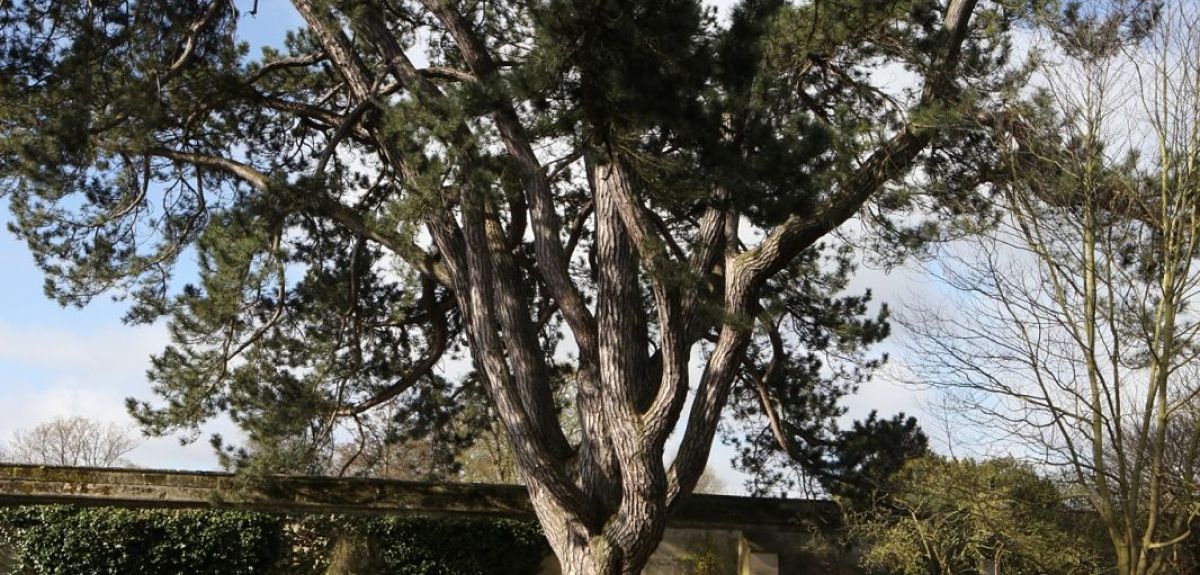
Oxford University's Botanic Garden is planning a send-off for the iconic black pine known as 'Tolkien's tree', which needs to be removed from the Garden after two limbs fell from the tree on Saturday.
The tree, a Pinus nigra, was a favourite of J R R Tolkien during his time in Oxford and some say its twisting branches resemble the 'ents' in his The Lord of the Rings novels.
Experts at Oxford City Council and Oxford University have decided the tree needs to be cut down. The decision was unavoidable but it does mean scientists can finally solve the mystery surrounding the tree.
Dr Stephen Harris of Oxford University’s Department of Plant Sciences explained: 'The received wisdom regarding the black pine is that it was planted in 1799 from seed that was collected by the Third Sherardian Professor of Botany, John Sibthorp, in Austria.
'We know that Sibthorp sent considerable amounts of plant material to Oxford from the eastern Mediterranean in 1786/87 and that he was in Austria in 1785. He was also in regions of Black Pine growth in 1795 but he died in 1796.
'If the story of the Black Pine is true then it should be at least 215 years old. The pine having to be cut down means that we have the opportunity to date the tree precisely and determine whether Sibthorp is likely to have been involved. The particular subspecies of Black Pine represented by the tree has also been a point of controversy - we should now be able to settle this controversy as well.'
The Garden has rigorous safety checks in place and every tree in the Garden is inspected annually. The area around the tree was evacuated before the limbs fell. The Garden will remain open while the work takes place, but the area around the tree will be cordoned off for the next few weeks.
Dr Alison Foster, acting director of the Garden, said: 'The black pine was a highlight of many people's visits to the Botanic Garden and we are very sad to lose such an iconic tree. We intend to propagate from this magnificent tree so that future generations will not miss out on this important link to Tolkien. We are considering using the wood from the black pine for an educational project along the lines of the One Oak project and hope to hold a celebratory event to commemorate the tree and its many associations in due course.
'I'd like to praise my staff for taking swift action to evacuate the area before the limbs fell from the tree and we assure visitors that all the trees in the Garden are subject to annual inspections by experts. The Garden will remain open over the next few weeks but the area near the tree will be inaccessible while work takes place. We apologise to visitors for the inconvenience this causes and we hope to reopen the entire Garden as soon as possible.'
Dr Stuart Lee, an English academic at Oxford University who has studied the fiction and manuscripts of Tolkien and ran the 2013 Tolkien Spring School in Oxford, said: 'Tolkien hated the wanton destruction of trees for no reason but it sounds to me like this is for all the right reasons so whilst this is sad news, it is inevitable.
'It is often said that the black pine inspired the 'ents' in Lord of the Rings, and it may be he liked the tree and saw something it in that inspired Treebeard, but in fact the ‘ents’ have many sources and ‘ent’ means giant in Old English, and Tolkien’s love of trees goes all the way back to his childhood.'
350 years ago on 26 July, the foundation stone was laid at Oxford University’s iconic Sheldonian Theatre.
Over the years the Theatre has been the meeting place of Congregation, the University’s governing body, and staged many prestigious ceremonies including matriculation, graduation and honorary degree ceremonies. It is also an important venue for musical performances and a popular destination for visitors to Oxford.
A curious lease was negotiated for the site in 1664. The University had to remove seven widows' cottages which were on the site to build the Theatre and agreed to pay £7 twice a year to a small charity – one pound for each widow's cottage. This payment continues today.
'It is not the sort of sum the university is used to paying,' says Dr Paul Coones, Chairman of the Curators of the Sheldonian Theatre. 'We neglected to pay in recent years and nearly had the site reclaimed. Now I have to check regularly to make sure it is getting paid. It is the sort of thing that could only happen in Oxford.'
The project began when Sir Christopher Wren was hired as the architect, after a generous donation from Bishop Gilbert Sheldon, former Warden of All Souls College and later Archbishop of Canterbury.
Wren's classical design, inspired by the amphitheatres of Ancient Rome, was strikingly different to other buildings in Oxford at the time.
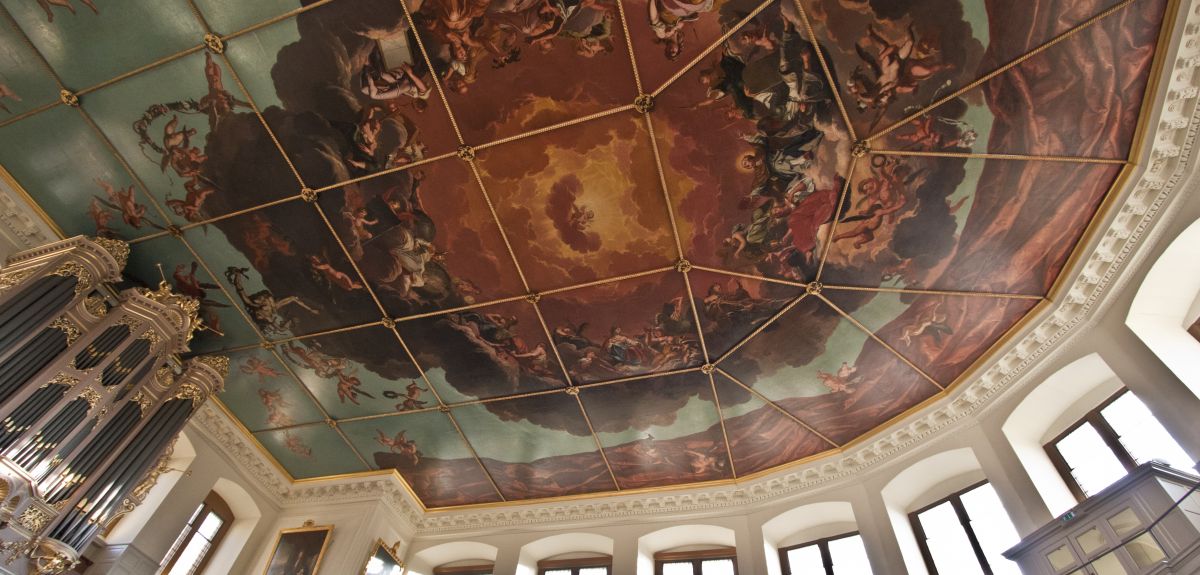
The famous painting on the ceiling was done by Robert Streater, and the cherubs in the painting depict Truth descending upon the Arts and Sciences to expel ignorance from the University.
The 350th anniversary celebrations are set to begin in November with a performance of Beethoven’s Ninth Symphony (16 November). This is an apt choice – the symphony was performed by Richard Wagner after he laid the first stone of the Bayreuth Festspielhaus in Germany.
The Theatre is planning a range of activity for the anniversary of the building’s opening in 2019, including an exhibition about recipients of honorary degrees from the University over the centuries.
Significant work has been done to the Theatre in recent years. In 2004 a four-year restoration of the painting on the ceiling began. The 32 panels were temporarily removed and had linings replaced, holes in the canvas fixed and over-painting removed, before being put back in the ceiling in 2008.
During the conservation process, architectural paint researchers noticed that the original colour scheme for the theatre chosen by Wren had been painted over in the 1720s. The Theatre was then restored to Wren’s original vision.
But what hasn’t changed at the Theatre is the uncomfortable seating – and nor will this change, says Dr Coones. 'It's a listed building – I can’t even change a doorknob because of that – and uncomfortable seats are part of the tradition really,' he explains. 'That is just how it has always been.'
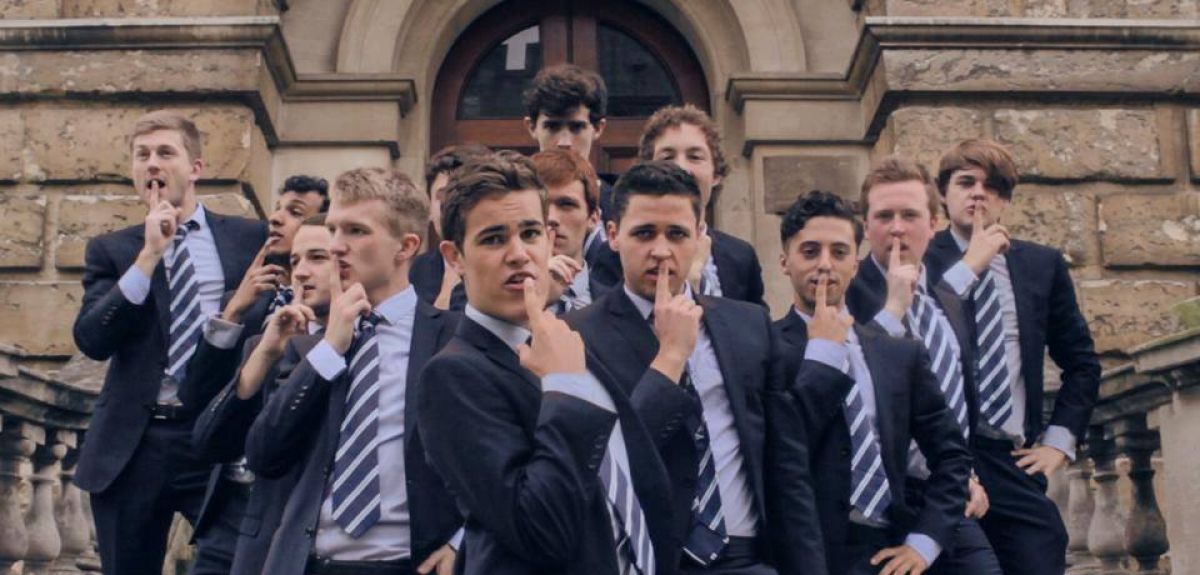
Oxford student a cappella group Out of the Blue is raising money for local charity Helen and Douglas House with their take on Shakira.
This may be the first time Radcliffe Square has played host to a close-harmony rendition of 'Hips Don't Lie'. Shakira herself has tweeted the video, which has over 660,000 views on YouTube.
Soloist Ollie Nicholls, a student at St Anne's said: 'I think people are more forgiving when it's for charity; they can overlook the fact we can't dance. That's something I've not stressed enough actually. I don't want the fact that it's for charity to be lost in all the hype about Shakira. The charity is Helen and Douglas House, who we've been supporting for over eight years.'
The group has been supporting Helen and Douglas House since 2006, and has raised over £35,000 in that time, as well as performing in the charity’s annual variety show, Childish Things.
Project manager and Lincoln College student Marco Alessi said: 'We chose to make a video for 'Hips Don't Lie' because it's one of the sillier, more upbeat songs from our set, and has always been a hit at Helen and Douglas House when we've performed it there.
'We chose Helen and Douglas House because the work they do is absolutely incredible. They offer free respite and end-of-life care to children and young adults with severely life-limiting illnesses, and bereavement support for their families.
'We visit regularly so we’ve got to know the staff and we've spent time with some of the families staying there and we're constantly overwhelmed with how positive and high-spirited they all are. The work the hospice does is really extraordinary.'
The single is available to download on Bandcamp, with the option of making a charitable donation.
- ‹ previous
- 164 of 252
- next ›
 Setting the agenda for the next century of quantum
 10 years on: The Oxford learning centre making an impact
 Mapping the Moon: the world’s first lunar atlas goes digital
  Oxford and The Brilliant Club: inspiring the next generation of scholars
 New course launched for the next generation of creative translators
 The art of translation – raising the profile of languages in schools
  Opening a window into the quantum world
 Tracking resistance: Mapping the spread of drug-resistant malaria
 Cities for cycling: what is needed beyond good will and cycle paths?