Features

Antimicrobial resistance (AMR) is one the most pressing challenges facing the world today. Common infections that were once easily treated by antibiotics are becoming life-threatening again. By 2050 it is predicted that over 10 million deaths will be caused by drug-resistant infections every year.
At the Ineos Oxford Institute for antimicrobial research (IOI), created in 2021 to advance antimicrobial research, Oxford’s graduate students are among those contributing to the search for solutions to tackle this growing threat to global health.
34 DPhil students from around the world are based at the IOI, each part of a focused research project that works to develop new antibiotics or study the spread and impact of AMR around the world.
 IOI DPhil student Kate Cook with research assistants Maryam and Firdausi in Kano, Nigeria
Working closely with two research assistants in the hospital – Maryam and Firdausi – Kate acts as a microbiological detective, identifying which kinds of bacteria are causing infections in patients, then investigating whether these bacteria are also present on hospital surfaces, and in insects caught on the wards.
“Designing creative experiments is the best part of my work. It can be challenging when there are huge numbers of samples to analyse, and trying to figure out how the bacterial transmission networks fit together, but the project is very rewarding. The opportunity to work with the team in Kano, who are equally as passionate about the project has been amazing.”
 IOI DPhil student Shonnette Premchand-Branker preparing plates in the lab
A microbiologist by training, Shonnette analyses fly samples which will be collected from countries across the globe.
“The flies are sent to our lab in Oxford after they have been collected and labelled in hospitals. They arrive whole, so our first step is to homogenise them, which basically means we make fly juice. The next step is to prepare bacterial cultures, and then extract and sequence their DNA. We’re looking for antimicrobial resistance genes that we know are related to multidrug-resistant infections.”
 IOI DPhil student Chy Akpulu preparing samples for analysis in the lab at IOI
The work is potentially life-saving – antibiotic resistance to sepsis is a leading cause of deaths in newborns, with 99% of global newborn mortality occurring in low-and-middle income countries.
“I am drawn to research that directly benefits people, and the work that the BARNARDS team were doing really resonated with me - not just scientific enquiry but helping the community itself by translating research into better clinical outcomes.”
 IOI DPhil student Wojtek Treyde at his desk at IOI
Wojtek Treyde, a PhD student who has previously studied at the University of Heidelberg in Germany is part of the INEOS Oxbridge Doctoral Initiative on Antimicrobial Resistance – a fully funded DPhil programme that enables up to seven candidates to study at both the universities of Oxford and Cambridge.
Wojtek is a computational chemist working on drug development. His PhD project combines his research experience so far – an undergraduate degree in chemistry and master’s degree with a focus in Machine Learning.
A branch of chemistry, computational chemistry uses computer simulations to solve complex chemical challenges, such as the discovery of new antibiotics to tackle rising rates of AMR. Wojtek works closely with lab-based researchers at the IOI to use machine learning to inform research.
“I wanted to use my training in an area where I could make a difference. Alongside climate change, AMR is the biggest threat facing humanity and I want to contribute to finding new solutions.”

Our early experiences can have a staggering impact on the rest of our lives – for better or worse. For young girls forced into marriages or unions against their will, usually with adult men, this can have profound lifelong consequences, including for wellbeing, education, and employment opportunities. Reducing early marriage can take many years of culture change, societal pressure, and policy change to transform the situation.
This is a strong example of how really robust, high-quality longitudinal research combining both quantitative and qualitative data can directly influence national policies to improve the lives of children and young people.
Dr Alan Sanchez, Young Lives Senior Quantitative Researcher
But along this journey, there are often turning points: pivotal moments that propel future progress.
In Peru, such a moment came on 25 November 2023 when the Government introduced new legislation to prohibit all marriages with minors under the age of 18. The potential impacts of this cannot be overstated: between 2013 and 2022, over 4,350 child marriages involving girls between the ages of 11 and 17 years were registered. Almost all (98%) of these resulted in young girls being married to adult men. But this is likely only the tip of the iceberg: estimates based on census data indicate that over 56,000 children aged between 12 and 17 (mostly girls) may be involved in a union and/or cohabitation.
This new law has closed a previous legal loophole which permitted teenagers to be married from the age of 14 years under certain conditions, with consent from at least one parent, despite the minimum legal age of marriage of 18 years for both girls and boys. Not only does the new law close this loophole, it also enables girls who were married as minors to have their marriages annulled.
On the surface, this may seem simply like a formal legislative process, but behind the scenes are years of evidence-gathering, lobbying, and policy engagement. In particular, the Young Lives study coordinated by the University of Oxford played a transformative role in building a compelling evidence base to champion the need for change.
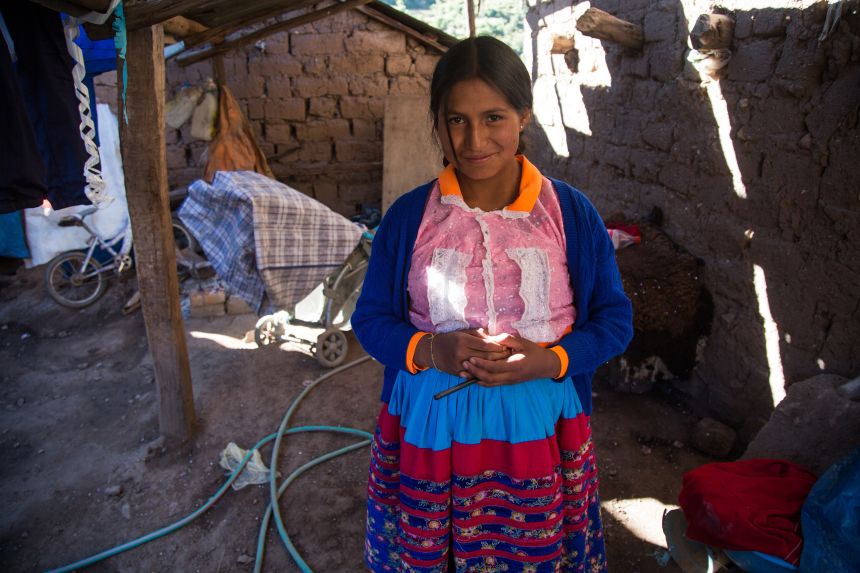 A Peruvian girl at home. © Young Lives / Sebastian Castañeda Vita
Data that fills in the gaps
In combination, the Young Lives data fills in a key evidence gap by giving a personal glimpse into what early marriage is actually like in these countries. Beyond the high-level statistics, there are personal stories that resonate.
Julia Tilford, Communications Manager for Young Lives
‘It is rare that you can draw a direct link between academic research and policy change, but in this case, it is unequivocal’ says Julia Tilford, Communications Manager for Young Lives. Since 2001, the project has been following the lives of 12,000 young people in Ethiopia, India, Peru and Vietnam, using a combination of surveys (conducted every 3 to 4 years) and supplementary in-depth interviews to generate high-quality, large-scale longitudinal data on the causes and consequences of poverty and inequality. From 2005, Young Lives has been led by the Department of International Development at the University of Oxford. However, Young Lives also works in collaboration with key partners in each of the four study countries, who are engaged directly with national policy and programme decision-makers – those in a position to effect change. Young Lives has also worked with Child Frontiers to conduct in-depth interviews on the lived experience of early and child marriage and parenthood in Ethiopia, India, Peru and Zambia.
Understanding the long-term impacts of early marriage for children and young people in poor communities is one of many aspects the study has holistically examined. It has demonstrated that girls who marry early are less likely to complete secondary education, leading to reduced opportunities to gain employment and financial independence. Girls from poor households and rural areas typically have limited knowledge about or access to sexual and reproductive health care and services, increasing the risk of teenage pregnancies. Furthermore, children born to young mothers (under the age of 18) generally have a lower birthweight and shorter height for their age. Girls who marry early are also at much greater risk of physical and psychosocial violence from their partners.
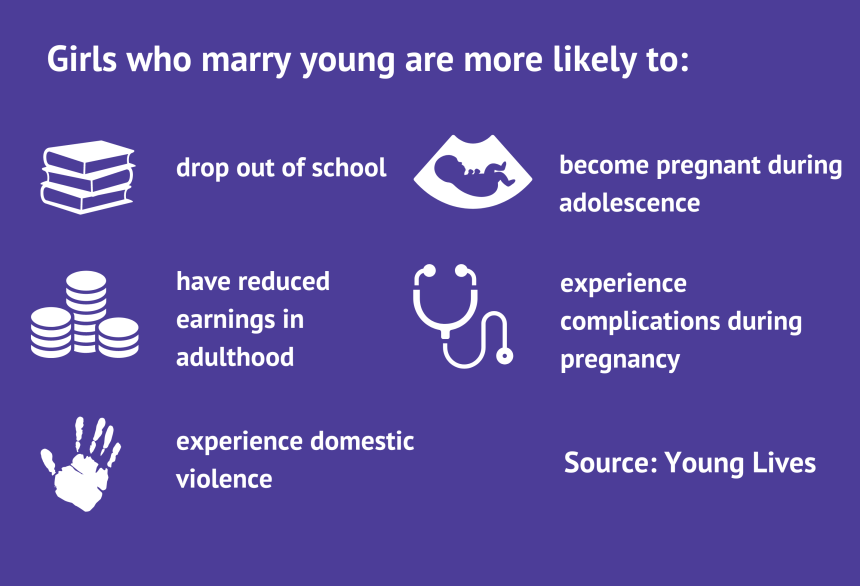 Some of the harmful impacts that marrying young can have on girls. Source: Young Lives.
 Every year, at least 12 million girls are married before they reach the age of 18. That is 28 girls every minute (UNICEF).
Translating research to policy impact
Leading up to the new Parliamentary Bill, Young Lives’ Peru team presented evidence on the impacts of early marriage and cohabitation through numerous presentations and briefings to key government officials, including in the Ministry of Women and Vulnerable Populations and the Ministry of Education. When the bill was presented to Congress in September 2022, Young Lives evidence was directly cited by Congresswoman Flor Pablo, who then invited Young Lives team members to present their findings at an influential congressional roundtable.
Being on the ground for over twenty years has enabled our Country Directors to establish long-term partnerships of trust and collaboration with key government partners and policy decision-makers. This enables Young Lives to be very effective at influencing national policies and programmes.
Kath Ford, Senior Policy Officer for Young Lives.
Dr Alan Sanchez, Young Lives Senior Quantitative Researcher and part of the group who presented at the roundtable, says: ‘Having such a robust evidence base was critical, because many people in Peru didn’t actually believe that early marriage had negative consequences.’
Alongside engaging with policy makers, Young Lives has also communicated its findings more widely – developing an animation, and working with the national press, which led to the findings being cited in high-profile articles in El Comercio and La República. The momentum built by these actions proved critical to keep the bill in progress when a political storm unleashed following the Peruvian President’s removal in December 2022 after an attempted coup d’état. Although the debate was postponed because of this, the bill eventually passed with 97% of Congress in favour.
‘What I have learnt from this process is that change takes time’ adds Dr Sanchez. ‘Besides the years needed to build up our strong longitudinal evidence base, it also takes time to analyse the data and build up support in Congress. You also need teamwork and political allies. In this case, having the support of Congresswoman Pablo was pivotal. She was personally motivated to change the law, and championed our evidence with key government ministers. In the end, even those who were political adversaries agreed that the bill was needed.’
Looking Forward
‘While the change in Peru’s legislation is an incredibly important step in protecting young girls from child marriage, legislation alone is not enough’ says Kath Ford, Senior Policy Officer for Young Lives. ‘The Young Lives study shows that poverty, gender inequality, and discrimination are key drivers of child marriage, meaning that policymakers need to adopt a broad approach to deliver real change for girls and young women. Tackling the root causes of child marriage also involves working closely with whole communities, including men and boys, and ensuring vulnerable girls and young women are protected by effective safety nets.’
Young Lives longitudinal evidence on the causes and consequences of child marriage in Peru has been pivotal for driving this important legislative change. By giving voice to the lived experiences of girls and young women, the study has enabled a much more in-depth understanding of how poverty and entrenched gender norms continue to drive child marriage, particularly among remote and indigenous communities.
Congresswoman Flor Pablo
Young Lives evidence on the consequences of early marriage is also starting to have a significant impact in India, where nearly 1 in 4 young women are married before the age of 18 (UNICEF, 2022). The Young Lives India team were invited to present evidence to the Indian Parliamentary Standing Committee as part of their examinations of a proposed new bill to increase the legal age of marriage for women from 18 to 21 years of age. This would be a seismic policy shift for a country where the majority of young women currently get married between the ages of 18 and 21.
Dr Renu Singh, Country Director, Young Lives India, says: ‘Young Lives has raised the importance of curbing child marriage and brought this important issue to the attention of policy makers over a number of years. The fact that the bill to raise the marriage of girls from 18 to 21 years has been passed by Cabinet, the first critical legislative step, before being ratified by Parliament is testament to this ongoing pressure.'
Meanwhile, the Young Lives team in Oxford are now completing the latest round of survey interviews. With the respondents now aged 22 and 29, the study is now focusing on how they are faring in young adulthood across a broad range of areas, including physical and mental health, education, work, and family relationships. New research findings will be published in early 2025.
You can learn more about Young Lives on the project's website.
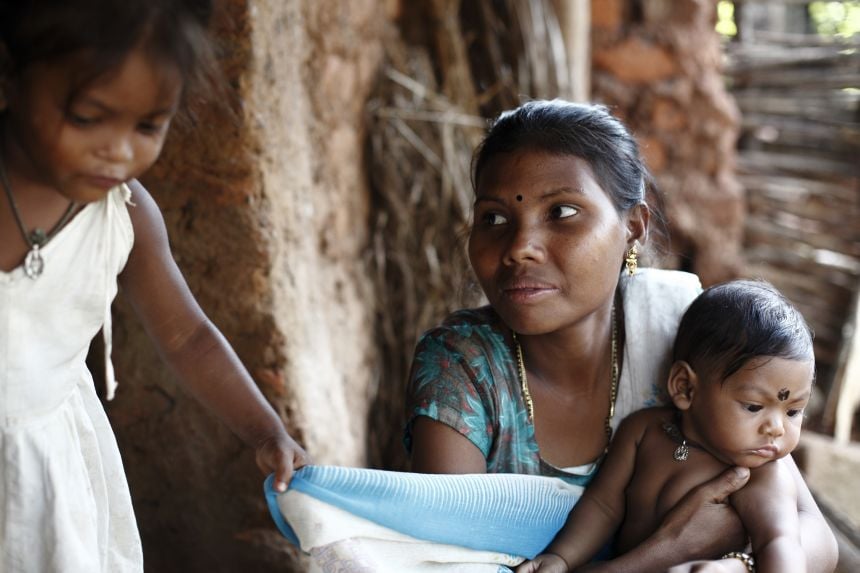 A young mother and her children in India. © Young Lives / Sarika Gulati
The world’s most powerful computer hasn’t yet been built – but we have the blueprint, says the team behind Oxford spinout Quantum Dynamics.
Meanwhile, Chris Ballance, co-founder of spinout Oxford Ionics, says ‘quantum computing is already solving complex computing test cases in seconds – solutions that would otherwise take thousands of years to find.’
Following decades of pioneering research and development – much of it carried out at the University of Oxford –some of the world’s most innovative companies have integrated their technology into existing systems with excellent results.
Ask a quantum scientist at the University of Oxford for a helpful analogy and they may direct you towards the Bodleian library: a classical computer would look through each book in turn to find the hidden golden ticket, potentially taking thousands of years; an advanced quantum computer could simply open every book at once.
From drug discovery and climate prediction to ultra-powerful AI models and next-generation cryptology and cybersecurity, the potential applications of quantum computing are near-limitless. We’re not there yet, but a host of quantum-based companies with roots in Oxford academia are driving us towards a world of viable, scalable and functional quantum computers – and making sure we’ll be safe when we get there.
With the UK government’s recent announcement to inject £45 million into funding quantum computing research, the future is looking brighter for getting these technologies out into the real world.
Let’s meet some Oxford spinouts leading the charge.
Quantum Motion Technologies
Research suggests that, as with today’s smartphones and computers, silicon is the ideal material from which to make qubits – the basic units of quantum information and the building blocks of quantum computers. Formed in 2017 by Professor Simon Benjamin of Oxford’s Department of Materials and Professor John Morton at UCL, Quantum Motion is developing scalable architecture to take us beyond the current small, error-prone quantum computers.
PQShield
Any news article about the benefits of quantum computing is also likely to highlight a threat: the potential of quantum technology to shatter today’s encryption techniques (imagine a computer able to guess all possible password combinations at once). PQShield, spun out of Oxford’s Mathematical Institute by Dr Ali El Kaafarani, uses sophisticated maths to develop secure, world-leading ‘post-quantum’ cryptosystems. The team has the largest assembly of post-quantum crypto specialists in the world, servicing the whole supply chain.
Orca Computing
Making quantum computing a practical reality is what drives the team at Orca, spun out of research developed at the University of Oxford in 2019. The company is developing scalable quantum architecture using photonics – the manipulation of light – as its basis. In the short-term, that means creating usable technology derived from repurposing telecoms for quantum. This enables the team to build massive-scale information densities without resorting to impossible numbers of components. In the longer-term, Orca’s approach means error-corrected quantum computers with truly transformative potential. Dr Richard Murray, CEO and co-founder, explains: ‘Thanks to our drive towards delivering commercially realistic solutions, we are addressing the consumption of quantum.’
Oxford Ionics
Co-founded in 2019 by Dr Chris Ballance of Oxford’s Department of Physics, Oxford Ionics’ qubits are composed of individual atoms – the universe’s closest approximation to a perfect quantum system. These high-performance qubits have won Oxford Ionics a £6m contract to supply a quantum computer to the UK’s National Quantum Computing Centre in Harwell, Oxfordshire, with the aim of developing new applications.
QuantrolOx
To build practical quantum computers, scientists will need millions of physical qubits working in constant harmony – a big challenge to scaling up. QuantrolOx’s AI software automates the ‘tuning’ process, allowing quicker feedback and better performance. The company, co-founded by Professor Andrew Briggs of Oxford’s Department of Materials, envisions a world where every quantum computer will be fully automated.
Oxford Quantum Circuits
Oxford Quantum Circuits’ quantum computer is the only one of its kind commercially available in the UK. The company, founded by Dr Peter Leek of Oxford’s Department of Physics and today led by founding CEO Ilana Wisby, is driving quantum technology out of the lab and directly to customers’ fingertips, enabling breakthroughs in areas such as predictive medicine, climate change and AI algorithms. Ilana’s vision is for ten machines in ten countries within ten years..
Other innovations in processing power
As quantum computing continues to progress – but with the timeline for adoption unclear – innovators in Oxford are also looking for ways to turbocharge today’s computing technology.
Salience Labs
The speed of AI computation doubles every few months, outpacing standard semiconductor technologies. Salience Labs, a joint spinout of Oxford and Münster universities, is building photon-based – rather than electron-based – solutions to allow us to keep up with exponential AI innovation and the vast amounts of information that require processing in the 21st century.
Lumai
AI’s ability to analyse vast datasets at rapid pace is one of its big selling points. Trained models can produce diagnoses from a patient’s medical images or help insurance companies detect fraud. Oxford spinout Lumai works at the nexus of 3D optics and machine learning to provide an energy-efficient AI processor that delivers computation speeds 1,000 times faster than traditional electronics, enabling AI inference to move to the next level.
Machine Discovery
Harnessing its proprietary neural network technology, Machine Discovery makes complex numerical simulations quicker and cheaper. The Oxford Department of Physics spinout aims to provide its customers with all the benefits of machine learning – without the years of AI research. Its ‘Discovery Platform’ technology allows users to describe their problem and let the software find the solution.

As we mark International Women’s Day, Professor Ekaterina Hertog spoke to us about AI, the increase of automation in the home and its impact on women and wider society. She considers whether AI and greater automation in the home have the potential to help alleviate some societal inequalities and lead to greater inclusion for women and under-represented groups in the workplace and wider society.
Can you tell us a little about your current research on AI, automation in the home and its significance for women as we celebrate IWD 2024?
Katya: My research lies at the intersection of digital sociology and family sociology. I lead an ESRC-funded Domestic AI project at the Oxford Internet Institute, University of Oxford, that explores the potential of new gadgets and apps to free up time now locked into unpaid housework and care work. Together with my team, we also investigate how willing people are to introduce these technologies into their private lives.
Smart, digitally connected household robots are becoming more common. Examples include cooking robots, such as Thermomix popular in Germany and several other European countries, as well as robotic vacuum cleaners, window cleaners, and lawnmowers. These technologies can save people time currently locked into domestic labour and free them up to do other things. At the same time, these gadgets still need some level of human input, whether tidying up before setting the robot vacuum cleaner to work or getting all the ingredients ready for the cooking robot.
Technology certainly has the potential to transform domestic work, but there are several barriers to full-scale adoption, both at an individual level and societal level.
Looking at this issue from an individual perspective, in a research paper* my team and I published last year we find that male and female experts imagine the usefulness and marketability of domestic automation technologies quite differently, especially in a highly gender unequal society like Japan. We found that female experts were more excited by the potential of the technology to take over domestic tasks, while male experts were more likely to point out that many domestic tasks would be quite expensive and therefore domestic automation will not be of interest to consumers. Female experts agreed with male experts that automating domestic work is not cheap but were more likely to maintain that such automation will be of interest to consumers even at a high price. A number of female experts we spoke to highlighted that they would be keen adopters of robots or other technologies that would help them with household chores.
Do you think that technology can help bring about greater equality for women in society, thinking about your own research in particular?
Katya: Technology is often talked about as our saviour, but it has limitations. It can be a useful tool to combat social inequalities if adopted thoughtfully, but it can also easily amplify inequalities rather than reduce them. Many social problems that cannot be solved through technology, or at least not through technology alone.
Let’s take gender inequality in domestic labour as an example and consider the role technology might play in helping to alleviate some of those inequalities with some practical examples. First, as I’ve already touched on, technology is to a significant extent shaped by the imaginaries of those behind its development and the most potentially useful technologies may not get developed or reach the market for social rather than technical reasons. If the people behind the development of the robots or apps that could help in the homes have a particular view of domestic work, because maybe they are able to outsource much of it, that will influence which technologies are developed and make it to the market and which never see the light of day.
Second, technologies have the potential to transform tasks, but this transformation by itself may not be enough to bring about substantial social change. Let’s consider the case of a washing machine. Washing machines made the task of keeping laundry clean a lot easier and less time-consuming. They were powerless, however, to challenge the social roles which expected women to do the lion share of domestic work. Moreover, as the widespread adoption of washing machines led to an increase of hygiene standards, much of the time freed up by the washing machines was immediately taken by domestic tasks around laundry washing, such as folding and ironing, that became more time consuming with the increased frequency of washing clothes. Finally, if technologies that help with domestic work come with a significant price tag, they may reduce gender inequality, but only in richer households.
Technology lives within the broader ecosystem of family and society, influencing how individuals engage with technology and what risks and opportunities they are exposed to. With the examples above I highlight the fact that technologies can help solve prevailing social problems, including gender inequality, but for this to happen we need thoughtful and principled design effort as well as broader attention to social barriers to gender equality and consideration for policy solutions going beyond technology.
We also need to think about our values and how these may influence the solutions we opt for. For example, do we want a kitchen robot to save us time on cooking family meals or do we want our jobs to be more flexible so all family members can spend more time cooking and share the household chores equally?
Your research could have a big impact for women, do you expect tech and AI to improve equality for women?
Katya: We need to think about how these AI tools are designed and who makes the decisions about what kind of technology we’re going to invest in. Tech sector tends to be male-dominated, with women and other under-represented groups having limited input in the solutions that make it to market.
We see decisions about AI technologies in the home being made by people who historically and on average, even today, do less domestic work and whose lives are less structured by the different types of domestic work as the burden still tends to fall more on women, despite some of the progress that’s been made with men contributing more in the home.
Technology is certainly a tool that we can use to improve our everyday lives, but these bigger structural issues need to be addressed before we see real long-lasting change.
What can be done to inspire inclusion in the way AI technologies are developed?
Katya: A lot of people are sounding the alarm about the way AI is developing so quickly without sufficient checks and balances in place and often with limited input from the groups most affected by its adoption. It’s been said that AI often simply reproduces existing inequalities rather than breaks the mould and I agree with that to a degree.
The transformative impact of AI depends to a large extent on the design decisions we’re making now and our ability to plan strategically for the outcomes we want to see which truly reflect a diverse society.
Breaking down social barriers and reducing inequalities inherent in AI technologies won’t happen by itself. It's about several factors, design, regulation, active strategic planning and decision-making, and optimising the tech for multiple goals, whether profit, diversity, or well-being, although it’s usually all of these things to some extent.
What do you hope will be different for women in the age of AI and what concerns you?
Katya: The technologies that get designed and funded are the ones that predominately feature on the mental maps of the people in power at the helm of these big tech companies, which disproportionately tend to be white men. Looking ahead, I’d like to see greater diversity and inclusion at top, which is then reflected in the AI technologies that get launched to the market. It’s not just about including women’s experiences, which is very important, it’s also about including the voices and experiences of other groups that are currently under-represented.
I’d also like to see more work done around measuring the consequences of implementation of AI technologies and their impact on women and under-represented groups. All too often there is a rush to launch the latest innovative AI tool in a media fanfare and just put it out there, without the software developers building in any type of tracking facility to see what the consequences of the technology are and the effects it has on people’s lives. For example, facial recognition software used in education was better at authenticating white rather than non-white faces which racial inequalities to test taking, but that only got picked up once a large number of children were negatively affected.
Often, any issues with the technology only get raised when it has been adopted at scale, and by then it is often costly and time consuming to make changes to design to address observed bias or minimise any other unintended consequences of implementation further down the line. Having a process which mandates at least some level of participatory design, a pilot stage, and regular post-implementation checks would be important to achieving a more inclusive future in the age of AI.
And finally, what advice would you give to other women in the tech industry this IWD?
Katya: I’ve learned a lot about how AI can exacerbate and generate inequalities, both from my research in the field of domestic AI and my own experience juggling my professional life with my personal life. I’ve been fortunate in that before having a family, I was able to see some of the data around how much time is spent on domestic work once you have children, which prompted me to have a very explicit conversation with my partner about how we were going to navigate balancing our working lives with our family lives once we had children.
I would encourage other female researchers just starting in this male-dominated field to think very strategically about their values and what they want to achieve in their professional and personal lives. Think about the work-life balance and how you will achieve sharing domestic and paid work responsibilities equally within your relationship, especially after having children.
Professor Ekaterina Hertog is Associate Professor in AI and Society at the Oxford Internet Institute and the Institute for Ethics In AI, in association with Wadham College.
Find out more about Professor Hertog’s current research project: Domestic AI
Download her latest peer-reviewed papers:
The future of unpaid work: Estimating the effects of automation on time spent on housework and care work in Japan and the UK published by the journal Technological Forecasting and Social Change
Authors: Ekaterina Hertog, Setsuya Fukuda, Rikiya Matsukura, Nobuko Nagase, Vili Lehdonvirta
‘The future(s) of unpaid work: How susceptible do experts from different backgrounds think the domestic sphere is to automation?’ published by the journal Plos One
Authors: Vili Lehdonvirta, Lulu P. Shi, Ekaterina Hertog, Nobuko Nagase,Yuji Ohta
‘It’s not her fault’: Trust through anthropomorphism among young adult Amazon Alexa users
Published by the journal Convergence
Authors: Elizabeth Fetterolf and Ekaterina Hertog

Using chemistry to help reach sustainability goals is becoming an increasingly attractive research area. From solving global plastic pollution to improving the performance of rechargeable batteries found in electric cars, ‘green chemistry’ is a truly promising topic.
This article was researched and written by Isabel Williams, a former Masters Student at Oxford University’s Department of Biology.
Tackling the plastic pollution problem
 Synthetic plastics do not break down easily, causing them to be a major pollutant in natural environments. Image credit: mbala mbala merlin/ Getty Images.
But why is plastic such a problematic material? To find out why and to begin to tackle these problems, one needs to look at the material’s chemistry.
Plastics are made from synthetic ‘polymers’. Polymers are made from small molecular building blocks, called ‘monomers’, forming a large molecule resembling beads on a string. In plastics, these monomers are usually derived from non-renewable sources such as petrochemicals, making the production of plastic polymers highly unsustainable since they rely on fossil fuels. Additionally, due to the strong bonds between their monomers, synthetic polymers can persist and pollute the environment for hundreds of years before breaking down.
The solution: replacing plastics with ‘greener’ polymers
 Dr Matilde Concilio (left) and Dr Gregory Sulley (right). Photo credit: Dr Gregory Sulley
Researchers at the University of Oxford’s Department of Chemistry are utilising a green chemistry approach to tackle plastic pollution. The aim? To phase out existing polymers and plastics and replace them with greener, more sustainable alternatives.
One avenue being explored is the production of polymers from renewable, bio-derived materials, rather than petrochemicals. Dr Matilde Concilio, a Postdoctoral Research Associate in Professor Charlotte Williams’ laboratory, works on making bio-derived polymers from commercially available resources. By using chemicals already commercialised, safety-checked, and approved, the hope is that any products or processes developed in this way will be swiftly accepted and adopted by industry. With bio-derived plastics accounting for only 1.5% of global plastic production in 2021, there is enormous potential for these materials to upscale and ultimately replace their less-sustainable competitors.
I’m convinced that polymers are the future, but only if you do it in a sustainable way.
Dr Matilde Concilio, Department of Chemistry
Dr Concilio’s bio-derived polymers are not only made from renewable sources but are also more sustainable from a processing standpoint. Usually, monomers need to be purified many times to achieve a high-quality final product. This is both energetically costly and expensive.
‘So, to make it more sustainable, what I’m trying to do is use monomers that don’t need to be purified’ Dr Concilio explains. This way, less energy, time, and money are spent on the polymerisation process.
Key to the development and uptake of these new polymers is ensuring that their material properties are as good as, if not better than, current petrochemically-derived options. This is essential if these new materials are to be adopted at scale within plastics industries.
Ultimately, what we want to do is phase out [the current plastics], so that our plastics, which we’re quite heavily reliant on as a society, come from renewable sources.
Dr Gregory Sulley, Department of Chemistry
‘One of the main targets for us is to try and property-match to the incumbent materials,’ says Dr Gregory Sulley, another Postdoctoral Research Associate in Professor Charlotte Williams’ laboratory. ‘Ultimately, what we want to do is phase out [the current plastics], so that our plastics, which we are quite heavily reliant on as a society, come from renewable sources.’
With continued work and collaboration, hopefully, sustainable plastics will go on to replace their more unsustainable alternatives, making plastic pollution a problem of the past. With any luck, the sight of plastic in our landfills, oceans, and beaches will soon be a distant memory.
Tailor-made polymers for energy storage solutions:
Similar green chemistry approaches are being applied to solve problems in energy storage. For instance, rechargeable batteries require their components to be in contact with one another to function. However, this is complicated by the fact that some of the components change volume as the battery is charged and discharged. With these batteries used in electric cars, solar panels, and wind turbines, overcoming this problem is a huge priority to help reach Net Zero emission targets.
So, how do you solve this problem? Enter polymers.
 Dr Georgina Gregory. Photo credit: Royal Society.
This application-driven design is integral to Dr Gregory’s work to improve the design of polymers so that they can overcome the current limitations of rechargeable batteries.
‘The polymer, in some respects, comes in as a way of holding it all together’ Dr Gregory explains. This means the polymer needs to be:
- Adhesive: to stick everything together in the battery;
- Slightly flexible: to accommodate the changes in volume;
- Ionically conductive: the polymer needs to allow ions (electrically-charged atoms) to flow through the battery.
With these three properties in mind, the researchers set out to precisely design a polymer for use in batteries. By specifically selecting building blocks possessing these properties, and utilising their ability to tightly control the polymerisation process, they were able to tailor the product to the problem.
A sustainable solution
The major global problem is replacing the plastics that we currently have. They are in absolutely everything, even things that you don’t even know they’re in.
Dr Georgina Gregory, Department of Chemistry
You would think with these many criteria, sustainability would fall to the back-burner. However, sustainability is still central to Dr Gregory’s tailor-made polymers.
‘I’m always trying to pick building blocks that are bio-derived and/or form degradable polymers so they lessen the environmental impact at end-of-life.’
In particular, Dr Gregory aims to use polymers that lend themselves to chemical recycling. Here, you ‘unzip’, or ‘depolymerise’ the polymer back to the monomers, or original building blocks, then use these monomers to make new polymers. Therefore, these tailor-made, hopefully, bio-derived polymers don’t contribute to the global issue of plastic pollution.
This ability to produce ‘tailored’ polymers is a special skill, one that is enabling University of Oxford chemists to tackle the crucial engineering challenges that are currently holding back the key technologies we need to achieve Net Zero.
Taking the hazards out of a hazardous production process
Sometimes, it isn’t so much the end product but the production process that creates environmental problems. Take fluorochemicals, for instance. This group of chemicals have a wide range of important applications – including polymers, agrochemicals, pharmaceuticals, and the lithium-ion batteries in smartphones and electric cars – and had a $21.4 billion global market in 2018. But currently, all fluorochemicals are generated from the toxic and corrosive gas hydrogen fluoride (HF) in a highly energy-intensive process. In addition, even with the best safety precautions, HF spills have occurred numerous times over the last decades, sometimes with fatal accidents and severe environmental impacts.
Thankfully, this may not be the case in the future, thanks to a new, safer approach developed by a team of University of Oxford chemists, alongside colleagues in Oxford spin-out FluoRok, University College London, and Colorado State University. The innovative method takes inspiration from the natural biomineralization process that forms teeth and bones.
Normally, HF itself is produced by reacting a crystalline mineral called fluorspar (CaF2) with sulfuric acid under harsh conditions, before it is used to make fluorochemicals. In the new method, fluorochemicals are made directly from CaF2, completely bypassing the production of HF: an achievement that chemists have sought for decades.
This advance builds on decades of research from the laboratory led by Professor Véronique Gouverneur FRS at the University of Oxford. ‘The direct use of CaF2 for fluorination is a holy grail in the field, and a solution to this problem has been sought for decades’ she says. ‘The transition to sustainable methods for the manufacturing of chemicals, with reduced or no detrimental impact on the environment, is today a high-priority goal that can be accelerated with ambitious programs and a total re-think of current manufacturing processes.’
By commercialising this technology, we aim to enable the development of safe, sustainable, and cost-effective synthesis of fluorocarbons worldwide. We hope that this study will encourage scientists around the world to provide disruptive solutions to challenging chemical problems, with the prospect of societal benefit.
Professor Véronique Gouverneur FRS, Department of Chemistry
In the novel method, solid-state CaF2 is activated by a biomineralization‑inspired process, which mimics the way that calcium phosphate minerals form biologically in teeth and bones. Professor Véronique’s team ground CaF2 with powdered potassium phosphate salt in a ball-mill machine for several hours, using a mechanochemical process that has evolved from the traditional way that we grind spices with a pestle and mortar.
The resulting powdered product, called FluoromixTM, allows over 50 different fluorochemicals to be made directly from CaF2, with yields of up to 98%.
Calum Patel, a DPhil student in the Department of Chemistry, and one of the researchers leading this work, says: ‘Mechanochemical activation of CaF2 with a phosphate salt was an exciting invention because this seemingly simple process represents a highly effective solution to a complex problem; however, big questions on how this reaction worked remained. Successful solutions to big challenges come from multidisciplinary approaches and expertise, I think the work really captures the importance of that.’
The process represents a paradigm shift for the manufacturing of fluorochemicals across the globe, and led to the creation of spin‑out company FluoRok in 2022. With the method being suitable for both academic and industrial applications, the research team hope it will ultimately lead to significant impacts in minimising carbon emissions (e.g. by shortening supply chains) and increasing the reliability of fluorochemical supply chains.
 An artistic illustration of the ball-milling process behind the newly developed method for generating fluorochemicals. Image credit: Calum Patel.
As Professor James Naismith, Head of the Mathematical, Physical and Life Sciences Division at Oxford University, says, these examples demonstrate how Oxford is leading the way to develop innovative solutions to our most pressing challenges. 'It is only through innovation that we can both improve the quality of life and stop damaging the planet' he says. 'Chemists at Oxford are leaders in green chemistry; the science behind sustainability. The range of work highlighted here includes materials from biology that could replace the fossil fuel-derived polymers modern life depends on, zero impact materials for lithium batteries, and replacing the use of waste-generating hazardous processes for chemicals which we can’t yet do without. The future is being made in Oxford by our talented researchers and students; this is a global effort with partnerships spanning the world.'
Green chemistry, also called sustainable chemistry, is defined as ‘the design of chemical products and processes that reduce or eliminate the use and generation of hazardous substances’ by the European Environmental Agency (EEA). Interest in this area has been increasing since the 1990s, with the US Environmental Protection Agency and the Royal Society of Chemistry’s journal, Green Chemistry, playing an important role.
- ‹ previous
- 3 of 9
- next ›
 25-year Oxford study finds the effects of conflict last for generations
 What Louise Thompson’s campaign tells us about the national maternity crisis
 Celebrating 25 Years of Clarendon
  Learning for peace: global governance education at Oxford
  What US intervention could mean for displaced Venezuelans
  Setting the agenda for the next century of quantum
 10 years on: The Oxford learning centre making an impact
 Mapping the Moon: the world’s first lunar atlas goes digital
  Oxford and The Brilliant Club: inspiring the next generation of scholars
 New course launched for the next generation of creative translators