Features

By Hunter Doughty
The saiga is a Star-Wars looking Critically Endangered antelope from Central Asia, whose horn is used in traditional Chinese medicines (TCM). Last month, a new ruling by the Convention on International Trade in Endangered Species of Wild Fauna and Flora strengthened trade regulations around saiga product exports. However, conservationists have argued (for numerous unsustainably used wildlife products, such as elephant ivory and rhino horn) that demand reduction and not just trade regulation, is vital to long-term, effective solutions. And unfortunately, this consumer-focused attention is still limited for many lesser known species, like the saiga, that are being impacted by poaching.
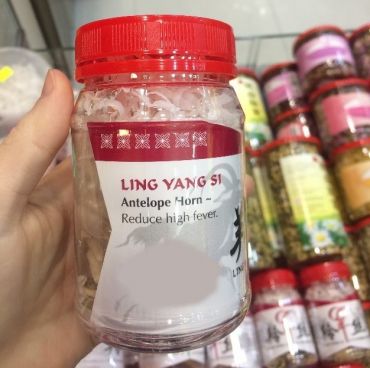 Saiga horn sold as medicinal remedy
Saiga horn is mainly used to treat fever and heatiness (a TCM state of illness with symptoms like nasal congestion and sore throat). Poaching of saigas in the 1990s took out more than 95% of the population, and poaching still persists today, despite many policy and on-the-ground efforts from range states and international bodies. In addition to this hunting pressure, saigas have also been heavily impacted in recent years by mass bacterial and viral disease outbreaks.
To address the dire attention gap around saiga horn consumers, our work, published today in PLOS One, represents the most extensive research to date on a saiga consumer population. We conducted over 2200 consumer surveys in Singapore with members of the general Chinese Singaporean population. Singapore is recognised as a top saiga consumer country, and within the country, legal-with-permit saiga horn products are marketed most commonly as ling yang (羚羊), antelope’s horn, or "Cornu Saiga tataricae".
Through our work we found that 19% of respondents were high-level saiga horn users. This means that they consider saiga horn to be a product they use most often to treat heatiness or fever in themselves and others. Additionally, 47% of individuals who buy saiga horn for themselves were also buying it for someone else. We saw that saiga horn users were most likely to be middle-aged Buddhist or Taoists, however, horn use was seen across almost all demographic groups.
Consumer research like this one is a first and necessary step in demand reduction efforts. By thoroughly understanding a user group you can more accurately design behavioural interventions targeting unsustainable consumption, or really any undesirable behaviour. Such evidence-based interventions are being conducted every day in fields like public health and development, targeting behaviours that range from alcohohism, to poverty alleviation, and excessive meat consumption.
One key insight we found, for instance, is that TCM shopkeepers and an individual’s family are the most likely people to have recommended saiga horn to someone, thus these are the influencers that can be utilised in a behavioural intervention. Shopkeepers, for example, fill a similar role as a western pharmacist, and pharmacist-dessiminated health interventions are a common tool that a shopkeeper-disseminated intervention could be based on.
We also found that saiga horn users had a greater overall propensity for perceiving animals that are used in TCM as being common in the wild (regardless of the animals’ actual conservation status), and that this difference was especially significant for saiga. Identifying an awareness gap like this one gives a clear possible angle for a future project message that strives to drive up conservation concern in a socially relevant way.
 Saiga horns for sale
Saiga horn use in Singapore is extensive, and non-negligible. And if attention remains solely on the supply-side of an unsustainable or illegal wildlife trade, then the root of the problem - consumer demand - will continue to drive poaching until there are no individuals left to poach.
Hunter Doughty is part of the Department of Zoology and this research features in the Oxford Martin Programme on the Illegal Wildlife Trade.
Read the full paper, 'Saiga horn user characteristics, motivations, and purchasing behaviour in Singapore'.
By Rachel Kowalski, DPhil candidate in Oxford’s Faculty of History and leader of the Violence Studies network.
This month marks the 50th anniversary of the outbreak of violence in Derry, Northern Ireland, in what has become known as the Battle of the Bogside. The August 1969 riots, involving local communities and the Royal Ulster Constabulary (RUC), are often referenced as the events which marked the beginning of the 30-year conflict commonly known as the Northern Ireland Troubles.
But the stones and petrol bombs thrown on those summer days were not the first sign of intercommunal tension, nor the first violent expressions of discontent. British Army troops has been deployed in the province on internal security duties since April of that year, and recent scholarship suggests there is reason to question previous claims that the RUC’s request for the deployment of troops in August 1969 came as a ‘surprise’ to the General Officer Commanding, Lieutenant General Sir Ian Freeland. Rather, the roots of the conflict were long, the violence was varied and persistent, and its impact was severe and deep.
Between 1969 and 1998, more than 35,000 shooting attacks and 10,000 explosions claimed the lives of over 3,600 individuals, with a further 40,000 suffering horrific or life-altering injuries. It’s not uncommon to see the most high-profile violent events of the conflict referred to in the media or commemorated on an annual basis.
But the conflict was more than the sum of those particularly spectacular or egregious events. The diverse and complex character of the conflict, which spanned decades, cannot be grasped if we reduce the history to its morbid ‘highlights’. The participating paramilitary groups’ motivations, members and activities were as diverse and changing as the various political and security forces’ responses to them, and whole communities were affected as a result. The totality of the resulting harm exceeded that which proved fatal or left visible scars on the bodies of survivors.
This June, the Violence Studies research network (part of TORCH, the Oxford Research Centre in the Humanities) hosted a series of events to examine the Northern Ireland Troubles in light of the 50th anniversary. Among those events were seminars featuring presentations from academics whose research into the early years of the conflict involves consulting previously closed archival materials. Papers from Dr Edward Burke, Dr Simon Prince, Professor Gavin Schaffer and Dr Margaret Scull shed light on a variety of key issues including the role of community support, the media and the Catholic Church.
Those papers reveal the microdynamics of both the perpetration and experience of violence in the early years of the conflict. But it’s the everyday experience of living through conflict that can be hardest to capture. The sources most readily available to scholars of violence – newspapers, security statistics, memoirs and oral histories – naturally tend to skew towards the extremes. And that’s why the multimedia performance of poet and musician Steafán Hanvey, hosted this June alongside the academic paper presentations, was so significant and powerful.
The performance doubled up as the official UK book launch of Hanvey’s father-son photo-poetry book, Reconstructions: the Troubles in Photographs and Words (2019, Merrion Press). The book provides unique insight into a family’s experience of the complex and vivid history of the Troubles, featuring images captured by Hanvey’s father, the renowned Northern Irish photographer Bobbie Hanvey, paired with Hanvey’s own strikingly original and powerfully raw poetry. The work was given life at the launch as Hanvey performed his music and poetry, accompanied by a slideshow of his father’s photographs. The audience gained an insight into how it feels to spend one’s formative years anchored in a conflict zone – Hanvey’s memories of only narrowly escaping harm himself were truly humbling to hear.
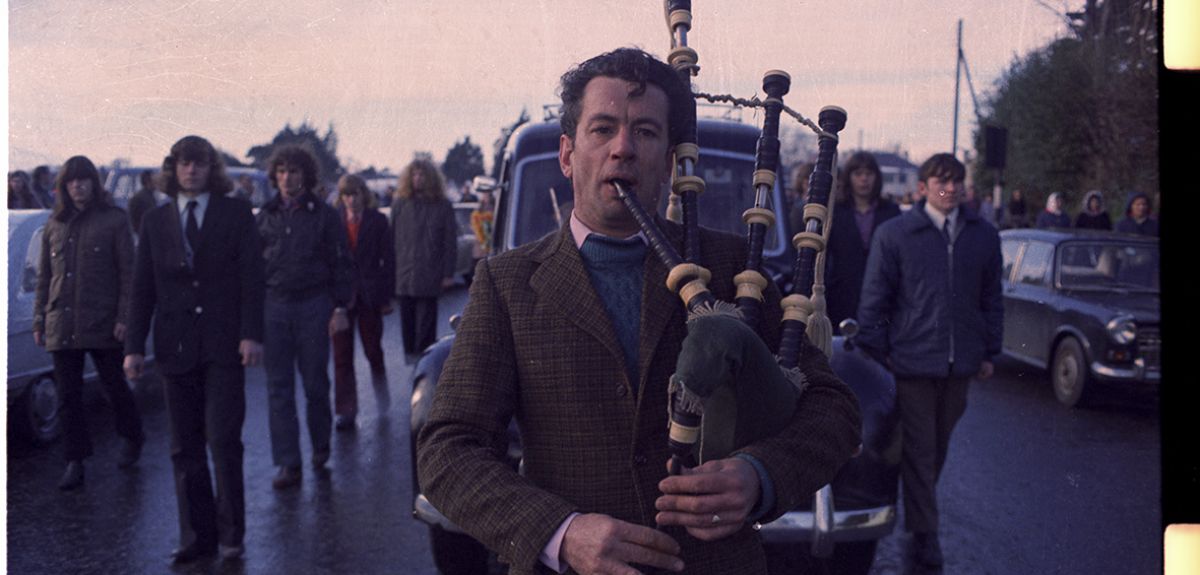
Hanvey’s performance of the poem 17 (Cause to Grieve) was particularly powerful. The piece was composed in response to Bobbie Hanvey’s photograph of a father’s salute at the graveside of his daughter, the IRA volunteer Vivienne Fitzsimons, who was ‘killed in action’ in February 1973 alongside a comrade as they transported a bomb. Vivienne lived just around the corner from Steafán Hanvey, who was ‘but seven months old when she left home for the last time’. Hanvey’s words convey both the closeness and distance of their separate paths, and how things could have been very different had he made other choices. But, unlike Vivienne, the only thing Hanvey was sure of at 17 was that he ‘wasn’t sure of anything; the only thing [he] would have died for was a record deal’.
For more on the Northern Ireland Troubles commemorative series by the Violence Studies network, listen to interviews and lecture recordings on the podcast channel Understanding Violence.

By Katharina Kaiser, Fabian Schulz, and Leo Gross (IBM Research - Zurich); Lorel M. Scriven, Przemyslaw Gawel and Harry L. Anderson (Oxford University)
Carbon, one of the most abundant elements in the universe, can exist in different forms - called allotropes - giving it completely different properties from color to shape to hardness. For example, in a diamond every carbon atom is bonded to four neighboring carbons, whereas in graphite, every carbon atom is bonded to three neighboring carbons.
While these are well studied forms of carbon, there are lesser-known forms and one in particular has been elusive – cyclocarbons, where the carbon atoms have only two neighbors, arranged in the shape of a ring. Discussed for many years, their structure was unknown, and two possibilities were debated, either with all the bonds in the ring of the same length or with alternating shorter and longer bonds. Adding to the drama, evidence for their existence was published in the gas phase, but due to their high reactivity, they could not be isolated and characterized – that is until now.
Based on our previous successes in imaging molecules with atomic force microscopy (AFM) and creating molecules by atom manipulation, scientists from the University of Oxford's Department of Chemistry and IBM Research attempted to find the answer to this debate. Our goal was to synthesize, stabilize and characterize cyclocarbon.
And for the first time, we have succeeded in stabilizing and imaging a ring of 18 carbon atoms.
Our approach was to generate cyclocarbon by atom manipulation on an inert surface at low temperatures (5 K) and to investigate it with high-resolution AFM. We started the collaboration between the groups of Oxford and IBM three years ago with this goal. Initially, we focused on linear segments of two-fold coordinated carbons, exploring possible routes for creating such carbon-rich materials by atom manipulation. We triggered chemical reactions by applying voltage pulses with the tip of the atomic force microscope. We found that such segments could be formed on a copper substrate covered by a very thin layer of table salt. Because the salt layer is chemically very inert, the reactive molecules did not form covalent bonds to it.
After the successful creation of the linear carbon segments, we attempted to create cyclocarbon on the same surface. To this end, the Oxford group synthesized a precursor to cyclo[18]carbon that is a ring of 18 carbon atoms.
Future applications are suggested by the fact that we could fuse cyclocarbons and/or cyclic carbonoxides by atom manipulation. This possibility of forming larger carbon rich structures by fusing molecules with atom manipulation opens the way to create more sophisticated carbon-rich molecules and new carbon allotropes. Eventually, custom-made molecular structures might be used as elements for molecular electronics, based on single electron transfer.

By Professor David Banister
In the UK, there is a legal commitment to reducing the net carbon account for all six greenhouse gases by 80 per cent (1990-2050) under the Climate Change Act 2008, and recently this target has been raised to 100 per cent. By 2050 UK greenhouse gas emissions will be cut to net zero. At present the aviation sector has been allowed to set and deliver voluntary targets. As globalisation progresses, more goods and people are being transported further and more frequently at ever-increasing CO2 costs. The aviation sector accounts for 7.3 per cent of UK CO2 emissions, but by 2050, aviation may account for over 20 per cent of all UK CO2 emissions. This radically changing position is a combination of other sectors reducing their levels of CO2 emissions whilst international aviation’s share of the total continues to increase.
This pattern of growth in long distance travel is not just restricted to the UK, but it is characteristic of all developed and many emerging economies. Globalisation has shrunk the planet, and society is now dependent on long distance and high quality supply chains as continued specialisation and concentration of production has kept prices low. Business practices have been transformed, but it is for leisure activities, together with visiting friends and relatives, that are now the fastest growing sectors of international travel. Leisure travel and visiting friends and relatives now account for about 85 per cent of UK air travel.
International aviation cannot be excluded from making a substantial contribution to CO2 reduction, as many planes will still be in operation in 2050. Offsetting emissions is not a solution to the problem, as it only serves to delay having to make more fundamental decisions. Substantially increasing the costs of flying through taxation on aviation fuel and through charging VAT on tickets, together with appropriate measures to account of the emissions at high altitude, will all help. But the only means to significantly reduce aviation CO2 emissions levels is to fly less.
The options available to reduce emissions for aviation are very limited, with some scope for electric or hybrid planes, alternative fuels (e.g. biofuels), lighter-weight materials, innovative design, improved fuel efficiency, and more efficient air traffic control and routing. But the main problem is the scale of change required and the time frame needed for effective action. The aviation industry has failed to address the climate crisis in terms of new aircraft or its operating practices.
Globally, this inaction is compounded by more aviation capacity is being constructed. The third runway at London Heathrow is currently going through its final stages of approval, and this will increase the number of annual flights from 473,000 to 740,000 (+56 per cent) and passenger numbers from 78m to 130m (+67 per cent). Currently London Heathrow produces 20.83 Mt CO2e each year, about 95 per cent of which can be attributed to flights (PEIR, 2019), and that with the expected growth in travel CO2 emissions will increase by about a half, even with optimistic assumptions on the introduction of technological innovations. Expansion on this scale at one major airport makes the UK net zero target unachievable.
Heathrow will offset all increases in CO2 emissions thought the UN Corsia scheme that is being introduced as a pilot scheme in 2021, with the voluntary first stage starting in 2024, and a subsequent mandatory phase in 2027, prior to a review in 2032. Yet there is very little detail on the exact rules to be followed, on eligible offset projects, and on the links with the existing EU Emissions Trading System. The International Coalition for Sustainable Aviation have calculated that only 6 per cent of all projected CO2 emissions from international aviation (2015-2050) will be covered. Such an imprecisely specified scheme will have no real impact for at least 10 years, and by that time projected CO2 emissions from aviation could have doubled.
There are huge inconsistencies between the rhetoric and the reality. It is hard enough to set the targets for reductions in CO2 emissions, but decisions are still being made to increase capacity. Such a strategy is entirely at odds with the net zero emissions targets. It is no longer only a matter of economics, but one of societal values, social pressure and personal choice. It is ultimately one about the quality of the life now and in the future, and the consequences of not addressing the climate crisis in a connected and holistic way that accepts the complexities and interactions between all decisions made.
David Banister is an Emeritus Professor of Transport Studies at the School of Geography and the Environment, University of Oxford.

Thousands of genes are involved in the regulation of our day-to-day metabolism and relatively little is understood about their function. One key protein, an ABC Transporter called ABCC5, has recently been predicted to be a susceptibility gene for Type 2 diabetes. In a new study Associate Professor Heidi de Wet of the Department of Physiology, Anatomy and Genetics has confirmed ABCC5's role in energy metabolism and identified the mechanism behind its metabolic impact for the first time.
A multitude of physiological signals regulates our appetite and metabolism. An empty stomach triggers the “hunger hormone”, Ghrelin, which acts on the brain to stimulate feelings of hunger. When the stomach becomes full, those hunger signals are muted. The arrival of digested food in the small intestine from the stomach engages with hormone-secreting cells known as enteroendocrine cells. These cells are the first point of contact between you and your food: the digested food triggers receptors on these endocrine cells causing them to release hormones into the circulatory system. These hormones have very important downstream effects: they regulate the release of insulin from the pancreas, prompt capillaries to move blood towards the stomach to absorb the food, trigger feelings of satiety in the brain, and interacts with the liver, muscle and fat to enable it to absorb glucose. In essence, 'these hormones are spectacularly important because they drive human metabolism in response to food,' explains Professor de Wet.
ATP-binding cassette transporters (ABC transporters) are proteins found in cell membranes that transport various substances in and out of the cell. This family of transporters is very well known in the context of certain diseases. Loss of function mutations in the CFTR gene (ABCC7) can cause the respiratory disease Cystic Fibrosis, while gain of function mutations in the multidrug resistance-associated protein 1 (ABCC1) can cause a tumour to become resistant to chemotherapy. However, the function of one of these transporters, an orphan transporter called ABCC5, was unknown for some time, until a recent study found compelling evidence for its key role in energy metabolism.
A Genome-Wide Association Study used subcutaneous adipose tissue from patients and control subjects stored as part of a diabetes biobank. The study demonstrated that overexpression of ABCC5 in human adipose tissue would cause their subjects to have a three-fold increased risk of developing type 2 diabetes with age. The individuals with increased levels of ABCC5 had increased visceral fat accumulation and were more insulin resistant. Consequently, the study predicted that ABCC5 may be the new susceptibility gene for Type 2 diabetes. However, the mechanism behind this susceptibility was unknown.
In order to confirm the role of ABCC5 in energy metabolism and understand the mechanism behind ABCC5’s metabolic impact, a team led by Associate Professor Heidi de Wet knocked the gene out in mice using a CRISPR technique and examined their metabolic profile. Distinctly opposite to the human overexpression phenotype, mice with no ABCC5 were lean, had less fat and were more active. They also demonstrated increased insulin sensitivity and increased amounts of gut hormone being released in response to an oral glucose dose. 'These mice were probably metabolically more healthy because they were able to respond better to the amount of food arriving in their small intestine,' says Professor de Wet. 'But, still we were unsure of the mechanism; how does ABCC5 manage to get more gut hormone released into the blood stream of these mice?'
Upon further investigation, the team were able to show that ABCC5 is most likely a neuropeptide transporter, meaning its function is to load neuropeptides into vesicles inside cells. The vesicle content is then released by a process called exocytosis, which refers to the series of events triggered when the receptors in enteroendocrine cells detect digested food, culminating in the secretion of hormones from these cells. 'Neuropeptides are information molecules, and these information molecules can be dumped into the circulation to tell your body how to respond to the arrival of digested food in the stomach,' says Professor de Wet. Once the vesicle content is released, the hormones are then free to act on downstream targets.
For the first time, the role of ABCC5 in glucose metabolism and in the regulation of metabolism in humans has been established. The de Wet Group has been able to find a direct link between ABCC5, its metabolic impact as predicted in the Genome-Wide Association Study, and the specific function this ABC transporter has in the gut.
The full publication, 'Abcc5 Knockout Mice Have Lower Fat Mass and Increased Levels of Circulating GLP‐1,' is available to read in the journal Obesity.
- ‹ previous
- 53 of 253
- next ›
 What Louise Thompson’s campaign tells us about the national maternity crisis
 Celebrating 25 Years of Clarendon
  Learning for peace: global governance education at Oxford
  What US intervention could mean for displaced Venezuelans
  Setting the agenda for the next century of quantum
 10 years on: The Oxford learning centre making an impact
 Mapping the Moon: the world’s first lunar atlas goes digital
  Oxford and The Brilliant Club: inspiring the next generation of scholars
 New course launched for the next generation of creative translators
 The art of translation – raising the profile of languages in schools