
Community of Sanctuary
The University of Oxford is committed to being a place of welcome for people who have been forcibly displaced around the world, and supports students and academics who have been forced to flee conflict or persecution.

History
Oxford University, colleges and wider city has a long-standing history of supporting people with lived experience of displacement, dating back to welcoming refugee academics during the Second World War up to the most recent support provided to students and academics affected by global crises.
The University's dedicated Refugee Studies Centre was established in 1982 and undertakes research, teaching, and outreach relating to all aspects of forced displacement.
Oxford has received University of Sanctuary status, and is proud to have signed the City of Sanctuary Organisation Pledge.
Professor Alexander Betts talks about Oxford's University of Sanctuary status...
Establishing Oxford as a Community of Sanctuary
Oxford's colleges of Sanctuary
Several Oxford colleges have a longstanding history of supporting displaced scholars, including through collaboration with the Council for At-Risk Academics (Cara), which helps academics facing persecution, violence and conflict to continue their work in safety.
Building on this commitment, Mansfield College became Oxford's first College of Sanctuary in 2021, followed by Somerville College in 2023. Both colleges have been recognised for their work to create welcoming and supportive environments for people seeking sanctuary, including through educational opportunities, scholarships and wider community engagement.
In September 2026, Reuben College became Oxford's third College of Sanctuary and the first graduate college to receive the award. Reuben was also the first college to achieve accreditation through the University's College of Sanctuary awards process, recognising its commitment to supporting people affected by displacement and fostering an inclusive college community.
Together, these colleges demonstrate the important role Oxford's collegiate community plays in providing opportunities, building connections and supporting those seeking sanctuary.
Oxford Sanctuary Fairs
The Oxford Sanctuary Fair has become a central part of the University’s commitment to being a Community of Sanctuary, bringing together refugees, asylum seekers, local residents, community organisations and public services in a shared space of connection, support and collaboration. Since its launch in 2023 as Oxford’s first town-and-gown Sanctuary Fair, the event has grown year on year in scale and participation, reflecting a strengthening network of partnerships across the city and beyond.
Held annually as part of Refugee Week, the Fair offers a free, inclusive space featuring exhibitions, workshops, performances and information clinics, alongside opportunities to connect with local services and community groups. In 2024 and 2025, the programme expanded to include a wider range of partners across the University, local authorities, charities and the private sector, supporting knowledge-sharing and practical engagement.
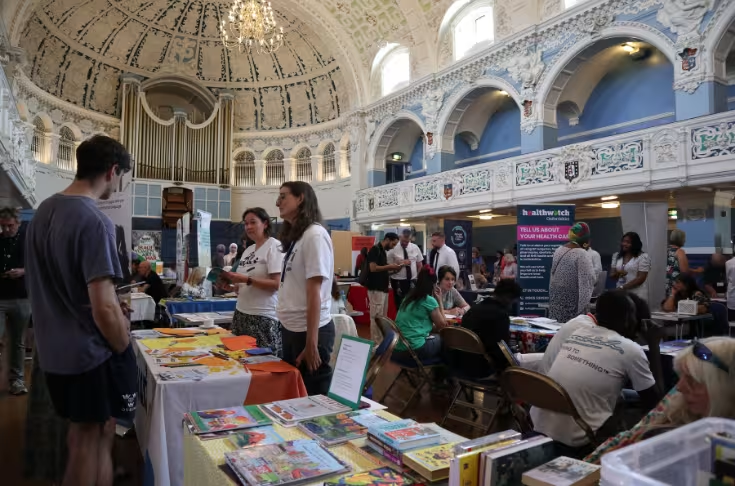
In June 2026, the fourth annual Oxford Sanctuary Fair moved to Florence Park Community Centre, with a two-day programme designed to bring the event closer to the communities it serves. The programme included family activities, live music, community stalls, the Displaced Derby football match and a workshop exploring education and English-language pathways, reflecting the Fair's continuing emphasis on inclusion, participation and community partnership.
As the Fair continues to evolve, it plays an increasingly important role in connecting research, education and lived experience, while supporting access to resources, volunteering opportunities and community-led initiatives. Find out more about the next Oxford Sanctuary Fair.
Oxford's Sanctuary Community
Scholarships and support
The University delivers an integrated programme of scholarships and support for students from displacement backgrounds under its ‘Oxford Sanctuary Community’. This provides pre-arrival and on-course support, a regular programme of social and cultural events, and a dedicated point of contact for all self-identifying members of the community.
The University offers a range of scholarships and a cohort support programme for students from displacement backgrounds.
With thanks to the generous support of funding partners across the University and colleges, as well as support from student members, the University has been able to offer scholarships to refugees and other forced migrants since 2016.
Academic Futures
Since 2022, the University has offered graduate scholarships to students from displacement backgrounds as part of its wider Academic Futures programme. The Refugee Academic Futures graduate scholarship scheme includes a dedicated contact person and cohort support programme available to all students within the collegiate University, who self-identify as having a displacement background.
Support for Ukraine
In 2022, the University welcomed 26 graduate students from Ukraine who were affected by the Russian invasion of Ukraine to join our graduate community. Further scholarships have been offered for the 2023-24 and 2024-25 academic years.
Support for Gaza and the West Bank
The Palestine Crisis Scholarship Scheme will provide access to higher education to students displaced by the humanitarian crisis in Gaza and the West Bank through the provision of full graduate scholarships to study at Oxford in 2025-26.
Other support
A range of other scholarships for students from displacement backgrounds have been confirmed for 2025-26 (and beyond), for instance as part of the University’s Africa Oxford Initiative in collaboration with the Mastercard Foundation, and through the Hope scholarships, in collaboration with the Weidenfeld Hoffmann Trust. More information can be found on the University's graduate scholarships pages.
Oxford Student Action for Refugees
We encourage our students to learn about sanctuary and to create an inclusive culture of welcome. As part of this, the University supports the Oxford branch of Student Action for Refugees in recruiting new members for the academic year.
Oxford's research
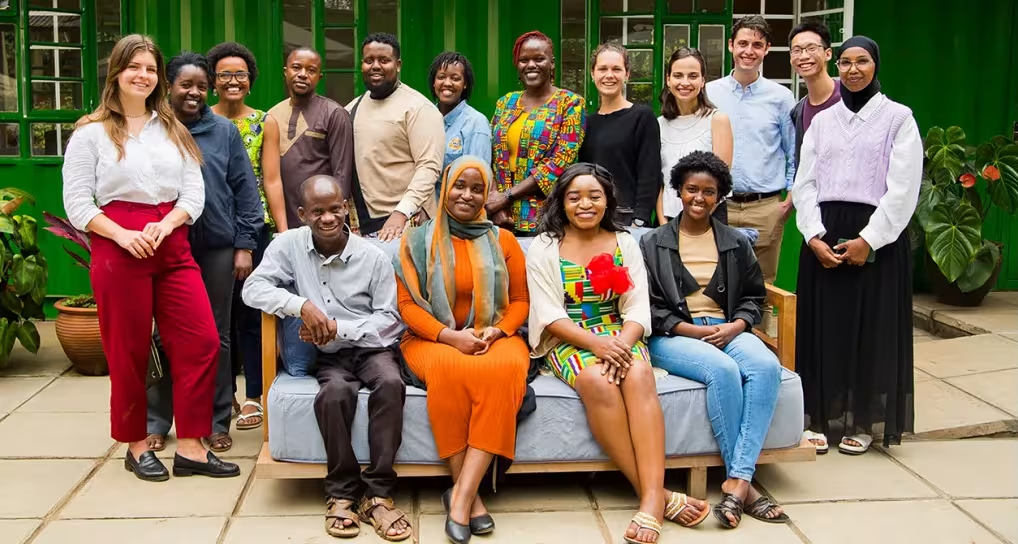
Refugee-Led Research Hub in Nairobi
With a physical base in Nairobi, the Refugee-led Research Hub (RLRH) supports researchers from displacement backgrounds to lead work that informs policy, practice and public understanding. It moves beyond participation by placing lived experience at the centre of research leadership and knowledge production.
The Hub delivers academic programmes, including a three-month online course in Refugee and Forced Migration Studies open to learners globally. It also supports access to graduate study and creates opportunities for participants to contribute to refugee-led research projects. This work connects research, education and professional development, building pathways into higher education and leadership.
The Hub also convenes the Refugee-Led Research Festival, a growing platform for collaboration and exchange. First held in 2022, the festival brought together researchers, artists and practitioners across East Africa through a hybrid programme of workshops, discussions, screenings and training.
The festival has continued to expand in scale and reach. In 2024, it brought participants from across the region, including colleagues from Nairobi, Dadaab and Kakuma, into a series of conferences, workshops and collaborative sessions focused on strengthening refugee leadership in research and localising knowledge production.
This approach continues through related workshops and international activity, including recent convenings in Amman. These sessions bring together participants from displacement backgrounds to develop research skills, build networks and explore pathways into postgraduate study and professional opportunities.
A short film, created by filmmakers with displacement backgrounds, documents the festival's early days and captures its collaborative, community-led approach.
Refugee Studies Centre
Oxford’s Refugee Studies Centre (RSC) undertakes research, teaching, and outreach on all aspects of forced displacement, combining academic rigour with a clear focus on real-world impact.
The Centre offers an MSc in Refugee and Forced Migration Studies, alongside a range of short courses, many of which include bursaries for learners from displacement backgrounds. It also publishes Forced Migration Review, the world’s leading practitioner-focused publication on forced displacement, produced in multiple languages and widely used by policymakers and practitioners.
Through its research, the RSC actively seeks to inform both policy and practice, shaping responses to displacement at local, national, and global levels. This work sits within a wider ecosystem across the University, where specialist research on migration and displacement is also led by centres such as the Centre for Migration, Policy, and Society.
For more information about the Oxford Sanctuary Community or the Sanctuary Fair, please email [email protected].