Features

Yesterday the Messenger probe sailed within 125 miles of the surface of Mercury. This closest fly-by of the planet since 1975 has provoked considerable interest ahead of the probe going into orbit in 2011. Oxford scientists are involved in another Mercury mission, BepiColombo, due to launch in 2013. They are co-investigators on the MERTIS instrument which will examine the surface composition of the planet - in particular looking for feldspars - as well as examining how heat travels across the surface and heat flux in Mercury's interior.
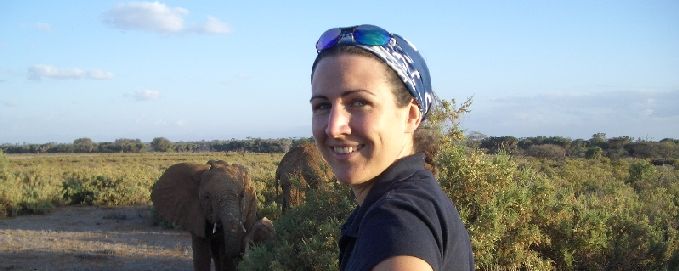 Lucy King
Working in Kenya, Lucy King found that the buzz of angry bees acts as a natural elephant deterrent. We caught up with Lucy to discuss her research, the huge media interest it generated and ask: what else scares off a 6-tonne pachyderm?
OxSciBlog: Why is keeping elephants away from people so important?
Lucy King: People and wildlife used to live side by side in Africa and in my study site, Kenya, there are still strong traditional and cultural bonds with elephants. However, as the human population has continued to develop and expand, elephants are being squashed into smaller and smaller home ranges often with key migratory corridors being cut off by man made structures such as roads, schools, farms, bore holes and factories. Due to this developing infrastructure pastoralists in Kenya are being encouraged to settle down and grow crops. This massive change in landscape use has caused conflict with elephants who are still trying to utilise the full scope of their traditional home ranges. Elephants that come across farms full of ripe tomatoes, potatoes and maize won't hesitate to break in and start feeding and this is where the conflict begins. Farmers will do anything to keep their crops and families safe from damage and unfortunately records of shootings, spearings and poisonings of elephants are on the increase. Our project work is trying to come up with a low-tech deterrent method that will not only keep elephants away from fields of crops but will also enhance the income of farmers through the sale of bee products.
OSB: How did you discover their fear of the sound of angry bees?
LK: On the back of his successful paper in 2002 which showed that elephants avoided trees with beehives in, my supervisor, Prof Fritz Vollrath, did a rather unique pilot experiment using bee sounds. There was a semi-tame African elephant on one of the ranches in Kenya that had been badly stung by a bee swarm the year before. Fritz played bee sounds at this elephant to see what would happen and he really freaked out and ran away. This triggered off several research questions which is what my DPhil is now based on. The key attribute we are working with is the incredible memory that elephants have showing that a past negative experience with bees can be remembered by elephants years later and results in a retreating behaviour. I am now trying to understand this behaviour better by conducting more formal, controlled sound trials and our initial results were published in Current Biology in October 2007.
OSB: Why are elephants, with their thick hides, scared of bee stings?
LK: Elephants can't be stung through their hides but bees are attracted to the water around their eyes which is a weak spot for stings. More importantly we know that elephants can disturb wild beehives as they forage up in the branches of trees and bees can get into and sting the inside of their sensitive trunks. We have stories from people who have witnessed this unfortunate event and the elephant was described as going 'berserk' trying to get the bee out of the trunk! Must be terribly painful and not something an elephant would forget in a hurry. We are also not sure if elephant calves would have thick enough skins to deter bee stings. If not, its understandable that mothers would be very wary about letting their young ones get too close to a wild African beehive.
OSB: How might hives be used as a natural elephant deterrent?
LK: We are working on a unique design for a beehive fence which has gone through a successful pilot project stage. We are now planning a larger scale trial with more farms to see if this could be a potential solution for keeping elephants away from crops (or at least lessen the crop-raiding damage). I'm also testing the idea that beehives offer some deterrent effect to trees on the back of Fritz's work in 2002.
OSB: What else scares off an elephant?
LK: Well, not much to be honest! Lions are generally chased away by elephants during the day but at night they can attack and kill young elephant calves so we know elephants are less successful against lions at night. Other things that seem to scare elephants away, at least initially, are fire, torches, dogs, bangers and bullets.
OSB: Have you had any close calls with elephants yourself?
LK: Yes, quite a few actually although all my fault for getting to close. We had one female elephant charge us as we were clearing some dung away from a tree experiment we were doing. She shot around the bush faster than you can imagine with ears out and trumpeting SO loudly! Luckily the car was very close by and we had to leap in and keep very still until she calmed down. Her trumpeting triggered her whole family to come out of the bush and they all started trumpeting and ear flapping at us in the car circling around us and basically showing us who was boss! Another time we were charged by a large bull in musth who was just bulging with testosterone and energy. I was in such a rush to get away from him that I had to drive my landrover up over a sandy ridge which slowed him down a bit. I went about 300 meters before realising that I was still in 1st gear and the screaming of my engine probably scared him off more than my deterrent tactics! Generally the elephants we work with are gentle and caring beasts but there is no harm in being reminded occasionally that we should be careful not to intrude into their space.
OSB: Were you surprised at the media interest? Any tricky questions?
LK: The media interest was enormous and we were very surprised by the extent of the interest, particularly from overseas countries as far as Indonesia, India, Australia, America, Canada and Brazil. We didn't get too many tricky questions although some journalists seemed to get stuck on the idea that if elephants are scared of bees they could also be scared of mice which was amusing but rather off the point! Discovery Channel came and did a live television interview with me from my house in Nairobi for their Canadian programme 'Daily Planet' which was quite an experience.
OSB: What's the latest on your research?
LK: We are concentrating on a large scale field trial of our beehive fence idea which will be crucial to see if the idea works in practice. I'm also collaborating with Disney's Wildlife Conservation Fund scientists to expand and develop our sound experiments. It's a very exciting time and I'm only just starting my second year of my DPhil so there is plenty of time left for more discoveries!
Lucy King is currently a DPhil Researcher in Oxford University's Animal Behaviour Research Group
Diabetic? Then you should be prescribed statins, according to a paper in today's Lancet. Statins are drugs that can lower your cholesterol. As statins reduce the risk of death from heart attack by a third and almost 80 per cent of diabetics die from heart attacks or strokes you can see why this might be a good idea. Colin Baigent, who led the work at Oxford, said: 'These benefits are present in everyone who has diabetes who has been studied - irrespective of whether they have had a heart attack or stroke, their age or sex, and their cholesterol levels'. Researchers collated evidence from studies involving 90,000 people.
How people power can be the key to scientific success
With a million images of galaxies to classify and no computer program up to the task the Galaxy Zoo team had one big scientific headache: ‘I classified about 50,000 galaxies myself in a week,’ said astrophysicist Kevin Schawinski, ‘it was really hard work.’ Even with the help of colleagues at this rate it could take many months, even years, to achieve their objective. Yet, just three days later, the team had 1.6 million galaxy classifications and were able to massively expand the scope of their original project.
How did they do it? By, in three days, recruiting 40,000 members of the public to register on the www.galaxyzoo.org website and start classifying galaxies. This number rose to over 100,000 armchair astronomers following the July 2007 launch and would lead to their new target of having every galaxy classified over 30 times being met by November 2007. ‘The response has been amazing,’ said Dr Chris Lintott who leads the Galaxy Zoo team at Oxford, ‘we thought people would be interested in the project but the enthusiasm and dedication shown by our volunteers, as well as the sheer number of people getting involved, is unbelievable.’
Galaxy Zoo is just the latest Oxford initiative to get non-scientists involved in science. ClimatePrediction.net was launched in September 2003 to use the power of people’s home computers to investigate state-of-the-art climate models. It would go on to become the world’s largest experiment to try and produce a forecast of climate in the 21st Century. February 2006 saw the www.climateprediction.net researchers team up with the BBC for the BBC Climate Change Experiment that was nominated for a BAFTA and, in October 2007, won the internet category of the Prix Europa media awards. The Screensaver Lifesaver Project (www.chem.ox.ac.uk/curecancer) also got people to donate their home computing power, this time to screen 3.5 billion molecules for cancer-fighting potential. The project, which finished in April 2007, ran for six years and made use of 450,000 years of screensaver time to determine which molecules had a high likelihood of being developed into a drug.
So what makes members of the public give up their time, or computer time, for free? If Galaxy Zoo users are anything to go by then the something visually fun that peaks people’s curiosity and gives them a sense of achievement is a winner. Word of mouth was a key element of the site’s success as visitors emailed the address around the world: ‘I heard about this site in an email. Being an avid birdwatcher with a strong interest in physics and astronomy, this sounded like it would be right up my alley,’ said Nat Taylor Winston from Nashville, USA ‘I found I couldn't stop once I started.’ Derek Barnett from Florida discovered that it even appealed to his five-year-old son: ‘he saw the first couple images, and asked me what I was doing. I explained to him the very basics, and he asked if he could do some with me. So, up into my lap he jumped and we sat here for an hour looking at things that few people, if anyone, had ever seen. When he'd finally had enough for one night he looked at me and asked ‘Daddy, can we play the galaxy game again tomorrow?’ I told him, ‘of course, but it's not a game, it's science.’ After a couple of stunned seconds of silence, he said, ‘we're doing SCIENCE?’ with the sort of excitement that most people lose after they grow up.' It seems that wonder and enthusiasm, plus a worthy goal, times lots of people can be a very powerful formula for doing ambitious science.
This article was previously published in the December 2007 edition of Blueprint magazine.
- ‹ previous
- 252 of 252
 What US intervention could mean for displaced Venezuelans
  Setting the agenda for the next century of quantum
 10 years on: The Oxford learning centre making an impact
 Mapping the Moon: the world’s first lunar atlas goes digital
  Oxford and The Brilliant Club: inspiring the next generation of scholars
 New course launched for the next generation of creative translators
 The art of translation – raising the profile of languages in schools
  Opening a window into the quantum world
 Tracking resistance: Mapping the spread of drug-resistant malaria