Features

By David Macdonald, Director of WildCRU
Tigers are in dire straits, with prospects for the Indochinese subspecies among the most dire of all. This is why I want to spotlight the work of Eric Ash for leading research on one of the few known breeding sites for the subspecies anywhere in the world.
Eric Ash, a doctoral student at Wildlife Conservation Research Unit (WildCRU), part of the University of Oxford’s Department of Zoology, has dedicated himself to the conservation of tigers in Thailand for the last nine years. Now, with our collaborators at the Freeland Foundation, he has led our new paper published in the journal, Land.
The under-studied and endangered Indochinese tiger faces extinction and continuing declines, a distinction that unhappily makes the subspecies a candidate for Critically Endangered status
The under-studied and endangered Indochinese tiger (Panthera tigris corbetti) faces extinction and continuing declines, a distinction that unhappily makes the subspecies a candidate for Critically Endangered status. Thailand plays a crucial role in its conservation – there are few known breeding populations in other range countries. Our work has focused on Thailand’s Dong Phayayen-Khao Yai forest complex (DPKY), a group of five protected areas and UNESCO World Heritage Site, where Eric and Freeland Foundation, in partnership with the Thai-government and Panthera, conducted a massive camera-trapping study to find out just how the tigers there were faring.
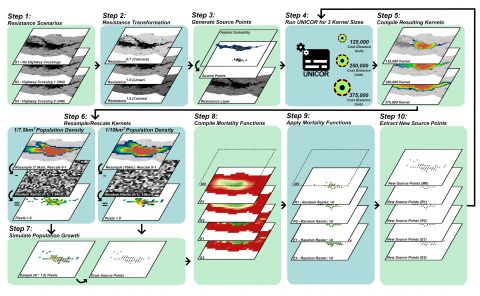
Importantly, we evaluate the sensitivity of population connectivity models to the variation and interaction of key factors, such as landscape resistance to movement, dispersal ability, population density, and mortality, over a series of timesteps. The article, led by researchers at WildCRU, offers insight into potential tiger range expansion scenarios.
The authors utilize spatially and temporally-dynamic simulations to model tiger population changes and dispersal from this landscape to potential habitat elsewhere in Thailand, Cambodia, and Laos, areas where tigers are thought to be extinct.Our new paper builds upon the remarkable news that this vital population of tigers could be recovering, as evidenced by signs that tigers are beginning to disperse from core areas into frontier habitat from which they had previously been extirpated
Our new paper builds upon the remarkable news that this vital population of tigers could be recovering, as evidenced by signs that tigers are beginning to disperse from core areas into frontier habitat from which they had previously been extirpated.
This was a huge analytical effort, informed by an even greater effort under arduous conditions in the field which generated over a million camera-trapping images and almost 80,000 collective trap nights over nine years. The team ran advanced analyses, requiring months of high-level computing, which produced 24,300 simulations of population, landscape connectivity, and density of dispersing individuals across the landscape to evaluate the effect of key factors.
The result? The computer models suggest that the tiger’s fate is extremely sensitive to variations in mortality and dispersal ability – and, over time, these two factors interact to strongly affect predictions. For the technical aficionado: incorporation of an explicit mortality component, reflecting differences in probability of survival across the landscape, combined with increased dispersal ability, resulted in considerably lower estimates of population and connectivity.
These results are hugely important for tigers, but they also offer an important lesson more broadly: given the importance of population connectivity modelling in cutting-edge ecological research, the approach of the WildCRU team can inform future assessments for rare or threatened species where empirical data are scarce – a challenge faced by many researchers around the world.
This study is among the first explicitly to evaluate the interaction of dispersal ability and mortality on population size, distribution and connectivity in a spatially and temporally explicit dynamic framework. The authors are convinced that future studies should adopt this approach, explicitly accounting for mortality risk across landscapes and potential interactions with dispersal ability over time. The ways in which these factors can vary over time in reality can drastically affect the simulated results. Importantly, for translating this research into impact, the study identified potential population growth and range expansion scenarios for tigers along with key factors relevant to their long-term management across this key landscape in Southeast Asia.
'How Important Are Resistance, Dispersal Ability, Population Density and Mortality in Temporally Dynamic Simulations of Population Connectivity? A Case Study of Tigers in Southeast Asia', Ash, E.; Cushman, S.A.; Macdonald, D.W.; Redford, T.; Kaszta, Ż. Land 2020, 9, 415. https://www.mdpi.com/2073-445X/9/11/415

By Professor Louise Hayward, Department of Education, University of Glasgow and Professor Jo-Anne Baird, Department of Education, University of Oxford
We are not living in normal times. In common with many countries around the world, Scotland has had to cancel their examinations and to rely on teacher judgement. The young people and their teachers who have worked so hard and who have achieved so much in such difficult circumstances are to be applauded. The pressure such sudden changes have put on examination boards also has to be recognised. They have had to generate, trial and test then implement a new system in a matter of months when normally such changes take many years.
Today young people across Scotland will receive their examination results. They are anxious because these results are high stakes. Future opportunities, for example access to particular university or college courses or to employment are limited and the examination results represent the way that Scotland chooses to open doors to these opportunities. It may not be much comfort to this year’s young people but for previous generations the stakes were even higher. Not performing well in examinations meant that doors closed. The education system in Scotland is now much more flexible and offers alternative routes such as the wide range of opportunities offered by Scotland’s colleges.
Every year in Scotland the examination results prove contentious. If the results improve, standards must be falling; if the results decline, the education system is failing. Rarely is either true
However, every year in Scotland the examination results prove contentious. If the results improve, standards must be falling; if the results decline, the education system is failing. Rarely is either true. However, any approach to assessment where the implications are so significant for individuals and their families should, and do, come under significant scrutiny. The nature of any system that seeks to ration opportunities will always lead to a situation where some are delighted and others disappointed. That happened last year and it will happen this year.
Teacher assessment has much to commend it - the teacher is able to gather evidence about more of the curriculum, knows the young person, is able to collect evidence over time rather than a single snapshot. Yet, particularly when the stakes are high, teacher assessment also faces challenges. Having teacher judgements be consistent, not only within a school, but across every school in the country is a major challenge for countries internationally. For the system to be fair, teacher judgements need to be consistent nationally.
The moderation of teachers’ professional judgements is part of a national quality assurance system to ensure parity. Without moderation, this year’s results might not only have been inconsistent, they might have been far too generous. This is what we know from research on teachers’ estimates. The consequences of that for this year’s young people could have been very damaging, if this had become known as the year that the results were inflated. There is research evidence to point to differences in teacher judgement that relate to gender, class and ability. It is crucial that due attention is paid to those to ensure that young people are treated fairly.
No method of assessment is perfect. External examinations suit some young people who thrive on the pressure - others find the pressure unbearable and struggle to cope. Have an off day on the exam day and your results can vary significantly.
No method of assessment is perfect. External examinations suit some young people who thrive on the pressure - others find the pressure unbearable and struggle to cope. Have an off day on the exam day and your results can vary significantly
Examinations are limited in what they can measure and commonly internationally lead to narrowing of the curriculum and limited approaches to learning and teaching. Significant amounts of time in 4th, 5th and 6th years are spent rehearsing for examinations and can become little more than past papers, prelims and endless tests leaving young people dissatisfied and disinterested. The Examinations become an end in themselves and learning only matters if it is in the examination.
Learning in the 21st century demands more than that. What matters for young people in future depends as much on their ability to collaborate, to be creative, to add value to society as it does on their ability to solve a quadratic equation. It is not a question of either/or. Both matter. Our qualifications system needs to change to respond to what matters for our future citizens. Teacher professional judgement will play a crucial role in that new system.
This year, as in previous years, some young people will not receive the results they so hoped for. Recognising that the system has had to change more quickly than might have been desired to respond to COVID-19, the SQA will offer a more open appeal process than has been the case in previous years. This is just. The Appeal process offers a space where evidence related to each case can be reconsidered and decisions reviewed. Where further evidence points to the need to change a grade, changes will be made. SQA should and has committed to do this.
This year, as in previous years, some young people will not receive the results they so hoped for. Recognising that the system has had to change more quickly than might have been desired to respond to COVID-19, the SQA will offer a more open appeal process than has been the case in previous years. This is just
However, as in previous years, even after Appeal some young people will remain disappointed. That is the nature of a system where future opportunities are competitive because they are limited in number. Public confidence in the qualification system is crucially important to this year’s pupils. As a nation, we owe it to our young people to value their efforts and their achievements and not to seek to ask more of this year's qualification system than we have asked of the systems in previous years. To do so would put at risk the credibility of the awards of the very young people we seek to support.
Professors Hayward and Baird are independent academics (Professors of Education) and do not speak on behalf of their institutions. They are members of a number of advisory groups, including SQA’s Qualifications Committee but are not employees and do not speak on behalf of SQA.
We got the ‘green’ in green issues from the chlorophyll in plants. But the botanical world – which drives the planet’s ecosystems – is the Cinderella science, struggling for resources and recognition, struggling even to keep up with the rate of extinction. And there’s a reason for that – or quite a few, says Oxford Professor of Systematic Botany, Robert Scotland.
While arbitrary international targets are set for ‘saving species’, loss is very much a reality in the funding-strapped world of plants. The truth is, plants have been disappearing at the rate of at least two species a year, every year, for the last 250 years (but that’s a very conservative estimate, we don’t really know).
There are a lot of unknowns - and very big numbers - in the world of plants. Of the 370,000 known species of flowering plants, at least half are so poorly known they are almost invisible to any conservation effort
There are a lot of unknowns - and very big numbers - in the world of plants. Of the 370,000 known species of flowering plants on Earth, at least half are so poorly known they are almost invisible to any conservation effort - as fewer than 25% of flowering plants have a conservation assessment. In terms of insects, the situation is even worse: with just one million described species out of an estimated 6 million. To put these numbers in context, altogether there are some 36,000 birds, mammals and butterflies – about which much more is known.
We do know that about 40% of all land has been claimed for agriculture, so the assumption is that many plants and insects have already disappeared. But we do not really know. It is estimated because of this that more than half the plants in the world’s collections are mislabelled. Imagine for a moment, how significant that (big number) is. If 50% of plants in collections have an incorrect name, what does that mean for our understanding of one of the biggest living groups on Earth? And what does it mean for conservation?
Plant taxonomy, the approach that could sort this situation, does not fit into the zeitgeist - science by innovation
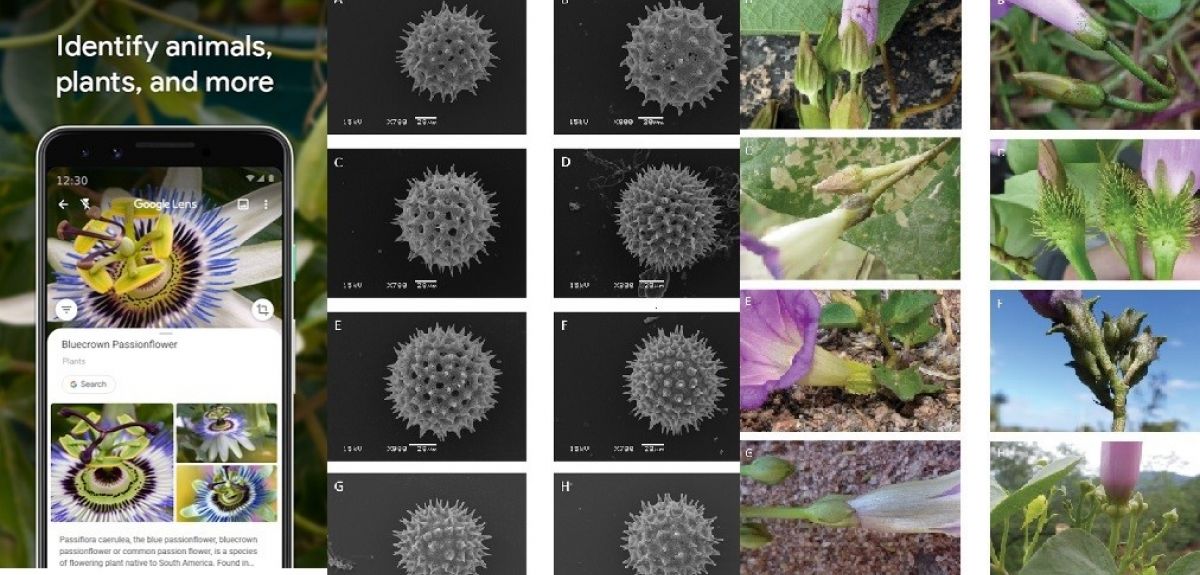
The fact is, plant taxonomy, the approach that could sort this situation, does not fit into the zeitgeist - science by innovation. There is innovation in plant science. Professor Scotland’s team embraced all the technological advances available, including DNA and phylogenetic trees – earlier this year to create a door-stopping monograph of Ipomoea ‘morning glories’. But the science, the pain-staking taxonomy of identifying and recording many known specimens in a species and creating a monograph, is unadulterated, hard-core botany. It may not be good TV, but it is fundamental and good science.
No Luddite, when walking his dogs, Professor Scotland enjoys using Google Lens to identify UK plants. ‘The app is often right in context of UK plants that are very well known,’ he says, surprised, although pleased to be able to catch it out. But the Professor stands by the science of monography, carefully cataloguing and classifying plants as the most effective way to bring order to the chaos of the botanical world - and make long-term progress.
It is essential, says Professor Scotland, to get to grips with what is there, before it is possible to save it. But at the moment, given a business-as-usual capacity, recent Oxford research has shown it takes about 100 years to discover a plant species, at the most basic level. From collecting the first specimen of a species, to describing it as new, and then gathering 15 correctly-identified specimens of that species, it can take a century.
According to a research paper from a team including Professor Scotland and Dr Zoe Goodwin of Edinburgh, some 40 years is the initial discovery phase – that’s from when the sample is brought in by a plant collector, to when it is identified by a botanist.
But, such is the lack of capacity in the system for taking this further, it can then be another 60 years before the next stage is completed and the 15 samples are gathered, as supporting evidence. It is a tortuous process. It impedes progress and action, but it is essential to identifying species.
What chance of achieving conservation targets, when there is no accurate inventory of plants? What chance can there be of a completed inventory of plants, when it takes 100 years even to reach a basic understanding of a species?
What chance of achieving conservation targets, when there is no accurate inventory of plants? What chance can there be of a completed inventory of plants, when it takes 100 years even to reach a basic understanding of a species? How can this process be speeded up, when there is little interest or support for monographic taxonomy and no coordinated international policy – and half of collections are mislabelled? The task is simply enormous – and that is before we even get to thinking about conservation and biodiversity.
Targets for climate change are clear and comprehensible. But when it comes to plants, the 2010 targets – for instance, to have conservation assessments for all plants by 2020 - were ‘pie in the sky’, according to Professor Scotland, ‘Well-meaning but out of reach’.
He maintains, ‘The most recent high-profile policy suggestion is to simplify the message, as was done for climate change scientists, where the aim is to limit global warming to two degrees C. The suggested unified biodiversity target is to limit species’ extinctions to 20 species per year for the next 50 years.’
But, a clearly exasperated Professor Scotland says, ‘This target is impossible to implement, given the lack of basic knowledge of the world’s biodiversity
When it comes to plants, the 2010 targets...were ‘pie in the sky’, according to Professor Scotland, ‘Well-meaning but out of reach’
In fact, he says, most of the Convention on Biodiversity (CBD) international targets, from 2010-2020, ‘were doomed to fail’.
In simple terms, Professor Scotland explains, ‘There is no global strategy for sorting out the taxonomy of flowering plants and insects, so understanding the conservation status of many tropical plants and insects is simply not possible....unless you know what is there, how can you save it or monitor its health?’
Professor Scotland is not recommending an unreconstructed return to Victorian botany as a solution to the world’s problems. But, he insists, it is essential to tackle the huge gaps in knowledge before significant global targets can be made.
Why does it matter?
Clearly a cricket fan, he maintains, ‘Taxonomy is a front foot approach [attempting to tackle the issue, rather than taking a reactive approach]. But we are a very long way from any willingness [internationally] to see something worthwhile in this, despite the evidence.’
Much can be learned from the experience of creating the Ipomoea monograph. Although they were following the path of the first monographer, another Scottish-born Oxford botanist, the celebrated Robert Morison, Professor Scotland and the team confronted the very modern reality of the international plants problem. It was clearly a seminal experience.
It is tempting for the team to reflect that not much has changed in the 300+ years since Morison created the world’s first monograph [of the carrot family]. But taxonomy is in some ways more difficult now than in the past, because of the huge number of specimens that now exist, a voluminous messy literature and many names associated with a group (60-70% of published plant names are usually synonyms). Years of effort was needed to identify the many specimens of Ipomoea in collections around the world - many were synonyms, as the same species had been ‘discovered’ and named multiple times.
If you’re attempting to monitor the health of biodiversity and extinction accurately, you need to know what’s there. We’re never going to get to a comprehensive system where we know everything, but we are a very long way from knowing even half of the world's biodiversity in any detail
Professor Scotland maintains, ‘On the one hand there is a huge diversity of plants, which is a great resource for humankind. But it needs sorting out.
‘On the other hand, if you’re attempting to monitor the health of biodiversity and extinction accurately, you need to know what’s there. We’re never going to get to a comprehensive system where we know everything, but we are a very long way from knowing even half of the world's biodiversity in any detail.’
Goodwin et al 2020 How long does it take to discover a species? Systematics and Biodiversity
Wood et al 2020. A foundation monograph of Ipomoea (Convolvulaceae) in the New World 2020, PhytoKeys. 10.3897/phytokeys.143.32821
Muñoz-Rodríguez et al 2019. A taxonomic monograph of Ipomoea integrated across phylogenetic scales. Nature Plants 5, 11, 1136-1144. 10.1038/s41477-019-0535-4

Professor Katrin Kohl of Oxford's Faculty of Medieval and Modern Languages has written a letter to The Guardian calling on Ofqual to 'urgently adjust grade boundaries and implement proper quality control for Modern Foreign Languages (MFL) exams'. The letter has been signed by 150 university teachers, and The Guardian has also published a report on the issues raised. Here, Katrin Kohl gives further details about how the design and grading of exams are affecting MFL subjects and the pupils studying them.
Languages have long been considered ‘difficult’. The reasons are obvious – you can’t make progress without learning lots of vocabulary, you have to get your mind round illogical grammar rules and avoid getting discouraged by mistakes when applying them, and you project yourself publicly as an ignoramus every time you open your mouth to practise speaking. Moreover, words and rules are almost as quickly forgotten as they’re learned. Add to this the fact that English native speakers already know the most useful language in the world including the language of the internet and dominant pop culture, and it’s hardly surprising that foreign language learning in the UK is suffering.
There are many joys and rewards in learning languages, too – cognitive benefits, cultural enrichment, communicative empowerment, sense of adventure, creation of a new identity. Yet these require careful nurturing, patience and time. And time is in particularly short supply in crowded school timetables.
Powerful measures are needed if the difficulties are not to win the day. The most effective one is making the subject compulsory at school. In other European countries that’s normal. In England, that battle was lost in 2004 when the Labour government made languages optional at GCSE. Further nails were hammered into the languages coffin with the intensive promotion of STEM subjects as a career advantage, the abolition of the fourth AS subject from 2016, and the push towards fewer GCSEs with the reformed qualifications. Counter-measures by the government such as the EBacc and compulsory language teaching at primary level have not succeeded in reversing the trend.
There’s now widespread alarm at the rapid loss of language skills as schools reduce provision and universities close language departments. The All-Party Parliamentary Group on Modern Languages has demanded a Recovery Programme; the British Academy has issued a Call for Action together with the Royal Society, Academy of Medical Sciences and Royal Academy of Engineering; and the Arts and Humanities Research Council has invested some £16 million in research programmes designed to give languages a shot in the arm.
Meanwhile the spotlight is on the GCSE and A level exams in Modern Foreign Languages – are they fit for purpose? This is all the more critical in a context where other factors are impacting negatively on the subject. Yet schools report that it’s primarily the difficulty of the course and exams that is prompting learners to drop the subject. There are two interconnected issues here. One is ‘severe grading’. The other is the intrinsic difficulty of the exam papers, which in turn generates courses that are too demanding and makes for stressed teachers and learners. The exam regulator Ofqual is ultimately responsible for both issues since it oversees the work of the exam boards and maintains standards across subjects.
After some ten years of complaints from teachers, five years of support from the higher education subject community, and several consultations and research studies, Ofqual acknowledged last November that grading in MFL A levels is indeed, as teachers had claimed, ‘severe’ and that French, German and Spanish A levels are ‘of above average difficulty’. Yet Ofqual decided not to make an adjustment to the grades.
A consultation is now underway for a similar exercise with GCSEs in MFL. The decision expected in the autumn. So what about the impact of severe grading? Ofqual has been amassing statistical proof to show that there is no causal link with falling numbers. But can that possibly be the case? Which learner, parent or school will go for a subject that has statistically been proven even by the exam regulator to be ‘severely graded’ and thereby put the student’s university place at risk?
A key factor underlying excessive difficulty of the language exams for English learners is the presence of native and near-native speakers of the language in the exam cohort. This factor is unique to Modern Foreign Languages and it was partially addressed by Ofqual in 2017 with a small one-off adjustment to A level grading in French, German and Spanish. But what hasn’t yet been acknowledged is their effect on the exam papers.
This is significant, especially for smaller languages where the proportion of native speakers tends to be highest. Research commissioned by Ofqual showed that in the German A level sample, almost half the students gaining an A* were native-speakers, while at grade A, they made up almost a fourth. These are invisible to examiners, exam boards and Ofqual when it comes to scrutinising marks profiles. So even if the exam is far too difficult for non-native speakers, there will be enough marks gained at the top end to suggest the exam is working.
In fact an examiners’ report for the 2018 A level in German indicates that there may be insufficient awareness of difficulty as an issue. In the case of a reading comprehension question concerning a grammatically highly complex sentence with a word very unlikely to be familiar to an English learner, the examiner comments that the question ‘discriminated well. A few candidates answered this correctly and gained a mark’. The sample answer given in the report for this part of the exam is likely to be by a near-native speaker.
Learners, then, face a triple whammy – a rushed, stressful course that can’t possibly prepare them thoroughly for the exam at the end of it; a demoralising exam experience that makes them feel failures; and a grade that is below what they would get in another subject for equivalent performance.
So what’s to be done? There’s a window between now and Ofqual’s autumn decision for a change of direction. Ofqual needs to acknowledge the overwhelming evidence of anomalies in Modern Foreign Languages assessment – and act:
- Reopen the question of A level grading, and carry out the necessary adjustment to eliminate ‘severe grading’.
- Simplify the exam papers, and ensure that the exam boards start working with robust criteria for controlling the level of linguistic difficulty appropriately for non-native speakers.
- Gain better understanding of the impact of native and near-native speakers on exam papers, marking and grading, and make the necessary adjustments for all languages so non-native speakers are rewarded appropriately.
The subject community in schools and universities is keen to support this endeavour. If Ofqual does not address these matters now, language learning in the UK will face an inexorable further downward spiral caused by unrealistic expectations, exam difficulty, severe grading, irreversible loss of provision in schools and universities, and an intensifying teacher shortage.
You can read Ofqual’s response to the Guardian article and letter here.
Read Professor Kohl's letter to Ofqual, plus supporting documents on the Creative Multilingualism website.

In the summer of 2015, Peter Frankopan published his book The Silk Roads: A New History of the World, described by Bloomsbury as ‘a major reassessment of world history in light of the economic and political renaissance in the re-emerging east’.
Just three-and-a-half years later, the book has been named one of the 25 most important works translated into Chinese over the past 40 years. The Silk Roads takes its place on the list alongside literary classics including Pride and Prejudice, The Great Gatsby, Catcher in the Rye and One Hundred Years of Solitude.
Professor Frankopan, Professor of Global History at Oxford and Senior Research Fellow at Worcester College, described himself as ‘flabbergasted’ to be chosen for the list, which was compiled by Amazon China on the 40th anniversary of Chinese reform and opening-up.
He said: ‘When I was told about it, I thought it was a wind-up. Many of the books on the list are ones I admire hugely, and to be mentioned in the same breath as The Great Gatsby, One Hundred Years of Solitude, or A Brief History of Time is genuinely astonishing. I realise that tastes come and go, so who knows if it will still be mentioned in 25 years’ time. But it is a great testimony to the importance of the humanities in general, of history, and of the impact that historical writing can have far beyond the Senior Common Rooms of Oxford.’
The Silk Roads challenged Eurocentric views of world history, shifting the focus east of the Mediterranean. It became a bestseller in a host of countries and categories, and was met with widespread acclaim. A follow-up work, The New Silk Roads, was released last year and explores more recent events.
In Professor Frankopan’s own words, by writing The Silk Roads he was simply ‘trying to explain how the past looks from the perspective of the Eastern Mediterranean, Middle East, Central Asia and beyond’.
He added: ‘I’ve been a Senior Research Fellow at Worcester for nearly 20 years, and Director of the Oxford Centre for Byzantine Research since it was founded nearly a decade ago. I simply wanted to explain why the regions, peoples and cultures that I work on are not just interesting, but also important. It was not easy to write at all and I spent many, many late nights at my computer trying to work out if it was possible. I never thought for a moment about whether lots of people would read it. But I did think it was worth trying to write!’
Reflecting on the book’s success, Professor Frankopan – who has just published an illustrated version of The Silk Roads for younger readers – said: ‘It’s been a lovely – if sometimes strange – experience. This week alone, I’ve had tweets or Instagrams from people sending pictures of my book from bookshops in Norway, Indonesia, Nigeria, India and Pakistan, and lots of emails from all over the world, often asking questions about what to read next, or for more information about a specific location, which I always try to answer if I can. But I don’t think it has affected me – we have four children, who do a pretty good job in keeping my feet on the ground. And because, like most academics, I always have deadlines for articles or chapters in books, there’s never a great deal of time to bask in the sunshine as I’ve got too much to be getting on with as it is.’
- ‹ previous
- 3 of 9
- next ›
 Setting the agenda for the next century of quantum
 10 years on: The Oxford learning centre making an impact
 Mapping the Moon: the world’s first lunar atlas goes digital
  Oxford and The Brilliant Club: inspiring the next generation of scholars
 New course launched for the next generation of creative translators
 The art of translation – raising the profile of languages in schools
  Opening a window into the quantum world
 Tracking resistance: Mapping the spread of drug-resistant malaria
 Cities for cycling: what is needed beyond good will and cycle paths?