Features
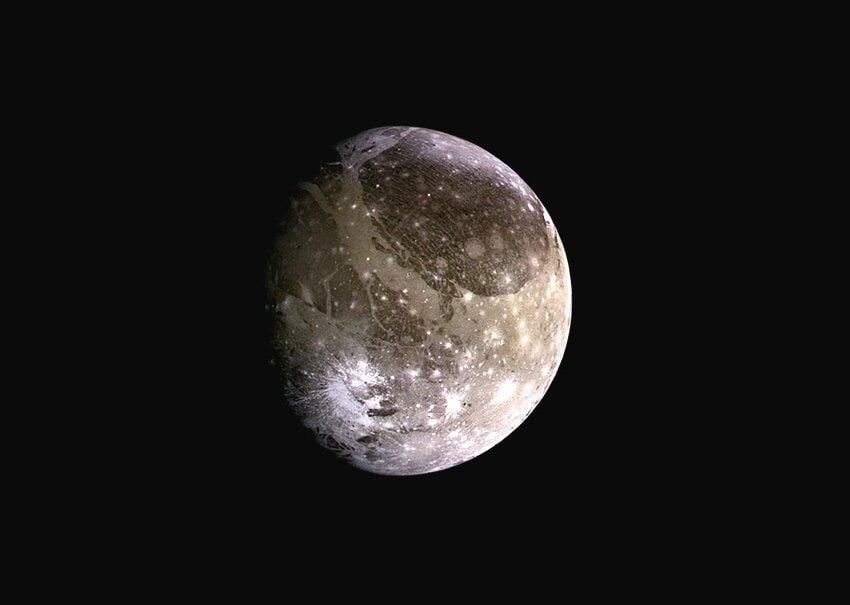 Ganymede as observed by the Galileo spacecraft
It’s official: it was announced today that Oxford University scientists will help to prepare a mission to Jupiter and its icy moons.
But whilst the JUICE spacecraft will beam back valuable data on several of the planet’s satellites, it will give special attention to one in particular: Ganymede.
I asked Leigh Fletcher of Oxford University’s Department of Physics, one of the JUICE team, about the appeal of Ganymede, what they hope to find there, and how Oxford scientists will probe the secrets of this enigmatic 'waterworld'…
OxSciBlog: What makes Ganymede so interesting?
Leigh Fletcher: When people think of moons in our solar system, they often imagine them as being inferior to the main planets, and somehow less interesting. The moons of Jupiter show how wrong that misguided assumption can be - the four largest Jovian moons (Io, Europa, Ganymede, and Callisto) are the size of planets, and each has a fascinating and rich geologic and chemical history.
These moons truly are worlds in their own right, with a diverse range of unusual landscapes and features that can keep scientists busy for decades. ESA has chosen to focus on Ganymede, the largest example of an icy moon in our solar system. It is thought to be made of roughly equal measures of rocks and water ice, and is likely to harbour a saltwater ocean beneath its icy crust. For those searching for habitable environments in our solar system, the mantra has always been to follow the water, as the vital solvent for the chemical reactions of life.
Ganymede's surface has a mixture of ancient, dark, cratered surfaces, and brighter water-ice-rich regions of ridges. The biggest feature is a dark plain called Galileo Regio, visible from Earth even through amateur telescopes, and may even have polar caps of water frost. Furthermore, Ganymede has an extremely tenuous oxygen atmosphere, and is the only moon in our solar system with a magnetic field, probably caused by convection within a liquid iron core.
OSB: How does it compare to Jupiter’s other moons?
LF: To better understand Ganymede, it's important to consider the processes which shaped its evolution and surface features by comparing it to the other Galilean moons: although these four worlds of fire and ice probably had the same origins in the Jovian sub-nebula, their present-day structure is the end of product of aeons of subsequent evolution. Jupiter's immense gravity causes tidal flexing of the moons (strongest at Io, weak or absent at Callisto), providing energy to liquefy the water ice crusts and produce internal activity.
Io is mostly rocky, lacking the water ice of the other satellites but featuring hundreds of active volcanoes. Europa is the smallest of the four, with a smooth geologically-young icy surface overlying a water ocean, heated by the tidal flexing from Jupiter. Ganymede's ocean is likely to be deeper than Europa's, under a thicker ice crust. Callisto is further away and experiences less tidal heating, resulting in an ancient terrain, one of the most highly cratered surfaces in the solar system.
OSB: What do we hope JUICE will find out about it?
LF: JUICE will be the first orbiter of an icy moon, and provide a full global characterisation of its surface composition, geology and structure. An ice-penetrating radar will peer through the icy crust for the first time, providing us with our first access to the water ocean of a Galilean moon. Our key goal is to assess the potential habitability of Ganymede as a representative of a whole class of ‘waterworlds’ which may exist around other stars, building upon the discoveries of habitable environments on the Earth's deep ocean ridges.
So JUICE will be looking for key characteristics of habitability on Ganymede - sources of energy, access to crucial chemical elements, liquid water, and stable conditions over long periods of time.
It's a crucial step in our reconnaissance and exploration of our solar system, and towards answering the question of 'What are the necessary conditions that make a planetary body habitable?’ By comparing the three potentially ocean-bearing Galilean moons, we hope to identify the physical and chemical characteristics driving the evolution of this planetary system.
JUICE will study the extent of Ganymede's ocean, its connection to the deep interior and ice shell; the global distribution and evolution of surface materials, geologic features, and present-day surface activity; and the interaction with the local environment and magnetosphere. In addition, JUICE will explore recent activity and composition on Europa, and characterise Callisto as a remnant of the early Jovian system. Finally, JUICE will be capable of exploring the wider Jovian system, from the complex and dynamic Jovian atmosphere, the magnetosphere, the minor satellites and rings.
OSB: What instruments will be needed to study it?
LF: The proposed JUICE payload has cameras to take images of the icy moon surfaces and swirling Jovian clouds; spectrometers covering ultraviolet, near-infrared and sub-millimetre wavelengths to determine moon compositions and temperatures, winds, composition and cloud characteristics on Jupiter; a magnetometer and plasma instruments to conduct an investigation of Jupiter's magnetosphere; and a laser altimeter, ice-penetrating radar and radio science instrument to probe below the surface of the Galilean moons and through the Jovian cloud decks.
The payload is just a model right now, and other instruments could be added. All this will be launched on a 5 tonne spacecraft in 2022, with solar arrays to provide power and a large high-gain antenna to return the data to Earth. It will take 7.5 years to reach the giant planet, before going into orbit around Jupiter to conduct an extensive survey of the whole planetary system. Then, in the final phase in 2032, it will enter orbit around Ganymede.
OSB: How are Oxford scientists likely to contribute?
LF: Oxford has a strong heritage of contributing instrumentation and data analysis techniques for outer solar system missions, notably with the near infrared mapping spectrometer (NIMS) on Galileo and the composite infrared spectrometer (CIRS) on Cassini.
We also have a long-term campaign of giant planet studies from ground-based observatories in Hawaii and Chile and space-borne telescopes (Spitzer, Herschel, Hubble). This has allowed us to contribute to the science case for a return mission to Jupiter and its icy moons, identifying the key questions and mysteries left unanswered by previous generations of spacecraft.
Oxford, along with many other UK institutions, will hope to contribute instrumentation to fly to Jupiter to address some of these questions. Involvement with Galileo and Cassini enabled Oxford to build up a rich planetary science group, with a broad range of experience from lab spectroscopy to spacecraft hardware, and from icy moons to gas giant dynamics. This expertise will help us to solve the challenges of the JUICE mission.
OSB: What is the next big milestone for the JUICE mission?
LF: Now that the mission has been officially selected by ESA as the L-class mission for 2022, the hard work really begins. Industry will be invited to design and build the spacecraft systems, and an announcement of opportunity will be issued to call for instrument designs. Teams will be assembled to thrash out ideas for instruments that address key scientific questions, all hoping to see their particular design on the launch pad when we lift off for Jupiter in a decade's time.
The final go-ahead for the mission from ESA, known as 'adoption', should come in the next 2-3 years.
Exactly what sort of headgear do sub-atomic particles wear?
This is one of the important issues addressed in an animation about the Large Hadron Collider (LHC), the first offering from Oxford Sparks, a new portal giving people access to some of the exciting science happening at Oxford University.
In search of the science behind the fun, I asked Alan Barr of Oxford University’s Department of Physics, who works at the LHC, about his role as scientific adviser on the animation and coping with a cast of prima donna protons…
OxSciBlog: Why do you think we need an animation about the LHC?
Alan Barr: The Large Hadron Collider is one of the inspirational science experiments of our time, but it can be difficult for a non-expert to understand what it is about. Anything which helps make the science accessible - even as a first taste - is a good idea as far as I’m concerned. So when the OxfordSparks team suggested using ‘A quick look around the LHC’ as a pilot for OxfordSparks.net, I happily agreed to help advise on the science side.
OSB: What contribution did you make to the LHC nugget?
AB: I wish I could say I’d done the animation – but thankfully the hard bit was done by Karen Cheung, a really impressive professional animator from the company Jelly. My role as scientific consultant was to try to make sure that, as well as being great fun, the cartoon conveyed as much physics as possible, and as accurately as possible. Of course that’s a bit tricky in a cartoon. Protons don’t really wear crash helmets, and the Higgs boson doesn’t really have a flower in his hat, even if he appears to in the cartoon. But we were able to illustrate the basic ideas of what happens at CERN - the acceleration, the collisions and the detection of new particles.
OSB: What concept are you most proud to see in the finished animation?
AB: When particles move close to the speed of light, the effects of Einstein’s relativity are really important. Very fast particles get heavier, and so our character - Ossie - starts feeling rather bloated as he gets accelerated. Later on, when the protons collide, their energy is turned into new, exotic particles - again just as predicted by Einstein and as we observe in the collisions at CERN.
We’ve also put together some extra information on the OxfordSparks web page describing a little more background about how the accelerator works, and the role that Oxford played in the construction and operation. We explain, for example, how we one can detect the characteristic signals we expect from exotic new particles like Mr Higgs.
OSB: What feedback have you had from fellow physicists/the public?
AB: I emailed an early version of the animation to some of our own graduate students here in Oxford. As soon as I heard their laughter coming down the corridor I knew that we were onto a winner. After we released it on YouTube the uptake was fast… I’ve just had a peek at the YouTube page and there have already been more than 27,000 views, so it’s clearly caught the public imagination. We’ve also had interest from other LHC scientists around the world… so who knows – we may even end up going international, just like the LHC itself.
You can like Oxford Sparks on Facebook, follow on twitter or visit at YouTube.
Scientists studying the calls made by killer whales and pilot whales have a big problem: these whales talk too much.
Because they make so many different sounds it is very hard to work out what these noises might mean. A first step would be to understand the typical sounds these animals make, and that’s where volunteers visiting Whale.FM can help.
Robert Simpson of Oxford University, one of the researchers behind the project, told Scientific American’s Mariette DiChristina:
‘When you visit Whale.FM, you are presented with a sound clip of a recording of a whale. The idea is to match the big sound that you see/hear with one of the smaller ones underneath.
‘All the pairings go into a database and we use that to find the best pairs of sounds and build up our understanding of what the whales are saying to each other. Basically: we need help decoding the language of whales.’
Whale.FM is the latest in a series of ‘citizen science’ projects led by or involving Oxford University scientists (others include Old Weather, Ancient Lives, and Galaxy Zoo) and is a collaborative effort of Scientific American, Zooniverse and the research institutions WHOI, TNO, the University of Oxford, and SMRU.
One of the questions always raised by citizen science projects is whether volunteers can perform tasks as well as professional scientists. To test this the team took a selection of calls where they already knew the call category and tested them against the groupings given by people visiting the site.
‘We found that the Whale.FM volunteers grouped up the sounds in the same way that professionals would,’ Robert comments. ‘It agrees very well. We found approximately 90 percent agreement in our preliminary test. Our volunteers are amazing!’
Perhaps the biggest surprise, he says, is that their results could be used to help improve automated algorithms for decoding whale sounds:
‘There are tens of thousands of whale calls out here. It would seem that Whale.FM can help narrow the big problem into a smaller, more manageable one.’
In a crowd, looking different can be dangerous, at least if you’re a pigeon.
A new study from Oxford University has examined the so-called ‘oddity effect,’ in which predators preferentially attack different-looking individuals within a prey group - presumably because it enables them to focus on a single target within a confusing, moving mass.
To test whether this hunting strategy actually pays off for the predator in terms of enhanced reproductive success, Christian Rutz of Oxford University’s Department of Zoology studied urban goshawks preying on feral pigeons in the city of Hamburg, Germany.
A report of his research is published in Current Biology.
In feral pigeons, most individuals are grey-blue but many flocks contain a few white birds.
‘Goshawks are specialist bird hunters, and in urban environments, their preferred prey is the feral pigeon,’ says Christian. ‘When attacked by a raptor, pigeons seek safety in numbers and form a tight flock. Goshawks struggle to single out a suitable victim in such flocks, but by focussing on an odd-coloured individual, they seem to be able to enhance their attack success.’
But, Christian explains, like other skills this hunting strategy is something young birds have to learn: ‘Male goshawks apparently hone their hunting skills over their first few years of life. As they get older, they become not only better pigeon hunters in general, but they also get increasingly selective for odd-coloured individuals.’
Importantly, the study found that those hawks that master this selective attack strategy are the best breeders:
‘An efficient hunter can provide a lot of food to their offspring,’ Christian comments. ‘In goshawks, the most selective pigeon hunters initiate their clutches very early in the season and raise young of excellent body condition.’
This finding leads to an intriguing question: why doesn’t this selective hunting drive rare white pigeons to extinction?
‘Feral pigeons apparently prefer to mate with partners who are of a different colour to themselves,’ Christian notes. ‘Thus, white pigeons may risk paying the ‘ultimate price’ for being conspicuous, and get killed by a hawk, but they are preferred mating partners of their much more common grey-blue counterparts and seem to enjoy reproductive advantages whilst alive.’
The work may encourage studies in other species to move beyond simply recording success rates in predators attacking swarming prey, to examine explicitly how different attack strategies may affect a predator’s reproductive performance.
An Oxford University researcher has won FameLab UK, a competition that aims to spot the best new science communicators by getting them to deliver a nugget of science wisdom in a talk lasting just three minutes.
In the final, which took place last night at the Royal Institution, Andrew Steele of Oxford University’s Department of Physics secured the prize ahead of nine other finalists with a talk about why carrots are a delicious testing ground for quantum mechanics.
‘Why is this carrot orange? It turns out that carrots are quantum vegetables, and their delightful colour can be understood with one of the simplest ideas in quantum mechanics: the so-called particle in a box,’ Andrew told the judges and assembled audience.
He went on to describe how the beta-carotene in carrots is a ‘molecule in a box’:
‘Think of it like an angry cat. <miaow> In fact, to squeeze an electron, or a cat, into a box so small that we knew exactly where it was would take an infinite amount of energy. And kicking a cat in an infinitely small box would just be mean…’
Andrew concluded by exploring how light interacts with carrots and tearing a spectrum printed on a card in half:
‘If you shine white light on a carrot, everything that’s green or more energetic gets absorbed by the electrons, and you’re only left with red, orange and yellow being reflected back into your eyes. And that’s why carrots are orange.’
His talk won over the judging panel of Andrew Cohen, head of BBC’s science unit, anatomist, science writer and broadcaster Professor Alice Roberts, and Oxford neuroscientist Professor Russell Foster, as well as winning the audience award.
Andrew tells me: ‘The final was pretty nerve-wracking! There was strong competition and a real diversity of styles so it must've been as hard for the judges as it was for us finalists. It was amazing to have the chance to speak in such an illustrious venue as the Royal Institution, and obviously I'm thrilled with the outcome!’
The prize includes £1000 in cash and £750 to spend on a science communication activity and Andrew will go on to compete for the title of International FameLab Champion at The Times Cheltenham Science Festival in June.
- ‹ previous
- 189 of 252
- next ›
 Setting the agenda for the next century of quantum
 10 years on: The Oxford learning centre making an impact
 Mapping the Moon: the world’s first lunar atlas goes digital
  Oxford and The Brilliant Club: inspiring the next generation of scholars
 New course launched for the next generation of creative translators
 The art of translation – raising the profile of languages in schools
  Opening a window into the quantum world
 Tracking resistance: Mapping the spread of drug-resistant malaria
 Cities for cycling: what is needed beyond good will and cycle paths?