Features

Thursday 8 March marks International Women's Day, a global commitment to honouring the cultural, social, economic, political and academic contributions of women. Over the next few weeks, Science Blog will start the celebrations by shining a light on the incredible women of Oxford and some of their achievements.
Despite the different backgrounds, motivations and journeys that brought them to the University, each of the women featured have one important thing in common: success. In a field where women are still woefully underrepresented, they are rapidly carving their own niche, inspiring budding scientists of tomorrow in their own way.
Science Blog meets Layal Liverpool: 'I can't wait until there are no more firsts'
Representation is often discussed in today's society, but it means something different to everyone. Its impacts though are undisputed, taking hold from a young age and rippling out to shape the rest of our lives. Lack of representation can distort our understanding of people who are not like us and prevent some from imagining themselves in a situation - blocking their talent from developing into an opportunity in the process.
One person who understands this well is Layal Liverpool, a 24-year-old DPhil student investigating virus-host interactions at the MRC Weatherall Institute of Molecular Medicine. In addition to her studies, Layal is a committed science communicator and STEM ambassador. She shares her experience as a young woman of colour navigating the world of academic science.
I've been to a few career seminars, but only ever seen one woman of colour presenting. I can't wait until that changes and there are no more firsts.
What inspired you to pursue a career in science?
Even at the age of five I had a natural interest in learning new things and solving problems, to the point that I was obsessed with encyclopaedias - my parents were worried I wouldn't read anything else.
I also had a great A-level biology teacher, who had a PhD and happened to be a woman. Having her in my life meant that I never saw science as not being for girls.
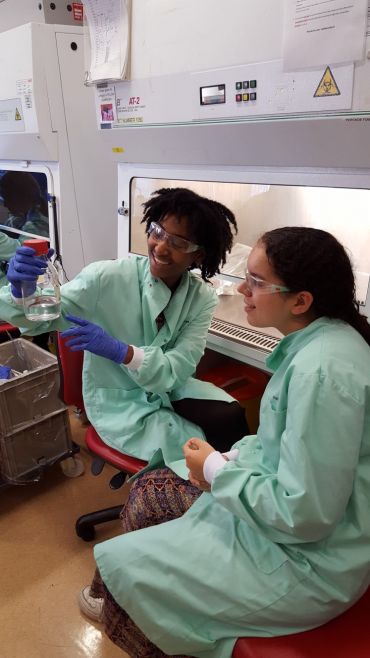 Layal (left) hard at work in the lab with a visiting student, at the MRC Weatherall Institute of Molecular Medicine. Image credit: OU
How did you come to specialise in infectious diseases?
My parents are originally Ghanaian, so as a child I spent a lot of time there. Ghana was significantly affected by the HIV pandemic and growing up I saw marketing about using condoms and how to stop the spread of HIV. I was just a kid and had no idea what it was, but I was curious and wanted to find out more. During my bachelor's degree at UCL, I took a brilliant course on infection and became absolutely fascinated by viruses in particular. I find the way the human body works - particularly disease and why things go wrong - fascinating. I chose to study immunity against viruses in general, to learn about multiple infections.
Viruses are not even alive and yet they can cause such complicated diseases - that fascinates me.
What are you working on at the moment?
At the moment I am building on a lab project established by a previous researcher, aiming to better understand how viruses are detected when they first invade our cells.
Do you think diversity is an issue in STEM?
Absolutely. Just the other day I attended a career seminar - I've been to a few of these, but this was the first time I had ever seen a woman of colour presenting. I felt so inspired and was really struck by the fact that she was the first highly successful woman of colour that I had seen giving one of these seminars. I can't wait until that changes and there are no more firsts.
It was really interesting to hear from her about how much the world has changed since she first started working - for example, she shared some past experiences of overt discrimination in the workplace.
My advice to anyone considering a career in science is don't let self-doubt stop you. The only way you definitely won't get in is by not applying.
Would you say that role models are important in science?
I've been fortunate to have wonderful role models so far that I truly appreciate, but very few have looked like me and I hope that changes. I think that would be really great for the younger generation because representation matters.
I love my field and feel very fortunate to be here at Oxford, but if I could change one thing about my experience it would be to have and interact with more women like me at different stages. The University has a mentoring scheme, and I think it would be great if that ran across all levels. For example, as a doctoral student I could be mentored by someone more senior, but equally I could mentor new applicants and people just starting and help them navigate the University.
How would you describe your experience at Oxford?
I am constantly grateful to be here, and get to work alongside world-leading researchers, but I think university is still a very elite environment, and there is a way to go to improve diversity - especially at my level. I have noticed that the higher you go within the University, the diversity decreases, which is a shame. There are a lot of talented people working in STEM who I think could be there, but the opportunities need to be available to get them there.
If I could change one thing about my experience it would be to have and interact with more women like me at different stages.
Are there any changes that you think would make a difference?
More representation is not easily achievable, unless more young people are inspired to pursue science careers. I have volunteered at Saturday Science Club, a science activity programme for families run by Science Oxford, and my hope is that when the children in the group are asked 'what does a scientist look like?' they will say 'anything'.
What does being a woman in science mean to you?
I view my studies as an important step along the road of using scientific research to benefit society. It wasn't that long ago that women didn't have these opportunities. I like to reflect and recognise how far we've come, but also how far we still have to go. There are some incredible women doing incredible things in science and I feel fortunate to have the opportunity to work alongside them and contribute.
How did you first get involved with science communications?
I actually auditioned for FameLab, where you have to explain a scientific concept of your choice in three minutes to a general audience. I spoke about HIV and made it to the regional final. A key element of understanding something is being able to explain it in simple terms, and the experience really improved my science communication - I really enjoyed it.
Why is communication so important in science?
Perhaps they have always been there, but nowadays there seem to be more misconceptions around science that can lead to dangerous ideas, such as the anti-vaccine crusade. Better communication about science would give people an understanding, so that that they can hopefully appreciate the benefits of vaccines and other important interventions.
What has been your biggest learning curve so far?
I learn a lot from my outreach work with children - they are so smart. As you grow older you have more to lose, so you develop a sense of fear and stop asking important questions. I think they ask more probing questions than adults, and I find they inspire me to change my approach to my work.
A key element of understanding something is being able to explain it in simple terms. A good scientist should be able to explain their work to anyone.
Who inspires you?
I've been fortunate to have lots of great role models - male and female - but my parents are my biggest inspiration. They are both immigrants that have overcome their own share of challenges to build a life for my sister and me. Education was a privilege that they worked hard for so that we could have more opportunities than they did. Both are half Ghanaian, but my mum is half Lebanese and immigrated to the UK. My dad is half Dominican and immigrated to the Netherlands - which means that I am fortunate to have claim to five nationalities.
What gets you up in the morning?
In the world of science things don't always work the first time, but I love the feeling of carrying out an experiment and getting an unexpected result. Often that is where new discoveries are made.
What are you most proud of?
Honestly, I am just proud to be here. We often doubt ourselves, particularly if there aren't role models that look like us. But my advice to anyone considering a career in science is don't let that stop you. The only way you definitely won't get in is by not applying.
WATCH LAYAL EXPLAIN HER PHD IN THE PUB:
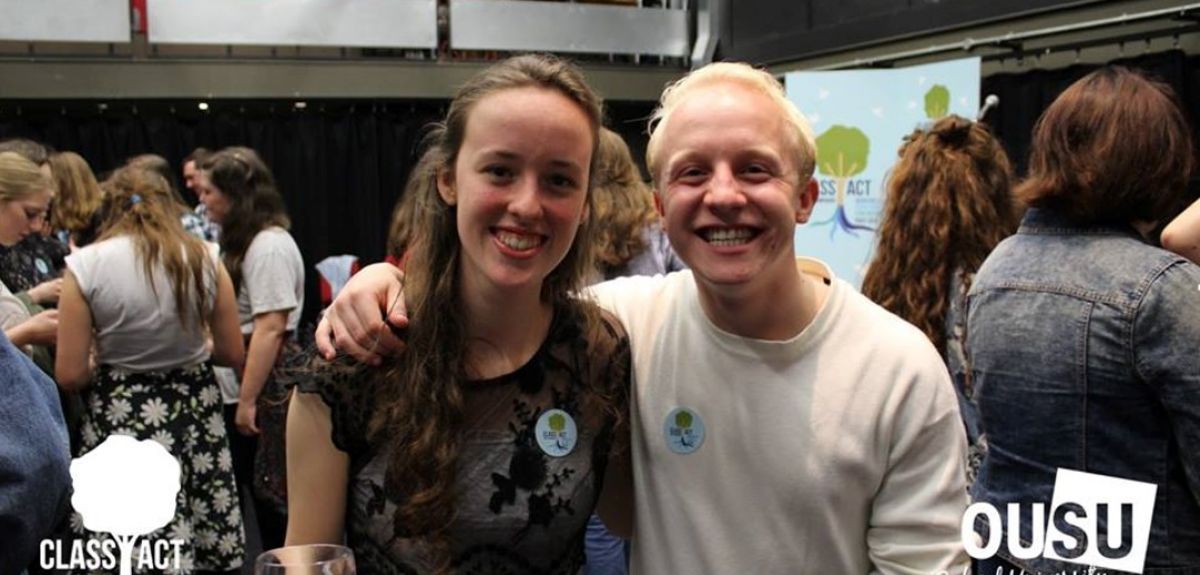
Even though nobody in her family had been to university before, Jaycie Carter dreamed of studying English at Oxford.
And, now that she’s here, she’s making sure that all students who study here feel comfortable regardless of their background.
Jaycie is part of a team, led by Oxford University Student Union (OUSU), that set up Class Act, a new campaign that aims to support working class, low income, state comprehensive and first-generation students.
“I’d been thinking a lot about class, and writing about it for my English degree, and I thought it would make such a difference for students like me to have a place where they could meet, talk, and discuss the issues that we face,” Jaycie says.
From a young age, Jaycie, who is from the West Midlands, enjoyed studying, using English and psychology to explore the history of ideas and society.
“I knew I wanted to go to university, cause I’ve always been quite academic and read a lot,” she says.
Jaycie hoped to go to Oxford, and now that she’s here, she’s relishing all the city offers.
“It was the dream, so it’s a bit weird actually being here now. Sometimes I have to remind myself—it’s really cool that I’m here!” she says.
Outside of her English degree, she’s also an active member of the LGBTQ community.
“I really like my course, and studying areas I’m interested in, like class and sexuality,” she says. “And the LGBTQ community is great, we have so many resources and events happening every week.”
Being part of the LGBTQ community made Jaycie think about how valuable it would be to have a similar community for students from working-class backgrounds.
“I saw how helpful it is to meet with other people who are similar to you,” she says. She wanted to foster the same sense of community for working-class and state-educated students who, like her, can face a unique set of challenges when they arrive at university.
“It can sometimes be alienating if you or your family don’t have much experience of higher education,” she says.
So, when she heard about a new campaign for working-class students that was in the pipeline, Jaycie got involved. The campaign launched in May 2017, and Jaycie was elected co-chair. Now, she’s excited to get started.
“It’s important to give people spaces to acknowledge the things they face. My aim is to create the things I needed when I got here,” she says.
The campaign has four strands: working class, state comp, low income, and first generation. Any student who identifies with any of the strands is welcome to get involved. “We want to make our campaign as broad and welcoming as we can. We’re not try to define what it means to be working class,” Jaycie says.
Since the launch, the campaign has held a social, and there are plenty more plans in place. This includes speaker events and a survey that will ask students what they’d like to see from the campaign.
With a team of reps—which represent the diverse experiences and identities of students in Oxford—the committee ran four social events last term, as well further events such as an LGBTQ meet up and a social for students from state comprehensives.
They’re also hoping to create an academic guide, which will give students access to information they might not have been made aware of before they arrive, and to run careers events, in which alumni from Class Act backgrounds will come and chat about their experiences and offer students the opportunity to network.
Jaycie is excited to be part of a committee that will complement all of the positive access work that Oxford does by creating support systems for students once they arrive.
And her efforts are already paying off. “The reception has been amazing. Lots of people have said it’s great that the problems they’ve faced are being acknowledged and discussed,” she says.

An image of a single positively-charged strontium atom, held near motionless by electric fields, has won the overall prize in a national science photography competition, organised by the Engineering and Physical Sciences Research Council (EPSRC).
‘Single Atom in an Ion Trap’, by David Nadlinger, from the University of Oxford, shows the atom held by the fields emanating from the metal electrodes surrounding it.
The distance between the small needle tips is about two millimetres. When illuminated by a laser of the right blue-violet colour the atom absorbs and re-emits light particles sufficiently quickly for an ordinary camera to capture it in a long exposure photograph.
The winning picture was taken through a window of the ultra-high vacuum chamber that houses the ion trap. Laser-cooled atomic ions provide a pristine platform for exploring and harnessing the unique properties of quantum physics.
They can serve as extremely accurate clocks and sensors or, as explored by the UK Networked Quantum Information Technologies Hub, as building blocks for future quantum computers, which could tackle problems that stymie even today’s largest supercomputers. The image, came first in the Equipment & Facilities category, as well as winning overall against many other stunning pictures, featuring research in action, in the EPSRCs competition – now in its fifth year.
David Nadlinger explained how the photograph came about: “The idea of being able to see a single atom with the naked eye had struck me as a wonderfully direct and visceral bridge between the miniscule quantum world and our macroscopic reality," he said.
"A back-of-the-envelope calculation showed the numbers to be on my side, and when I set off to the lab with camera and tripods one quiet Sunday afternoon, I was rewarded with this particular picture of a small, pale blue dot.”

Names, dates, bad jokes, life advice: we find graffiti almost everywhere in modern life.
But not many people realise that scrawling on walls isn’t anything new. At least three thousand years ago, in the dusty heat of Ancient Egyptian temples, people did the very same thing.
Dr. Elizabeth Frood, Associate Professor of Egyptology, has been painstakingly uncovering examples of such graffiti at the four-thousand-year-old Temple of Karnak.
Nestled alongside official images of the gods are the names and drawings of ordinary people. Some are carved into sandstone, while others have been carefully inked and painted.
“People write their names and titles—sort of like “I was here”,” Dr. Frood explains. “A lot of the graffiti is by temple staff. In one stairwell, we have a baker’s name and image—I imagine him as someone who made delicious cakes for the gods.”
Unlike some of the more unsavoury graffiti you might stumble across nowadays, however, our ancient contemporaries appear to have been quite inspired by religion.
“People always ask me, “Ooh, is there obscenity?” And I have to admit, “No, they’re really pious!”” Dr. Frood says.
But this doesn’t mean that the graffiti were always accepted. In some cases, Dr. Frood has discovered that it had been plastered over or even erased, although sometimes, just like today, this was simply to make room for more graffiti.
“You look at it, and you know there’s something different about it, a bit jarring. You can imagine priests or officials walking through, seeing it, and thinking, “Weird!””.
Dr. Frood first noticed the graffiti during her own doctorate, when she was researching formal temple displays.
“I remember walking through the temple, looking at all the formal inscriptions. And then, suddenly, it was like looking through a kaleidoscope—something shifted, and all of this graffiti popped out of the wall!”
The graffiti had been there all along. “I’d been a student pottering around in this temple, and I’d not noticed, and then suddenly my lens changed—and it was everywhere!”
Dr. Frood carried on with her doctorate, but she didn’t forget the graffiti. When the chance to work on it finally popped up, in 2010, she grabbed it.
Researching graffiti is hard work. In collaboration with the Centre Franco-Égyptien d’Études de Temples de Karnak, Dr. Frood and her doctoral student, Chiara Salvador, have been meticulously photographing, copying, and analysing the inscriptions. They then try to date it by examining the style of handwriting and the surrounding archaeology.
But such thorough work means that Dr. Frood has the opportunity to connect with people who lived thousands of years ago.
“When you’re recording a graffito, and tracing someone’s name, you’re following the hand of someone that was writing on the temple wall in, say, 1100 BC. And on an emotional level, that’s very powerful.”
And documenting this graffiti gives us an unusual peek into daily life of an ancient society.
“We’re accessing the day-to-day,” Dr. Frood says. “You can begin to imagine this busy, bustling temple environment—people doing building work, performing rituals, cleaning up.
“The moment you shift your lens, the temple becomes this cluttered, busy, bustling, human space. It’s often hard for us to imagine what these environments would’ve felt like, but the graffiti lets us do that. And that’s what makes them so special.”
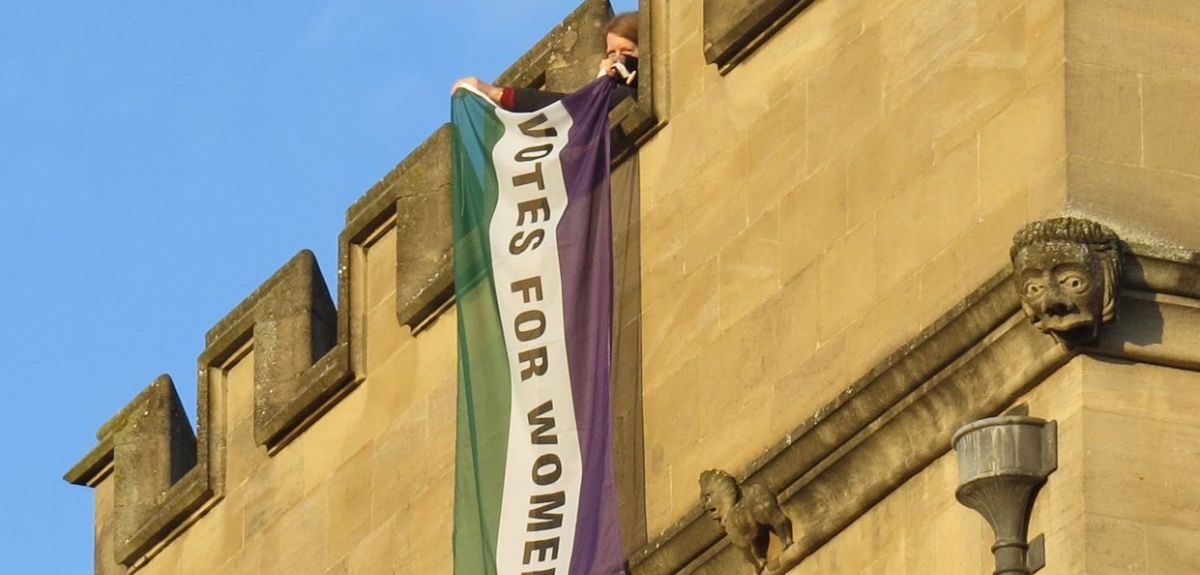
More than 20 Oxford colleges and departments flew a flag to celebrate the 100 year anniversary of women’s suffrage today (Tuesday 6 February).
It is the centenary of the Representation of the People’s Act, which granted the vote to women over the age of 30 who met a property qualification. The same Act gave the vote to and enfranchised all men over the age of 21 for the first time.
The event was organised by TORCH (The Oxford Research Centre in the Humanities), in collaboration with city and county Council representatives, and other cultural organisations in the city. It marks the launch of a year-long programme of initiatives including exhibitions and public lectures.
The flag flew proudly above 21 University of Oxford Colleges, along with the Humanities Division in Radcliffe Humanities (originally the Radcliffe Infirmary), the Music Faculty and the Rothermere American Institute, the County and Town Halls, Modern Art Oxford, Shepherd & Woodward, and Oxford Castle.
The flags read ‘Votes for Women’, which was printed on a backdrop of purple, white and green – the colours of the Women's Social and Political Union, which was led by Emmeline Pankhurst.
- ‹ previous
- 81 of 252
- next ›
 What US intervention could mean for displaced Venezuelans
  Setting the agenda for the next century of quantum
 10 years on: The Oxford learning centre making an impact
 Mapping the Moon: the world’s first lunar atlas goes digital
  Oxford and The Brilliant Club: inspiring the next generation of scholars
 New course launched for the next generation of creative translators
 The art of translation – raising the profile of languages in schools
  Opening a window into the quantum world
 Tracking resistance: Mapping the spread of drug-resistant malaria