Features
With batteries still struggling to pack the same power as petrol one of the great challenges for electric vehicles is extending their range.
A team led by researchers at Oxford University's Department of Engineering Science and The Oxford Martin School has been pushing the boundaries of what such machines can do with their prototype electric vehicle PEGGIE.
The PEGGIE crew had a successful debut at last year's Shell Eco-marathon Europe competition, a showcase for ultra energy-efficient vehicles built by student teams, and entered this year's event in Rotterdam on 19 May.
The Oxford team won the Technical Innovation Award ahead of nearly 200 other teams from across Europe for a series of innovations:
This year the car sported a photovoltaic array of 130 individual cells which continually reconfigure themselves for maximum efficiency, improving efficiency by over 5%: the team compare it to getting rid of your car's gearbox and instead having an engine that continually rebuilds itself so that its performance is optimised for the vehicle's speed and torque requirements at all times.
Not only does PEGGIE's design enable regenerative braking – recovering energy during braking – and free-wheeling but it also features a 'smart' clutch that electronically synchronises the speed and position of the clutch teeth and controls how they engage. Because this design minimises the forces at work inside the clutch the entire drivetrain can be built from smaller and lighter teeth, gears, and actuators.
To help the driver adopt the most efficient driving style possible she gets a handy Android app to refer to on a mobile handset attached to the controls. The app delivers a colourful map plotting torque along one axis and speed along another – rather like playing a computer game the aim is to drive keeping the crosshairs in the map's 'green zone' which indicates the most efficient style.
The Oxford team also improved PEGGIE's range by over 50% on last year, delivering a performance of 564 km/kWh (the equivalent of Oxford to Minsk on a pint of petrol) coming seventh in the solar electric class, an improvement on last year's twelfth place.
'The Shell Eco-Marathon was a fantastic, if at times traumatic, experience,' said Pete Armstrong, Team Technical Manager. 'It was an honour to be awarded the technical innovation prize, we were very impressed by other vehicles who had developed a range of exciting ideas and techniques in areas such as real-time throttle control and 3D printed components that could be swapped out quickly.
'We owe our result this year to the inspiration drawn from other teams when we debuted last year. Although there is a very competitive atmosphere, the overriding experience is one where hundreds of teams help each other out in the face of all the inevitable challenges that arise, exchange ideas and try to have fun in the process.'
If you are interested in getting involved in the PEGGIE team email [email protected] For sponsorship opportunities email [email protected]
At Friday's launch of the Li Ka Shing Centre for Health Information and Discovery at Oxford University, researchers spoke about the potential to revolutionise health research and offer patients better, safer and more personalised treatments through 'big data' and improved approaches to drug discovery.
The new centre is being supported by a £20m gift from the Li Ka Shing Foundation and £10m from the Higher Education Funding Council for England.
Professor Peter Donnelly, who will be involved in the analysis of large health-related data sets in the new centre, said Oxford is achieving something by bringing all these elements together that has not been done anywhere in the academic world before, 'moving forward understanding of human biology and turning this into new treatments'.
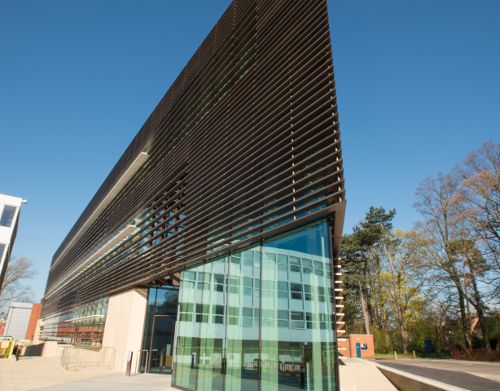 Target Discovery Institute
Credit: John Cairns
The Li Ka Shing Centre is being developed in two phases on the University's Old Road Campus. The first phase, the Target Discovery Institute under Professor Peter Ratcliffe, is now complete (above) and researchers will shortly start moving in. The Institute will use high-throughput biology to define better drug targets in collaboration with industry, addressing a critical 'blockage' in the existing drug development process.
The Target Discovery Institute will generate comprehensive data about disease using genomic and chemical screens – important data for the early stages of drug discovery.
The second phase will focus on the analysis of large data sets in a Big Data Institute, bringing together leading researchers from across genetics, epidemiology and public health, clinical medicine, computer science and IT, statistics and bioinformatics.
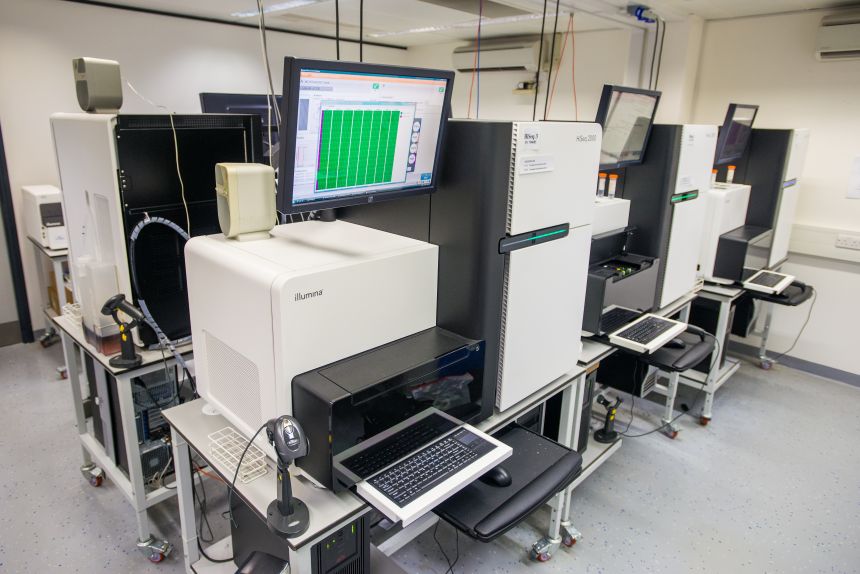 DNA sequencers
Credit: John Cairns
Very large sets of medical data are now routinely collected – through electronic patient records, DNA sequencing (the image shows genome sequencers at Oxford University), comprehensive biological data on disease mechanisms, treatment monitoring, clinical trials, pharmacy records, medical imaging, and national registries of hospitalisations, cancers and other outcomes.
Bringing health-related datasets together for researchers to use in an anonymised way, and making use of new tools to scrutinise that data to gain insights, will provide powerful new insights into who develops illnesses and why.
Oxford University already has world-leading expertise in these areas: pioneering the introduction of genomics into medical care, leading giant cohort studies like the Million Women Study and UK Biobank, running some of the largest clinical trials of treatment worldwide, and establishing methods for global disease surveillance in malaria and other major infectious diseases.
Being locked in a cell with three companions can be a good thing if you are a component of a quantum computer.
These components, called quantum bits, are fragile and susceptible to outside interference, making them easier to control when isolated in cells of four.
Now scientists from Oxford and Singapore report in Nature Communications a way these cells could be networked up with light even if these links are 'noisy' and unreliable.
I asked Simon Benjamin of Oxford University's Department of Materials and National University of Singapore, an author of the report, about quantum cells, noisy networks, and computing with pink diamonds…
OxSciBlog: What are the problems with conventional designs for a quantum computer?
Simon Benjamin: One way to build a quantum computer is similar to how today's microchips work: thousands or millions of basic components, all laid out in a dense pattern like buildings in a city. There are two problems with doing this:
First, the basic components of a quantum computer, called qubits, are hard to control and need to be kept as isolated as possible. Ideally you'd like to have each qubit in its own space with its own dedicated control systems around it.
The second problem is that some of the best candidate systems for qubits cannot be formed into ordered patterns, even if we want to. An example is something called an 'NV centre' which can occur naturally in diamond (technically it's a 'defect', but a very useful one!) Experimentalists can locate the NV centres in a piece of diamond and control them, but we can't force them to appear in specific places. Not yet anyway.
OSB: How might cells and a 'noisy network' overcome these problems?
SB: The approach we advocate is to replace that pattern of millions of qubits with many little chunks, or 'cells'. Each cell would only have a few qubits in it, for example four. It is a manageable task to control four qubits with a single set of control equipment, and most physical systems (like the NV centres mentioned above) can manage to store four qubits.
But of course this leaves us with a problem: how to link up the little cells? We know that linking quantum systems is possible using photons but sadly those links tend to be quite prone to errors. Fortunately we've found that it's ok to use those 'noisy' links: we can put up with them going wrong 10% of the time, or even more. And the qubits inside each cell can go wrong too, although they need to be better behaved, let's say they should go wrong less than 1% of the time.
The upshot of all this is that replacing the big, complex system with lots of little cells linked by noisy connections is fine - you don't really lose any performance, and the targets for how well behaved the qubits should be don't change much either.
OSB: What sort of systems might a noisy network work best with?
SB: Well I've already mentioned NV centres in diamond. The NV stands for Nitrogen-Vacancy, and this means that inside the diamond there is a place where a Nitrogen atom has replaced the normal Carbon, and beside this intruder atom there is a 'hole' where another Carbon is missing.
It turns out that this tiny structure has amazing properties: it can store several quantum bits, and they can be read out using a pulse of laser light. In fact, if you look at a diamond with a pink hue in a jewellery shop then the pink colour is typically coming from NV centres!
As well as NV centres, another good quantum system is the ion trap, where a few atoms are held frozen in a vacuum by an electromagnetic trap. It's hard to make a trap that can hold hundreds of atoms in an ordered way (let alone the millions that might be needed for computing). But it's not so hard to build many traps, each holding a few atoms, and link them with light.
OSB: What other types of 'noise' or 'error' does your approach not account for?
SB: In our study we've tried to be pretty general and put in all kinds of noise. Also, there are kinds of noise that we don't need to worry about because of the network architecture: something called 'correlated noise' can cause a lot of trouble, it means errors clumping together instead of appearing randomly. But in our system this shouldn't happen between different cells of the network, because they are far apart and disconnected except when we want them to communicate.
OSB: What does your work tell us about how hard it will be to build useful quantum computers?
SB: I would say that this work helps to show that the network approach (connecting lots of little computers) is very practical. Since some of the most promising candidate systems work well in the network picture, this is very encouraging.
One exciting recent result is that researchers in the Netherlands have just successfully shown a quantum link between two pieces of diamond, each inside its own fridge! So the idea of linking quantum systems definitely works... now we'll have to see how rapidly we can progress to a real network with lots of cells in it. A few years perhaps!
The paper, entitled 'Topological quantum computing with a very noisy network and local error rates approaching one percent', is published in Nature Communications.
Michelle Lee first set foot in Gabon in 2001: 'I went with just a backpack expecting to stay three weeks, but ended up being the project manager there for six years,' she tells me.
Now a DPhil student at Oxford University's WildCRU, working on land-use and conservation planning, back then Michelle gave up her desk job at the Smithsonian Institute in Washington to fly out and take over after the manager of the Institute’s Gabon biodiversity project quit.
Gabon is a haven for wildlife and a hotspot of global biodiversity. Its small and highly urbanised population, along with its substantial petroleum and mineral deposits, have reduced typical pressures on land conversion. Consequently, Gabon boasts some of the largest remaining tracts of pristine tropical forest in the world.
During her time spearheading the Smithsonian project, Michelle became acutely aware not only of Gabon's significance for conservation but also of the sparse ecology and land-use data that was crippling conservation efforts. 'When I started my doctoral studies there wasn't even a national bird or mammal list compiled, let alone any species-distribution maps,' she recalls. 'There were also no maps of existing land uses, and the latest habitat maps were from the 1970s.'
Over the past four years, Michelle has worked with local experts to gather this vital data. In a process similar to that used by the IUCN's for their Red List threat assessments, she has completed a prioritization analysis of Gabon's terrestrial vertebrates and produced distribution maps for the top priority species. She has also updated the nationwide habitat maps for the country and assessed how different habitat types are allocated across different land uses throughout Gabon.
Her research is providing a foundation for science-based land use planning and policy development in Gabon, whose government is unusual amongst its neighbours in its strong commitment to fostering biodiversity preservation and ecotourism, alongside economic expansion.
'The slow and painstaking task of prioritisation and mapping allowed me to identify key habitats that were poorly represented in Gabon's national reserve system and to propose improvements to the current protected area network,' she tells me.
Michelle has presented her scientific findings directly to the head of National Parks, and is working with the government to identify areas that require more field verification. 'As a signatory to the International Convention on Biological Diversity, Gabon is legally required to meet certain targets for habitat and wildlife protection,' she explains. 'My research enabled the government to see where they fell short of these targets, and together we are planning scenarios to address these shortfalls and improve the efficacy of the reserve design.'
A large part of Michelle's success at conveying her research findings and expert opinion to Gabon's policy-makers comes from the fact that she drew together the many disparate sources of data needed for the planning process.
'I think that being in-country helped me figure out what would be helpful for us to know, and then I tried to address this.' However, as she is quick to point out, the process of being heard required more than just researching the right questions and a government willing to listen. 'My involvement would probably have been impossible without my history of working in the country and my understanding of the context on the ground,' she says. 'This has helped me gain the confidence of the people involved. So I am able to present conservation options that I think might be both internationally appreciated and politically palatable.'
What she only casually alludes to though, is the importance of persistence, perseverance, and passion. 'For a long time I carried around these big maps of mineral depositions and habitat and wildlife distributions wherever I went,'she remembers, smiling. 'I would unroll them at any opportunity and encourage people to see how conservation and development could be accommodated and planned for together in a spatially-structured scientific process. I guess I eventually got my message through. Or perhaps they just got sick of seeing me carrying them around!'
When I ask Michelle for her advice to other conservation scientists, she replies that patience, flexibility and the ability to compromise are critical for negotiating the path from science to policy.
'Trying to do conservation science in a developing nation, even one as environmentally aware as Gabon is a balancing act. I realised early on that I could not adopt a 'conservation agenda' if I wanted to achieve the greatest outcomes for environmental sustainability,' Michelle says. 'Gabon is trying hard to balance job creation, food security, and economic development alongside biodiversity retention and carbon sequestration. At some point, detrimental impacts are unavoidable and you have to make difficult decisions. Conserving 50% of elephant habitat is great, but it also means that you are prepared to lose 50% of their habitat.'
This means that transcending the divide between research and policy requires a slightly different breed of scientist. One who is willing to adapt their focus and adjust their expectations of outcomes, one who can balance the analytically correct answer with what makes real-life sense, and one who views science as a means of solving a problem rather than an end in itself.
As Michelle notes: 'Applied science is an entirely different process to research science, as it should be. Because of my background, I am able to wear both hats, and operate as research scientist in my doctoral studies and as applied scientist when I interact with the Gabonese government. Ultimately, though, we need both.'
Shelly Lachish is a Research Fellow in Oxford's Department of Zoology and a freelance writer.
Fruit flies may have more individuality and personality than we imagine.
And it might all be down to a bit of genetic shuffling in nerve cells that makes every fly brain unique, suggest Oxford University scientists.
Their new study has found that small genetic elements called 'transposons' are active in neurons in the fly brain. Transposons are also known as 'jumping genes', as these short scraps of DNA have the ability to move, cutting themselves out from one position in the genome and inserting themselves somewhere else.
The inherent randomness of the process is likely to make every fly brain unique, potentially providing behavioural individuality – or 'fly personality'. So says Professor Scott Waddell, who led the work at the University of Oxford Centre for Neural Circuits and Behaviour: 'We have known for some time that individual animals that are supposed to be genetically identical behave differently.
'The extensive variation between fly brains that this mechanism could generate might demystify why some behave while others misbehave,' he suggests.
The Oxford researchers, along with US colleagues at the University of Massachusetts Medical School and Howard Hughes Medical Institute, were able to deep-sequence the DNA from small numbers of nerve cells in the brains of Drosophila fruit flies.
They identified many transposons that were inserted in a number of important memory-related genes. Whether this is detrimental or advantageous to the fly remains an open question, the researchers say.
Scott Waddell notes that neural transposition has been described in rodent and human brains, and transposons have historically been considered to be problematic parasites. New insertions of transposons can on occasion disrupt genes (as was found in this study), and transposons have been associated to some human disorders such as schizophrenia.
However, it is also possible that organisms have harnessed transposition to generate variation within cells, and by extension create variation between individual animals that may turn out to be favourable.
Scott Waddell wants next to determine whether neural transposition provides an explanation for variation in fruit fly behaviour by finding ways of halting the process in flies in his lab.
- ‹ previous
- 181 of 252
- next ›
 What US intervention could mean for displaced Venezuelans
  Setting the agenda for the next century of quantum
 10 years on: The Oxford learning centre making an impact
 Mapping the Moon: the world’s first lunar atlas goes digital
  Oxford and The Brilliant Club: inspiring the next generation of scholars
 New course launched for the next generation of creative translators
 The art of translation – raising the profile of languages in schools
  Opening a window into the quantum world
 Tracking resistance: Mapping the spread of drug-resistant malaria