Features

The Royal Astronomical Society (RAS) has awarded 2018 Winton Capital prizes, which recognise the outstanding work of young researchers, to Oxford University scientists Dr Rebecca Bowler and Dr Kerri Donaldson Hanna.
Dr Kerri Donaldson Hanna, UKSA Aurora Research Fellow in the Department of Physics, is honoured for her contribution to her field of geophysics. Specialising in the study of the surface compositions of rocky, airless bodies through infrared remote sensing, Dr Donaldson Hanna is currently playing a key role on NASA’s OSIRIS-Rex mission to return a sample of the asteroid Bennu to Earth in 2022.
Her research record includes leading on projects combining datasets across multiple wavelength ranges and work in the field of thermal infrared spectroscopy. Alongside her research goals, Dr Donaldson Hanna also makes contributions to the wider planetary science community, organising RAS specialist discussion meetings and acting as a committed mentor for budding planetary scientists.
Dr Donaldson Hanna said: 'I feel quite honoured to be recognised for my early career achievements through such a prestigious award and genuinely appreciate those that nominated me for the award.'
Dr Rebecca Bowler, Hintze Fellow in the Department of Physics at Oxford University, receives the prize for astronomy. Through her work demonstrating that highly luminous objects do exist into the epoch of re-ionisation, and understanding star-forming galaxies at ultra-high redshifts, she has helped to shape our knowledge of the world above us.
Although still in the early stages of her career, Dr Bowler has already served as principal investigator on Hubble Space Telescope, ALMA and VLT projects. She was also awarded the 2016 Block Prize for ‘promising young physicist.’
Dr Bowler said she was ‘delighted and honoured’ to receive the RAS award.

In last week's Artistic Licence blog, Bethany White wrote about a writing group run by history students. This week, she finds out whether or not the group works.
I’d heard many good things about the Shut Up And Write writing group, but I’d never tried it out for myself.
But with a worryingly high number of words left to write for my PhD, and the encouragement of the group’s leader, Rachel Delman, I finally decided to give it a go.
Feeling lethargic on a Monday morning in June, I headed to the History Faculty.
The group I found there was small but friendly. We gathered in the common room for breakfast and chatted about our writing goals. At 9.30, we settled into one of the classrooms.
Furtively brushing pastry crumbs from my lap, I opened my laptop and dutifully gathered my notes, casting sneaky glances around the room.
I felt like a novice. Would I really be able to write for this long without getting distracted? What about Twitter?!
It’s no secret that writing a PhD is a long slog. In fact, any kind of writing involves navigating a psychological obstacle course.
First there are all the distractions: e-mail, Twitter, Facebook, news, memes, YouTube, 4,000-word think-pieces that must be read now. Suddenly, everything else in the world seems far more important.
But it’s not just the lure of distraction. You’ve also got to contend with writer’s block. Writer’s block is endlessly frustrating. At its worst, you can’t think of any words at all.
At its best, you can just about pluck some out and put them in order, but at a pace that feels like running in slow-motion.
It was these two demons that I was hoping to excise by joining the writing group. Hopefully, I thought, the guilt-trip of being in a room full of productive people would keep me on the straight and narrow.
Before we began, Rachel went around the room and asked us to announce a writing goal for the day.
Someone wanted to finish their master’s thesis; another wanted to tidy up their references; another needed to perfect an abstract. I settled for a thousand words of a new chapter.
As soon as we started, library silence filled the room: complete stillness save the tapping of keyboards and the odd shuffle of papers. Brows furrowed and pens were chewed as everyone clicked into concentration.
It was remarkably easy to focus. The room felt heavy with the weight of work, and in a room like that, motivation is catching. By the end of the first hour, I’d written five hundred words, and hadn’t checked Twitter once.
During the break, I chatted to Rachel about why she thinks writing in a group helps.
“I think it works because it’s such short chunks of time, and you assume everyone else is working,” she says.
“When I’m on my own, if I get an e-mail, I check it. But when I’m in the group, I think, I’ve only got fifty minutes left—I’ll check it later!”
I agree. Most of the time, comparison is demoralising and unhelpful. But in such a supportive environment, little dashes of it can help. If he can finish his footnotes, I can write this paragraph. We’re all in this together.
In the second session, I flew through five hundred more words. It felt refreshing to work uninterrupted, and to wrangle with references rather than guilty retweets.
The third hour was harder, and more sluggish. But by the end of the session I had 1,263 words, in a row, making some degree of sense, that I hadn’t had that morning. I’d also gained three strawberries, an almond pastry, two cups of coffee, and some writing companions.
I’m sure the writing group isn’t a magic fix. We all have good days and bad days—days when you feel like you’re writing the next big thing, and days when all you can heave out of yourself is one lonely sentence.
But working together, regularly, for a strict number of hours, is unusual for a humanities postgraduate, and it definitely helps. It helps to know that you’re among others and that everyone else struggles, but it also helps just to have a chat over coffee.
Writing is hard. But with initiatives like Shut Up and Write, hopefully the journey will feel a little easier. Plus, there are free strawberries. That always helps.
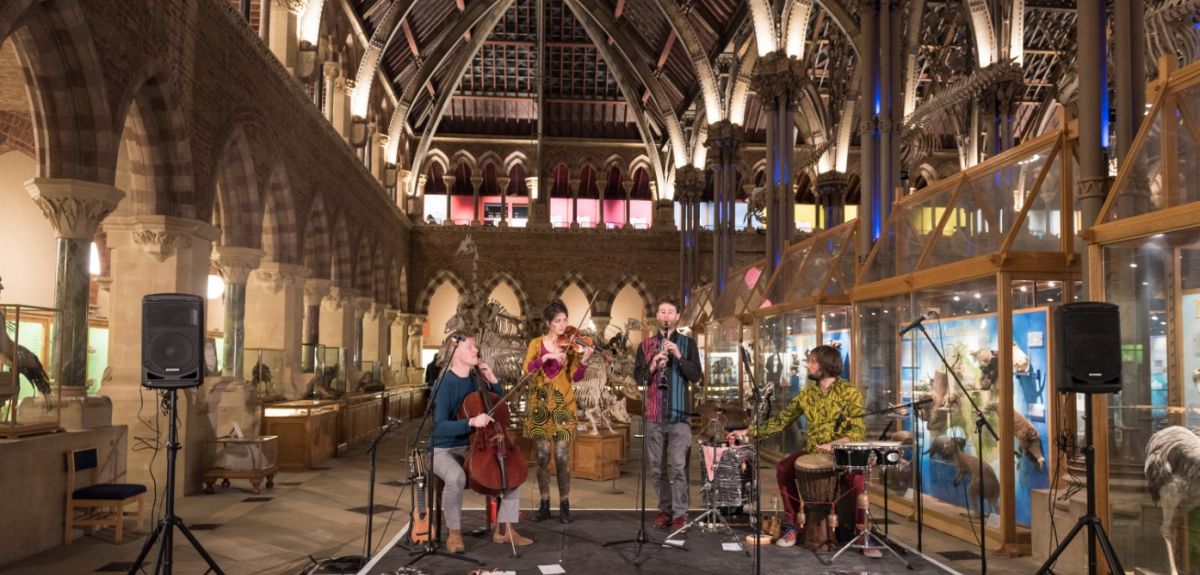
'Lost Late' was a sold-out event held in Oxford late last year, as part of the national Being Human festival.
It was hosted at the Oxford University Museum of Natural History and the Pitt Rivers Museum, and was a collaboration with The Oxford Research Centre in the Humanities (TORCH).
On the night, researchers from across the humanities put on events for the public.
For example, Sally Shuttleworth, Professor of English Literature at Oxford, told some of the 1,600 visitors about a lesser-known aim of many people in Victorian England - to live to 100. "The ‘secrets’ of such long life might strike us as surprisingly modern – cut down on drink, tobacco and meat-eating; don’t overwork, and construct a ‘green’ town, filled with gardens and trees," she said.
"I love events like Lost Late with their blending of research with games or music and drama, and magical transformation of the buildings."
TORCH has partnered with the national Being Human Festival for the last three years. Vicky McGuinness, TORCH Business Manager, said the partnership works well because both organisations have "shared aims of public engagement with research with wider audiences".
"And by collaborating with Pitt Rivers Museum and the Museum of Natural History, we are able to do so in an exciting and diverse environment and give researchers a much larger audience reach," she added.
Here are some photographs from the night:
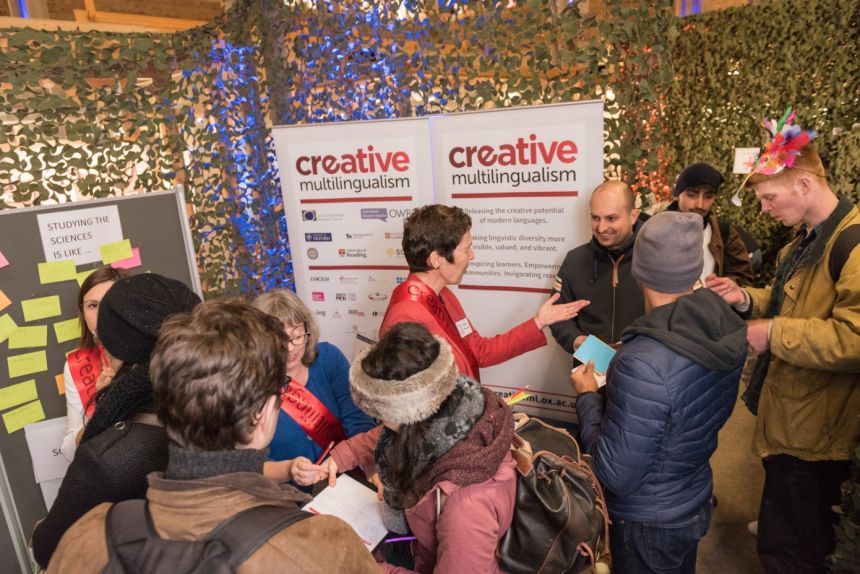 Professor Katrin Kohl
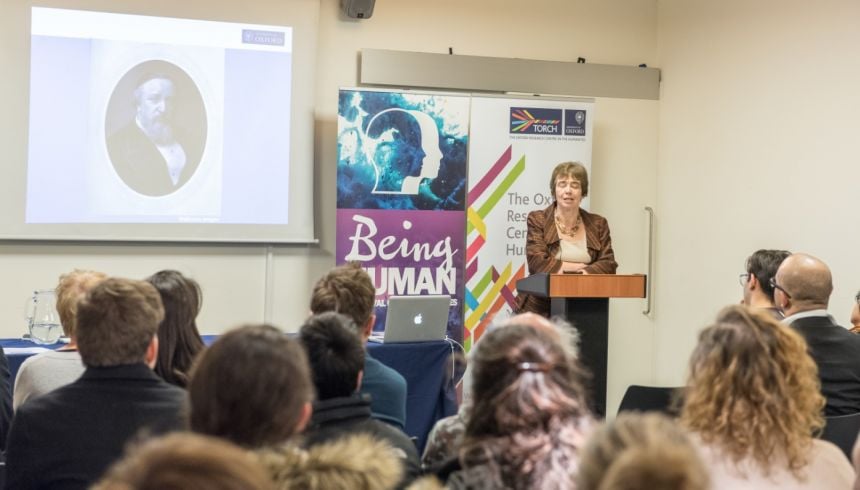 Professor Sally Shuttleworth
In the long summer vacation after the first year of his PhD, Luca Zenobi couldn’t write.
As a DPhil student, not being able to write poses a problem. Grappling for ways to kick-start himself into writing mode, Luca did what we all do when we need answers. “I Googled “how to write”,” he remembers.
When he did, Luca came across “all the usual advice,” but something stood out. “Lots of people suggested getting a group together, with writing the only thing you’re allowed to do.”
Writing groups have been springing up in Oxford - Dr Alice Kelly runs a successful one in TORCH, for example - but there wasn’t one in the History Faculty.
And Luca found that many students, like him, were struggling to get words down on paper. So, once the summer ended and October dawned, Luca set up the Oxford History Graduate Network’s writing group.
Almost two years on, Shut Up and Write (SUAW) is now a staple of postgraduate History life. After running the group for a year, Luca handed over the reins to fellow DPhil student Rachel Delman. The two have worked hard to make it as effective, and as enjoyable, as possible.
So how does it work? Twice a week, from 9am to 1pm, students meet in the Faculty. After fuelling themselves with pastries and coffee, they sit down to write for an hour at a time, punctuated by fifteen-minute breaks.
At the beginning of the session, students declare a writing goal for the day. Being accountable helps people stay on track. “I think the psychology of it really helps,” Rachel says.
Whether it’s the psychology or the pastries, something is working. The group has a keen group of regular attendees. Why do Luca and Rachel think it’s been so successful?
“A PhD can be very isolating,” Luca says. “The writing group gives people the opportunity to talk with other people doing the same thing—how’s it going? What are you working on? And then you end up discussing and sharing tips.”
But it’s not just the social element that makes SUAW so well-attended. It’s also an effective way to work. “I had times when the only proper writing I could get done was at the writing group,” Luca says.
The writing group has certainly been a blessing for students craving conversation and routine. But it’s also completely changed Luca and Rachel’s own experiences of Oxford.
As convenors, they attend twice a week, every week, providing breakfast, helping everyone set writing goals, and paying close attention to the clock.
“I’ve gained a lot of confidence from running the group, which will help in an academic career,” Rachel says.
Luca agrees, and adds, “It’s nice to know that you’re helping people out. I’ve realised that we all struggle, and that it’s fine, it’s part of the process, and talking about it is a good thing.”
Now in the later stages of their doctorates, Rachel and Luca are stepping back from the group at the end of this academic year. But they’re proud of what it’s achieved. “It’s built a community in the Faculty that wasn’t really there before,” Rachel says.
Do they have any advice for their successors? Rachel thinks about it. “Just keep buying pastries!”
Next week, Bethany will try the writing group herself and review it for Artistic Licence. But if it doesn't work, there may not be a blog next week...
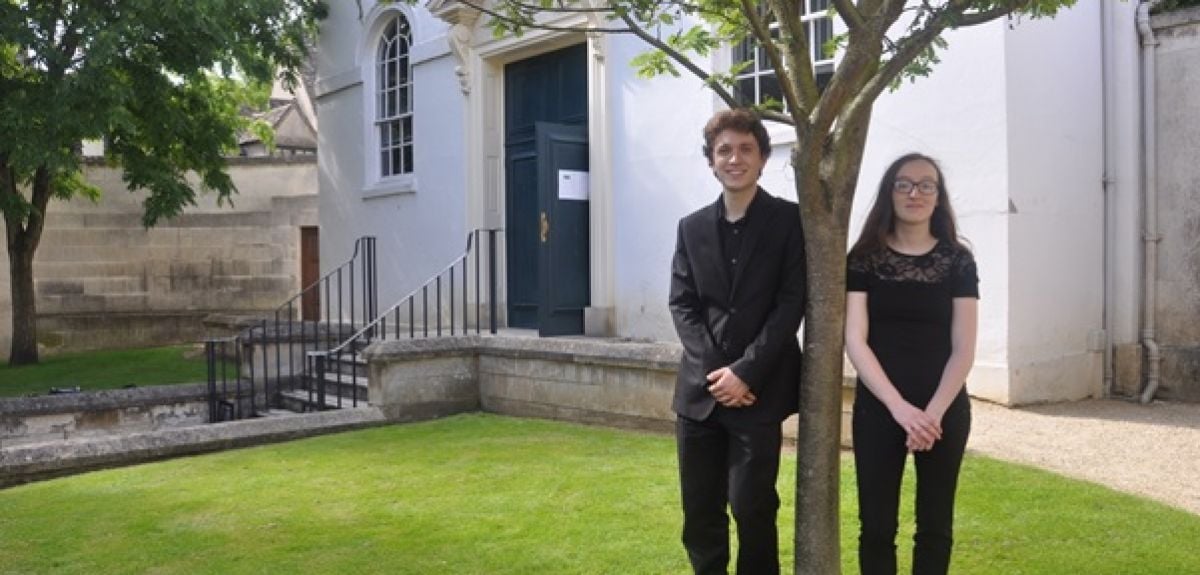
What does moonlight sound like? How can a violin ‘murmur like perfume’? And what do you think ‘a bird abandoned by its companion’ would sound like on the piano?
These might not seem like obvious questions you’d encounter in a French class. But Dr Jennifer Rushworth, Junior Research Fellow in Modern Languages, and a group of undergraduate students, spent a year thinking about the answers.
As part of a year-long project, Dr Rushworth and the students turned a completely imaginary piece of music, described in French, into a real concert, performed by professional musicians.
The imaginary piece of music comes from Marcel Proust’s In Search of Lost Time, a seven-volume novel that’s one of the most well-known works of French literature.
In the novel, the main character is obsessed by a piece of music by a fictional composer called Vinteuil. Proust describes the music—but using almost no technical language. We don’t know what notes to play, but we do know that the music sounds as ‘soft as silken scarves’.
Dr Rushworth, who teaches Proust to undergraduates, had often wondered what this music might sound like. Last May, with funding from the John Fell OUP fund, she decided to find out for herself.
The first step was translating the descriptions into English from the original French.
Dr Rushworth and twenty-four undergraduate volunteers translated thousands of words of French musical descriptions into English. For the students, it was a fitting way to test their translation skills.
Next, Dr Rushworth handed over the translations to two undergraduates in Music. Together, they worked to translate the text for a second time—this time, from plain English into a musical score.
Finally, the composers handed their pieces over to professional musicians, who played the music at a concert in the Holywell Music Room on 5th May.
And, just like that, sentences written in French almost a hundred years ago became music swelling to fill a music hall in 2017.
Why, as a linguist, did Dr Rushworth want to make the music come alive? “I wanted to see if you could take text as a recipe for writing music,” she says.
She was also interested in how different people might read the text in different ways. So, for example, would a French reader interpret the music differently to an English reader, or a music student to a languages student?
But creating imaginary music also comes with uniquely high expectations. “Part of the point of Proust’s imaginary music is that, because it’s imaginary, it’s perfect,” Dr Rushworth explains. “Everything that’s real is disappointing.”
So what does Proust’s imaginary music like? Is it disappointing?
Not for Dr Rushworth. “I wasn’t disappointed,” she says. “I thought it sounded amazing.”
Although she’d worked on the project for a year, she had to wait until the day of the concert to hear the final result. Seated in one of the oldest public music halls in Europe, the music finally washed over her—and the violins murmured, like perfume.
Curious? You can listen to the music for yourself here.
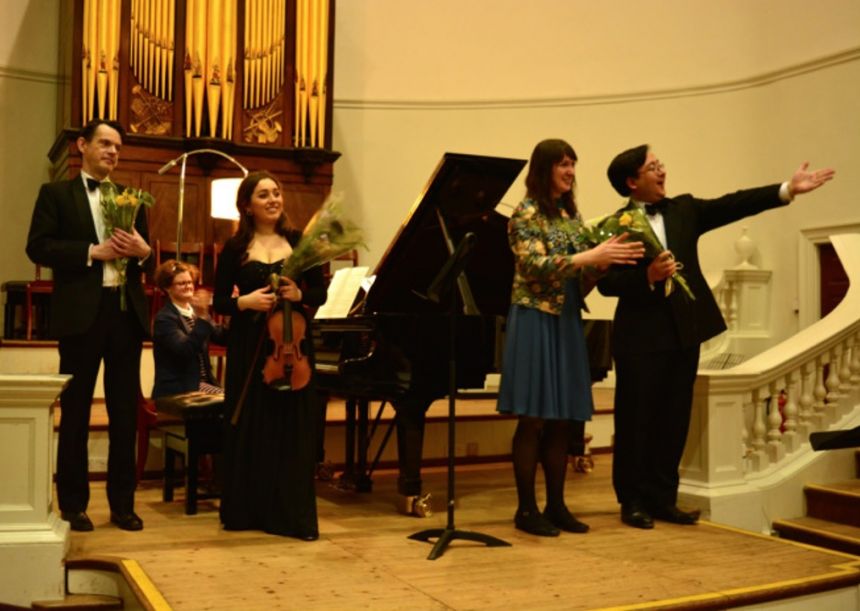 The performance itself
- ‹ previous
- 83 of 252
- next ›
 Setting the agenda for the next century of quantum
 10 years on: The Oxford learning centre making an impact
 Mapping the Moon: the world’s first lunar atlas goes digital
  Oxford and The Brilliant Club: inspiring the next generation of scholars
 New course launched for the next generation of creative translators
 The art of translation – raising the profile of languages in schools
  Opening a window into the quantum world
 Tracking resistance: Mapping the spread of drug-resistant malaria
 Cities for cycling: what is needed beyond good will and cycle paths?